Question
  1. Using Bohr's second postulate of quantization of orbital angular momentum show that the circumference of the electron in the $n^{th}$ orbital state in hydrogen atom is n times the de Broglie wavelength associated with it.
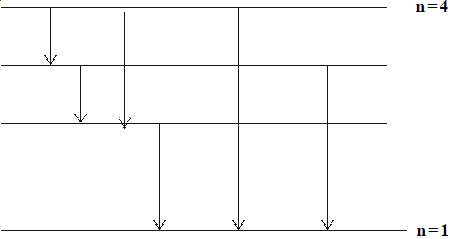
  2. The electron in hydrogen atom is initially in the third excited state.What is the maximum number of spectral lines which can be emitted when it finally moves to the ground state?
Answer

  1. According to Bohr's second postulate
$\text{mvr}_{n} =\frac{\text{nh}}{2\pi}$
$\Rightarrow2\pi\text{r}_{n} = \frac{\text{nh}}{\text{mv}}$
But $\frac{\text{h}}{\text{mv}} =\frac{\text{h}}{\text{p}} =\lambda$
$\therefore2\pi\text{r}_{n} = \text{n}\lambda$
  1. For third excited state n = 4
for ground state n = 1
Hence possible transitions are
$n_1 = 4$ to $n_1 = 3, 2, 1$
$n_1 = 3$ to $n_1 = 2, 1$
$n_1 = 2$ to $n_1 = 1$
Total number of transitions = 6
Alternate Answer

Need a full question paper?

Generate a complete, print-ready paper with questions like this in minutes — across 16+ boards, with answer keys.

Start Generating Free

Similar questions

How many time constants will elapse before the charge on a capacitors falls to 0.1% of its maximum value in a discharging RC circuit?
Two small bodies of masses 10kg and 20kg are kept a distance 1.0m apart and released, Assuming that only mutual gravitational forces are acting, find the speeds of the particles when the separation decreases to 0.5m.
A long straight wire carries a current of 35 A. What is the magnitude of the field B at a point 20 cm from the wire?
A person sitting on the top of a tall building is dropping balls at regular intervals of one second. Find the positions of the $3^{\text {rd }}, 4^{\text {th }}$ and $5^{\text {th }}$ ball when the $6^{\text {th }}$ ball is being dropped.
Write some properties of electromagnetic waves.
Which of the following will describe the smallest circle when projected with the same velocity perpendicular to the magnetic field B (i) $\alpha$-particle and (ii) $\beta$-particle?
A proton has spin and magnetic moment just like an electron. Why then its effect is neglected in magnetism of materials?
A positive point charge (+ q) is kept in the vicinity of an uncharged conducting plate. Sketch electric field lines originating from the point on to the surface of the plate.
Derive the expression for the electric field at the surface of a charged conductor.
  1. Derive Snell's law on the basis of Huygen's wave theory when light is travelling from a denser to a rarer medium.
  2. Draw the sketches to differentiate between plane wavefront and spherical wavefront.
Show that the radius of the orbit in hydrogen atom varies as $n^2,$ where n is the principal quantum number of the atom.