Question
State Bohr’s quantization condition of angular momentum. Calculate the shortest wavelength of the Bracket series and state to which part of the electromagnetic spectrum does it belong.

Answer

According to Bohr's quantisation, the electrons revolve around the nucleus only in those orbits for which the angular momentum is the integral multiple of
$\frac{\text{h}}{2\pi}$
$\text{L}=\frac{\text{nh}}{2\pi}$
For Bracket series $\text{n}_2=\infty,$
$\frac{1}{\lambda}=\text{R}_\text{H}\text{Z}^2\Big\{\frac{1}{4^2}-\frac{1}{\infty}\Big\}$
$\frac{1}{\lambda}=\frac{\text{R}_\text{H}}{16}$
$\lambda=\frac{16}{\text{R}_\text{H}}=14.58\times10^{-7}\text{m}$
This wavelength belongs to the inftra-red region.

Need a full question paper?

Generate a complete, print-ready paper with questions like this in minutes — across 16+ boards, with answer keys.
Start Generating Free

Similar questions

The decay constant of $\text{ }^{197}_{80}\text{Hg}$ (electron capture to $\text{ }^{197}_{79}\text{Au}$) is $1.8 × 10^{-4}\ S^{-1}$.
  1. What is the half-life?
  2. What is the average-life?
  3. How much time will it take to convert 25% of this isotope of mercury into gold?
A molecule of a substance has a permanent electric dipole moment of magnitude $10^{-29} C m$. A mole of this substance is polarised (at low temperature) by applying a strong electrostatic field of magnitude $10^6 V m ^{-1}$. The direction of the field is suddenly changed by an angle of $60^{\circ}$. Estimate the heat released by the substance in aligning its dipoles along the new direction of the field. For simplicity, assume $100 \%$ polarisation of the sample.
In a Van de Graaff type generator a spherical metal shell is to be a $15 \times 10^6 \mathrm{~V}$ electrode. The dielectric strength of the gas surrounding the electrode is $5 \times 10^7 \mathrm{Vm}^{-1}$. What is the minimum radius of the spherical shell required? (You will learn from this exercise why one cannot build an electrostatic generator using a very small shell which requires a small charge to acquire a high potential.)
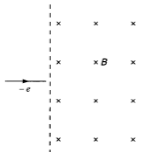
$a.$ An electron moving horizontally with a velocity of $4 \times 10^4\ m / s$ enters a region of uniform magnetic field of $10^{-5} T$ acting vertically upward as shown in the figure. Draw its trajectory and find out the time it takes to
Image

$b.$ A straight wire of mass $200 g$ and length $1.5 m$ carries a current of $2 A.$ It is suspended in mid air by a uniform magnetic field $B.$ What is the magnitude of the magnetic field?
Can the voltage drop across the inductor or the capacitor in a series LCR circuit be greater than the applied voltage of the a.c. source? Justify your answer.
A book is lifted from the floor and is kept in an almirah. One person says that the potential energy of the book is increased by 20J and the other says it is increased by 30J. Is one of them necessarily wrong?
Sound waves from a loudspeaker spread nearly uniformly in all directions if the wavelength of the sound is much larger than the diameter of the loudspeaker.
  1. Calculate the frequency for which the wavelength of sound in air is ten times the diameter of the speaker if the diameter is 20cm.
  2. Sound is essentially transmitted in the forward direction if the wavelength is much shorter than the diameter of the speaker. Calculate the frequency at which the wavelength of the sound is one tenth of the diameter of the speaker described above. Take the speed of sound to be 340m/s.
A straight solenoid of length $50 \ cm$ has $1000$ turns and a mean cross$-$sectional area of $2 \times 10^{-4} m^2$. It is placed with its axis at $30^{\circ}$, with a uniform magnetic field of $0.32 T .$ Find the torque acting on the solenoid when a current of $2 A$ is passed through it.
Plot a graph showing the variation of coulomb force (F) versus$\bigg(\frac{1}{\text{r}^{2}}\bigg)$; where r is the distance between the two charges of each pair of charges: (1 μC, 2 μC) and (2 μC, – 3 μC). Interpret the graphs obtained.
Find the fundamental, first overtone and second overtone frequencies of an open organ pipe of length 20cm. Speed of sound in air is 340m/s.