Question
State Brewster's law and show that when light is incident at polarizing angle the reflected and refracted rays are mutually perpendicular to each other.
Answer

Brewster's law : The tangent of polarising angle is equal to the refractive index of the reflecting medium with respect to the surrounding $\left( n _2\right)$. If ip is the polarising angle. $\tan i_p={ }_1 n_2=\frac{n_2}{n_1} \ldots$ (1)
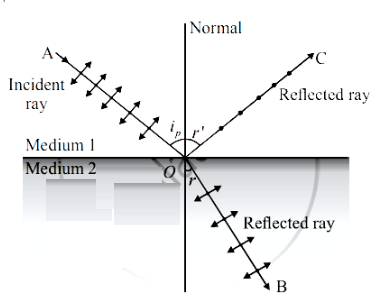
where $n _1$ is the absolute refractive index of the surrounding and $n _2$ is that of the reflecting medium. Figure shows a ray AO of unpolarised light incident on the interface separating two mediums. The degree of polarisation of the reflected ray OC varies with the angle of incidence and is a maximum for the angle of incidence equal to the polarising angle $i_p$ of the pair of mediums. For all angle of incidence, the refracted ray $O B$ is only partially polarised.
Image
In figure, the angle of incidence is $i_p$, the angle of reflection is $r^{\prime}$ and the angle of refraction is r . By Snell's law, $\frac{n_2}{n_1}=\frac{\sin i_p}{\sin r} \ldots$ (2)
From, Eqs. (1) and (2)
$\tan i_p=\frac{\sin i_p}{\cos i_p=} \frac{\sin i_p}{\sin r}$
$\therefore \cos i_p=\sin r$
$\text { Now, } r^{\prime}=i_p$
$\therefore \cos r^{\prime}=i_p$
$\therefore \cos r^{\prime}=\operatorname{sir} r$
$\therefore \sin \left(90^{\circ}-r^{\prime}\right)=\sin r$
$\therefore r=90^{\circ}-r^{\prime} \text { or, } r^{\prime}+r=90^{\circ}$
$\therefore \angle \operatorname{coB}=90^{\circ}$
This indicates that, for complete polarisation of the reflected ray at the polarising angle, the reflected and the refracted rays are mutually perpendicular.

Need a full question paper?

Generate a complete, print-ready paper with questions like this in minutes — across 16+ boards, with answer keys.

Start Generating Free

Similar questions

The equation of a simple harmonic progressive wave is given by $y=0.05 \sin \pi\left(20 t-\frac{x}{6}\right)$, where all quantities are in SI units. Calculate the displacement of a particle at $5 m$ from the origin and at the instant 0.1 second. Also find the phase difference between two particles separated by $5 m$.
Define surface energy of the liquid. Obtain the relation between the surface energy and surface tension.
State and explain Newton's law of viscosity.
A solenoid $1.5 m$ long and $4 \ cm$ in diameter has $-10$ turns $/ \ cm$. A current of $5 A$ is passing through it. Calculate the magnetic induction $(i)$ inside $(ii)$ at one end on the axis of the solenoid.
A coaxial cable, whose outer radius is five times its inner radius, is carrying a current of $1.5 A$. What is the magnetic field energy stored in a $2 m$ length of the cable?
State Huygens' principle. Explain geometrical construction of a plane wavefront.
With the help of a circuit diagram describing an experiment to study the photoelectric effect.
A solid sphere of mass $1 \mathrm{~kg}$ rolls on a table with linear speed $2 \mathrm{~m} / \mathrm{s}$, find its total kinetic energy.
The mass and the radius of the Moon are, respectively, about $\frac{1}{81}$ time and about $\frac{1}{3.7}$ time those of the Earth. Given that the rotational period of the Moon is 27.3 days, compare the rotational kinetic energy of the Earth with that of the Moon.
The photoelectric current in a photoelectric cell can be reduced to zero by a stopping potential of 1.8 volt. Monochromatic light of wavelength 2200Å is incident on the cathode. Find the maximum kinetic energy of the photoelectrons in joules. [Charge on electron \(=1.6 \times 10^{-19} C\)]