Questions

Answer the following in Brief

Take a timed test

32 questions · self-marked practice — reveal the answer and mark yourself.

Question 13 Marks
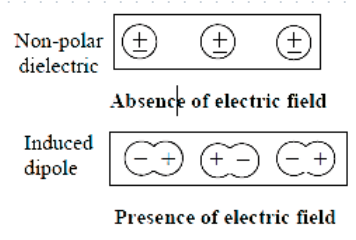
With the help of neat diagrams, explain how the non-polar dielectric material is polarised in external electric field of increasing intensity. Define polarisation in dielectrics
Answer
Image
If a dielectric (non-polar) molecule is placed in an external electric field, a small induced dipole moment is created because the positive charge in each atom is pushed in the direction of the field and negative charge is pushed in the opposite direction as shown in the figure.
Polarization is the amount of induced surface charge per unit area or the surface density of polarization charges appearing at right angles to applied external electric field.
View full question & answer
Question 23 Marks
A parallel beam of monochromatic light is incident on a glass slab at an angle of incidence \(60^{\circ}\). Find the ratio of width of the beam in the glass to that in the air if refractive index of glass is \(\frac{3}{2}\).
Answer
Given: $i=60^{\circ}, \mu_g=1.5$,
Let $d _{ g }=$ width of beam in glass slab,
$d_a=$ width of beam in air
To find: Ratio of widths $\left(\frac{d_g}{d_{ a }}\right)$
Formulae:
i. $\mu_g=\frac{\sin i}{\sin r}$
ii. $\frac{d_g}{d_a}=\frac{\cos r}{\cos i}$
Calculation: From formula (i),
$\sin r=\sin i / \mu_{g} \\
\therefore \sin r=\sin 60^{\circ} / 1.5=0.8660 / 1.5=0.5773 \\
\therefore r=\sin ^{-1}(0.5773)=35^{\circ} 16^{\circ}$
From formula (ii),
$\frac{d_g}{d_a}=\frac{\cos r}{\cos i}=\frac{\cos 35^{\circ} 16 i}{\cos 60^{\circ}} \\
\therefore \frac{d_g}{d_a}=\frac{0.8164}{0.5}=1.633 \\
\therefore \frac{d_g}{d_a}=1.633: 1$
$\therefore$ Ratio of the widths of beam $=1.633: 1$
The ratio of widths of the beam in glass to that in air is $1.633: 1$.
View full question & answer
Question 33 Marks
In a single slit diffraction pattern, the distance between first minima on the right and first minima on the left of central maximum is \(4 mm\). The screen on which the pattern is displaced, is \(2 m\) from the slit and wavelength of light used is 6000Å. Calculate width of the slit and width of the central maximum.
Answer
Given:- $\lambda=6000 \AA=6 \times 10^{-7} m$,
$D=2 m$
$X_1+X_2=4 mm=4 \times 10^{-3} m$
To find:- Width of slit (a)
Width of central maximum (W)
Formula:-
i. $X_1+X_2=\frac{2 \lambda D}{a}$
ii. $W=X_1+X_2$
Calculation: From formula (i),
$4 \times 10^{-3}=\frac{2 \times 6 \times 10^{-7} \times 2}{a}$
$\therefore a=6 \times 10^4 m$
The width of the slit is $6 \times 10^{-4} m$.
From formula (ii),
Width of central maximum $=4 \times 10^{-3} m$
The width of the central maximum is $4 \times 10^{-3} m$.
View full question & answer
Question 43 Marks
In a biprism experiment, when a convex lens was placed between the biprism and eyepiece at a distance of \(30 cm\) from the slit, the virtual images of the slits are found to be separated by \(7 mm\). If the distance between the slit and biprism is \(10 cm\) and between the biprism and eyepiece is \(80 cm\), find the linear magnification of the image.
Answer
Given : $D = 10 + 80 = 90 cm, d = 30 cm, d_1 = 90 - 30 = 60 cm$
To find : Linear magnification (m)
Formula : Linear magnification \(m=\frac{d_1}{d}=\frac{ v }{u}\)
Calculation : From formula,
\(\frac{d_1}{d}=\frac{ v }{u}=\frac{60}{30}\)
$\therefore m = 2$
The linear magnification of the image is 2.
View full question & answer
Question 53 Marks
In a biprism experiment, a slit is illuminated by a light of wavelength  $4800Å.$ The distance between the slit and biprism is \(15 cm\) and the distance between the biprism and eyepiece is \(85 cm\). If the distance between virtual sources is \(3 mm\), determine the distance between 4th bright band on one side and \(4^{\text {th }}\) dark band on the other side of the central bright band.
Answer
$\lambda = 4800 Å = 4.8 \times 10^{−7}m,$
$d = 3 mm = 3 \times 10^{−3}m,$
$D = 15 + 85 = 100 cm = 1 m$
Distance between 4th bright band on one side and $4^{th}$ dark band on the other side of the central
bright band, $(X4 + X′4) = ?$
For $n^{th}$ bright band,
\(X _{ n }=\frac{ n \lambda D }{ d }\)
\(\therefore \quad X _4=\frac{4 \lambda D }{ d }\)
For \(n ^{\text {th }}\) dark band,
\(X _{ n }^{\prime}=(2 n -1) \frac{\lambda D }{2 d }\)
\(\therefore \quad X _4^{\prime}=(2 \times 4-1) \frac{\lambda D }{2 d }=\frac{7}{2} \frac{\lambda D }{ d }\)
\(\therefore \quad X _4+ X _4^{\prime}=\frac{4 \lambda D }{ d }+\frac{7}{2} \frac{\lambda D }{ d }\)
\(=\frac{4 \times 4.8 \times 10^{-7} \times 1}{3 \times 10^{-3}}+\frac{7}{2} \times \frac{4.8 \times 10^{-7} \times 1}{3 \times 10^{-3}}\)
\(=6.4 \times 10^{-4} m +5.6 \times 10^{-4} m\)
\(=12 \times 10^{-4} m\)
The distance between 4th bright band on one side and 4th dark band on the other side of the central bright band is $12 \times 10^{−4}m.$
View full question & answer
Question 63 Marks
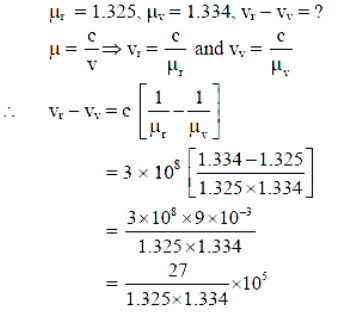
The refractive indices of water for red and violet colours are 1.325 and 1.334 respectively. Find the difference between the velocities of rays for these two colours in water. \(\left( c =3 \times 10^8 m / s\right.\) )
Answer
Image
$= (log (27) − log (1.325) − log (1.334)) \times 10^5$
$= (1.4314 − 0.1222 − 0.1252) \times 10^5$
$= (antilog (1.184)) \times 10^5$
$= 15.28 \times 105 = 1.528 \times 10^6 m/s.$
The difference between the velocities of rays for red and violet colours in water is
$1.528 \times 10^6 m/s.$
 
View full question & answer
Question 73 Marks
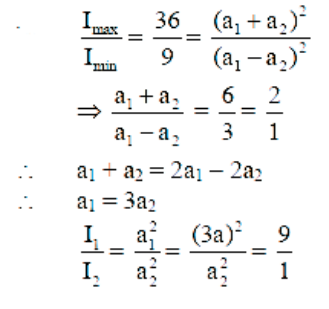
In Young's experiment, the ratio of intensity at the maxima and minima in an interference pattern is \(36: 9\). What will be the ratio of intensities of two interfering waves?
Answer
Image
The ratio of the intensities of the two interfering waves is 9 : 1.
View full question & answer
Question 83 Marks
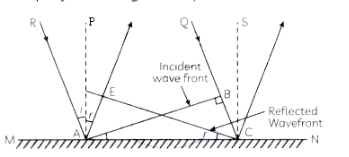
With the help of a neat diagram, explain the reflection of light on a plane reflecting surface.
Answer
Consider a plane wavefront AB of monochromatic light incident obliquely at an angle on a plane mirror MN as shown in the figure.
Image
MN : plane mirror, RA and QC : Incident rays, AP and CS : Normals to MN, AB : Incident wavefront, CE : Reflected wavefront, i : Angle of incidence, r : Angle of reflection
The wave front AB touches the reflecting surface MN at A at time t = 0.
Let v be the speed of light in the medium. lf T is the time taken by the incident wavefront to travel from B to C.
Then BC = v T.
During this time, secondary wave originating from A covers the same distance, so that the secondary spherical wavelet has a radius vT at time T. Drow a tangent CE to the wavelet.
From figure,
∠RAP = ∠i = angle of incidence
∠PAE = ∠r = angle of redlection
In ΔABC and Δ AEC
AC is common side
AE = BE
∠ABC = ∠AEC
= 90°
∴ ΔABC and ΔAEC are congruent.
∴ ∠ACE = ∠BAC
= ∠i ....(i)
Also as AE is perpendicular to CE and AP is perpendicular to AC
∠ACE = ∠PAE
= ∠r ...(ii)
∴ From equations (i) and (ii),
∠ i = ∠ r
As a result, the angle of incidence and the angle of reflection are identical. The first rule of reflection is this.
Additionally, it is clear from the figure that incident and reflected rays both reside in the same plane but on opposing sides of the normal. The second low of reflection is at hand.
Thus, the laws of reflection of light ore deduced.
View full question & answer
Question 93 Marks
Plane wavefront of light of wavelength $6000Å$  is incident on two slits on a screen perpendicular to the direction of light rays. If the total separation of 10 bright fringes on a screen \(2 m\) away is \(2 cm\), find the distance between the slits.
Answer
Given,
Distance between 10 fringes $=2 cm=0.02 m$
$\lambda=6000 \AA$
$=6000 \times 10^{-10} m$
$\therefore$ Fringe width, $w=\frac{0.02}{10}=0.002 m$
$D=2 m$
Fringe width $w=\frac{\lambda D}{d}$
$d=\frac{\lambda D}{w}$
$=\frac{6,000 \times 10^{-10} \times 2}{0.002}$
$=6 \times 10^{-4} m$
The distance between the slits is $6 \times 10^{-4} m$.
View full question & answer
Question 103 Marks
State Huygens' principle. Explain geometrical construction of a plane wavefront.
Answer
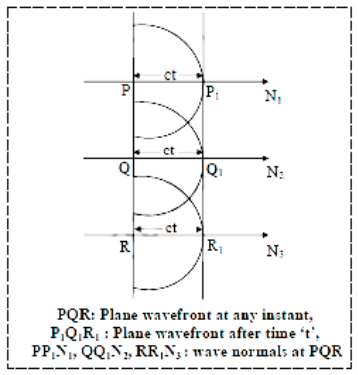
According to Huygens principle, each point of the wavefront is the source of a secondary disturbance and the wavelets emanating from these points spread out in all directions with the speed of the wave. These wavelets emanating from the wavefront are usually referred to as secondary wavelets and if we draw a common tangent to all these spheres, we obtain the new position of the wavefront at a later time.
Image
a. A plane wavefront is formed when point of observation is very far away from the primary source.
b. Let PQR represent a plane wavefront at any instant. According to Huygens' principle,all the points on this wavefront will act as secondary sources of light sending out secondary wavelets in the forward direction.
c. Draw hemispheres with $P, Q R$.... as centres and 'ct' as radius. The surface tangential to all such hemispheres is $P_1 Q_1 R_1 \ldots$. at instant ' $t$ '. It is a new wavefront at time ' $t$ '.
d. The plane wavefronts is propagated as plane waves in homogeneous isotropic medium. They are parallel to each other.
e. PP1N1, $Q Q_1 N_2, R R_1 N_3$ are the wave normals at $P, Q R$ respectively. These wave normals show the direction of propagation of plane wavefront.
f. The new wavefront $P_1 Q_1 R_1$ is parallel to primary wavefront PQR.
View full question & answer
Question 113 Marks
If the difference in the velocities of light in glass and water is \(0.25 \times 10^8 m / s\), calculate the velocity of light in air. Given that refractive index of glass and water with respect to air are 1.5 and \(\frac{4}{3}\) respectively.
Answer
Given,
Refractive index of glass with respect to air, \(\mu_g=1.5\)
Refractive index of water with respect to air, \(\mu_w=\frac{4}{3}\)
Let \(v_g\) be speed of light in glass and
Let \(v_w\) be speed of light in water
The \(\left|v_g-v_w\right|=0.25 \times 10^8\)
\(\mu_g=\frac{\text { speed of light in air }}{\text { speed of light in glass }}\)
So, \(v_g=\frac{v_a}{\mu_g}\) and \(v_w=\frac{v_a}{\mu_w}\)
\(\Rightarrow\left|v_g \sim v_w\right|=0.25 \times 10^8\)
\(\Rightarrow\left|\frac{v_a}{\mu_g}-\frac{v_a}{\mu_w}\right|=0.25 \times 10^8\)
\(\Rightarrow v_a\left|\frac{1}{\mu_g}-\frac{1}{\mu_w}\right|=0.25 \times 10^8\)
\(\Rightarrow v_a\left|\frac{1}{1.5}-\frac{3}{4}\right|=0.25 \times 10^8\)
\(\Rightarrow v_a \times 0.0833=0.25 \times 10^8\)
\(\therefore\) Speed of light in air \(v_a=\frac{0.25 \times 10^8}{0.833}=3 \times 10^8 m / s\)
View full question & answer
Question 123 Marks
In a biprism experiment, light of wavelength 5200Å is used to obtain an interference pattern on the screen. The fringe width changes by \(1.3 mm\) when the screen is moved towards the biprism by \(50 cm\). Calculate the distance between the two virtual images of the slif.
Answer
\(\lambda=5200Å=5.2 \times 10^{-7} m\)
\(X_1-X_2=1.3 mm =1.3 \times 10^{-3} m\)
\(D_1-D_2=50 cm =0.5 m\)
\(X_1-X_2=\frac{\lambda D_1}{d}-\frac{\lambda D_2}{d}\)
\(=\frac{\lambda}{d}\left(D_1-D_2\right)\)
\(\therefore d=\frac{\lambda\left(D_1-D_2\right)}{X_1-X_2}\)
\(=\frac{5.2 \times 10^{-7} \times 0.5}{1.3 \times 10^{-3}}\)
\(=2 \times 10^{-4} m\)
= 0.2 mm
View full question & answer
Question 133 Marks
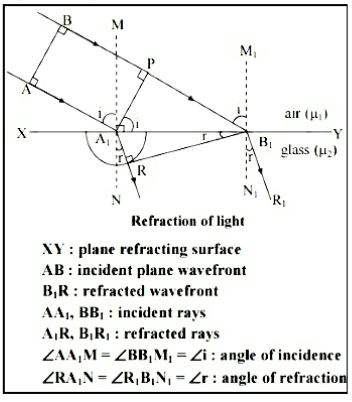
Explain refraction of light on the basis of wave theory. Hence prove the laws of refraction.
Answer
Laws of refraction :
The ratio of the velocity of light in rarer medium to the velocity of light in a denser medium is a constant called the refractive index of denser medium w.r.t. rarer medium. The incident rays, refracted rays, and normal lie in the same plane. Incident ray and refracted ray lie on opposite sides of normal.
Image
Phenomenon of refraction can be explained on the basis of wave theory of light.
1. Let $X Y$ be the plane refracting surface separating two media air and glass of respectively. indices $\mu_1$ and $\mu_2$ refractive.
2. A plane wave front $A B$ is advancing obliquely towards $X Y$ from the air. It is bounded by rays $A A_1$ and $B B_1$ which are incident rays.
3. When ' $A$ ' reaches ' $A_1$ ', then ' $B$ ' will be at ' $P$ '. It still has to cover distance $P B 1$ to reach $X Y$.
4. According to Huygens' principle, secondary wavelets will originate from $A_1$ and will spread over a hemisphere in the glass.
5. All the rays between $A A_1$ and $B B_1$ will reach $X Y$ and spread over the hemispheres of increasing radii in the glass. The surface of the tangency of all such hemispheres is $RB _1$.
This gives rise to refracted wavefront $B_1 R$ in the glass.
6. $A_1 R$ and $B_1 R_1$ are refracted rays.
7. Let $c 1$ and $c_2$ be the velocities of light in air and glass respectively.
8. At any instant of time ' $t$ ', distance covered by incident wavefront from $P$ to $B_1=P B_1=c_1 t$ Distance covered by a secondary wave from $A_1$ to $R=A_1 R=c_2 t$.
View full question & answer
Question 143 Marks
State Brewster's law and show that when light is incident at polarizing angle the reflected and refracted rays are mutually perpendicular to each other.
Answer
Brewster's law : The tangent of polarising angle is equal to the refractive index of the reflecting medium with respect to the surrounding $\left( n _2\right)$. If ip is the polarising angle. $\tan i_p={ }_1 n_2=\frac{n_2}{n_1} \ldots$ (1)
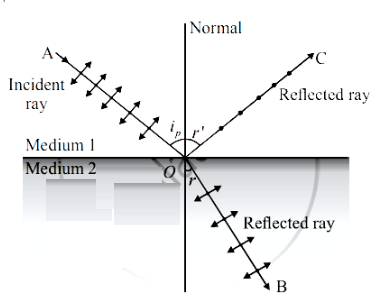
where $n _1$ is the absolute refractive index of the surrounding and $n _2$ is that of the reflecting medium. Figure shows a ray AO of unpolarised light incident on the interface separating two mediums. The degree of polarisation of the reflected ray OC varies with the angle of incidence and is a maximum for the angle of incidence equal to the polarising angle $i_p$ of the pair of mediums. For all angle of incidence, the refracted ray $O B$ is only partially polarised.
Image
In figure, the angle of incidence is $i_p$, the angle of reflection is $r^{\prime}$ and the angle of refraction is r . By Snell's law, $\frac{n_2}{n_1}=\frac{\sin i_p}{\sin r} \ldots$ (2)
From, Eqs. (1) and (2)
$\tan i_p=\frac{\sin i_p}{\cos i_p=} \frac{\sin i_p}{\sin r}$
$\therefore \cos i_p=\sin r$
$\text { Now, } r^{\prime}=i_p$
$\therefore \cos r^{\prime}=i_p$
$\therefore \cos r^{\prime}=\operatorname{sir} r$
$\therefore \sin \left(90^{\circ}-r^{\prime}\right)=\sin r$
$\therefore r=90^{\circ}-r^{\prime} \text { or, } r^{\prime}+r=90^{\circ}$
$\therefore \angle \operatorname{coB}=90^{\circ}$
This indicates that, for complete polarisation of the reflected ray at the polarising angle, the reflected and the refracted rays are mutually perpendicular.
View full question & answer
Question 153 Marks
In a biprism experiment, light of wavelength 5200Å is used to obtain an interference pattern on the screen. The fringe width changes by \(1.3 mm\) when the screen is moved towards the biprism by \(50 cm\). Calculate the distance between the two virtual images of the slif.
Answer
\(\lambda=5200Å=5.2 \times 10^{-7} m\)
\(X_1-X_2=1.3 mm =1.3 \times 10^{-3} m\)
\(D_1-D_2=50 cm =0.5 m\)
\(X_1-X_2=\frac{\lambda D_1}{d}-\frac{\lambda D_2}{d}\)
\(=\frac{\lambda}{d}\left(D_1-D_2\right)\)
\(\therefore d=\frac{\lambda\left(D_1-D_2\right)}{X_1-X_2}\)
\(=\frac{5.2 \times 10^{-7} \times 0.5}{1.3 \times 10^{-3}}\)
\(=2 \times 10^{-4} m\)
= 0.2 mm
View full question & answer
Question 163 Marks
The refractive indices of water and diamond are \(\frac{4}{3}\) and 2.42 respectively. Find the speed of light in water and diamond. \(\left(c=3 \times 10^8 m / s \right)\)
Answer
\({ }^a \mu_w=\frac{4}{3}\)
\({ }^a \mu_d=2.42\)
\({ }^a \mu_w=\frac{4}{3}=\frac{V_a}{V_w}\)
\(\therefore V_w=\frac{3 \times 10^8}{\frac{4}{3}}=3 \times 10^8 \times \frac{3}{4}=2.25 \times 10^8 m / c\)
\({ }^a \mu_d=2.42=\frac{V_a}{V_d}=\frac{3 \times 10^8}{V_d}\)
\(V_d=\frac{3 \times 10^8}{2.42}=1.23 \times 10^8 m / s\)
View full question & answer
Question 173 Marks
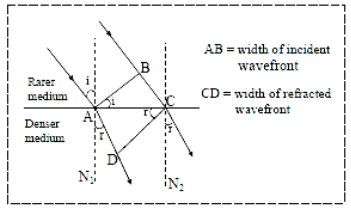
The width of plane incident wavefront is found to be doubled on refraction in denser medium. If it makes an angle of \(65^{\circ}\) with the normal. Calculate the refractive index for the denser medium.
Answer
Image
Given: i = 65°, CD = 2AB
To find: Refractive index (μ)
formulae:
\(\frac{\cos i}{\cos r}=\frac{ AB }{ CD } \ldots \ldots \ldots . .(1)\)
\(\mu=\frac{\sin i}{\sin r}\)........(2)
From formula 1
\(\frac{\cos 65^{\circ}}{\cos r}=\frac{ AB }{2 AB }\)
\(\frac{0.4226}{\cos r}=\frac{1}{2}\)
\(\cos r=32^{\circ} 16 \prime\)
from formula 2
\(\mu=\frac{\sin 65^{\circ}}{\sin \left(32^{\circ} 16 \prime\right)}\)
\(\mu=1.697\)
The refractive index for the denser medium is 1.697.
View full question & answer
Question 183 Marks
In Young's experiment the ratio of intensity at the maxima and minima in the interference pattern is \(36: 16\). What is the ratio of the widths of the two slits?
Answer
\(\frac{I_{\max }}{I_{\min }}=\left(\frac{\frac{A_1}{A_2}+1}{\frac{A_1}{A_2}-1}\right)^2\)
\(\operatorname{Let} \frac{A_1}{A_2}=r\)
\(\therefore \frac{I_{\max }}{I_{\min }}=\left(\frac{r+1}{r-1}\right)^2\)
\(\therefore \frac{36}{16}=\left(\frac{r+1}{r-1}\right)^2\)
\(\therefore \frac{6}{4}=\left(\frac{r+1}{r-1}\right)\)
\(\therefore r=\frac{5}{1}\)
\(\frac{A_1}{A_2}=\frac{5}{1}\)
Ratio of width \(=\left(\frac{A_1}{A_2}\right)^2=\frac{25}{1}\)
View full question & answer
Question 193 Marks
Derive the laws of reflection of light using Huygen's theory.
Answer
Huygen’s wave theory :
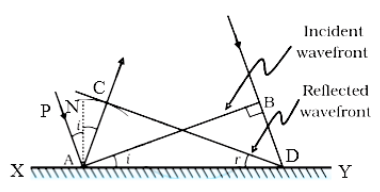
Reflection at a plane surface : Consider a plane reflecting surface XY. Let AB be a plane wavefront of light incident obliquely on XY. When the incident wavefront touches XY at A, a secondary wavelet starts, spreading from A according to Huygens’ principle. Let the ray at B reach XY at D after a time t. If v is the speed of light in air then BD = vt. During this time t, the secondary wavelet from A spreads over a hemisphere of radius vt. with centre at A. Let CD be a tangent to this hemisphere. Then AC = BD. C and D are in the same phase. If we consider all the points between A and D, then CD will be tangential to all the secondary wavelets originating from these points at the end of t seconds. Hence CD is the reflected wavefront.
Image
Draw AN normal to XY. Then
\(\angle P A N=i\), the angle of incidence, and \(\angle N A C=r\) the angle of reflection
In triangles BAD and CDA
AC = BD = vt; AD is common, and \(\angle A B D=\angle A C D=90^{\circ}\)
because the rays are normal to wavefronts.
\(\therefore\) Triangles BAD and CDA are congruent
\(\therefore \angle D A C=\angle B D A, 90^{\circ}-r=90^{\circ}-i\)
OR \(\therefore i=r\)
i.e , angle of incidence is equal to angle of reflection . 
View full question & answer
Question 203 Marks
Determine the change in wavelength of light during its passage from air to glass, if the refractive index of glass with respect to air is 1.5 and frequency of light is \(4 \times 10^{14} Hz\). ( c\(\left.=3 \times 10^8 m / s \right)\)
Answer
Given : \(\mu_8=1.5 ; n =4 \times 10^{14} Hz ; c =3 \times 10^8 m / s\)
The wavelength of light incident on glass from air is
\(x _{ a }=\frac{ c }{ n }=\frac{3 \times 10^8}{4 \times 10^{14}}=7.5 \times 10^{-7} m =7500 \times 10^{-10}=7500 A\)
Now, the velocity of light in glass is given from its refractive index as
\(\mu_g=\frac{c}{v_g}\)
We also know that velocity is product of frequency and wavelength.
\(\therefore \mu_g=\frac{c}{v_g}=\frac{n \lambda_\sigma}{n \lambda_g}=\frac{\lambda_\sigma}{\lambda_g}\)
\(\therefore \lambda_g=\frac{\lambda_\sigma}{\lambda_g}=\frac{7500}{1.5}=\)5000Å
Therefore, the difference in wavelength is
\(\lambda_\sigma-\lambda_g=7500-5000=\)2500Å)
View full question & answer
Question 213 Marks
The optical path difference between two identical waves arriving at a point is \(371 \lambda\). Is the point bright or dark ? If the path difference is \(0.24 mm\), calculate the wavelength of light used.
Answer
\(6469 \AA\)
View full question & answer
Question 223 Marks
In Young's double slit experiment, the slits are \(0.5 mm\) apart and interference is observed on a screen placed at a distance of \(100 cm\) from the slit. It is found that 9 th bright fringe is at a distance of \(8.835 mm\) from the \(2^{\text {nd }}\) dark fringe, on the same side of the centre of the fringe pattern. Find the wavelength of light used.
View full question & answer
Question 233 Marks
Explain the construction of plane wavefront using Huygens' principle
Answer
Image
a. A plane wavefront is formed when point of observation is very far away from the primary source.
b. Let PQR represent a plane wavefront at any instant. According to Huygens' principle,all the points on this wavefront will act as secondary sources of light sending out secondary wavelets in the forward direction.
c. Draw hemispheres with P, Q R.... as centres and 'ct' as radius. The surface tangential
to all such hemispheres is $P_1 Q_1 R_1 \ldots$. at instant ' $t$ '. It is a new wavefront at time ' $t$ '.
d. The plane wavefronts is propagated as plane waves in homogeneous isotropic medium. They are parallel to each other.
e. PP1N1, $Q Q_1 N_2, R R_1 N_3$ are the wave normals at $P, Q R$ respectively. These wave normals show the direction of propagation of plane wavefront.
$f$. The new wavefront $P_1 Q_1 R_1$ is parallel to primary wavefront PQR.
View full question & answer
Question 243 Marks
Obtain an expression for path difference and fringe width of interference pattern in Young's double slit experiment. Show that the fringe width is same for consecutive bright and dark bands.
Answer
coming soon…
View full question & answer
Question 253 Marks
The refractive indices of glass and water w.r.t. air \(\frac{3}{2}\) and \(\frac{4}{3}\) respectively. Determine the refractive index of glass w.r.t. water.
Answer
Given:
\({ }_a \mu_g=\frac{3}{2},{ }_a \mu_w=\frac{4}{3}\)
Find: \({ }_w \mu_g\)
Formula: \({ }_w \mu_g=\frac{{ }_a \mu_g}{{ }_a \mu_w}\)
solution: \(a_{\mu-} g=\frac{C_a}{C_g}\) and \({ }_a \mu_w=\frac{C_a}{C_w}\)
\({ }_w \mu_g=\frac{C_w}{C_g}\)
From Formula
\({ }_a \mu_g=\frac{\frac{3}{2}}{\frac{4}{3}}\)
\({ }_w \mu_g=1.12\)
The refractive index of glass w.r.t. water is 1.12.
View full question & answer
Question 263 Marks
Using analytical method for interference bands, obtain an expression for path difference between two light waves.
Answer
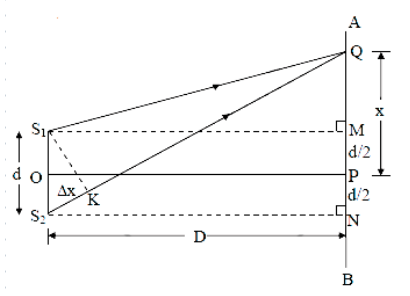
a) Let $S_1$ and $S_2$ be the two coherent monochromatic sources which are separated by short distance $d$. They emit light waves of wavelength $\lambda$
b) Let $D =$ horizontal distance between screen and source
c) Draw $S _1 M$ and $S _2 N \perp AB$
$OP =$ perpendicular bisector of slit.
Since $S_1 P=S_2 P$, the path difference between waves reaching $P$ from $S_1$ and $S_2$ is zero, therefore there is a bright point at $P$.
d) Consider a point Q on the screen which is at a distance x from the central point P on the screen. Light waves from $S_1$ and $S_2$ reach at $Q$ simultaneously by covering path $S_1 Q$ and $S_2 Q$ where they superimpose
Image

e. \(\operatorname{In} \Delta S _1 MQ\),
\(\left( S _1 Q \right)^2=\left( S _1 M \right)^2+( MQ )^2\)
\(\left(S_1 Q\right)^2=D^2+\left(x-\frac{d}{2}\right)^2\)...(1)
f. \(\operatorname{In} \Delta S _2 NQ\),
\(\left( S _2 Q \right)^2=\left( S _2 N \right)^2+( NQ )^2\)
\(\therefore \quad\left( S _2 Q \right)^2= D ^2+\left| x +\frac{ d }{2}\right|^2\)...(2)
g. Subtract equation (1) from (2),
\(\left( S _2 Q \right)^2-\left( S _1 Q \right)^2\)
\(=\left(D^2+\left(x+\frac{d}{2}\right)^2\right)-\left(D^2+\left(x-\frac{d}{2}\right)^2\right)\)
\(=D^2+\left(x+\frac{d}{2}\right)^2-D^2-\left(x-\frac{d}{2}\right)^2\)
\(=\left(x+\frac{d}{2}\right)^2-\left(x-\frac{d}{2}\right)^2\)
\(=\left(x^2+\frac{d^2}{4}+x d\right)-\left(x^2+\frac{d^2}{4}-x d\right)\)
\(=x^2+\frac{d^2}{4}+x d-x^2-\frac{d^2}{4}+x d\)
\(\left( S _2 Q \right)^2-\left( S _1 Q \right)^2=2 xd\)
\(\therefore \quad\left( S _2 Q + S _1 Q \right)\left( S _2 Q - S _1 Q \right)=2 xd\)
\(\therefore \quad S _2 Q - S _1 Q =\frac{2 XQ }{ S _2 Q + S _1 Q }\)...(3)
h).  If x << D and d << D then,
$S_1Q ≈ S_2Q ≈ D$
$S_2Q + S_1Q = 2D$
∴ Equation (3) becomes,
\(S_2 Q-S_1 Q=\frac{2 x d}{2 D}\)
\(\therefore S_2 Q-S_1 Q=\frac{x d}{D}\)
\(\therefore \triangle x=\frac{x d}{D}\)...(4)
Equation (4) gives the path difference of two interfering light waves 
View full question & answer
Question 273 Marks
Determine the change in wavelength of light during its passage from air to glass, if the refractive index of glass with respect to air is 1.5 and the frequency of light is \(5 \times 10^{14} Hz\). Find the wave number of light in glass [Velocity of light in air, \(c=3 \times 10^s m / s\) ]
Answer
Given:$ \mu _g= 1.5, n=4 \times 10^{14}Hz, c = 3 \times 10^8m/s$
The wavelength of light incident on glass from air is\(\lambda=\frac{c}{n}=\frac{3 \times 10^8}{3.5 \times 10^{14}}=8.571 \times 10^{-7} m =8571 \times 10^{-10} m\)=8571Å
Now, the velocity of light in glass is given from its refractive index as
\(\mu_g=\frac{c}{v_g}\)
We also know that velocity is product of frequency and wavelength.
\(\therefore \mu=\frac{c}{v_g}=\frac{n \lambda_a}{n \lambda_g}=\frac{\lambda_a}{\lambda g}\)
\(\therefore \lambda_g=\frac{\lambda_a}{\mu_g}=\frac{8571}{1.5}=\)5714Å
Therefore, the difference in wavelength is
\(\lambda_a-\lambda_g=8571-5714=2857\)Å
The wave number is the reciprocal of the wavelength
Therefore, the wave number in glass is
\(\bar{\lambda}_g=\frac{1}{\lambda_g}\)
\(\therefore \bar{\lambda}_g=\frac{1}{5.714 \times 10^{-7}}=1.75 \times 10^6 m ^{-1}\) 
View full question & answer
Question 283 Marks
In a biprism experiment, the fringes are observed in the focal plane of the eye-piece at a distance of \(1.2 m\) from the slit. The distance between the central bright band and the \(20^{\text {th }}\) bright band is \(0.4 cm\). When a convex lens is placed between the biprism and the eye-piece, \(90 cm\) from the eye-piece, the distance between the two virtual magnified images is found to be \(0.9 cm\). Determine the wavelength of light used.
Answer
Given:
$D=1.2 m$
The distance between the central bright band and the 20th bright band is 0.4 cm .
$\therefore y_{20}=0.4 cm=0.4 \times 10^{-2} m$
$W=\frac{y_{20}}{20}=\frac{0.4}{20} \times 10^{-2} m=2 \times 10^{-4} m$
$d_1=0.9 cm=0.9 \times 10^{-2} m, v_1=90 cm=0.9 m$
$\therefore u_1=D-v_1=1.2 m-0.9 m=0.3 m$
Now, $\frac{d_1}{d}=\frac{v_1}{u_1}$
$\therefore d=\frac{d_1 u_1}{v_1}=\frac{\left(0.9 \times 10^{-2}\right)(0.3)}{0.9} m$
$=3 \times 10^{-3} m$
$\therefore$ The wavelength of light,
$\lambda=\left(\frac{W d}{D}\right)=\frac{2 \times 10^{-4} \times 3 \times 10^{-3}}{1.2} m$
$=5 \times 10^{-7} m$
$=5 \times 10^{-7} \times 10^{10} \AA$
$=5000 \AA$
View full question & answer
Question 293 Marks
In biprism experiment, 10th dark band is observed at \(2.09 mm\) from the central bright point on the screen with red light of wavelength \(6400 AA\). By how much will fringe width change if blue light of wavelength \(4800 AA\) is used with the same setting?
Answer
In the biprism experiment, the$ 10^{th}$ dark band is observed.
The distance between the mth dark band with the central bright band is
\(x _{ m }=(2 m-1) \frac{\lambda D}{2 d}\)
Therefore, the distance for the 10th dark band is
\(x_{10}=((2 \cdot 10)-1) \frac{\lambda D}{2 d}=\frac{19 \lambda D}{2 d}\)
Now, when red light is used, we have
\(\left(x_{10}\right)=\frac{19 \lambda_r D}{2 d}\)...(1)
Similarly, for blue light, we have
\(\left(x_{10}\right)_b=\frac{19 \lambda_b D}{2 d}\)...(2)
Now, the fringe width is
\(X=\frac{\lambda D}{d}\)
\(\therefore X_r=\frac{\lambda_r D}{d}\)...(3)
\(\therefore X_b=\frac{\lambda_b D}{d}\)...(4)
From equations (1) and (3), we get
\(\left(x_{10}\right)_r=\frac{19 X_r}{2}=2.09 mm\)
\(\therefore X_r=\frac{2 \cdot 2.09}{19}=0.22 mm\)
Dividing equations (1) and (2), we get
\(\frac{\left(x_{10}\right)_r}{\left(x_{10}\right)_b}=\frac{\frac{19 \lambda_r D}{2 d}}{\frac{19 \lambda_b D}{2 d}}=\frac{\lambda_r}{\lambda_b}\)
\(\therefore\left(x_{10}\right)_b=\lambda_b \cdot \frac{\left(x_{10}\right)_r}{\lambda_r}=\frac{4800 \cdot 2.09}{6400}=1.57 mm\)
Now, from equations (2) and (4), we get
\(\left(x_{10}\right)_b=\frac{19 X_b}{2}=1.57 mm\)
\(\therefore X _{-} b =\frac{2 \cdot 1.57}{19}=0.165 mm\)
Therefore, the change in fringe width when blue light is used instead of red is $X_r-X_b=0.22-0.165=0.055mm$
View full question & answer
Question 303 Marks
Determine the change in wavelength of light during its passage from air to glass. If the refractive index of glass with respect to air is 1.5 and the frequency of light is \(3.5 \times 10^{14} Hz\), find the wave number of light in glass. [Velocity of light in air, \(c=3 \times 10^8 m / s\) ]
Answer
Given: $\mu _g= 1.5, n=4 \times 10^{14}Hz, c = 3 \times 10^8m/s$
The wavelength of light incident on glass from air is
\(\lambda=\frac{c}{n}=\frac{3 \times 10^8}{3.5 \times 10^{14}}=8.571 \times 10^{-7} m =8571 \times 10^{-10} m =8571\)Å
Now, the velocity of light in glass is given from its refractive index as
\(\mu_g=\frac{c}{v_g}\)
We also know that velocity is product of frequency and wavelength.
\(\therefore \mu=\frac{c}{v_g}=\frac{n \lambda_a}{n \lambda_g}=\frac{\lambda_a}{\lambda g}\)
\(\therefore \lambda_g=\frac{\lambda_a}{\mu_g}=\frac{8571}{1.5}=5714\)Å
Therefore, the difference in wavelength is
\(\lambda_a-\lambda_g=8571-5714=2857\)Å
The wave number is the reciprocal of the wavelength
Therefore, the wave number in glass is
\(\bar{\lambda}_g=\frac{1}{\lambda_g}\)
\(\therefore \bar{\lambda}_g=\frac{1}{5.714 \times 10^{-7}}=1.75 \times 10^6 m ^{-1}\)
View full question & answer
Question 313 Marks
If the critical angle of a medium is \(\sin ^{-1}\left(\frac{3}{5}\right)\) find the polarising angle.
Answer
Given :
The critical angle is given as
$sin\theta _c = 1/n$
\(\therefore \theta_c=\sin ^{-1}\left(\frac{1}{n}\right)\)...(1)
It is given that
\(\theta_c=\sin ^{-1}\left(\frac{3}{5}\right)\)
\(\therefore \sin ^{-1}\left(\frac{1}{n}\right)=\sin ^{-1}\left(\frac{3}{5}\right) \ldots \ldots \ldots . .\). form (1)
\(\therefore \frac{1}{n}=\frac{3}{5}\)
\(\therefore n=\frac{5}{3}\)
Now, the polarising angle is given as
\(\theta_p=\tan ^{-1} n\)
\(\theta_p=\tan ^{-1}\left(\frac{5}{3}\right)\)
\(\theta_p=\tan ^{-1}(1.667)\)
\(\theta_p=59^{\circ} 2 \prime\)
the polarising angle is \(59^{\circ} 2 \prime\)
View full question & answer
Question 323 Marks
Describe biprism experiment to calculate the wavelength of a momochromatic light. Draw the necessary ray diagram.
Answer
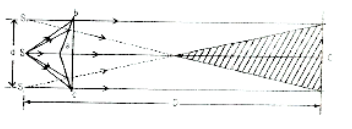
Fresnel’s biprism experiment can be used to determine the wavelength of a monochromatic light. The fig. shows the experimental arrangement and ray diagram.
Image
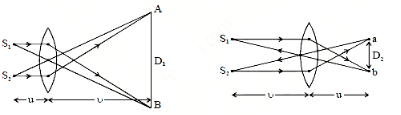
Apparatus : An optical bench is used in the biprism expeiment. It consists of a heavy metal platform about 2m in length and carrying four vertical stands to a slits, the biprism, the lens and eyepiece. The stands can be
moved along the bench as well as perpendicular to the bench
Adjustment : The slit S is adjusted to be vertical and narrow. It is illuminated by light from a monochromatic source placed behind it. The light emerging from the slit is made incident on the biprism. The eyepiece stand
is arranged at about 1 m from the slit. The refracting edge of the biprism and the vertical cross-wire of the eyepiece are arranged parallel to the slit and along a straight line. The sit is observed through the eyepiece
and the biprism is slowly rotated aobut the horizontal axis. When its refracting edge becomes exactly parallel to the slit, the interference pattern consisting of alternate bright and dark bands is seen through the
eyepiece. The slit must be suffciently narrow so that the bands are sharp and clear.
Measurement : The wavelength of a monochromatic light is given by $\lambda=\frac{X d}{D}$, is the band width or the fringe width d is the distance between the coherent sources and D is the distance between the sources and the eyepiece. The distance D can be measured directly with the help of the scale marked on the optical bench. To measure the band width X , the micrometer screw fitted to the eyepiece is adjusted such that the vertical crosswire is made coincide with one of the bright bands. The micromater reading X1 is noted By rotating the screw in the same sense, the vertical cross-wire is made coincide with successive bright bands and the corresponding reading $X _2, X _3, X _4, \ldots$ etc. are noted. The mean value of $\left( X _2- X _1\right),\left( X _3- X _2\right),\left( X _4- X _3\right) \ldots$ etc are noted. The mean value of $\left( X _2- X _1\right),\left( X _3-\right.$ $\left.X _2\right),\left( X _4- X _3\right) \ldots$... etc gives the mean band width X . To measured the distance between two coherent sources, a convex lens is mounted on the stand between the biprism and the eyepiece. Without disturbing the slit and the biprism, the eyepiece stand is moved along the bench so that the distance the slit and the eyepiece is more than four times the focal length of the lens. The lens stand is moved towards the biprism and its position (L1) is so adjusted that the two magnified images of the slit are seen through the eyepiece by rotating the micrometer screw. The vertical cross-wire in the eyepiece is made to coincide with each image and the corresponding reading is noted. The difference between these two reading gives the distance d1 between the two magnified images. The lens is moved towards the eyepiece and its position ( $L _2$ ) is so adjusted that two diminished images of the slit are seen through the eyepiece. The distance $d_2$ between these images is measure as in case of $d_1$ Then the distance between the two coherent sources is given by $d=\sqrt{d_1 d_2}$
The wavelength of the monochromatic light is determined by formula i.e $\lambda=\frac{\bar{X} d}{D}$
Image
View full question & answer