Question
State briefly the necessity of providing Depreciation.

Answer

Depreciation is provided with the following objectives:
  1. To Determine Correct Profit or Loss: Depreciation is an expense of the business and, therefore, is a charge against revenue. If it is not accounted as an expense, Profit and Loss Account for the accounting period would not give a true and fair view of the profitability of the business (i.e., net profit/ net loss).
  2. To show True and Fair View of the Financial Position: Depreciation, if not charged, would result in assets being stated at a higher value. As a result of this the Position Statement (Balance Sheet) would not present a true and fair view of the financial position.
  3. To determine the Cost of Production: Depreciation is taken into consideration for calculating the cost of production. If it is not taken into account, cost of the production will be lower by the amount of depreciation.
  4. To provide funds for replacement: Depreciation is a non-cash expense and when charged the amount of depreciation is retained in the business and can be used for the replacement of fixed assets after the expiry of their estimated useful life.
  5. To comply with legal provisions: It is necessary to charge depreciation to comply with the provisions of the Companies Act and the Income Tax Act.

Need a full question paper?

Generate a complete, print-ready paper with questions like this in minutes — across 16+ boards, with answer keys.
Start Generating Free

Similar questions

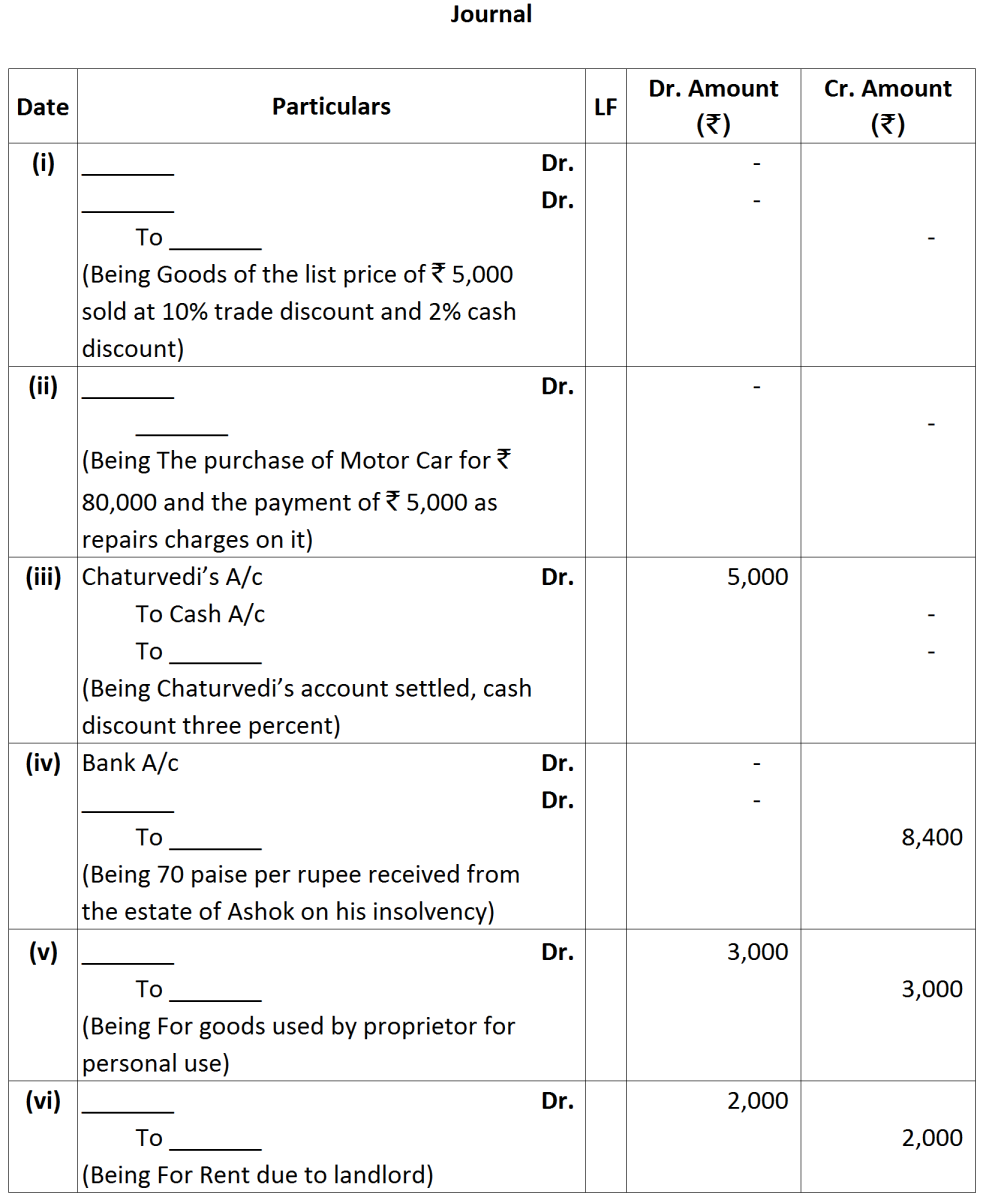
Give the journal entries corresponding to the narration given below:
Journalise the following entries:
  1. Goods costing ₹ 500 given as charity.
  2. Sold goods to Mayank of ₹ 1,00,000, payable 25% by cheque at the time of sale and balance after 30 days of sale.
  3. Received ₹ 975 from Harikrishna in full settlement of his account of ₹ 1,000.
  4. Received a first and final dividend of 60 paise in a rupee from the Official Receiver of Rajan, who owed us ₹ 1,000.
  5. Charge interest on Drawings ₹ 1,500.
  6. Sold goods costing ₹ 40,000 to Anil for cash at a profit of 25% on cost less 20% trade discount and paid cartage ₹ 100, which is not to be charged from customer.
X sold goods to Y on 1.3.2017 for ₹ 12,000 and drew upon Y a bill of exchange for the same amount payable after two months. X immediately discounted the bill with his bank at 9% p.a. The maturity date of the bill was a non business day (holiday), therefore, X had to present the bill as per the provisions of the Indian Instruments Act, 1881. The bill was dishonoured by Y and X paid ₹ 45 as noting charges. Y settled the claim of X five days after the dishonour of the bill by a cheque which included interest @ 12% for the term of the bill.
Journalise the above transactions in the books of X and Y and prepare Y's account in the books of X and X's account in the books of Y.
Trial balance of Madan did not agree and he put the difference to suspense account. He discovered the following errors:
  1. Sales return book overcast by ₹ 800.
  2. Purchases return to Sahu ₹ 2,000 were not posted.
  3. Goods purchased on credit from Narula ₹ 4,000 though taken into stock, but no entry was passed in the books.
  4. Installation charges on new machinery purchased ₹ 500 were debited to sundry expenses account as ₹ 50.
  5. Rent paid for residential accommodation of madam (the proprietor) ₹ 1,400 was debited to Rent account as ₹ 1,000. Rectify the errors and prepare suspense account to ascertain the difference in trial balance.
Enter the following transactions in Return Outward Book of Modern Furniture House, Udaipur (Rajasthan) assuming CGST @ 6% and SGST @ 6% and post it into Ledger:
2017
 
Nov. 7
Returned to Sachdeva Furniture Store, Ahmedabad (Gujarat):
5 Chairs @ ₹ 2,000 each
1 Table for ₹ 15,000
Less: 10% Trade Discount
Nov. 22
Returned 8 Chairs to India Furniture House, Jodhpur (Rajasthan) @ ₹ 1,500 each, being not of specified quality
Nov. 24
Returned one Dining Table to Arora & Co., Jaipur (Rajasthan) being not according to sample ₹ 50,000
Nov. 28
Allowance claimed from Delhi Furniture Shop, Ahmedabad (Gujarat) on account of mistake in the invoice ₹ 16,000
Trial Balance of a bookkeeper shows an excess of debits over credits by ₹ 261. This difference is placed in a Suspense Account to facilitate books closure. Later on the following errors were discovered:
  1. A credit item of ₹ 349 has been debited to a Personal Account as ₹ 439.
  2. A sum of ₹ 625 written off from fixtures as depreciation has not been posted to the Depreciation Account.
  3. ₹ 9,000 paid for furniture bought have been charged to the Purchases Account.
  4. A discount allowed to a customer has been credited to him as ₹ 145 in place of ₹ 154.
  5. A sale of ₹ 594 was posted as ₹ 495 in the Sales Account.
  6. The total of Returns Inward Book has been added ₹ 10 short.
Pass the Journal entries to correct these errors and prepare the Suspense Account.
  1. What are the different causes that make a Trial Balance incorrect?
  2. Pass the rectifying Journal entries:
  1. A credit sale of goods for ₹ 2,500 to Krishna has been wrongly passed through the Purchases Book.
  2. ₹ 5,000 paid for freight on machinery purchased was debited to the Freight Account as ₹ 500.
  3. The Returns Inward Book has been wrongly overcasted by ₹ 100.
  4. An amount of ₹ 500 due from Ramesh which had been written off as bad debt in previous year was recovered and had been posted to the Personal Account of Ramesh.
  5. A sum of ₹ 460 owed by Hari had not been included in the list of debtors.
Prepare a Two Column Cash Book from the following transactions∶
2016
 
May 1
Cash at office ₹ 72
Bank overdraft ₹ 1,250
May 4
Received from Prem Chand a cheque for ₹ 1,875 in full settlement of his account of ₹ 1,900. The cheque was banked on the same day
May 5
Bought goods and paid by cheque ₹ 500
May 6
Narinder settled his account of ₹ 700 by a cheque. This was banked on the same day.
May 9
Paid to Manohar Lal by a cheque for ₹ 420. Discount received ₹ 80
May 12
Cash sales to date ₹ 400 of which ₹ 300 were banked
May 17
Sold old typewriter for cash ₹ 320
May 20
Received a cheque for ₹ 400 from Naresh in full settlement of his account of ₹ 460. The cheque is endorsed to Suresh on 24th May in full settlement of his account of ₹ 420
May 25
Received a cheque from Hari Prakash for ₹ 150. The cheque is endorsed to Raj Prakash on 27th May; Discount received ₹ 30
May 28
Withdrew from Bank for office use ₹ 100 and for personal use ₹ 100
May 29
Withdrew (from office) for payment of private bills ₹ 425
May 30
Paid by cheque salaries ₹ 160 and rent ₹ 100
May 31
Bank charges as per Pass Book ₹ 5
Journalise the following transactions is the journal of M/s. Goel Brothers and post them to the ledger.
2017
 
Jan. 01
Started business with cash
1,65,000
Jan. 02
Opened bank account in PNB
80,000
Jan. 04
Goods purchased from Tara
22,000
Jan.05
Goods purchased for cash
30,000
Jan.08
Goods sold to Naman
12,000
Jan.10
Cash paid to Tara
22,000
Jan.15
Cash received from Naman
11,700
 
Discount allowed
300
Jan. 16
Paid wages
200
Jan. 18
Furniture purchased for office use
5,000
Jan. 20
Withdrawn from bank for personal use
4,000
Jan. 22
Issued cheque for rent
3,000
Jan. 23
Goods issued for house hold purpose
2,000
Jan. 24
Drawn cash from bank for office use
6,000
Jan. 26
Commission received
1,000
Jan. 27
Bank charges
200
Jan. 28
Cheque given for insurance premium
3,000
Jan. 29
Paid salary
7,000
Jan. 30
Cash sales
10,000
A Ltd. purchased a machine for ₹ 5,00,000 on 1st April, 2012. Further addition were made on 1st October 2012 and on 1st July 2013 for ₹ 4,00,000 and ₹ 3,00,000 respectively. On 1st January, 2015, 1st machine was sold for ₹ 2,85,000 and new machine was purchased for ₹ 6,00,000.
Prepare Machine A/c for three years ending 31st March, 2015 if depreciation is to be charged @10% p.a. on straight line basis.