Question
  1. What are the different causes that make a Trial Balance incorrect?
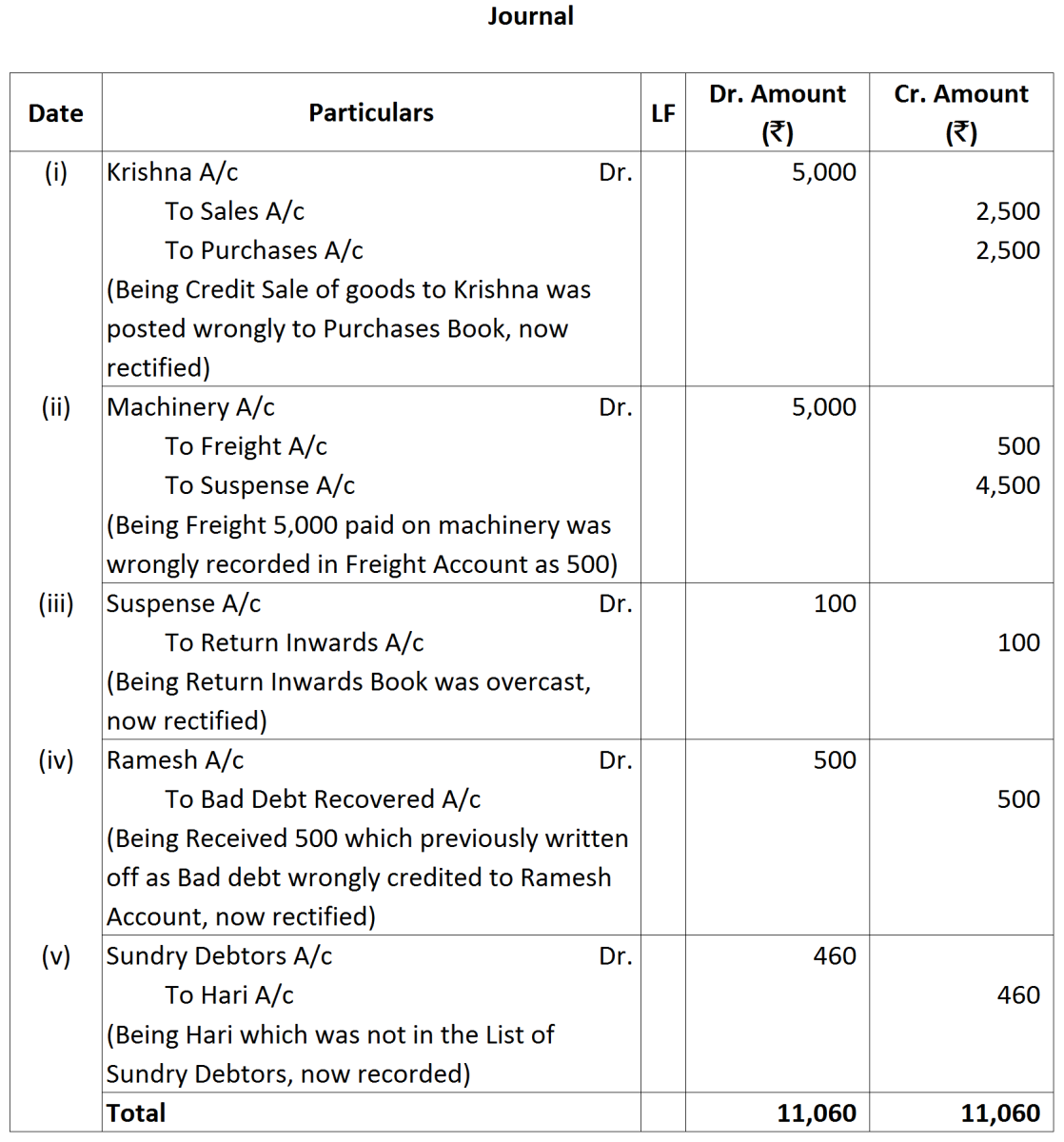
  2. Pass the rectifying Journal entries:
  1. A credit sale of goods for ₹ 2,500 to Krishna has been wrongly passed through the Purchases Book.
  2. ₹ 5,000 paid for freight on machinery purchased was debited to the Freight Account as ₹ 500.
  3. The Returns Inward Book has been wrongly overcasted by ₹ 100.
  4. An amount of ₹ 500 due from Ramesh which had been written off as bad debt in previous year was recovered and had been posted to the Personal Account of Ramesh.
  5. A sum of ₹ 460 owed by Hari had not been included in the list of debtors.
Answer

  1. The following are the causes that make a Trial Balance incorrect.
  1. Incomplete posting of Journal Entry.
  2. Posting in the wrong side of Account.
  3. Wrong totalling of Subsidiary Books.
  4. Wrong balance of Account.
  5. Omission of total of Subsidiary book into Account.
  6. Wrong totalling of the Trial Balance.
  1.  

Need a full question paper?

Generate a complete, print-ready paper with questions like this in minutes — across 16+ boards, with answer keys.

Start Generating Free

Similar questions

On 1st August, 2010, Hindustan Toys Ltd. purchased a plant for ₹ 12,00,000. The firm writes off depreciation at 10% p.a. on the diminishing balance and the books are closed on 31st March each year. On 1st July, 2012, a part of this plant of which the original cost was ₹ 1,80,000 was sold for ₹ 1,00,000 and on the same date a new plant was purchased for ₹ 4,00,000. Show the Plant Account and Provision for Depreciation Account for three years ending 31st March, 2013.
X Ltd. purchased a plant on 1st July, 2010 costing ₹ 5,00,000. It purchased another plant on 1st September, 2010 costing ₹ 3,00,000. On 31st December, 2012, the plant purchased on 1st July, 2010 got out of order and was sold for ₹ 2,15,000. Another plant was purchased to replace the same for ₹ 6,00,000. Depreciation is to be provided at 20% p.a. according to Writen Down Value Method. The accounts are closed every year on 31st March.
Show the Plant Account and Provision for Depreciation Account.
Journalise the following transactions in the books of Manoj Store:
  1. Purchased goods from Ramesh ₹ 20,000 less Trade Discount at 20% plus IGST @ 12% .
  2. Sold goods costing ₹ 7,000 to Krishna for ₹ 9,000 plus IGST @ 12%.
  3. Sold goods for ₹ 10,000 and charged IGST @ 12% against cheque.
  4. ₹ 5,000 were deposited into Savings Account.
  5. Machinery costing ₹ 4,00,000 for which order was placed earlier paying advance of ₹ 40,000. The balance amount was paid as follows:
  6. An old machine (personal) valued at ₹ 30,000 was given in exchange:
  1. Issued a cheque from his savings account for ₹ 1,30,000.
  2. Balance by issue cheque from firm's bank account.
  3. Paid wages ₹ 2,500 for installation of machine.
Babu purchased on 1st April, 2017, a machine for ₹ 6,000. On 1st October, 2017, he also purchased another machine for ₹ 5,000. On 1st October, 2018, he sold the machine purchased on 1st April, 2017 for ₹ 4,000.
It was decided that Depreciation @ 10% p.a. was to be written off every year under Diminishing Balance Method.
Assuming the accounts were closed on 31st March every year, show the Machinery Account for the years ended 31st March, 2018 and 2019.
What are the causes of depreciation?
Explain Debit and Credit note in five sentences.
On 1st January 2017, Amar sold goods to Akbar for ₹ 60,000. Akbar accepts two bills of ₹ 25,000 for 2 months, and ₹ 35,000 for 3 months.
The first bill was discounted from bank on 3rd January 2017 for ₹ 24,900 and 2nd bill endorsed to Anthony on 15th January 2017.
First bill was met on maturity but second bill got dishonoured and noting charges of ₹ 200 being paid. Amar charged ₹ 300 as Interest and drew another bill for the amount due for further 2 months. This bill was met on maturity.
Pass the necessary Journal Entries in the books of Amar, Akbar and Anthony.
Prove that the Accounting Equation is satisfied in all the following transactions of Sameer Goel:
  1. Started business with cash ₹ 10,000.
  2. Paid rent in advance ₹ 300.
  3. Purchased goods for cash ₹ 5,000 and credit ₹ 2,000.
  4. Sold goods for cash ₹ 8,000 costing ₹ 4,000.
  5. Paid salary ₹ 450 and salary outstanding being ₹ 100.
  6. Bought motorcycle for personal use ₹ 3,000.
Explain the following:
  1. Dual Aspect Concept.
  2. Accrual Concept.
  3. Going Concern Concept.
  4. Cost Concept.
  5. Accounting Period Concept.
Put the following on the proper side of a Cash Account, a Debtor's Account and a Creditor's Account:
S.No
 
i
Sold goods to Sanjay on credit
50,000
ii
Sold goods to Mohan for cash
20,000
iii
Purchased goods from Ram on credit
25,000
iv
Cash received from Sanjay
19,000
v
Goods returned by Sanjay
2,000
vi
Paid rent
500
vii
Cash paid to Ram
15,000