Question
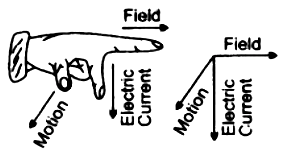
State Fleming's left hand rule.
Answer


According to this rule, stretch the thumb, forefinger and middle finger of your left hand such that they are mutually perpendicular. If the first finger points in the direction of magnetic field and the second finger in the direction of the current, then the thumb will point in the direction of motion of the conductor or the force acting on the conductor.

Need a full question paper?

Generate a complete, print-ready paper with questions like this in minutes — across 16+ boards, with answer keys.

Start Generating Free

Similar questions

A body, when acted upon by a force of 10 kgf, gets displaced by 0.5 m. Calculate the work done by the force, when the displacement is (i) in the direction of force, (ii) at an angle of 60° with the force, and (iii) normal to the force. (g = 10 N kg-1)
Figure shows a uniform metre rule placed on a fulcrum at its mid-point O and having a weight 40gf at the 10 cm mark and a weight of 20gf at the 90 cm mark.

How can the rule be brought in equilibrium by using an additional weight of 40 gf ?

An electric kettle is rated 2.5 kW, 250 V. Find the cost of running the kettle for two hours at Rs. 5.40 per unit.
The resistance of filament of an electric heater is 500 Ω It is operated at 200V for 1 hour daily. Calculate the current drawn by the heater and the energy consumed in joule.
On keeping the stem of a vibrating tuning fork on the surface of a table, a loud sound is heard. Give reason.
Give scientific reasons for the following:

Bottled drinks are cooled more effectively when surrounded by lumps of ice than by cold water at 0°.
You are given four pulleys and three strings. Draw a neat and labelled diagram to use them so as to obtain a maximum mechanical advantage equal to 8. In you diagram make the directions of load, effort and tension in each strand.
What assumptions have you made to obtain the required mechanical advantage?
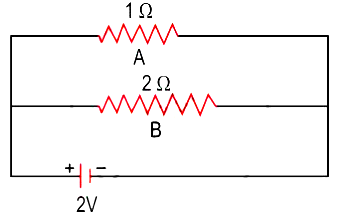
Calculate current flowing through each of the resistors A and B in the circuit shown in following figure?

An electric bulb is rated '100 W, 250 V'. How much current will the bulb draw if connected to a 250 V supply ?
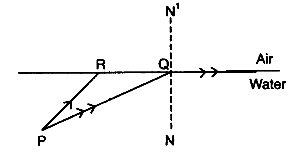
PQ and PR are two light rays emerging from the object as shown in the figure below:

(i) What is the special name given to the angle of incidence (∠PQN) of ray PQ?
(ii) Copy the ray diagram and complete it to show the position of the image of the object P when seen obliquely from above.
(iii) Name the phenomenon that occurs if the angle of incidence ∠PQN is increased still further.