Questions

[3 Mark Question Answer]

🎯

Test yourself on this topic

28 questions · timed · auto-graded

Question 13 Marks
The primary coil of a transformer has 200 turns while the secondary coil has 1000 turns. What type of transformer is this? if the input voltage is 10V, what will be the output voltage?
Answer
The transformer is step-up transformer.
Given: $N_p=200, N_s=1000, E_p=10, E_s=$ ?
By relation
$
\frac{ E _{ s }}{ E _{ p }}=\frac{ N _{ s }}{ N _{ p }}
$
$
\frac{ E _{ s }}{10}=\frac{1000}{200}
$
or $E _{ s }=\frac{10 \times 1000}{200} \times 50 V$
View full question & answer
Question 23 Marks
Describe a simple Experiment to demonstrate that there Exists a magnetic field around a current-carrying conductor.
Answer
The conductor is kept in N-S direction and its ends are connected to a battery, rheostat and a tapping key. When the key is open i.e., no current flows in the conductor, the needle points in N-S direction. As the key is pressed and a current passes in the conductor, the needle deflects. This shows that a magnetic field Exists around a current carrying conductor.
View full question & answer
Question 33 Marks
State the two properties of the magnetic lines of force around a circular coil.
Answer
The important properties are:
(i) The magnetic lines of force near the wire are nearly circular, especially at the points where
the current enters or leaves the coil.
(ii) At the centre of the coil, the lines of force are almost parallel to each other, showing that the magnetic field at the centre or the coil may be considered uniform.
View full question & answer
Question 43 Marks
The primary windings of a step-up transformer are usually made of thicker wire than the secondary. Explain.
Answer
In case of a step-up transformer, the e.m.f. across the secondary coil is greater than across the primary coil. So the current in the secondary coil is less than in the primary coil. Therefore to reduce heat loss in the windings, the primary coil is made of thicker wire than the secondary coil.
View full question & answer
Question 53 Marks
What is the function of a transformer in an a.c. circuit? How do the input and output powers in a transformer compare?
Answer
A transformer is a device by which the amplitude of an alternating e.m.f. can be increased or decreased.
For an ideal transformer, when there is no loss of energy, the output power is equal to input power i.e.,
Power in secondary coil = power in primary coil
$E_SL_S = E_PL_S$​​​​​​​
View full question & answer
Question 63 Marks
Why is the core of a transformer made of soft iron?
Answer
The core of a transformer is made of soft iron because it has high permeability so it provides complete linkage of magnetic flux of the primary coil to the secondary coil. Secondly, the hysteresis loss of energy in soft iron is less.
View full question & answer
Question 73 Marks
State the principle of a transformer.
Answer
It is based on the principle of 'electromagnetic induction'. The magnitude of induced e.m.f. is given by the formula.
$
\frac{\text { No. of turns in primary coil }}{\text { No.of. turns in secondary coil }}=\frac{\text { E.m.f. in primary }}{\text { E.m.f in secondary }}
$
Neglecting power losses
Elective power fed in the primary (input) = Elective power produced in secondary (output)
or $E _{ p } \times i _{ p }= E _{ s } \times i _{ s }$
$
\frac{E_p}{E_s}=\frac{i_s}{i_p}
$
View full question & answer
Question 83 Marks
What is the function of a transformer in an a.c. circuit? How do the input and output powers in a transformer compare?
Answer
A transformer is a device by which the amplitude of an alternating e.m.f. can be increased or decreased.
For an ideal transformer, when there is no loss of energy, the output power is equal to input power i.e.,
Power in secondary coil = power in primary coil
$E_SL_S = E_PL_S$​​​​​​​
View full question & answer
Question 93 Marks
State three factors which govern the speed of rotation of an electric motor.
Answer
(i) The strength of current in the coil,
(ii) The number of turns in the coil,
(iii) The strength of the magnetic field.
View full question & answer
Question 103 Marks
Point out three differences between an electromagnet and a bar (or permanent) magnet.
Answer
Electromagnet Bar Magnet
1. An electromagnet exhibits a much stronger magnetic field. A bar magnet is not able to exhibit a strong magnetic field.
2. Its polarity can be reversed by reversing the direction of current flowing in the turns of the coil (or solenoid). Its polarity is fixed.
3. It is a temporary magnet, it behaves as a magnet only when the current flows through the solenoid. It is a permanent magnet and cannot be readily demagnetized.
View full question & answer
Question 113 Marks
What are the factors that govern the magnitude of force acting on a current carrying conductor which is freely suspended in a magnetic field?
Answer
The magnitude of force acting on a current carrying conductor placed in a magnetic field depends on the following factors:
(i) The force F is directly proportional to the strength of the current flowing in the conductor,
i.e., F ∝ i.
(ii) The force F is directly proportional to the strength of the magnetic field, i.e., F ∝ B; and
(iii) The force F is directly proportional to the length of the conductor, i.e., F ∝ l.
View full question & answer
Question 123 Marks
State the factors, on which depends the magnitude of the force acting on current carrying conductor, when it is kept in a magnetic field perpendicular to it.
Answer
Experimentally it is found that the magnitude of the force acting on a current-carrying conductor kept in a magnetic field in a direction perpendicular to it, depends on the following factors:
(i) The F is directly proportional to the length of the current-carrying conductor, i.e., F ∝ l.
(ii) F is directly proportional to the strength of the magnetic field, i.e., F ∝ B.
(iii) F is directly proportional to the strength of the current flowing in the conductor, i.e., F ∝ i.
Combining the above factors we find that:
or F ∝ i Bl
F = KiBl
View full question & answer
Question 133 Marks
Name and state the law which determines the direction of induced current.

or

State Fleming’s right-hand rule.

Answer
Fleming's right hand rule: Stretch the forefinger, middle finger and the thumb of your right hand mutually perpendicular to each other. If the forefinger indicates the direction of magnetic field and the thumb will indicates the direction of motion of conductor, then the middle finger indicates the direction of induced current.
View full question & answer
Question 143 Marks
State Faraday’s law of electromagnetic induction.
Answer
Faraday's formulated two laws of electromagnetic induction:

(i) Whenever there is a change in the magnetic flux linked with a coil, an e.m.f. is induced. The induced e.m.f. lasts so long as there is a change in the magnetic flux linked with the coil.

(ii) The magnitude of the e.m.f. induced is directly proportional to the rate of change of the magnetic flux linked with the coil. If the rate of change of magnetic flux remains uniform, a steady e.m.f. is induced.

View full question & answer
Question 153 Marks
Name three losses of energy in a transformer. How are they minimized?
Answer
(i) Heat losses in the windings of transformer. They are minimized by taking a thicker wire in the primary coil than in the secondary coil in a step-up transformer, whereas a thicker wire in secondary coil than in primary coil in a step-down transformer.
(ii) Hysteresis losses in the core of transformer. They are minimized by using soft iron core.
(iii) Eddy current losses in the core of transformer. They are minimized by taking the core laminated instead of taking it as one solid piece.
View full question & answer
Question 163 Marks
State important properties (or characteristics) of magnetic lines of force around a straight conductor.
Answer
The main properties are:
(i) The magnetic lines of force are in the form of concentric circles around the conductor but as their distance from the conductor increases, the curvature of lines of force decreases.
(ii) The direction of the magnetic lines of force reverses if the direction of the flow of current in the conductor reverses.
(iii) With the increase of current in the conductor, the number of lines of force or the intensity of the magnetic field also increases.
View full question & answer
Question 173 Marks
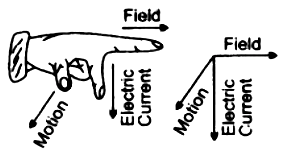
State Fleming's left hand rule.
Answer

According to this rule, stretch the thumb, forefinger and middle finger of your left hand such that they are mutually perpendicular. If the first finger points in the direction of magnetic field and the second finger in the direction of the current, then the thumb will point in the direction of motion of the conductor or the force acting on the conductor.
View full question & answer
Question 183 Marks
State and explain Maxwell’s Cork Screw Rule.
Answer
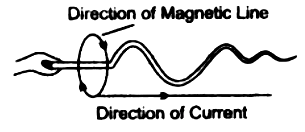
Maxwell’s Cork Screw Rule:

Imagine a right handed cork screw placed parallel to a current carrying conductor such that when it is rotated, it advances in the direction of the current. Then the direction in which the thumb rotates gives the direction of the magnetic lines of forces.
View full question & answer
Question 193 Marks
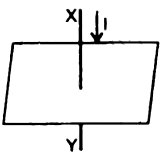
In the diagram XY is a straight conductor carrying current in the direction marked by the arrow. The conductor is held vertical by passing it through a horizontal cardboard sheet.

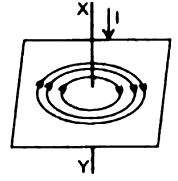
Draw three magnetic lines of force on the board and mark the direction of magnetic field in your diagram. State two factors on which magnitude of magnetic field at a point, depends.
Answer
The magnetic lines of force due to current in the straight conductor XY are shown in figure given alongside. The arrows on the magnetic lines of force shows the direction of magnetic field.

The magnitude of the magnetic field at a point depends on:
(i) The strength of the current in the conductor, and
(ii) The distance of a point from the conductor.
View full question & answer
Question 203 Marks
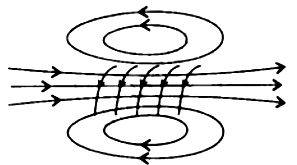
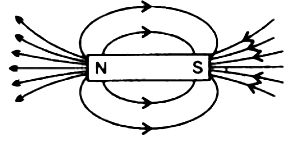
Sketch the lines of force of the magnetic field of a solenoid. How does its field compare with that of a bar magnet?
Answer
The magnetic field of a solenoid is very similar to that of a bar magnet. the given figure shows, respectively, the lines of force of the magnetic field of a current-carrying solenoid and a bar magnet.

View full question & answer
Question 213 Marks
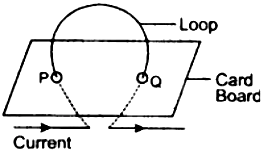
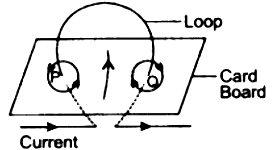
The diagram shows a current-carrying coil passing through a cardboard sheet. Draw three magnetic lines of force on the board.

State two factors on which magnitude of magnetic field at the centre depends.
Answer
Figure shows the magnetic lines of force due to current-carrying coil.

The magnitude of the magnetic field at the center of coil depends on:
(i) the strength of the current in the coil, and
(ii) the radius of coil.
View full question & answer
Question 223 Marks
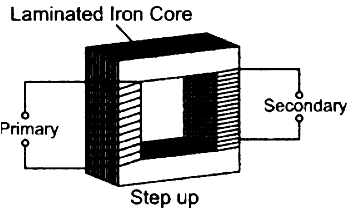
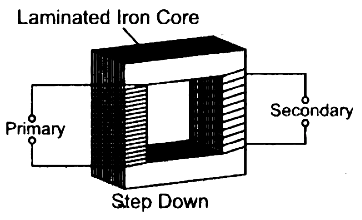
Draw a labelled diagram to show the various parts of a step-up transformer and step down transformer.
Answer
Step-up transformer is used to change low voltage alternating e.m.f. to high voltage alternating e.m.f. Its essential parts are shown in the given diagram:

View full question & answer
Question 233 Marks
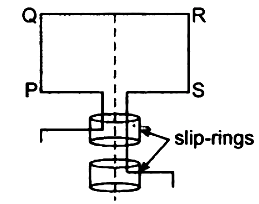
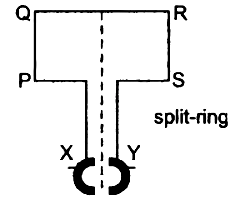
State change that you would make to convert an A.C. generator into a D.C. generator. Illustrate the change by a diagram.
Answer
As shown in the diagram the only change is that both the slip-rings of an A.C. generator are replaced by a split-ring (X-Y) (a ring split in two halves) which acts as a commutator or current-reverser.
A. C. Generator

D. C. Generator

The other parts in both are the same. By this device the current in the external circuit becomes unidirectional.
View full question & answer
Question 243 Marks
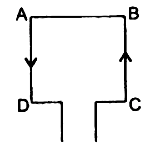
State the function of a split ring in D.C. motor.
Answer
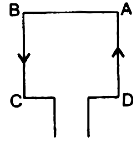
When the coil of a D. C motor turns through 180°, the split ring reverses the direction of the current in the coil from CBAD to DABC.


In this way, the coil continues to rotate continuously in the same direction and positive and negative polarities are maintained.
View full question & answer
Question 253 Marks
What is an electromagnet? What do you know about the simplest form of an electromagnet?
Answer

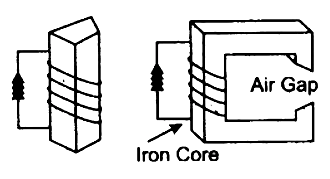
The electromagnet is a temporary magnet which can be magnetized or demagnetized in a very short time as per our requirements. In the simplest form, an electromagnet consists simply of a soft iron core around which a large number of turns of insulated wire are wound. Two of the simple forms of an electro magnet are shown in the figure alongside.
View full question & answer
Question 263 Marks
What is a solenoid? Why do we usually keep its diameter small in comparison to its length?
Answer

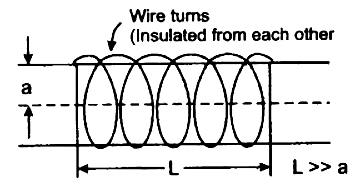
If a conducting wire (coated with an insulating paint or varnish) is closely wound on a (long) cylindrical core, the resulting coil is referred to as solenoid. It is usual to keep the diameter of the solenoid small compared to its length. This is done to bring about a greater degree of uniformity (and simplicity) in the axial magnetic field of the solenoid.
View full question & answer
Question 273 Marks
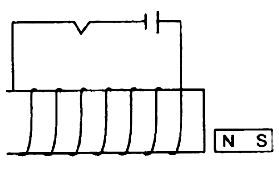
The adjacent diagram shows a small magnet placed near a solenoid. State whether the magnet is attracted or repelled, as the switch is pressed. Give a reason.
Answer

As the switch is pressed, the magnet will get repelled. The reason is that at the face of solenoid near the north pole of a magnet, the current flows in an anti-clockwise direction, so the face becomes north pole. The like poles repel, so the magnet is repelled.
View full question & answer
Question 283 Marks
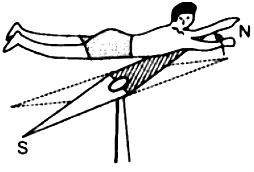
State and explain ‘Ampere’s Swimming Rule’ to determine the direction of magnetic field (or magnetic lines of force) around a current carrying conductor.
Answer

In Ampere’s swimming rule’, imagine a man swimming along the wire in the direction of the current with the face of the man towards the needle, such that current enters his feet and leaves his head, then the direction of the magnetic field produced is such the magnetic held, as shown in the diagram, towards his left hand.
View full question & answer
[3 Mark Question Answer] - Physics STD 10 Questions - Vidyadip