Question
State four ways for the judicious use of energy.

Answer

Four ways for the judicious use of energy:
(a) The fossil fuels such as coal, petroleum, natural gas should be used only for the limited purposes when there is no other alternative source of energy available.
(b) The wastage of energy should be avoided.
(c) Efforts must be made to make use of energy for community or group purposes.
(d) The cutting of trees must be banned and more and more new trees must be roped to grow.

Need a full question paper?

Generate a complete, print-ready paper with questions like this in minutes — across 16+ boards, with answer keys.
Start Generating Free

Similar questions

What happens to the $K.E$. when
(i) the mass of the body is doubled at a constant velocity and
(ii) the velocity of the body is doubled at constant mass?
Distinguish between a real and a virtual image.
An observer stands at a distance of 850 m from a cliff and fires a gun. After what time gap will he hear the echo? If sound travels at a speed of 350 m/sec., in air.
The magnification by a lens is +0.5. Name the lens and state how are u and v related?
(a) What is ultraviolet spectrum? What is the range of its wavelengths in $A$ ?
(b) Stale four important properties of ultraviolet rays.
(c) State four uses of ultraviolet rays.
A ship which is stationary at a distance of 680 m from the shore, sends a signal to the coast. Its echo is heard in 4s. Find the velocity of sound.
You are given four pulleys and three strings. Draw a neat and labelled diagram to use them so as to obtain a maximum mechanical advantage equal to 8. In you diagram make the directions of load, effort and tension in each strand.
What assumptions have you made to obtain the required mechanical advantage?
The resistance of two resistors joined in series is $8 \Omega$ and in parallel is $1.5 \Omega$. Find the value of the two resistances.
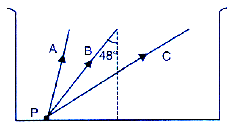
The given figure shows a point source P inside a water container three rays A, B, and C starting from the source P are shown up to the water surface. (a) show in the diagram the path of these rays after striking the water. The critical angle for water-air surface is 48°. (b) Name the phenomenon which the rays A, B, and C exhibit.
State the factors on which the angle of deviation depends.