Questions

[3 Mark Question Answer]

🎯

Test yourself on this topic

36 questions · timed · auto-graded

Question 13 Marks
A hydroelectric power station takes its water from a lake whose water level if 50 m above the turbine. Assuming an overall efficiency of 40%, calculate the mass of water which must flow through the turbine each second to produce power output of 1 MV.
Answer
Potential energy = mgh
Efficiency $=40 \%$
Useful work done $=40 \%$ of potential energy
$
\begin{aligned}
& =\frac{40}{100}( mgh )=0.4 \times( m \times 10 \times 50) \\
& =200 m
\end{aligned}
$
Power $=$ work done pr second
$1 MW =200 \times$ mass of water flowing each second
$1 \times 10^6 W =200 \times$ mass of water flowing each second
Mass of water flowing each second $=\frac{1 \times 10^6}{200}=5000 kg$
View full question & answer
Question 23 Marks
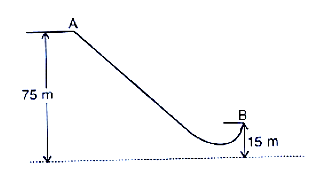
The diagram given below shows a ski jump. A skier weighing $60 kg$ stands at A at the top of ski jump. He moves from A to B and takes off for his jump at $B$.


(a) Calculate the change in the gravitational potential energy of the skier between $A$ and $B$.
(b) If $75 \%$ of the energy in part (a) becomes kinetic energy at B. Calculate the speed at which the skier arrives at B.
(Take $g =10 m s ^{-2}$ )
Answer
(a) Mass of skier $=60 kg$
Loss in potential energy $=m g(h 1-h 2)$
$
\begin{aligned}
& =60 \times 10 \times(75-15) \\
& =60 \times 10 \times 60=3.6 \times 10^4 J
\end{aligned}
$
(b) Kinetic energy at $B=\frac{75}{100} \times 3.6 \times 10^4=27000 J$
$
=2.7 \times 10^4 J
$
Kinetic energy $=1 / 2 m v^2$
$
\begin{aligned}
& 27000=1 / 2 m v^2 \\
& 27000=1 / 2 \times 60 \times v^2 \\
& v^2=\frac{27000}{30}=900 \\
& V =30 m / s
\end{aligned}
$
View full question & answer
Question 33 Marks
A stone of mass 500g is thrown vertically upwards with a velocity of $15 m s^{-1}. $Calculate: (a) the potential energy at the greatest height, (b) the kinetic energy on reaching the ground, (c) the total energy at its half-way point.
Answer
(a) Potential energy at the greatest height = initial kinetic energy
$\text { or, } mgh=1 / 2 \text { ?? }{ }^2 $
$=1 / 2 \times 0.500 \times 15 \times 15=56.25 J$
(b) Kinetic energy on reaching the ground = potential energy at the greatest height $=56.25 J$
(c) Total energy at its half-way point $=1 / 2(K+U)=56.25 J$
View full question & answer
Question 43 Marks
A pendulum with bob of mass m is oscillating on either side from its resting position A between the extremes B and C at a vertical height h and A. what is the kinetic energy K and potential energy U when the pendulum is at position (i) A, (ii) B and (iii) C?
Answer
(a) At position A, pendulum has maximum kinetic energy and its potential energy is zero at its resting position. Hence, K=mgh and U= 0.
(b) At B, kinetic energy decreases and potential energy increases. Hence, K= 0 and U=mgh
(c) At C also, kinetic energy K= 0 and potential energy U=mgh.
View full question & answer
Question 53 Marks
State four ways for the judicious use of energy.
Answer
Four ways for the judicious use of energy:
(a) The fossil fuels such as coal, petroleum, natural gas should be used only for the limited purposes when there is no other alternative source of energy available.
(b) The wastage of energy should be avoided.
(c) Efforts must be made to make use of energy for community or group purposes.
(d) The cutting of trees must be banned and more and more new trees must be roped to grow.
View full question & answer
Question 63 Marks
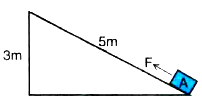
A block A, whose weight is 100 N, is pulled up a slope of length 5 m by means of a constant force (= 100 N) as illustrated in the following figure.

  1. What is the work done by force F in moving block A, 5 m along the slope?
  2. What is the increase in potential energy of the block A?
  3. Account for the difference in work done by the force and the increase in potential energy of the block.
Answer
F = 100 N; S = 5 m
(a) Work done by the force F
W = FS
= 100 × 5 = 500 J
(b) Increase in PE = mgh
= 100 × 3 = 300 J
(c) Difference in work = 500 - 300 = 200 J
This energy is used in doing work against frictional force between block and slope of plane and it appears as heat.
View full question & answer
Question 73 Marks
A man of mass $50 \ kg$ climbs up a ladder of height $10 \ m$. Calculate: (i) the work done by the man, (ii) the increase in his potential energy. $(g = 9.8 m s^{-2})$
Answer
Mass of man $= 50kg$
Height of ladder, $h2 = 10m$
(i) Work done by man $= mgh2$
$= 50 \times 9.8 \times 10 = 4900J$
(ii) increase in his potential energy:
Height,$h2 = 10m$
Reference point is ground, $h1 = 0m$
Gravitational potential energy =$ Mg (h2-h1)$
$= 50 \times 9.8 \times (10-0)$
$= 50 \times 9.8 \times 10 = 4900J$
View full question & answer
Question 83 Marks
A body of mass $5 kg$ falls from a height of $10 m$ to $4 m$. Calculate:
The total energy possessed by the body at any instant? (Take $g = 10 ms^{-2}).$
Answer
The total energy possessed by the body at
any instant remains constant for free-fall
It is equal to the sum of $P.E$. and $K.E$
$\therefore$ At height 10 m , i.e. at top most point $K.E = 0$
$\therefore$ Total energy $= P.E. + K.E.$
Total energy $= 500 + 0 = 500 J$
View full question & answer
Question 93 Marks
A box of weight $150$ kgf has gravitational potential energy stored in it equal to $14700 J$. Find the height of the box above the ground. (Take $g = 9.8 N kg^{-1})$
Answer
Gravitational potential energy $= 14700 J$
Force of gravity = mg $= 150 × 9.8N/kg = 1470N$
Gravitational potential energy = mgh
$14700 =1470 x h$
$h =10m$
View full question & answer
Question 103 Marks
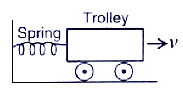
A spring is kept compressed by a small trolley of mass 0.5 kg lying on a smooth horizontal surface as shown in the adjacent fig. when the trolley is released, it is found to move at a speed $v=2 m s ^{-1}$. What potential energy did the spring possess when compressed?

Answer
Mass of trolley $= 0.5 kg$
Velocity $= 2 m/s$
When the compressed spring is released, its potential energy is converted into kinetic energy completely.
Potential energy of compressed spring = kinetic energy of moving trolley
Kinetic energy of trolley $= 1/2 \times mass \times (velocity)^2$
$= 1/2 \times 0.5 \times (2)^2$
$= 1/2 \times 0.5 \times 2\times 2=1J$
Hence, potential energy of compressed spring $= 1.0J$
View full question & answer
Question 113 Marks
A bullet of mass 50 g is moving with a velocity of $500 m s ^{-1}$. It penetrated 10 cm into a still target and comes to rest. Calculate: (a) the kinetic energy possessed by the bullet, (b) the average retarding force offered by the target.
Answer
Mass of bullet $= 50g = 0.05kg$
Velocity = 500m/s
Distance penetrated by the bullet$ = 10cm = 0.1m$
(a) Kinetic energy of the bullet $= 1/2 \times ???? \times (????????)^2$
$= 1/2 \times 0.05 \times (500)^2$
$= 1/2 \times 0.05 \times 500 \times 500=6250 J$
(b) Work done by the bullet against the material of the target= resistive force x distance
6250 = resistive force × 0.1m
Resistive force = 62500 N
View full question & answer
Question 123 Marks
Two bodies of equal masses are placed at heights h and 2h. Find the ration of their gravitational potential energies.
Answer
Height $H 1= h$
Height $H 2=2 h$
Mass of body $1=m$
Mass of body $2=m$
Gravitational potential energy of body $1= mgH 1= mgh$
Gravitational potential energy of Body $2= mgH 2= mg (2 h )$
Ratio of gravitational potential energies
$
=\frac{m g h}{m g(2 h)}=\frac{m g h}{2 m g h}=\frac{1}{2}=1: 2
$
View full question & answer
Question 133 Marks
A truck weighing 1000 kgf changes its speed from $36 km h ^{-1}$ to $72 km h -1$ in 2 minutes. Calculate:
(i) the work done by the engine and
(ii) its power/ $\left( g =10 m s ^{-2}\right)$
Answer
$
\begin{aligned}
& U =36 km / h =\frac{36 \times 1000 m }{3600 s }=10 m / s \\
& \text { and } V =72 km / h =\frac{72 \times 1000 m }{3600 s }=20 m / s
\end{aligned}
$
mass of the truck $=1000 kg$
(i) $w =\frac{1}{2} \times 1000 \times\left(20^2-10^2\right)$
$
\begin{aligned}
& W=500 \times(400-100) \\
& W=500 \times 300=150000 \jmath \\
& W=1.5 \times 10^5 J
\end{aligned}
$
(iii) Power $=\frac{\text { work done }}{\text { time taken }}=\frac{1.5 \times 10^5 J }{120 s }=1.25 \times 10^3 W$
View full question & answer
Question 143 Marks
A body of mass 10 kg is moving with a velocity $20 m s ^{-1}$. If the mass of the body is doubled and its velocity is halved, find the ratio of the initial kinetic energy to the final kinetic energy.
Answer
Let initial Mass, $m_1=10 kg$ and velocity, $v_1=20 m / s$
Final mass, $m _2=2 \times 10=20 kg$ and velocity, $v _2=20 / 2=10 m / s$ Initial kinetic energy, $K _1=1 / 2 \times$ mass $\times(\text { velocity })^2$
$
\begin{aligned}
& =1 / 2 \times 10 \times(20)^2 \\
& =1 / 2 \times 10 \times 20 \times 20 \\
& =2000 J
\end{aligned}
$
Final kinetic energy, $K _2=1 / 2 \times$ mass $\times(\text { velocity })^2$
$
\begin{aligned}
& =1 / 2 \times 20 \times(10)^2 \\
& =1 / 2 \times 20 \times 10 \times 10 \\
& =1000 J
\end{aligned}
$
$
\frac{K_1}{K_2}=\frac{2000}{1000}=\frac{1}{2}=2: 1
$
View full question & answer
Question 153 Marks
A ball of mass $0.5 kg$ slows down from a speed of $5 m / s ^{-1}$ to that of $3 m / s ^{-1}$. Calculate the change in kinetic energy of the ball.
Answer
$
\begin{aligned}
& \text { Mass of ball }=0.5 kg \\
& \text { Initial velocity }=5 m / s \\
& \text { Initial kinetic energy }=\frac{1}{2} \times \text { mass } \times(\text { velocity })^2 \\
& =\frac{1}{2} \times 0.5 \times(5)^2 \\
& =\frac{1}{2} \times 0.5 \times 25=6.25 J
\end{aligned}
$
Final velocity of the ball $=3 m / s$
Final kinetic energy of the ball =
$
\begin{aligned}
& \frac{1}{2} \times \text { mass } \times(\text { Velocity })^2 \\
& =\frac{1}{2} \times 0.5 \times(3)^2 \\
& =\frac{1}{2} \times 0.5 \times 9=2.25 J
\end{aligned}
$
Change in the kinetic energy of the ball $=2.25 J -6.25 J =-4 J$
There is a decrease in the kinetic energy of the ball .
View full question & answer
Question 163 Marks
A car is running at a speed of $15 km h ^{-1}$ while another similar car is moving at a speed of $30 km h ^{-1}$. Find the ration of their kinetic energies.
Answer
Given, velocity of first car, v1 = $15 km / h$
And velocity of second car, v2 $=30 km / h$
Since masses are same, kinetic energy is directly proportional to the square of the velocity (Kav2)
Hence, ratio of their kinetic energies is:
$\frac{k_1}{k_2}=\frac{v_1^2}{v_2^2}=\frac{15^2}{(30)^2}=\frac{15 \times 15}{30 \times 30}=\frac{1}{4}=1: 4$
View full question & answer
Question 173 Marks
Two bodies of equal masses are moving with uniform velocities v and 2v. Find the ratio of their kinetic energies.
Answer
Given, velocity of first body v1 = v And velocity of second body, v2 = $2 v$ Since masses are same, kinetic energy is directly proportional to the square of the velocity $\left( Kav ^2\right)$ Hence, ratio of their kinetic energies is:
$
\frac{k_1}{k_2}=\frac{v_1^2}{v_2^2}=\frac{v^2}{(2 v)^2}=\frac{v^2}{4 v^2}=\frac{1}{4}=1: 4
$
View full question & answer
Question 183 Marks
Calculate the decrease in the kinetic energy of a moving body if its velocity reduces to half of the initial velocity.
Answer
Kinetic energy is directly proportional to the square of velocity.
Velocity is reduced to half its original value. So, we get
$
\begin{aligned}
& \Delta K = K - K _{\text {new }}=\frac{1}{2} mv ^2-\frac{1}{2} m \left(\frac{1}{2} v \right)^2 \\
& \therefore \Delta K =\frac{1}{2} mv ^2-\frac{1}{2} mv ^2\left(\frac{1}{4}\right)=\frac{3}{4} \times \frac{1}{2} mv ^2=\frac{3}{4} k
\end{aligned}
$
View full question & answer
Question 193 Marks
What is meant by the gravitational potential energy? Derive expression for it.
Answer
Gravitational potential energy is the potential energy possessed by a body due to its position relative to the centre of earth.
For a body placed at a height above the ground, the gravitational potential energy is measured by the amount of work done in lifting it up to that height against the force of gravity.
Let a body of mass m be lifted from the ground to a vertical height h. The least upward force F required to lift the body (without acceleration) must be equal to the force of gravity (=mg) on the body acting vertically downwards. The work done W on the body in lifting it to a height h is
W = force of gravity (mg) × displacement (h) =mgh
This work is stored in the body when it is at a height h in the form of its gravitational potential energy.
Gravitational potential energy U = mgh
View full question & answer
Question 203 Marks
What do you mean by degradation of energy? Explain it by taking one example of your daily life.
Answer

During the transformation of energy from one form to another desired form, some part of energy is converted to some undesirable form or a part of it is lost to the surroundings due to the friction or radiations which cannot be used for any productive purpose. This is called dissipation of energy or degradation of energy.

Example:
When a light bulb glows, a major part of the electrical energy utilised is converted to heat energy while some part is converted to useful light energy.

View full question & answer
Question 213 Marks
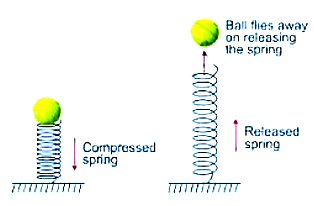
A ball is placed on a compressed spring. What form of energy does the spring possess? On releasing the spring, the ball flies away. Give a reason.
Answer
The compressed spring has elastic potential energy due to its compressed state. When it is released, the potential energy of the spring changes into kinetic energy which does work on the ball if placed on it and changes into kinetic energy of the ball due to which it flies away.

View full question & answer
Question 223 Marks
Differentiate between the potential energy (U) and the kinetic energy (K).
Answer
Potential energy (U) Kinetic energy (K)
1. The energy possessed by a body by virtue of its specific position or changed configuration is called potential energy. 1. The energy possessed by a body by virtue of its state of motion is called kinetic energy.
2. Two forms of potential energy are gravitational potential energy and elastic potential energy. 2. Forms of kinetic energy are translational, rotational and vibrational kinetic energy.
3. Example: A wound up watch spring has potential energy. 3. Example: a moving car has kinetic energy.
View full question & answer
Question 233 Marks
Name the three forms of kinetic energy and give on example of each.
Answer
The three forms of kinetic energy are:
(i) Translational kinetic energy- example: a freely falling body
(ii) Rotational kinetic energy-example: A spinning top.
(iii)Vibrational kinetic energy-example: atoms in a solid vibrating about their mean position.
View full question & answer
Question 243 Marks
Two bodies A and B of masses m and M (M≫ m) have same kinetic energy. Which body will have more momentum?
Answer
Kinetic energy is related to momentum and mass as
$
p=\sqrt{2 m k}
$
As the kinetic energy of both bodies are same, momentum is directly proportional to square root of mass.
Now, mass of body $B$ is greater than that of body $A$.
Hence, body B will have more momentum than body A.
View full question & answer
Question 253 Marks
A light mass and a heavy mass have equal momentum. Which will have more kinetic energy?
(Hint : Kinetic energy $K = P^2/2m$ where P is the momentum)
Answer
Kinetic energy, $k=\frac{p^2}{2 m}$ where $p$ is the momentum.
Both the masses have same momentum $p$. The kinetic energy, $K$ is inversely proportional to mass of the body.
Hence light mass body has more kinetic energy because smaller the mass, larger is the kinetic energy.
View full question & answer
Question 263 Marks
Differentiate between energy and power.
Answer
Energy Power
1. Energy of a body is its capacity to do work. (i) Power of a source is the energy spent by it in 1s.
2. Energy spent does not depend on time. (ii) Power spent depends on the time in which energy is spent.
3. S.I unit of energy is joule (J). (iii)S.I unit of power is watt (W)
View full question & answer
Question 273 Marks
Differentiate between work and power.
Answer
Work Power
1. Work done by a force is equal to the product of force and the displacement in the direction of force. 1. Power of a source is the rate of doing work by it.
2. Work done does not depend on time. 2. 2. Power spent depends on the time in which work is done.
3. S.I unit of work is joule (J). 4. S.I unit of power is watt (W).
View full question & answer
Question 283 Marks
A boy of mass m climbs up a staircase of vertical height h.
(a) What is the work done by the boy against the force of gravity?
(b) What would have been the work done if he uses a lift in climbing the same vertical height?
Answer
Let a boy of mass m climb up through a vertical height h either through staircase of using a lift. The force of gravity on the boy is F = mg acting vertically downwards and the displacement in the direction opposite to force (i.e., vertical) is S = −h. Therefore the work done by the force of gravity on the boy is
W = FS = − mgh
or, the work W = mgh is done by the boy against the force of gravity.
View full question & answer
Question 293 Marks
What are the S.I. and $C.G.S$ units of work? How are they related? Establish the relationship.
Answer
$S.I$ unit of work is Joule.
$C.G.S $unit of work is erg.
Relation between joule and erg:
1 joule $=1 N \times 1 m$
But $1 N=10^5$ dyne
And $1 m=100 cm=10^2 cm$
Hence, 1 joule $=10^5$ dyne $\times 10^2 cm$
$=10^7$ dyne $\times cm =10^7 erg$
Thus, 1 Joule $=10^7 erg$
View full question & answer
Question 303 Marks
A pump is used to lift 500 kg of water from a depth of 80 m in 10 s. calculate:
the work done by the pump
Answer
$\begin{aligned} & W = mg \times h = mgh \\ & W=500 \times 10 \times 80=4 \times 10^5 J \end{aligned}$
View full question & answer
Question 313 Marks
A boy of mass $40\ kg$ climbs up the stairs and reaches the roof at a height $8\ m$ in $5\ s$. Calculate:
  1. the force of gravity acting on the boy,
  2. the work done by him against the force of gravity,
  3. the power spent by boy. (Take $g =10 m s ^{-2}$ )
Answer
Mass of boy $=40 kg$, Vertical height moved, $h =8 m$, Time taken, $t =$ 5 s.
(i) Force of gravity on the boy $F = mg$
$ =40 kg \times 10 m / s ^{-2}$
$=400 N$
(ii) Work done against gravity, $W = mgh$
$=400 \times 8$
$=3200 J$
(iii) Power $=\frac{\text { work }}{\text { Time }}=\frac{ mgh }{ t }$
$=\frac{3200 J }{5 s }$
$=640 W$
View full question & answer
Question 323 Marks
A body, when acted upon by a force of 10 kgf, gets displaced by 0.5 m. Calculate the work done by the force, when the displacement is (i) in the direction of force, (ii) at an angle of 60° with the force, and (iii) normal to the force. (g = 10 N kg-1)
Answer
Force acting on the body = 10 kgf = 10 × 10 N = 100 N
Displacement, S = 0.5 m
Work done = force x displacement in the direction of force
(i) W = F × S
W = 100 × 0.5= 50 J
(ii) Work = force x displacement in the direction of force
W = F × S cosθ
W = 100 × 0.5 cos60o
W = 100 × 0.5 × 0.5(cos 60o = 0.5)
W = 25 J
(iii) Normal to the force:
Work = force x displacement in the direction of force
W = F × S cosθ
W = 100 × 0.5 cos90o
W = 100 × 0.5 × 0 = 0 J(cos90o = 0)
View full question & answer
Question 333 Marks
A boy takes $3$ minutes to lift a $20$ litre water bucket from a $20 \ m$ deep well, while his father does it in $2$ minutes. How much work each does? Take density of water $=10^3 kg m ^{-3}$ and $g =9.8 N kg ^{-1}$.
Answer
Work done $= mgh$
Given,
density of water $=10^3 kg m ^{-3}$
To convert, density of water to mass per litre
We know, 1 litre $=1000 cm ^3$ and $1 m ^3=10^6 cm ^3$
So, $10^3 kgm ^{-3}=\frac{1000 kg }{1 m ^3}$
$ =\frac{1000 kg }{10^6 cm ^3}$
$=\frac{1 kg }{1000 cm ^3}$
$=\frac{1 kg }{1 \text { litre }} $
Hence, $20 L$ of water $=20 Kg$ by mass
$\text { height }=20 m$
Now, substituting the values in the formula for work done we get
$ W=20 \times 9.8 \times 20$
$W=3.92 kJ $
View full question & answer
Question 343 Marks
A boy takes 3 minutes to lift a 20 litre water bucket from a 20 m deep well, while his father does it in 2 minutes. compare :
(i) the work, and
(ii) power developed by them.
Answer
(i) Work done is same for both as both the people carry the same weight of water to the same height.
Work done by boy: Work done by father = $1: 1$
(ii) Power developed is
$
\begin{aligned}
& \frac{P_{\text {boy }}}{P_{\text {father }}}=\frac{\frac{W}{t_{\text {boy }}}}{\frac{W}{t_{\text {father }}}}=\frac{t_{\text {father }}}{t_{\text {boy }}} \\
& \therefore \frac{P_{\text {boy }}}{P_{\text {father }}}=\frac{2}{3}=2: 3
\end{aligned}$
Power developed by boy: Power developed by father $= 2 : 3$
View full question & answer
Question 353 Marks
It takes 20 s for a person A of mass 50 kg to climb up the stairs, while another person B of same mass does the same in 15 s. Compare the power developed by the persons A and B.
Answer
A takes $20 s$ to climb the stairs while B takes $15 s$, to do the same. Hence $B$ does work at a much faster rate than $A$; more power is spent by B.
Power developed $\alpha \frac{1}{\text { time }}$ (and amount of work done is same)
$\frac{\text { Power developed by } A }{\text { Power developed by } B }=\frac{15}{20}=3: 4$
View full question & answer
Question 363 Marks
If the power of a motor is 40 KW, at what speed can it raise a load of 20,000 N?
Answer
$\begin{aligned} & \text { Power }=40 KW \\ & \text { Force }=20,000 N \\ & \text { Power }=\text { force } \times \text { velocity } \\ & \text { Velocity }=\frac{\text { Power }}{\text { Force }}=\frac{40 KW }{20,000}=\frac{40,000}{20,000}=2 m / s .\end{aligned}$
View full question & answer
[3 Mark Question Answer] - Physics STD 10 Questions - Vidyadip