Question
State Gauss's theorem in electrostatics. Apply this theorem to derive an expression for electric field intensity at a point near an infinitely long straight charged wire.

Answer

  1. Statement: Net electric flux through to a closed surface is equal to $\frac{1}{\varepsilon_\circ}$ times the total net charge enclosed within the surface.
(If the student just writes $\oint\text{E}.\text{ds} =\frac{\text{q}}{\in_\circ}$, award )
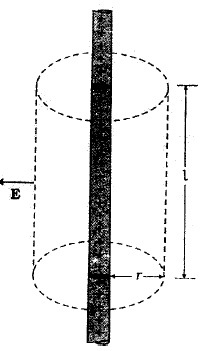
  1. Diagram:- 
  1. Derivation:- 
$\oint\text{E}.\text{ds} \int\limits_{s_1}\overline{E}.\text{d}\overline{s}_{1} + \int\limits_{s_2}\overline{E}.\text{ds}_{2} + \int\limits_{s_3}\overline{E}.\text{ds}_{3}$
$ = 0 + 0 + 2\pi\text{r}\ell$
Also, $\text{q} = \lambda$  $\ell$ (where $\lambda$  is charge per unit length)
$(\text{E}).(2\pi\text{r}\ell) = \frac{1}{\varepsilon_\circ}\lambda\ell $ OR $\text{E}2\pi\text{r}\ell\frac{\text{q}}{\varepsilon_\circ}$
$\text{E} = \frac{\lambda}{2\pi\varepsilon_\circ\text{r}}$ OR $\text{E} = \frac{\text{q}}{2\pi\varepsilon_\circ\text{r}\ell}$.

Need a full question paper?

Generate a complete, print-ready paper with questions like this in minutes — across 16+ boards, with answer keys.
Start Generating Free

Similar questions

A wire of length l carries a current i long the x-axis. A magnetic field exists, which is given $\overrightarrow{\text{B}}=\text{B}_0(\overrightarrow{\text{i}}+\overrightarrow{\text{j}}+\overrightarrow{\text{k}})\text{T}.$ Find the magnitude of the magnetic force acting on the wire.
A laser beam has intensity $2.5 \times 10^{14}\ Wm^{-2}.$ Find amplitudes of electric and magnetic fields in the beam.
Suppose A and B in the previous problem change their positions in such a way that the line joining them becomes perpendicular to the direction of wind while maintaining the separation x. What will be the time lag B finds between seeing and hearing the drum beating by A?
A 12.3 eV electron beam is used to bombard gaseous hydrogen at room temperature. Upto which energy level the hydrogen atoms would be excited?
Calculate the wavelengths of the second member of Lyman series and second member of Balmer series.
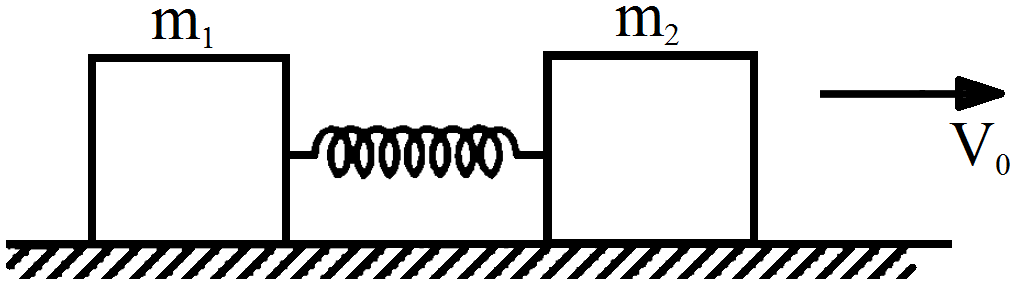
Two blocks of masses $m_1$ and $m_2$ are connected by a spring of spring constant $k.$ The block of mass $m_2$ is given a sharp impulse so that it acquires a velocity $v_0$ towards right. Find
  1. The velocity of the centre of mass.
  2. The maximum elongation that the spring will suffer.
The speed of light in glass is $2.0 \times 10^1m/s.$ Does it violate the second postulate of special relativity?
Two moving coil meters, $M_1$ and $M_2$ have the following particulars:
$R_1 = 10 \Omega, N_1 = 30,$
$A_1 = 3.6 \times 10^{–3} m^2, B_1 = 0.25 T$
$R_2 = 14 \Omega, N_2 = 42,$
$A_2 = 1.8 \times 10^{–3} m^2, B_2 = 0.50 T$
$($The spring constants are identical for the two meters$).$
Determine the ratio of $(a)$ current sensitivity and $(b)$ voltage sensitivity of $M_2$ and $M_1.$
An object P is focused by a microscope M. A glass slab of thickness 2.1cm is introduced between P and M. If the refractive index of the slab is 1.5, by what distance should the microscope be shifted to focus the object again?
Explain what would happen if in the capacitor given in Exercise $2.8, a\ 3\ mm$ thick mica sheet $($of dielectric constant $= 6)$ were inserted between the plates,
  1. While the voltage supply remained connected.
  2. After the supply was disconnected.
A pole of length 1.00m stands half dipped in a swimming pool with water level 50.0 cm higher than the bed. The refractive index of water is 1.33 and sunlight is coming at an angle of 45° with the vertical. Find the length of the shadow of the pole on the bed.