Question
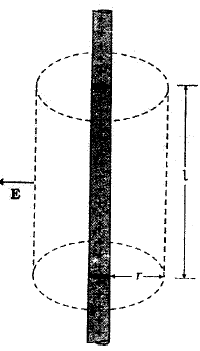
State Gauss's theorem in electrostatics. Apply this theorem to derive an expression for electric field intensity at a point near an infinitely long straight charged wire.

Answer

  1. Statement: Net electric flux through to a closed surface is equal to $\frac{1}{\varepsilon_\circ}$ times the total net charge enclosed within the surface.
(If the student just writes $\oint\text{E}.\text{ds} =\frac{\text{q}}{\in_\circ}$, award )
  1. Diagram:-
  1. Derivation:-
$\oint\text{E}.\text{ds} \int\limits_{s_1}\overline{E}.\text{d}\overline{s}_{1} + \int\limits_{s_2}\overline{E}.\text{ds}_{2} + \int\limits_{s_3}\overline{E}.\text{ds}_{3}$
$ = 0 + 0 + 2\pi\text{r}\ell$
Also, $\text{q} = \lambda$ $\ell$ (where $\lambda$ is charge per unit length)
$(\text{E}).(2\pi\text{r}\ell) = \frac{1}{\varepsilon_\circ}\lambda\ell $ OR $\text{E}2\pi\text{r}\ell\frac{\text{q}}{\varepsilon_\circ}$
$\text{E} = \frac{\lambda}{2\pi\varepsilon_\circ\text{r}}$ OR $\text{E} = \frac{\text{q}}{2\pi\varepsilon_\circ\text{r}\ell}$.

Need a full question paper?

Generate a complete, print-ready paper with questions like this in minutes — across 16+ boards, with answer keys.
Start Generating Free

Similar questions

A ball of mass 0.50kg moving at a speed of 5.0m/s collides with another ball of mass 1.0kg. After the collision the balls stick together and remain motionless. What was the velocity of the 1.0kg block before the collision?
  1. Draw a schematic diagram of a reflecting telescope.
  2. State the advantages of reflecting telescope over refracting telescope.
  1. State the law of radioactive decay. Write the SI unit of ‘activity’.
  2. There are $4\sqrt{2}\times10^6$ radioactive nuclei in a given radioactive sample. If the half life of the sample is 20 s, how many nuclei will decay in 10 s?
The product of the hole concentration and the conduction electron concentration turns out to be independent of the amount of any impurity doped. The concentration of conduction electrons in germanium is $6 \times 10^{19}$ per cubic metre. When some phosphorus impurity is doped into a germanium sample, the concentration of conduction electrons increases to $2 \times 10^{23}$ per cubic metre. Find the concentration of the holes in the doped germanium.
A water particle of mass 10.0mg and having a charge of $1.50 \times 10^{-6}C$ stays suspended in a room. What is the magnitude of electric field in the room? What is its direction?
A river 400m wide is flowing at a rate of 2.0m/s. A boat is sailing at a velocity of 10m/s with respect to the water, in a direction perpendicular to the river.
  1. Find the time taken by the boat to reach the opposite bank.
  2. How far from the point directly opposite to the starting point does the boat reach the opposite bank?
Two long parallel wires are 8 cm apart. Currents of magnitudes $i$ and $3 i$ are flowing in them respectively in the same direction. Where the resultant magnetic field due to two will be zero?
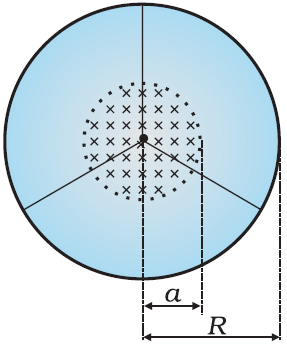
A line charge $\lambda$ per unit length is lodged uniformly onto the rim of a wheel of mass M and radius R. The wheel has light non-conducting spokes and is free to rotate without friction about its axis (Fig.). A uniform magnetic field extends over a circular region within the rim. It is given by,
$B = – B_0k (r ≤ a; a < R)$
= 0 (otherwise)
What is the angular velocity of the wheel after the field is suddenly switched off?
A string of length 40cm and weighing 10g is attached to a spring at one end and to a fixed wall at the other end. The spring has a spring constant of 160N/m and is stretched by 1.0cm. If a wave pulse is produced on the string near the wall, how much time will it take to reach the spring?
A capacitor of capacitance $10\mu\text{F}$ is connected across a battery of emf 6.0V through a resistance of $20\text{k}\Omega$ for 4.0s. The battery is then replaced by a thick wire. What will be the charge on the capacitor 4.0s after the battery is disconnected?