Question
State Gauss's theorem in electrostatics. Apply this theorem to derive an expression for electric field intensity at a point near an infinitely long straight charged wire.
(If the student just writes $\oint\text{E}.\text{ds} =\frac{\text{q}}{\in_\circ}$, award )

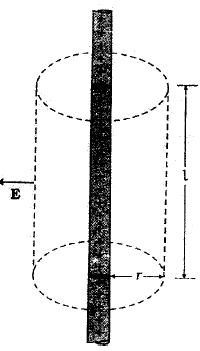
$\oint\text{E}.\text{ds} \int\limits_{s_1}\overline{E}.\text{d}\overline{s}_{1} + \int\limits_{s_2}\overline{E}.\text{ds}_{2} + \int\limits_{s_3}\overline{E}.\text{ds}_{3}$
$ = 0 + 0 + 2\pi\text{r}\ell$
Also, $\text{q} = \lambda$ $\ell$ (where $\lambda$ is charge per unit length)
$(\text{E}).(2\pi\text{r}\ell) = \frac{1}{\varepsilon_\circ}\lambda\ell $ OR $\text{E}2\pi\text{r}\ell\frac{\text{q}}{\varepsilon_\circ}$
$\text{E} = \frac{\lambda}{2\pi\varepsilon_\circ\text{r}}$ OR $\text{E} = \frac{\text{q}}{2\pi\varepsilon_\circ\text{r}\ell}$.
Generate a complete, print-ready paper with questions like this in minutes — across 16+ boards, with answer keys.