Question
  1. State Huygen’s principle. Using this principle draw a diagram to show how a plane wave front incident at the interface of the two media gets refracted when it propagates from a rarer to a denser medium. Hence verifiy Snell’s law of refraction.
  2. When monochromatic light travels from a rarer to a denser medium, explain the following, giving reasons:
    1. Is the frequency of reflected and refracted light same as the frequency of incident light?
    2. Does the decrease in speed imply a reduction in the energy carried by light wave?

Answer

  1. Law of Reflection : Let XY be a reflecting surface at which a wavefront is being incident obliquely. Let v be the speed of the wavefront and at time t = 0, the wavefront touches the surface XY at A. After time t, the point B of wavefront reaches the point B' of the surface.

According to Huygen’s principle each point of wavefront acts as a source of secondary waves. When the point A of wavefront strikes the reflecting surface, then due to presence of reflecting surface, it cannot advance further; but the secondary wavelet originating from point A begins to spread in all directions in the first medium with speed v. As the wavefront AB advances further, its points A1, A2 , A3 etc. strike the reflecting surface successively and send spherical secondary wavelets in the first medium.
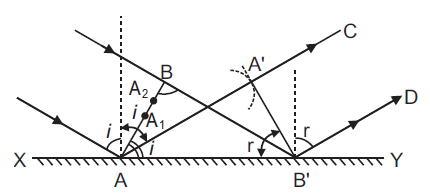
First of all the secondary wavelet starts from point A and traverses distance AA' (=vt) in first medium in time t. In the same time t, the point B of wavefront, after travelling a distance BB', reaches point B' (of the surface), from where the secondary wavelet now starts. Now taking A as centre we draw a spherical arc of radius AA' (= vt) and draw tangent A'B' on this arc from point B'. As the incident wavefront AB advances, the secondary wavelets starting from points between A and B', one after the other and will touch A'B' simultaneously. According to Huygen’s principle wavefront A'B' represents the new position of AB, i.e., A'B' is the reflected wavefront corresponding to incident wavefront AB.

Now in right-angled triangles ABB' and AA' B'

$\angle\text{ABB}' = \angle\text{AA'} B' \text{(both are equal to } 90^{o})$

side BB' = side AA' (both are equal to $v\text{t}$)

and side AB' is common

i.e., both triangles are congruent.

$\therefore\angle\text{BAB}' = \angle\text{AB}'\text{A}'$

i.e., incident wavefront AB and reflected wavefront A'B' make equal angles with the reflecting surface XY. As the rays are always normal to the wavefront, therefore the incident and the reflected rays make equal angles with the normal drawn on the surface XY, i.e.,

angle of incidence i = angle of reflection r

This is the second law of reflection.

Since AB, A'B' and XY are all in the plane of paper, therefore the perpendiculars dropped on them will also be in the same plane. Therefore we conclude that the incident ray, reflected ray and the normal at the point of incidence, all lie in the same plane. This is the first law of reflection. Thus Huygen’s principle explains both the laws of reflection.

  1.  
    1. If the radiation of certain frequency interact with the atoms/molecules of the matter, they start to vibrate with the same frequency under forced oscillations. Thus, the frequency of the scattered light (Under reflection and refraction) equals to the frequency of incident radiation.
    2. No, energy carried by the wave depends on the amplitude of the wave, but not on the speed of the wave.
Need a full question paper?

Generate a complete, print-ready paper with questions like this in minutes — across 16+ boards, with answer keys.

Start Generating Free

Similar questions

Two masses M1 and M2 are connected by a light rod and the system is slipping down a rough incline of angle $\theta$ with the horizontal. The friction coefficient at both the contacts is $\mu.$ Find the acceleration of the system and the force by the rod on one of the blocks.
Define the capacitance of a capacitor. Obtain an expression for the capacitance of a parallel plate capacitor. And explain on what factors the does capacitance depend?
The half-life of 40K is 1.30 × 10⁹y. A sample of 1.00g of pure KCI gives 160 counts/ s. Calculate the relative abundance of 40K (fraction of 40K present) in natural potassium.
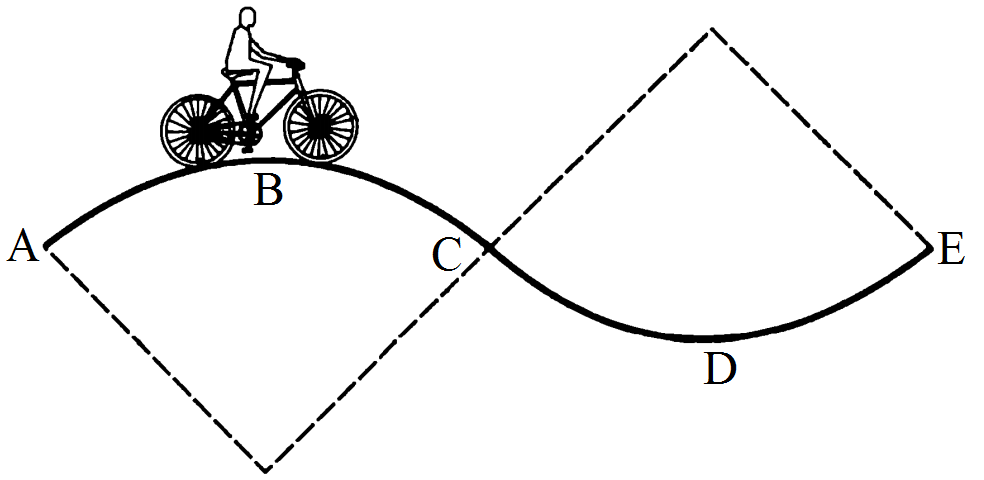
A track consists of two circular parts ABC and CDE of equal radius 100m and joined smoothly as shown in figure. Each part subtends a right angle at its centre. A cycle weighing 100 kg together with the rider travels at a constant speed of 18km/h on the track.
  1. Find the normal contact force by the road on the cycle when it is at B and at D.
  2. Find the force of friction exerted by the track on the tyres when the cycle is at B, C and D.
  3. Find the normal force between the road and the cycle just before and just after the cycle crosses C.
  4. What should be the minimum friction coefficient between the road and the tyre, which will ensure that the cyclist can move with constant speed? Take g= 10m/s2.

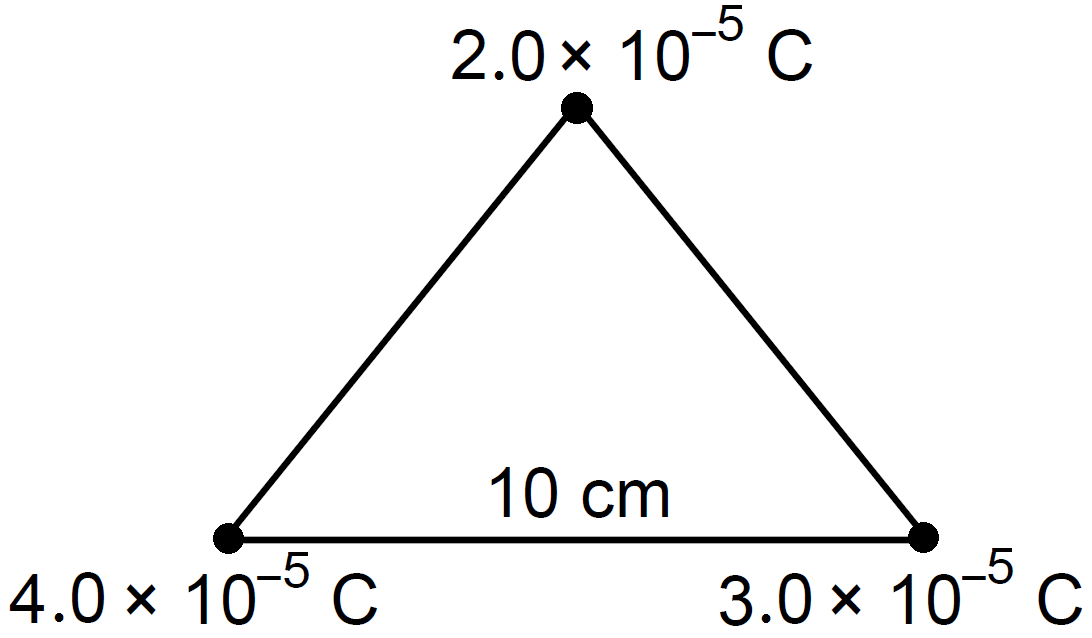
How much work has to be done in assembling three charged particles at the vertices of an equilateral triangle as shown in figure?

  1. Define mutual inductance and write its S.I. unit.
  2. Derive an expression for the mutual inductance of two long co-axial solenoids of same length wound one over the other.
  3. In an experiment, two coils c1 and c2 are placed close to each other. Find out the expression for the emf induced in the coil c1 due to a change in the current through the coil c2.
  1. Derive the mathematical relation between refractive indices n1 and n of two radii and radius of curvature R for refraction at a convex spherical surface. Consider the object to be a point since lying on the principle axis in rarer medium of refractive index nand a real image formed in the denser medium of refractive index n2. Hence, derive lens maker's formula.
  2. Light from a point source in air falls on a convex spherical glass surface of refractive index 1.5 and radius of curvature 20 cm. The distance of light source from the glass surface is 100 cm. At what position is the image formed?
Answer the following questions:
  1. Explain qualitatively on the basis of domain picture the irreversibility in the magnetisation curve of a ferromagnet.
  2. The hysteresis loop of a soft iron piece has a much smaller area than that of a carbon steel piece. If the material is to go through repeated cycles of magnetisation, which piece will dissipate greater heat energy?
  3. ‘A system displaying a hysteresis loop such as a ferromagnet, is a device for storing memory?’ Explain the meaning of this statement.
  4. What kind of ferromagnetic material is used for coating magnetic tapes in a cassette player, or for building ‘memory stores’ in a modern computer?
  5. A certain region of space is to be shielded from magnetic fields. Suggest a method.
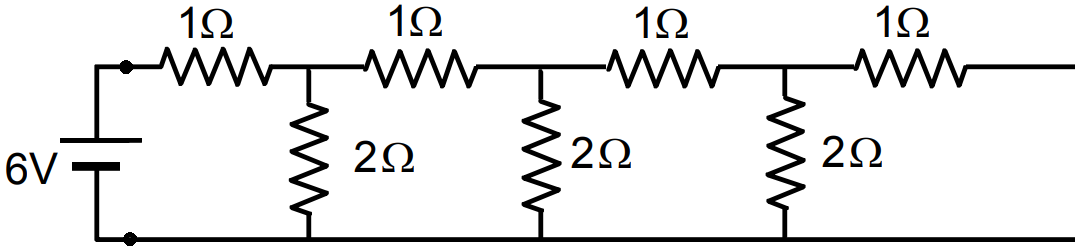
An infinite ladder is constructed with $1\Omega$ and $2\Omega$ resistors, as shown in the figure.

(a) Find the effective resistance between the points A and B. (b) Find the current that passes through the $2\Omega$ resistor nearest to the battery.

A 100 turn closely wound circular coil of radius $10 cm$ carries a current of 3.2 A. (a) What is the field at the centre of the coil? (b) What is the magnetic moment of this coil?
The coil is placed in a vertical plane and is free to rotate about a horizontal axis which coincides with its diameter. A uniform magnetic field of $2 T$ in the horizontal direction exists such that initially the axis of the coil is in the direction of the field. The coil rotates through an angle of $90^{\circ}$ under the influence of the magnetic field. (c) What are the magnitudes of the torques on the coil in the initial and final position?
(d) What is the angular speed acquired by the coil when it has rotated by $90^{\circ}$ ? The moment of inertia of the coil is $0.1 kg m ^2$.