Question
  1. State Huygen’s principle. Using this principle draw a diagram to show how a plane wave front incident at the interface of the two media gets refracted when it propagates from a rarer to a denser medium. Hence verifiy Snell’s law of refraction.
  2. When monochromatic light travels from a rarer to a denser medium, explain the following, giving reasons:
    1. Is the frequency of reflected and refracted light same as the frequency of incident light?
    2. Does the decrease in speed imply a reduction in the energy carried by light wave?

Answer

  1. Law of Reflection : Let XY be a reflecting surface at which a wavefront is being incident obliquely. Let v be the speed of the wavefront and at time t = 0, the wavefront touches the surface XY at A. After time t, the point B of wavefront reaches the point B' of the surface.

According to Huygen’s principle each point of wavefront acts as a source of secondary waves. When the point A of wavefront strikes the reflecting surface, then due to presence of reflecting surface, it cannot advance further; but the secondary wavelet originating from point A begins to spread in all directions in the first medium with speed v. As the wavefront AB advances further, its points A1, A2 , A3 etc. strike the reflecting surface successively and send spherical secondary wavelets in the first medium.
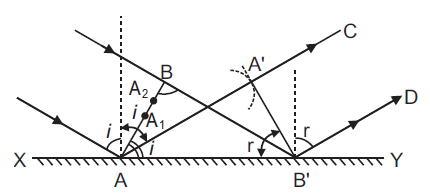
First of all the secondary wavelet starts from point A and traverses distance AA' (=vt) in first medium in time t. In the same time t, the point B of wavefront, after travelling a distance BB', reaches point B' (of the surface), from where the secondary wavelet now starts. Now taking A as centre we draw a spherical arc of radius AA' (= vt) and draw tangent A'B' on this arc from point B'. As the incident wavefront AB advances, the secondary wavelets starting from points between A and B', one after the other and will touch A'B' simultaneously. According to Huygen’s principle wavefront A'B' represents the new position of AB, i.e., A'B' is the reflected wavefront corresponding to incident wavefront AB.

Now in right-angled triangles ABB' and AA' B'

$\angle\text{ABB}' = \angle\text{AA'} B' \text{(both are equal to } 90^{o})$

side BB' = side AA' (both are equal to $v\text{t}$)

and side AB' is common

i.e., both triangles are congruent.

$\therefore\angle\text{BAB}' = \angle\text{AB}'\text{A}'$

i.e., incident wavefront AB and reflected wavefront A'B' make equal angles with the reflecting surface XY. As the rays are always normal to the wavefront, therefore the incident and the reflected rays make equal angles with the normal drawn on the surface XY, i.e.,

angle of incidence i = angle of reflection r

This is the second law of reflection.

Since AB, A'B' and XY are all in the plane of paper, therefore the perpendiculars dropped on them will also be in the same plane. Therefore we conclude that the incident ray, reflected ray and the normal at the point of incidence, all lie in the same plane. This is the first law of reflection. Thus Huygen’s principle explains both the laws of reflection.

  1.  
    1. If the radiation of certain frequency interact with the atoms/molecules of the matter, they start to vibrate with the same frequency under forced oscillations. Thus, the frequency of the scattered light (Under reflection and refraction) equals to the frequency of incident radiation.
    2. No, energy carried by the wave depends on the amplitude of the wave, but not on the speed of the wave.
Need a full question paper?

Generate a complete, print-ready paper with questions like this in minutes — across 16+ boards, with answer keys.

Start Generating Free

Similar questions

A 4.5 cm needle is placed 12 cm away from a convex mirror of focal length 15 cm. Give the location of the image and the magnification. Describe what happens as the needle is moved farther from the mirror.
Answer the following question:
Optical and radiotelescopes are built on the ground but X - ray astronomy is possible only from satellites orbiting the earth. Why?
The $\text{K}_\alpha$ X-rays of aluminium (Z = 13) and zinc (Z = 30) have wavelengths 887pm and 146pm respectively. Use Moseley's law $\sqrt{\text{v}}=\text{a}(\text{z-b})$ to find the wavelengths of the $\text{K}_\alpha$ X-ray of iron (Z = 26).
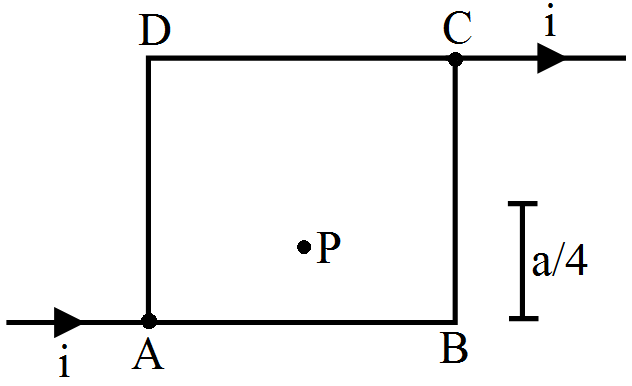
Figure shows a square loop of edge a made of a uniform wire. A current i enters the loop at the point A and leaves it at the point C. Find the magnetic field at the point P which is on the perpendicular bisector of AB at a distance $\frac{\text{a}}{4}$ from it.

  1. Describe briefly, with the help of a diagram, the role of the two important processes involved in the formation of a p-n junction.
  2. Name the device which is used as a voltage regulator. Draw the necessary circuit diagram and explain its working.
A metallic ring of mass m and radius l (ring being horizontal) is falling under gravity in a region having a magnetic field. If z is the vertical direction, the z-component of magnetic field is $\text{B}_\text{z}=\text{B}_0(1+\lambda\text{z})$. If R is the resistance of the ring and if the ring falls with a velocity v, find the energy lost in the resistance. If the ring has reached a constant velocity, use the conservation of energy to determine v in terms of $\text{m},\text{B},\lambda$ and acceleration due to gravity g.
Two parallel wires seprated by a distance of 10cm carry currents of 10A and 40A along-the same direction. Where should a third current be placed so that it experiences no magnetic force?
A sample of an ideal gas $(\gamma=1.5)$ is compressed adiabatically from a volume of 150cm3 to 50cm3. The initial pressure and the initial temperature are 150kPa and 300K. Find,
  1. The number of moles of the gas in the sample.
  2. The molar heat capacity at constant volume.
  3. The final pressure and temperature.
  4. The work done by the gas in the process.
  5. The change in internal energy of the gas.
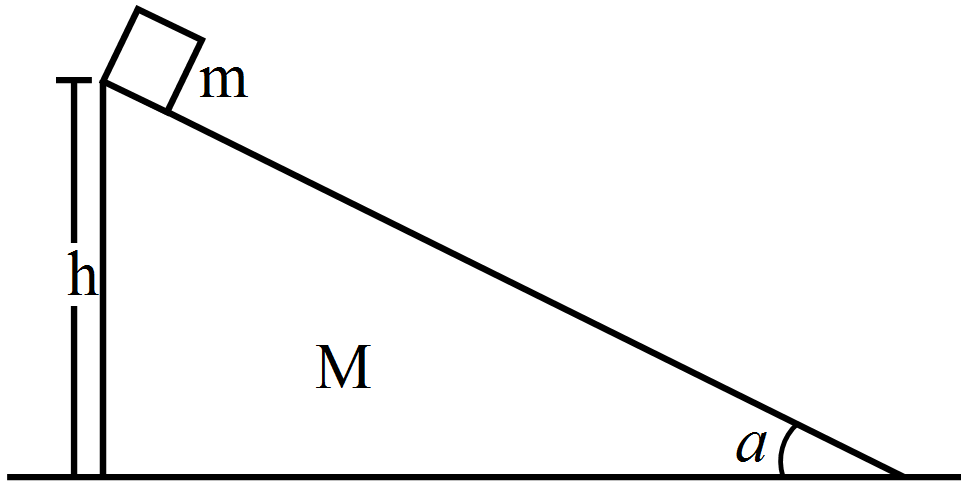
A block of mass m is placed on a triangular block of mass M, which in turn is placed on a horizontal surface as shown in figure. Assuming frictionless surfaces find the velocity of the triangular block when the smaller block reaches the bottom end.

A pin of length 2.00cm is placed perpendicular to the principal axis of a converging lens. An inverted image of size 1.00cm is formed at a distance of 40.0cm from the pin. Find the focal length of the lens and its distance from the pin.