Question
A metallic ring of mass m and radius l (ring being horizontal) is falling under gravity in a region having a magnetic field. If z is the vertical direction, the z-component of magnetic field is $\text{B}_\text{z}=\text{B}_0(1+\lambda\text{z})$. If R is the resistance of the ring and if the ring falls with a velocity v, find the energy lost in the resistance. If the ring has reached a constant velocity, use the conservation of energy to determine v in terms of $\text{m},\text{B},\lambda$ and acceleration due to gravity g.
Answer

In this problem a relation is established between induced current, power lost and velocity acquired by freely falling ring.
The magnetic flux linked with the metallic ring of mass m and radius l ring being horizontal falling under gravity in a region having a magnetic field whose z-component of magnetic field is $\text{B}_\text{z}=\text{B}_0(1+\lambda\text{z})$ is,
$\phi_\text{m}=\text{B}_\text{z}(\pi\text{l}^2)=\text{B}_0(1+\lambda\text{z})(\pi\text{l})$
Applying Faraday's law of EML, we have emf induced given by $\frac{\text{d}\phi}{\text{dt}}$ = rate of change of flux. Also, by Ohm's law
$\text{B}_0(\pi\text{l}^2)\lambda\frac{\text{dz}}{\text{dt}}=\text{IR}$
We have $\text{I}=\frac{\pi\text{l}^2\text{B}_0\lambda}{\text{R}}\text{v}$
Energy lost/second $=\text{I}^2\text{R}=\frac{(\pi\text{l}^2\lambda)^2\text{B}_0^2\text{v}^2}{\text{R}}$
Rate of change of $\text{PE}=\text{mg}\frac{\text{dz}}{\text{dt}}=\text{mgv}$ [as kinetic energy is constant for v = constant]
According to the law of conservation of energy
Thus, $\text{mgv}=\frac{(\pi\text{l}^2\lambda\text{B}_0)^2\text{v}^2}{\text{R}}\text{ or v}=\frac{\text{mgR}}{(\pi\text{l}^2\lambda\text{B}_0)^2}$
This is the required exspression of velocity.

Need a full question paper?

Generate a complete, print-ready paper with questions like this in minutes — across 16+ boards, with answer keys.

Start Generating Free

Similar questions

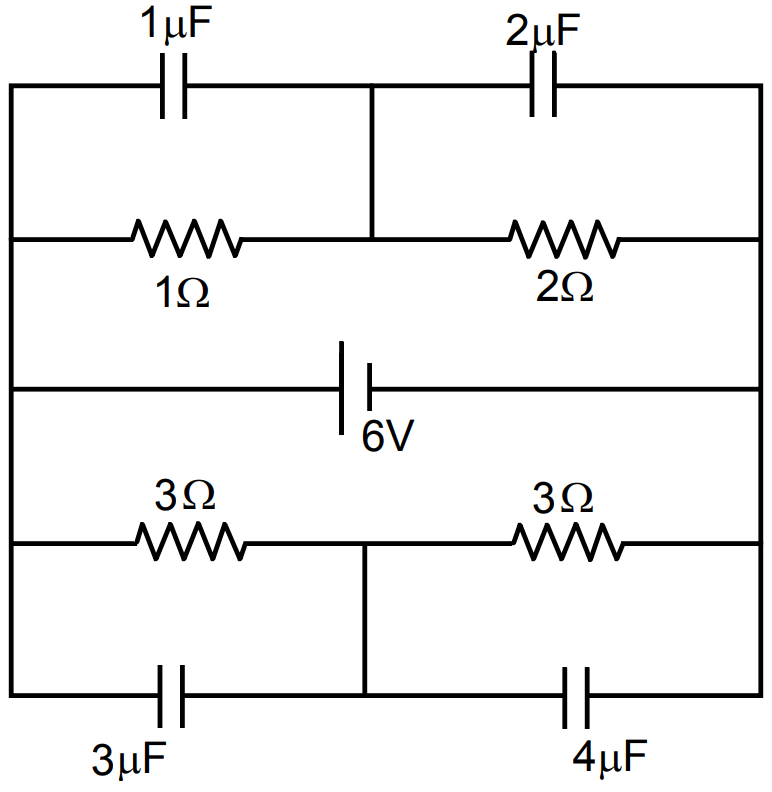
Find the charges on the four capacitors of capacitances $1\mu\text{F},2\mu\text{F},3\mu\text{F}$ and $4\mu\text{F}$ shown in the figure.

Answer the following question:
It is necessary to use satellites for long distance TV transmission. Why?


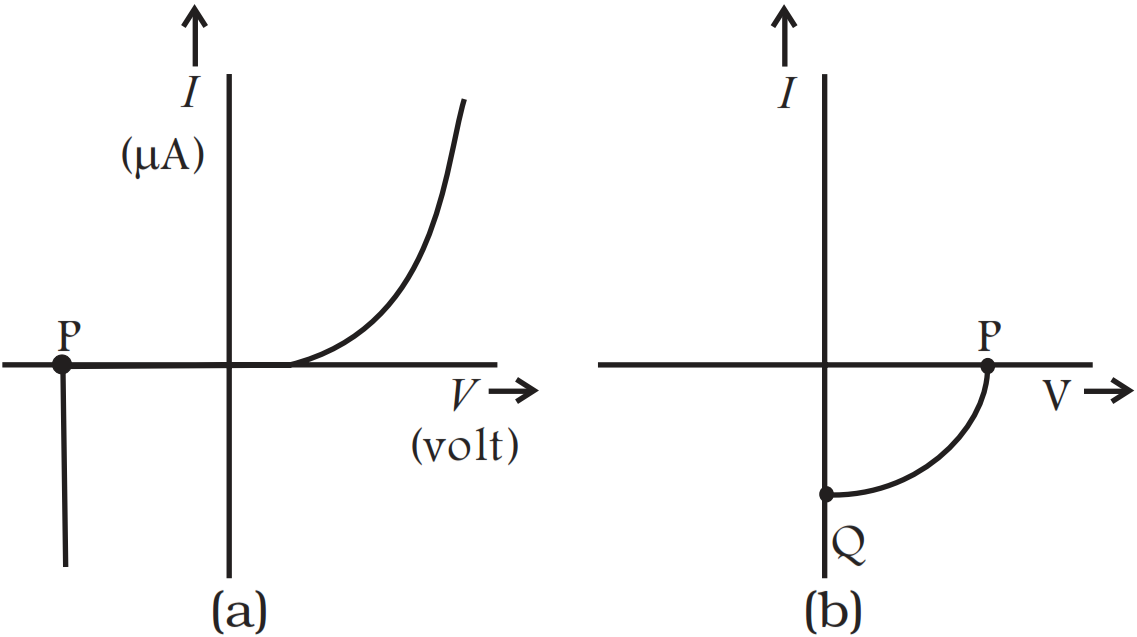
  1. Name the type of a diode whose characteristics are shown in Fig. (A) and Fig. (B).
  2. What does the point P in Fig. (A) represent?
  3. What does the points P and Q in Fig. (B) represent?
What is meant by forward bias and reverse bias of p-n junction diode? Draw experimental electrical circuit diagram to study V-I characteristic in forward bias and reverse bias of p-n junction diode. Draw forward bias and reverse bias V-I characteristic curves of p-n junction diode and briefly explain the following :
(i) Threshold or cut-in voltage
(ii) Breakdown voltage.
A smooth wedge A is fitted in a chamber hanging from a fixed ceiling near the earth's surface. A block B placed at the top of the wedge takes a time T to slide down the length of the wedge. If the block is placed at the top of the wedge and the cable supporting the chamber is broken at the same instant, the block will:
  1. Take a time longer than T to slide down the wedge.
  2. Take a time shorter than T to slide down the wedge.
  3. Remain at the top of the wedge.
  4. Jump off the wedge.
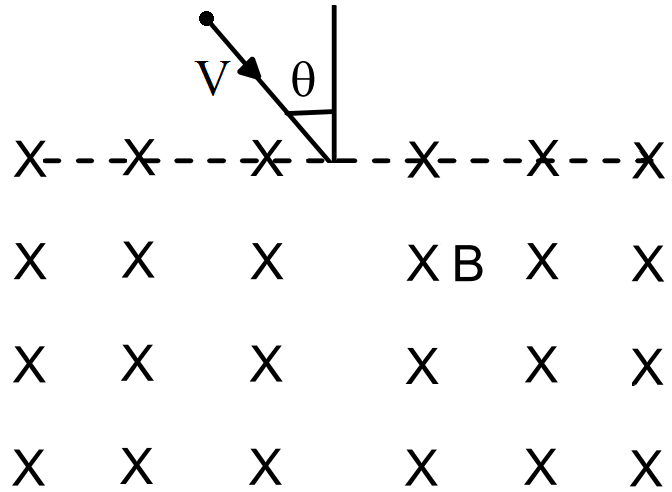
A particle of mass m and positive charge q, moving with a uniform velocity v, enters a magnetic field B, as shown,
  1. Find the radius of the circular arc it describes in the magnetic field.
  2. Find the angle subtended by the arc at the centre.
  3. How long does the particle stay inside the magnetic field?
  4. Solve the three parts of the above problem if the charge q on the particle is negative.

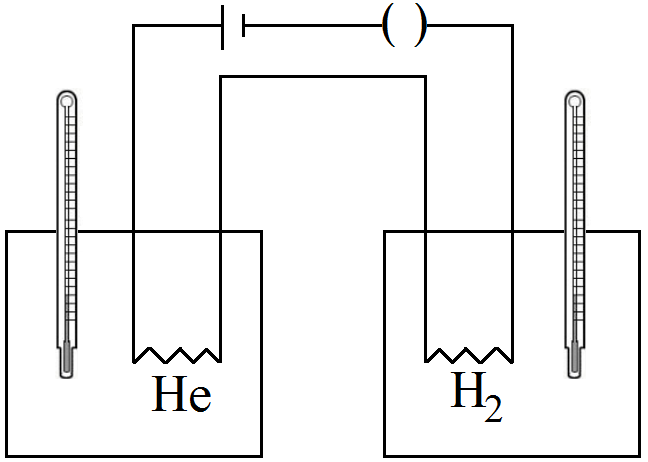
The figure shows two vessels with adiabatic walls, one containing 0.1g of helium $\big(\gamma=1.67,\text{M}=4\text{g-mol}^{-1}\big)$ and the other containing some amount of hydrogen $\big(\gamma=1.4,\text{M}=2\text{g-mol}^{-1}\big).$ Initially, the temperatures of the two gases are equal. The gases are electrically heated for some time during which equal amounts of heat are given to the two gases. It is found that the temperatures rise through the same amount in the two vessels. Calculate the mass of hydrogen.

Three coplanar parallel wires, each carrying a current of 10A along the same direction, are placed with a separation 5.0cm between the consecutive ones. Find the matnitude ol the magnetic force per unit lenght acting on the wires.
Two particles A and B having charges q and 2q respectively are placed on a smooth table with a separation d. A third particle C is to be clamped on the table in such a way that the particles A and B remain at rest on the table under electrical forces. What should be the charge on C and where should it be clamped?
What is the minimum energy that must be given to a H atom in ground state so that it can emit an $\text{H}_\gamma$ line in Balmer series. If the angular momentum of the system is conserved, what would be the angular momentum of such $\text{H}_\gamma$ photon?