Question
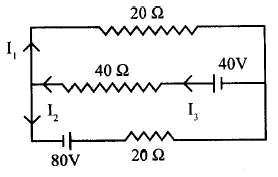
State Kirchhoff's rules of current distribution in an electrical network. Using these rules determine the value of the current I1 in the electric circuit given below.
Answer

Junction Rule: At any junction of several circuit elements the sum of currents entering the junction must be equal to the sum of currents leaving it.

Loop Rule: Algebraic sum of changes in the potential around any closed loop must be zero.
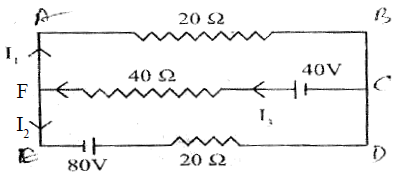
 

Loop ABCFA

$\text{I}_{1} + 2\text{I}_{3} = 2 ........................$ (1)

Loop FCDEF

$2\text{I}_{3} + \text{I}_{2} = 6 .................................$(2)

At F, $\text{I}_{1} + \text{I}_{2} = \text{I}_{3} ........................................$(3)

Solving (1), (2) and (3)

$\text{I}_{1} = - 0.8 \text{A}$

Need a full question paper?

Generate a complete, print-ready paper with questions like this in minutes — across 16+ boards, with answer keys.

Start Generating Free

Similar questions

A block is kept on the floor of an elevator at rest. The elevator starts descending with an acceleration of 12m/s2. Find the displacement of the block during the first 0.2s after the start. Take g = 10m/s2.
When a photon is emitted by a hydrogen atom, the photon carries a momentum with it. (a) Calculate the momentum carries by the photon when a hydrogen atom emits light of wavelength 656.3nm. (b) With what speed does the atom recoil during this transition? Take the mass of the hydrogen atom = 1.67 × 10⁻²⁷kg. (c) Find the kinetic energy of recoil of the atom.
A small pin fixed on a table top is viewed from above a distance of 50 cm. By what distance would the pin appear to be raised if it is viewed from the same point through a 15 cm thick glass slab held parallel to the table? Refractive index of glass = 1.5. Does the answer depend on the location of the slab?
Show that $\text{AB} + \overline{\text{AB}}$ is always 1.
A semiconducting material has a band gap of 1eV. Acceptor impurities are doped into it which create acceptor levels 1meV above the valence band. Assume that the transition from one energy level to the other is almost forbidden if kT is less than $\frac{1}{50}$ of the energy gap. Also, if kT is more than twice the gap, the upper levels have maximum population. The temperature of the semiconductor is increased from 0K. The concentration of the holes increases with temperature and after a certain temperature it becomes approximately constant. As the temperature is further increased, the hole concentration again starts increasing at a certain temperature. Find the order of the temperature range in which the hole concentration remains approximately constant.
A simple pendulum of length (l) is pulled aside to make an angle $\theta$ with the vertical. Find the magnitude of the torque of the weight (w) of the bob about the point of suspension. When is the torque zero?
  1. Draw a ray diagram for the formation of image by a compound microscope.
  2. You are given the following three lenses. Which two lenses will you use as an eyepiece and as an objective to construct a compound microscope?
Lenses Power (D) Aperture (cm)
L1 3 8
L2 6 1
L3 10 1
  1. Define resolving power of a microscope and write one factor on which it depends.
The potential barrier existing across an unbiased p-n. junction is 0·2 volt. What minimum kinetic energy a hole should have to diffuse from the p-side to the n-side if,
  1. The junction is unbiased.
  2. The junction is forwardbiased at 0.1 volt.
  3. The junction is reverse-biased at 0.1 volt?
  1. A point charge q moving with speed v enters a uniform magnetic field B that is acting into the plane of the paper as shown. What is the path followed by the charge q and in which plane does it move?
  2. How does the path followed by the charge get affected if its velocity has a component parallel to $\overrightarrow{\text{B}}$?
  3. If an electric field $\overrightarrow{\text{E}}$ is also applied such that the particle continues moving along the original straight line path, what should be the magnitude and direction of the electric field $\overrightarrow{\text{E}}$?

A 5.0 diopter lens forms a virtual image which is 4 times the object placed perpendicularly on the principal axis of the lens. Find the distance of the object from the lens.