Question
State Lenz's Law.

Answer

Lenz's law: It is stated that the direction of induced e.m.f. is always in such direction that it opposes the change in magnetic flux.
$
e=\frac{d \varphi}{d t}
$
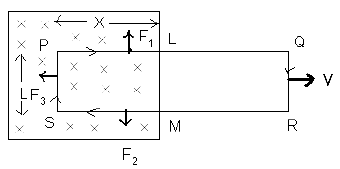
Consider a rectangular metal coil PQRS. Let ' $L$ ' be the length of the coil. It is placed in a partly magnetic field ' $B$ '. the direction of magnetic field is perpendicular to paper and into the paper. The ' $x$ ' part of the coil is in magnetic field at instant $t$. If the coil is moved towards right with a velocity $v=d x / d t$ with help of external agent like hand. The magnetic flux through the coil is $\Phi=B A=B L x \therefore \Phi=B L x$----(1) There is relative motion of a current through the coil. Let ' $i$ ' be current through the coil.

Three forces acts on the coil .
$F _1$ on conductor PL $\therefore F 1=$ Bix, vertically upward.
$F _2$ on conductor MS $\therefore F 2=$ Bix, vertically downward.
$F _3$ on conductor SP $\therefore F 3=$ BiL towards left. $F_1 \& F_2$ are equal and opposite and also in a same lines. They will cancel each other, $F_3$ is a resultant force. The external agent has to do work against this force.
$\therefore F 3=- Bil - ve$ sign indicates that force is opposite to $dx$.
If $dx$ is displacement in time $dt$, then work done $dw = F 3 dx$
$
\therefore dw =- \text { BiL } dx
$
This power is an electrical energy 'ei' where ' $e$ ' is an induced e.m.f.
$
\begin{aligned}
& \therefore e i=-\frac{B i l d x}{d t} \\
& \therefore e=-\frac{B L d x}{d t}
\end{aligned}
$
This power is an electrical energy 'ei' where ' $e$ ' is an induced e.m.f.
$
\begin{aligned}
& \therefore e i=-\frac{B i l d x}{d t} \\
& \therefore e=-\frac{B L d x}{d t}
\end{aligned}
$
$
\therefore e=-B L v
$
$\therefore e=-\frac{d}{d t}(B L x)$
$\therefore=e=-\frac{d \varphi}{d t}$ from eq (1)

Need a full question paper?

Generate a complete, print-ready paper with questions like this in minutes — across 16+ boards, with answer keys.
Start Generating Free

Similar questions

Prove that
Refractive index $=\frac{\text { Real depth }}{\text { Apparent depth }}$
What is the purpose of a switch in a circuit? Why is the switch put in the live wire? What
precaution do you take while handling a switch?
Trace a ray of light incident at 30° on a surface if travelling from air to glass. What is the angle of refraction in this case? (R.I. for glass = 3/2).
When a troop crosses a suspension bridge the soldiers are asked to break steps. Explain the reason.
$250 g$ of water at $30^{\circ} C$ is contained in a copper vessel of mass $50 g$.
Calculate the mass of ice
required to bring down the temperature of the vessel and its contents to $5^{\circ} C$. Given: specific
latent heat of fusion of ice $=336 \times 10^3 Jkg ^{-1}$, specific heat capacity of copper $=400 Jkg ^{-1} K ^{-1}$,
specific heat capacity of water $=4200 Jkg ^{-1} K ^{-1}$
A consumer uses 4 lamps of 60 watt, 2 lamps of 40 watt, and 2 lamps of 100 watt. All these are used for 6 hour daily. Find the total bill for 30 days when the rate of energy is 75 paise per unit and the meter rent is Rs. 1.
A truck weighing $1000$ kgf changes its speed from $36 km h ^{-1}$ to $72 km h -1$ in $2$ minutes. Calculate:
(i) the work done by the engine and
(ii) its power/ $(g = 10 m s^{-2})$
A ‘block and tackle’ system used 3 pulleys in the lower block and 4 pulleys in the upper block. What is the ‘velocity ratio’ of this system? If the load is to be lifted by a person capable of applying a maximum effort of 1000 N, what is the maximum load than can be lifted under ideal conditions?
The actual maximum load that gets lifted turns out to be 6300 N. What are the values of the actual M.A. and efficiency of the set-up?
The mechanical advantage of a machine is 5 and its efficiency is $80\%$. It is used to lift a load of 200 kgf to a height of $20 m.$ Calculate:
(i) The effort required, and
(ii) The work done on the machine $(g = 10 ms^{−2}).$
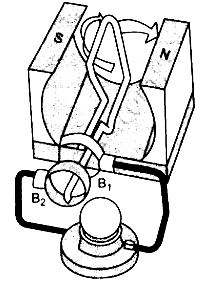
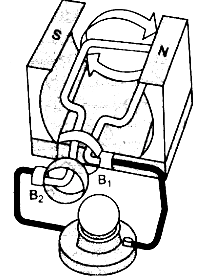
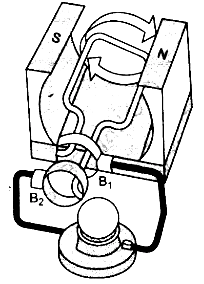
The given figures $1$ to $3$ show the working of a simple $A.C$. generator. Study the diagrams and answers of the following questions.


(i) State and explain the principle underlying the working of a simple generator.
(ii) Where is the loop of wire placed?
(iii) What happens when the loop is rotated?
(iv) Indicate the direction of the current flow through the wire for the first half of the turn (in first figure). Name and state the rule used in finding the direction of the current.
(v) Indicate the direction of the current for the case shown in second figure.
(vi) Indicate the direction of current in the outer circuit (i.e., electric bulb) in first and third figure.
(vii) What type of current is shown in the above diagrams? Explain.