Question
State Ohm’s law? How can it be verified experimentally? Does it hold good under all conditions? Comment.

Answer

According to Ohm's law the electric current flowing through a conductor is directly proportional to the potential difference applied across its ends provided the physical conditions such as temperature etc remains unchanged.

Let V be the potential difference applied across the ends of conductor through which current Iflows, then according to Ohm's law.

$\text{V}\propto\text{I}\Rightarrow\ \text{V}=\text{IR}$

Ohm’s law can be verified experimentally by the activity given below:
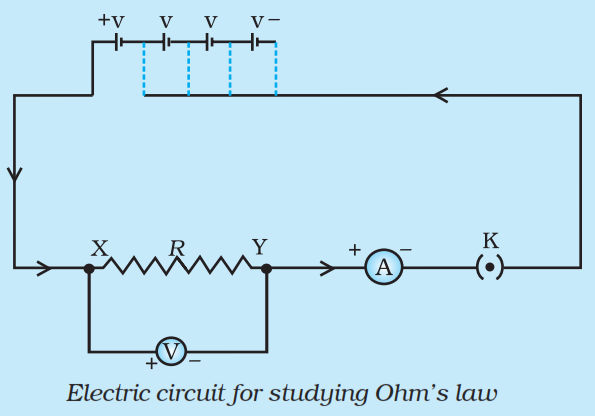
  1. Firstly, Set up a circuit as shown in figure given below, consisting of a nichrome wire XY of length, say 0.5m, an ammeter, a voltmeter and four cells of 1.5V each. (Nichrome is an alloy of nickel,chromium, manganese, and iron metals.)

  1. First use only one cell as the source in the circuit. Note the reading in the ammeter I, for the current and reading of the voltmeter V for the potential difference across the nichrome wire XY in the circuit. Tabulate them in the Table given.
  2. Next connect two cells in the circuit and note the respective readings of the ammeter and voltmeter for the values of current through the nichrome wire and potential difference across the nichrome wire.
  3. Repeat the above steps using three cells and then four cells in the circuit separately.
  4. Calculate the ratio of V to I for each pair of potential difference V and current I.
S.No. Number of cells used in the circuit Current through the nichrome wire, I (ampere) Potential difference across the nichrome wire, V (Volt) $\frac{\text{V}}{\text{I}}$ $\Big(\frac{\text{Volt}}{\text{Ampere}}\Big)$
1. 1      
2. 2      
3. 3      
4. 4      
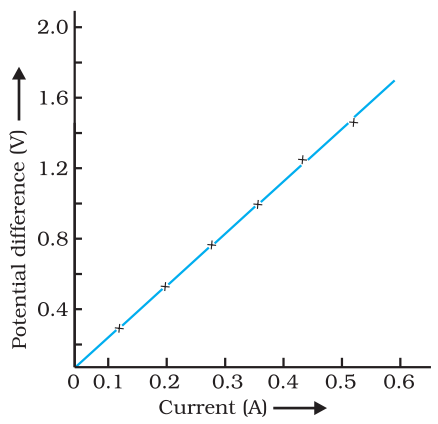
  1. Plot a graph between V and I. The graph will be a straight line as shown below.

  1. This verifies the Ohm’s law.

Ohm's does not hold under all conditions as it is basically not a fundamental law which means it has exceptions. Following are the conditions when Ohm’s law does not hold:

  • It is not obeyed when physical conditions of conductors like temperature keep on changing.
  • It is not obeyed by a lamp filament, junction diode, thermistor etc.
  • It is not obeyed in case of superconductors whose resistance is equal to zero.

Need a full question paper?

Generate a complete, print-ready paper with questions like this in minutes — across 16+ boards, with answer keys.
Start Generating Free

Similar questions

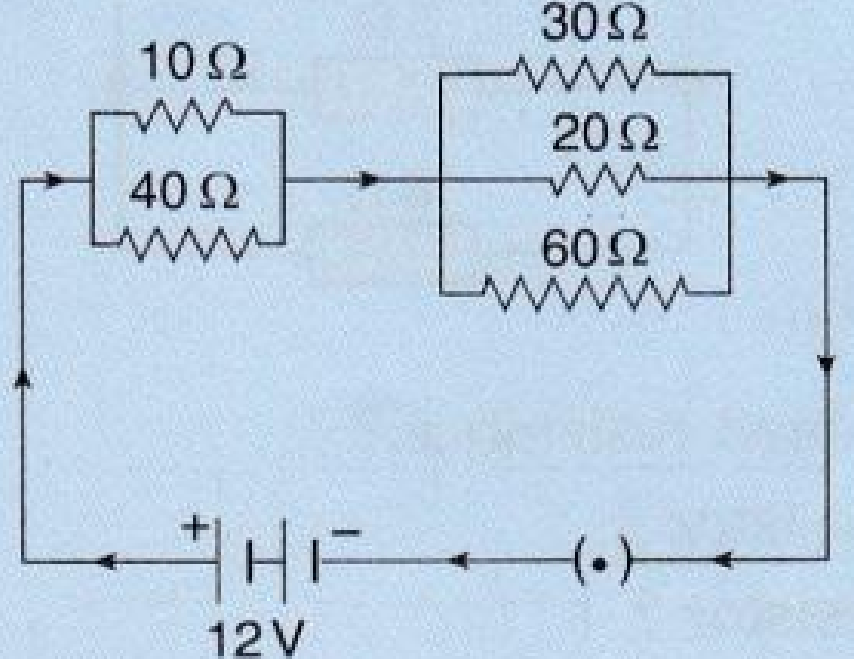
In the circuit diagram given below five resistances of $10 Ω, 40 Ω, 30 Ω, 20 Ω\ \text{and}\ 60 Ω$ are connected as shown to a 12V battery.

Calculate:
  1. Total resistance in the circuit.
  2. Total current flowing in the circuit.
i. State laws of reflection of light.
ii. An object of height 5.0 cm is placed at 15 cm in front of a concave mirror of focal length 10 cm . At what distance from the mirror should a screen be placed, so that a focussed image is obtained on it? Find the height of the image.
A student focussed the image of a candle flame on a white screen using a convex lens. He noted down the position of the candle screen and the lens as under,
Position of candle = 12.0cm
Position of convex lens = 50.0cm
Position of the screen = 88.0cm
  1. What is the focal length of the convex lens?
  2. Where will the image be formed if he shifts the candle towards the lens at a position of 31.0cm?
  3. What will be the nature of the image formed if he further shifts the candle towards the lens?
  4. Draw a ray diagram to show the formation of the image in case (iii) as said above.
In a house two 60W electric bulbs are lighted for 4 hours, and three 100W bulbs for 5 hours everyday. Calculate the electric energy consumed in 30 days.
The image of a candle flame placed at a distance of 30cm from a spherical lens is formed on a screen placed on the other side of the lens at a distance of 60cm from the optical centre of the lens. Identify the type of lens and calculate its focal length. If the height of the flame is 3cm, find the height of its image.
Draw the labelled diagram of an A.C. generator. With the help of this diagram, explain the construction and working of an A.C. generator.
How will you infer with the help of an experiment that the same current flows through every part of the circuit containing three resistances in series connected to a battery?
  1. What is scattering of light? Explain how the colour of the scattered light depends on the size of the scattering particles.
  2. Explain the reddish appearance of the Sun at sunrise or sunset. Why does it not appear red at noon?
  1. What is meant by dispersion of whlte light? Describe the formation of rainbow in the sky with the help of a diagram.
  2. What is hypermetropia? Draw ray diagrams to show the image formation of an object by:
  1. Hypermetropic eye.
  2. Correction made with a suitable lens for hypermetropic eye.
The speed of light in vacuum and in two different glasses is given in the table below:
Medium
Speed of light
Vacuum
Flint glass
Crown glass
3.00× 10⁸m/ s
1.86× 10⁸m/ s
1.97× 10⁸m/ s
  1. Calculate the absolute refractive indexes of flint glass and crown glass.
  2. Calculate the relative refractive index for light going from crown glass to flint glass.