Question
State Pythagoras theorem and its converse.

Answer

Pythagoras theorem: In a right angled triangle, the square of the hypotenuse is equal to the sum of the aquares of the other two sides.
Converse of Pythagoras theorem: In a triangle in the aquare of one side is equal to the sum of the squares of the other two sides, then the angle opposite to the side is a right angle.

Need a full question paper?

Generate a complete, print-ready paper with questions like this in minutes — across 16+ boards, with answer keys.
Start Generating Free

Similar questions

Show that the points A(-3, 2), B(-5, -5), C(2, -3) and D(4, 4) are the vertices of a rhombus. Find the area of this rhombus.
Hint: Area of a rhombus $=\frac{1}{2}\times(\text{product of its diagonals}).$
If $\alpha$ and $\beta$ are the zeroes of the quadratic polynomial $f(x) = x^2 - x - 4$, find the value of $\frac{1}{\alpha}+\frac{1}{\beta}-\alpha\beta$
Prove the following identities:
$\frac{1-\tan^2\theta}{\cot^2-1}=\tan^2\theta$
A sphere of maximum volume is cut-out from a solid hemisphere of radius r, what is the ratio of the volume of the hemisphere to that of the cut-out sphere?
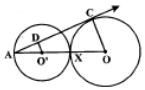
Equal circles with centres $O$ and $O\ '$ touch each other at $X. OO\ '$ produced to meet a circle with centre $O\ ', $ at $A. AC$ is a tangent to the circle whose centre is $O. O\ ' \ D$ is perpendicular to $AC$. Find the value of $\frac{ DO ^{\prime}}{ CO }$
Image
Find the roots of the following equations, if they exist, by applying the quadratic formula:
$2x^2 + x - 4 = 0$
The angle of elevation of a ladder leaning against a wall is 60° and the foot of the ladder is 9.5m away from the wall. Find the length of the ladder.
Two vertices of a triangle are $(1, 2), (3, 5)$ and its centroid is at the origin. Find the coordinates of the third vertex.
Prove the following trigonometric identities.
$\frac{1+\tan^2\theta}{1+\cot^2\theta}=\Big(\frac{1-\tan\theta}{1-\cot\theta}\Big)^2=\tan^2\theta$
Find the area of a sector of a circle with radius 6 cm, if the angle of the sector is $60^o.$