Question
State Raoult’s law for a solution containing volatile components. How does Raoult’s law become a special case of Henry’s law?

Answer

For a solution of volatile liquids, Raoult’s law states that the partial vapour pressure of each component of the solution is directly proportional to its mole fraction present in solution, i.e.,

$\text{P}_\text{A}\propto\text{x}_\text{A},\ \text{or }\text{P}_{\text{A}}=\text{P}_\text{A}^0\text{x}_\text{A}$

According to Henry’s law, the partial pressure of a gas in vapour phase (p) is directly proportional to mole fraction (x) of the gas in the solution.

p = KHx

On comparing it with Raoult’s law it can be seen that partial pressure of the volatile component or gas is directly proportional to its mole fraction in solution, only the proportionality constant KH differs from $\text{P}_\text{A}^0,$

$\text{p}_\text{A}\propto\text{x}$

Thus, it becomes a special case of Henry's law in which $\text{K}_\text{H}=\text{P}^0_\text{A}.$

Need a full question paper?

Generate a complete, print-ready paper with questions like this in minutes — across 16+ boards, with answer keys.
Start Generating Free

Similar questions

Consider the decomposition of hydrogen peroxide in alkaline medium which is catalysed by iodide ions.
$\text{2H}_2\text{O}_2\xrightarrow{\text{OH}^-}2\text{H}_2\text{O}+\text{O}_2$
This reaction takes place in two step as given below:
Step-I $\text{H}_2\text{O}_2+\text{I}^-\rightarrow\text{H}_2\text{O}_2+\text{IO}^-\text{ (slow)}$
Step-II $\text{H}_2\text{O}_2+\text{IO}^-\rightarrow\text{H}_2\text{O}_2+\text{I}+\text{O}_2\text{ (fast})$
  1. Write the rate law expression and determine the order of reaction w.r.t. H2O2.
  2. What is the molecularity of each individual step?
How many gram of Al metal will be obtained at the cathode by passing 0.1 Faraday electric current in $AlCl _3$ solution? (Atomic mass of Al $=27$ )
Differentiate between retention and inversion.
Write note on lead storage cell.
Discuss the classification of monohydric alcohols containing Csp3-OH bond.
Calculate the molarity of 250 mL solution made by dissolving 5 g NaOH in water.
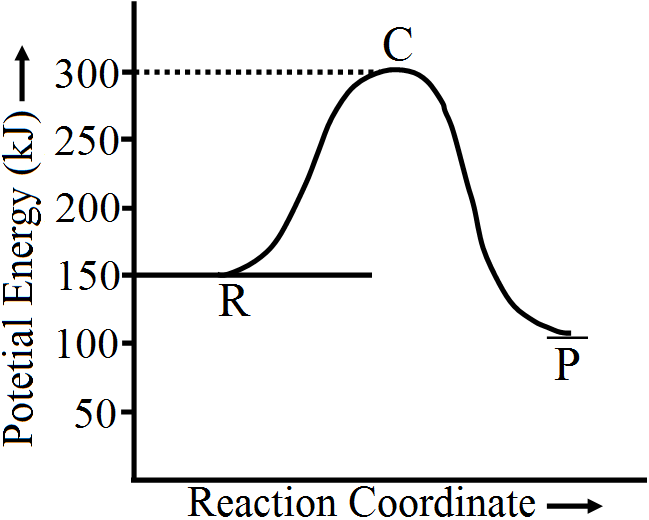
Answer the following questions on the basis of the given plot of potential energy vs reaction coordinate:

  1. What is the threshold energy for the reaction?
  2. What is the activation energy for forward reaction?
  3. What is the activation energy for backward reaction?
  4. What is enthalpy change for the forward reaction?

How would you account for the following:
  1. The transition elements have high enthalpies of atomisation.
  2. The transition metals and their compounds are found to be good catalysts in many processes.
What is Cross aldol condensation. Write structural formula and name of four possible aldol condensation products from Propanal and Ethanol.
In a reaction between A and B, the initial rate of reaction (r0) was measured for different initial concentrations of A and B as given below:
A/mol L-1 0.20 0.20 0.40
B/mol L-1 0.30 0.10 0.05
r0/mol L-1 s-1 5.07 × 10-5 5.07 × 10-5 1.43 × 10-4
What is the order of the reaction with respect to A and B?