Question
  1. State Raoult’s law for a solution containing volatile components.
How does Raoult’s law become a special case of Henry’s law?
  1. $1.00\ g$ of a non-electrolyte solute dissolved in $50\ g$ of benzene lowered the freezing point of benzene by $0.40\ K$. Find the molar mass of the solute. $(K_f$ for benzene$= 5.12\ kg\ mol^{-1})$.
Answer

  1. Partial vapour pressure of a liquid component is directly proportional to its mole fraction in its solution.
The partial pressure of the volatile component or gas is directly proportional to its mole fraction in solution. Only the proportionality constant $K_H$​​​​​​​ differs from $P^o_A​​​​​​​$​​​​​​​. Thus, Raoult’s law becomes a special case of Henry’s law in which $K_H$ becomes equal to $P^o_A$​​​​​​​.
  1. Given $W_B = 1∙00g$;
$W_A = 50g;$ $K_f = 5∙12K kg/ mol- 1;$ $\triangle T_f = 0∙40K$
$\Delta\text{T}_{f}=\text{K}_{f}\frac{\text{W}_{B}\times{1000}}{\text{M}_{B}\times\text{W}_{A}\text{(in grams)}}$
$\text{M}_{B}=\text{K}_{f}\frac{\text{W}_{B}\times{1000}}{\Delta\text{T}_{f}\times\text{W}_{A}}$
$\text{M}_{B}=\frac{\text{5.12}\times{1}\times{1000}}{\text{0.40}\times\text{50}}$
$= 256g mol^{-1}$​​​​​​​

Need a full question paper?

Generate a complete, print-ready paper with questions like this in minutes — across 16+ boards, with answer keys.

Start Generating Free

Similar questions

$[A], [B], [C], [D], [E], [F]$ and $[G]$ are amines each of which forms a hydrochloride containing $32.42\%$ chlorine. $[A], [B], [C]$ and $[D]$ evolve $N_2$ on reaction with $HNO_2,$ but $[E], [F], [G]$ and $[H]$ do not. Give structures of $[A]$ to $[H]$ with reasons.
Answer the following questions:
Is the variability in oxidation number of transition elements different from that of non–transition elements? Illustrate with examples.
Which of the following compounds would undergo aldol condensation, which the Cannizzaro reaction and which neither? Write the structures of the expected products of aldol condensation and Cannizzaro reaction.
  1. Methanal
  2. 2-Methylpentanal
  3. Benzaldehyde
  4. Benzophenone
  5. Cyclohexanone
  6. 1-Phenylpropanone
  7. Phenylacetaldehyde
  8. Butan-1-ol
  9. 2,2-Dimethylbutanal.
Answer the following question:Arrange the following in the order of property indicated against each set:
  1. $HF, HCl, HBr, HI$-increasing bond dissociation enthalpy.
  2. $H_2O, H_2S, H_2Se, H_2Te$-increasing acidic character
Rate constant for a first order reaction has been found to be $2.54 \times 10^{-3} \mathrm{~s}^{-1}$. Calculate its three-fourth life.
Give reasons for each of the following:
  1. $\text{SiF}_{6}^{2-}$ is known but $\text{SiCl}_{6}^{2-}$ is not known.
  2. Sulphur in vapour state exhibits paramagnetic behaviour.
  3. $PbO_2$ is a stronger oxidizing agent than $SnO_2$.
  4. $H_3PO_2$ acts as a monobasic acid.
  5. Bond dissociation energy of $F_2$​​​​​​​ is less than that of $Cl_2$.
  1. What happens when
  1. Chlorine gas is passed through a hot concentrated solution of $NaOH$?
  2. Sulphur dioxide gas is passed through an aqueous solution of a Fe (III) salt?
  1. Answer the following:
  1. What is the basicity of $H_3PO_3$ and why?
  2. Why does fluorine not play the role of a central atomin interhalogen compounds?
  3. Why do noble gases have very low boiling points?
Describe the differences in the properties of lanthanoids and actinoids.
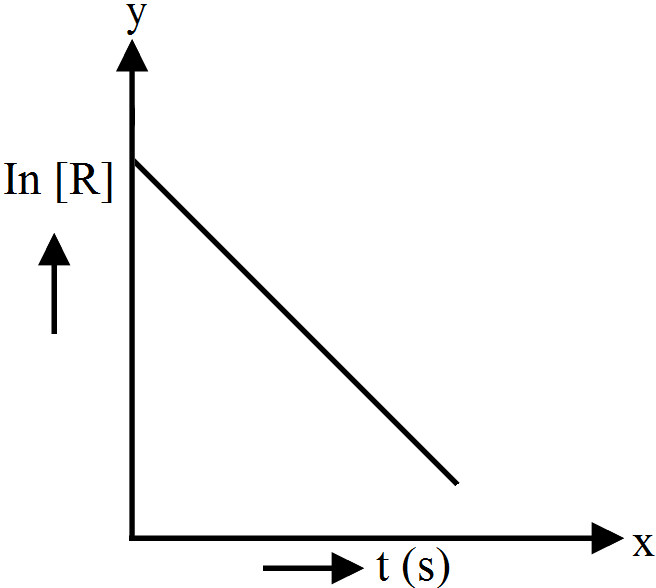
For a certain chemical reaction variation in the concentration ln $[R]$ vs. time plot is given alongside.For this reaction:
  1. What is the order of the reaction?
  2. What are the units of rate constant $k$?
  3. Give the relationship between $k$ and $t1/2$ (half-life period).
  4. What is the slope of the curve?
  5. Draw the plot log $[R]0 /[R]$ vs time $t(s)$.
Attempt any five of the following:
(a) Why are polysaccharides considered non-sugars?
(b) What is meant by invert sugars?
(c) Write the name of the component of starch which is water-soluble.
(d) Write the products obtained after hydrolysis of DNA.
(e) Name the deficiency disease resulting from lack of vitamin A and E in the diet.
(f) Which vitamin is linked with anti-sterility?
(g) a. What is the difference between a nucleoside and nucleotide?
     b. What products would be formed when a nucleotide from DNA containing thymine is hydrolysed?