Question
State Soddy $-$ Fajan’s displacement laws for radioactive transformations.

Answer

The atoms of radioactive element are unstable. When an atom of a radioactive element disintegrates, an entirely new element is formed.
This new element possesses entirely new chemical and radioactive properties.
The disintegrating element is called the parent element and the resulting product after disintegration is called the daughter element.
Soddy and Fajan studied the successive product elements of disintegration of radioactive elements and gave the following conclusions:
  1. Alpha $-$ Emission:
  2. $a -$ particle is nucleus of a helium atom having atomic number $2$ and atomic weight $4$. It is denoted by $_2He^4$.
  3. Therefore when an $\alpha-$ particle is emitted from a radioactive parent atom $(X),$ its atomic number is reduced by $2$ and atomic weight is reduced by $4$.
  4. Thus the daughter element has its place two groups lower in the periodic table.
  5. Thus the process of $a-$ emission may be expressed as:
$_\text{Z}\text{X}^\text{A}\ \rightarrow \ _{\text{z}-2}\text{Y}^{\text{A}-4}\ +\ _2\text{He}^4$
$\ \ \ \ \ \ \ \ \ \ \ \ \ \ \ \ \ \ \ \ \ \ \ \ \ \ \ \ \ \ \ \ \ \ \ \ \ (\alpha-\text{particle})$
Examples:
$\text{92U238 \ 90Th234 + _2He^4}$
$\text{80Ra226 \ 86Rn222 + _2He^4}$
  1. Beta $-$ Emission:
  2. $\beta-$ particle is an electron $(e)$ and is denoted by $_{-1}\beta^0.$ When a $\beta-$particle is emitted from a parent atom $(X),$ it atomic number increases by $1$. while atomic weight remains unchanged.
  3. As a result the doughter element $(Y)$ has a place one group higher in the periodic table. Thus the process of $\beta-$ emission may be expressed as:
$_\text{Z}\text{X}^\text{A}\rightarrow_{\text{Z}+1}\text{Y}^\text{A}+_{-1}\beta^0+\bar{\text{v}}$
where $\bar{\text{v}}$ is a fundamental particle called antineutrino which is massless and chargeless.
Example:
$_{90}\text{Th}^{228}\rightarrow_{89}\text{Ac}^{228}+_{-1}\text{b}^0+\bar{\text{v}}$
  1. Gamma $-$ Emission:
  2. The emission of $\lambda-$ray from a radioactive atom neither chages its atomic number nor its atomic weight.
  3. Therefore its place in periodic table remains undisplaced. In natural radioactivity $\lambda-$ radiation is accompanied with either $\alpha$ or $\beta-$ emission.

Need a full question paper?

Generate a complete, print-ready paper with questions like this in minutes — across 16+ boards, with answer keys.
Start Generating Free

Similar questions

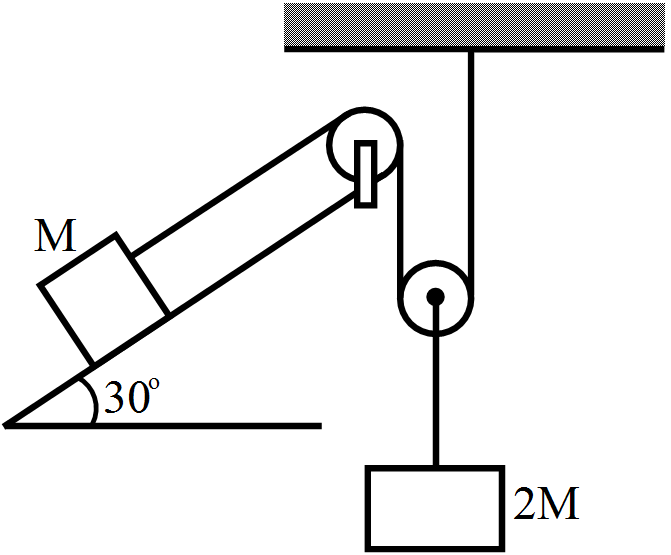
Find the acceleration of the block of mass M in the situation shown in figure. All the surfaces are frictionless and the pulleys and the string are light.
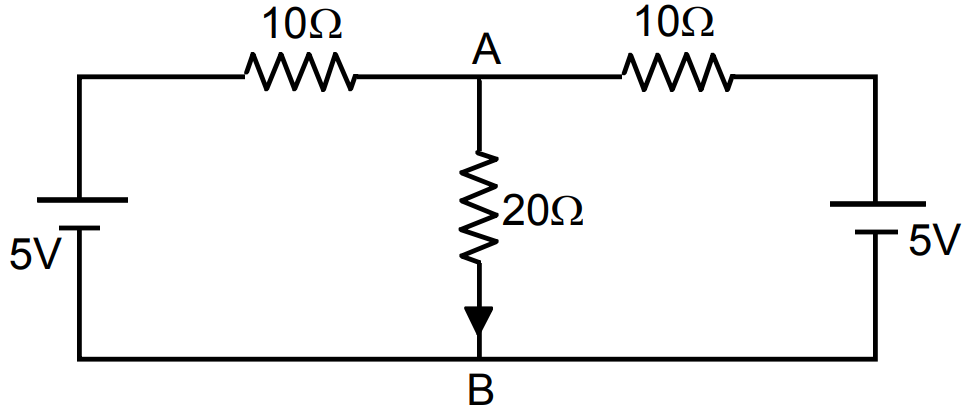
(a) Find the current in the $20\Omega$ resistor shown in the figure. (b) If a capacitor of capacitance $4\mu\text{F}$ is joined between the points A and B, what would be the electrostatic energy stored in it in steady state?
A tightly-wound solenoid of radius a and length l has n turns per unit length. It carries an electric current i. Consider a length dx of the solenoid at a distance x from one end. This contains n(dx) turns and may be approximated as a circular current in (dx).
  1. Write the magnetic field at the centre of the solenoid due to this circular current. Integrate this expression under proper limits to find the magnetic field at the centre of the solenoid.
  2. Verify that if a >> l, the field tends to $\text{B}=\frac{\mu_0\text{nil}}{2\text{a}}.$ Interpret these results.
A professor reads a greeting card received on his 50th birthday with +2.5D glasses keeping the card 25cm away. Ten years later, he reads his farewell letter with the same glasses but he has to keep the letter 50cm away. What power of lens should he now use?
A vessel of volume $V_0$ contains an ideal gas at pressure $P_0$ and temperature $T$ Gas is continuously pumped out of this vessel at a constant volume$-$ rate $dV\  I\  dt = r$ keeping the temperature constant. The pressure of the gas being taken out equals the pressure inside the vessel. Find, $(1)$ the pressure of the gas as a function of time. $(2)$ the time taken before half the original gas is pumped out.
The refractive index of a material $M_1$ changes by $0.014$ and that of another material $M_2$​​​​​​​ changes by $0.024$ as the colour of the light is changed from red to violet. Two thin prisms one made of $M_1(A = 5.3^\circ )$ and other made of $M_2(A = 3.7^\circ )$ are combined with their refracting angles oppositely directed.
  1. Find the angular dispersion produced by the combination.
  2. The prisms are now combined with their refracting angles similarly directed. Find the angular dispersion produced by the combination.
Consider a given sample of an ideal gas $\Big(\frac{\text{C}_\text{P}}{\text{C}_\text{V}}=\gamma\Big)$ having initial pressure $P_0$ and volume $V_0.$​​​​​​​
  1. The gas is isothermally taken to a pressure $\frac{\text{P}_0}{2}$ and from there, adiabatically to a pressure $\frac{\text{P}_0}{4}.$ Find the final volume.
  2. The gas is brought back to its initial state. It is adiabatically taken to a pressure $\frac{\text{P}_0}{2}$ and from there, isothermally to a pressure $\frac{\text{P}_0}{4}.$ Find the final volume.
Calculate the smallest wavelength of radiation that may be emitted by $(a)$ hydrogen$, (b) He^+$ and $(c) Li^{++}$​​​​​​​
Two circular coils of radii 5.0cm and 10cm carry equal currents of 21 A. The coils have 50 and 100 turns reepectively and are placed in such a way that their planes as well as the centres coincide. Find the magnitude of the magnetic field B at the common centre of the coils if the currents in the coils are (a) in the same sense (b) in the opposite sense.
The work function of a photoelectric material is 4.0eV.
  1. What is the threshold wavelength?
  2. Find the wavelength of light for which the stopping potential is 2.5V.