Question 15 Marks
A radioactive isotope has a half-life of T years. How long will it take the activity to reduce to
- 3.125%,
- 1% of its original value?
Answer
- After decay, the amount of the radioactive isotope = N
It is given that only 3.125°/o of No remains after decay. Hence, vee can wrtte:
$\frac{\text{N}}{\text{N}_0}=3.125\%=\frac{3.125}{100}=\frac{1}{32}$
But $\frac{\text{N}}{\text{N}_0}=\text{e}^{\lambda\text{r}}$
Where,
$\lambda$ = Decay constant
t = Time
$\therefore\ -\lambda\text{t}=\frac{1}{32}$
$-\lambda\text{t}=\text{In}1-\text{In}32$
$-\lambda\text{t}=0-3.4657$
$\text{t}=\frac{3.4657}{\lambda}$
Since $\lambda=\frac{0.693}{\text{T}}$
$\therefore\ \text{t}=\frac{3.466}{\frac{0.693}{\text{T}}}\approx5\text{T years}$
Hence, the isotope will take about ST years to reduce to 3.125% of its original value.
- After decay, the amount of the radioactive isotope = N
It is given that only 1% of N0 remains after decay. Hence, vve can write:
$\frac{\text{N}}{\text{N}_0}=1\%=\frac{1}{100}$
But $\frac{\text{N}}{\text{N}_0}=\text{e}^{-\lambda\text{t}}$
$\therefore\ \text{e}^{-\lambda\text{t}}=\frac{1}{100}$
$=\lambda\text{t}=\text{In }1-\text{In }100$
$-\lambda\text{t}=0-4.6052$
$\text{t}=\frac{4.6052}{\lambda}$
Since, $\lambda=0.693/\text{T}$
$\therefore\ \text{t}=\frac{4.6052}{\frac{0.693}{\text{T}}}=6.645\text{T years}$
Hence, the isotope will take about 6.645T years to reduce to 1% of its oriqlnal value. View full question & answer→Question 25 Marks
Obtain the amount of ${60}_{27}\text{Co}$ necessary to provide a radioactive source of $8.0\ \text{ mCi}$ strength. The half $-$ life of $^{60}_{27}\text{Co}$ is $5.3$ years.
AnswerThe strength of the radioactive source is given as:
$\frac{\text{dN}}{\text{dt}}=8.0\text{ mCi}$
$= 8 \times 10^{-3} \times 3.7 \times 10^{10}$
$= 29.6 \times 10^7 decay/ s$
where,
$N =$ Required number of atoms
Half $-$ life of $^{60}_{27}\text{Co },\ \text{T }_{1/2}=5.3$ Years
$= 5.3 \times 365 \times 24 \times 60 \times 60$
$= 1.67 \times 10^8 S$
For decay constant $\lambda,$ we have the rate of decay as:
$\frac{\text{dN}}{\text{dt}}=\lambda\text{N}$
$\frac{0.693}{\text{T}_{1/2}}=\frac{0.693}{1.67\times10^8}\text{ S}^{-1}$
Where, $\lambda$
$\therefore\ \text{N}=\frac{1}{\lambda}\frac{\text{dN}}{\text{dt}}$
$=\frac{29.6\times10^7}{\frac{0.6931.}{1.67\times10^8}}=7.133\times10^{16}\text{ atoms}$
$\text{For }_{27}\text{Co}^{60}:$
Mass of $6.023 \times 10^{23} ($Avogadro's number$)$ atoms $= 60g$
$\therefore$ Mass of $7.133\times10^{16}\text{ atoms }=\frac{60\times7.133\times10^{16}}{6.023\times10^{23}}$ $=7.106\times10^{-6}\text{g}$
Hence, the amount of $_{27}\text{Co}^{60}$ necessary for the purpose is $7.106 \times 10^{-6} g$.
View full question & answer→Question 35 Marks
Under certain circumstances, a nucleus can decay by emitting a particle more massive than an $\alpha$ particle. Consider the following decay processes:
$^{223}_{88}\text{Ra}\rightarrow^{209}_{82}\text{Pb}+^{14}_{6}\text{C}$
$^{223}_{88}\text{Ra}\rightarrow^{219}_{86}\text{Rn}+^{4}_{2}\text{He}$
Calculate the $Q-$ values for these decays and determine that both are energetically allowed.
AnswerTake a $^{14}_{6}\text{C}$ emission nuclear reaction:
$^{223}_{88}\text{Ra}\rightarrow^{209}_{82}\text{Pb}+^{14}_{6}\text{C}$
We know that:
Mass of $^{223}_{88}\text{Ra},\ \text{m}_1=223.01850\text{ u}$
Mass of $^{209}_{82}\text{Pb},\ \text{m}_2=208.98107\text{ u}$
Mass of $^{14}_{6}\text{C },\text{m}_3=14.00324\text{ u}$
Hence, the $Q-$ value of the reaction is given as:
$\text{Q}=(\text{m}_1-\text{m}_2-\text{m}_3)\text{c}^2$
$= (223.01850 - 208.98107 - 14.00324)c^2$
$= (0.03419 c^2) u$
But $1 u = 931.5 MeV/c^2$
$\therefore\ \text{Q}=0.03419\times931.5$
$= 31.848 MeV$
Hence, the $Q-$ value of the nuclear reaction is $31.848 MeV$.
Since the value is positive, the reaction is energetically allowed.
Now take a $^{4}_{2}\text{He}$ emission nuclear reaction:
$^{223}_{88}\text{Ra}\rightarrow^{219}_{86}\text{Rn}+^{4}_{2}\text{He}$
We know that:
Mass of $^{223}_{88}\text{Ra},\ \text{m}_1=223.01850$
Mass of $^{219}_{82}\text{Rn},\ \text{m}_2=219.00948$
Mass of $^{4}_{2}\text{He },\text{m}_3=4.00260$
$Q-$ value of this nuclear reaction is given as:
$\text{Q}=(\text{m}_1-\text{m}_2-\text{m}_3)\text{c}^2$
$= (223.01850 - 219.00948 - 4.00260)C^2$
$= (0.00642 c^2) u$
$= 0.00642 \times 931.5 = 5.98 MeV$
Hence, the $Q$ value of the second nuclear reaction is $5.98 MeV$.
Since the value is positive, the reaction is energetically allowed.
View full question & answer→Question 45 Marks
Consider the fission of $^{238}_{92}\text{U}$ by fast neutrons. In one fission event, no neutrons are emitted and the final end products, after the beta decay of the primary fragments, are $^{140}_{58}\text{Ce}$ and $^{99}_{44}\text{Ru}.$ Calculate $Q$ for this fission process.
The relevant atomic and particle masses are:
$\text{m}(^{238}_{92}\text{U})=238.05079\text{ u}$
$\text{m}(^{140}_{58}\text{Ce})=139.90543\text{ u}$
$\text{m}(^{99}_{44}\text{Ru})=98.90594\text{ u}$
AnswerIn the fission of $^{238}_{92}\text{U }, 10\beta^-$ particles decay from the parent nucleus.
The nuclear reaction can be written as:
$^{238}_{92}\text{U}+^1_0\text{n}\xrightarrow{\ \ \ \ \ \ \ }\ ^{140}_{58}\text{Ce }+^{99}_{44}\text{Ru }+10\ \ ^0_{-1}\text{e}$
It is given that:
Mass of a nucleus $^{238}_{92}\text{U},\ \text{m}_1=238.05079\text{ u}$
Mass of a nucleus $^{140}_{58}\text{Ce},\ \text{m}_2=139.90543\text{ u}$
Mass of a nucleus $^{99}_{44}\text{Ru },\text{m}_3=98.90594\text{ u}$
Mass of a neutron $^1_0\text{n },\text{m}_4=1.008665\text{ u}$
$Q-$ value of the above equation,
$\text{Q}=\Big[\text{m}'(^{238}_{92}\text{U})+\text{m}(^1_0\text{n})-\text{m}'(^{140}_{58}\text{Ce})-\text{m}'(^{99}_{44}\text{Ru})-10\text{m}_\text{e}\Big]\text{c}^2$
Where,
$m\ ' =$ Represents the corresponding atomic masses of the nuclei
$\text{m}'(^{238}_{92}\text{U})=\text{m}_1-92\text{m}_\text{e}$
$\text{m}'(^{140}_{58}\text{Ce})=\text{m}_2-58\text{m}_\text{e}$
$\text{m}'(^{99}_{44}\text{Ru})=\text{m}_3-44\text{m}_\text{e}$
$\text{m}(^1_0\text{n})=\text{m}_4$
$\text{Q}=\Big[\text{m}_1-92\text{m}_\text{e}+\text{m}_4-\text{m}_2+58\text{m}_\text{e}-\text{m}_3+44\text{m}_\text{e}-10\text{m}_\text{e}\Big]\text{c}^2$
$=\big[\text{m}_1+\text{m}_4-\text{m}_2-\text{m}_3\big]\text{c}^2$
$= [238.0507 + 1.008665 - 139.90543 - 98.90594]c^2$
$= [0.247995 c^2] u$
But $1 u = 931.5 MeV/c^2$
$\therefore\ \text{Q}=0247995\times931.5=231.007\text{ MeV}$
Hence, the $Q-$ value of the fission process is $231.007 MeV.$
View full question & answer→Question 55 Marks
A given coin has a mass of $3.0\ g$. Calculate the nuclear energy that would be required to separate all the neutrons and protons from each other. For simplicity assume that the coin is entirely made of $^{63}_{29}\text{Cu}$ atoms $($of mass $62.92960 u).$
AnswerMass of a copper coin $, m\ ' = 3g$
Atomic mass of $_{29}\text{Cu}^{63} \text{atom}, m = 62.92960 u$
The total number of $_{29}\text{Cu}^{63}$ atoms in the coin
$,\text{ N}=\frac{\text{N}_\text{A}\times\text{m}'}{\text{Mass number}}$
Where,
$N_A =$ Avogadro's number $= 6.023 \times 10^{23} \text{atoms /g}$
Mass number $= 63g$
$\therefore\ \text{N}=\frac{6.023\times10^{23}\times3}{63}=2.868\times10^{22}\text{ atoms}$
$_{29}\text{Cu}^{63}$ nucleus has $29$ protons and $(63 - 29) 34$ neutrons
$\therefore\ $Mass defect of this nucleus, $\Delta\text{m}'=29\times\text{m}_\text{H}+34\times\text{m}_\text{n}-\text{m}$
Where,
Mass of a proton $, m_H = 1.007825 u$
fvlass of a neutron $, m_n = 1.008665 u$
$\therefore\ \Delta' = 29 \times 1.007825 + 34 \times 1.008665 - 62.9296$
$= 0.591935 u$
Mass defect of all the atoms present in the coin, $\Delta\text{m}=0.591935\times2.868\times10^{22}$
$=1.69766958\times10^{22}\text{ u}$
But $1 u = 931.5 MeV/c^2$
$\therefore\ \Delta\text{m} = 1.69766958 \times 10^{22} \times 931.5 MeV/c^2$
Hence, the binding energy of the nuclei of the coin is given as:
$\text{E}_\text{b}=\Delta\text{mc}^2$
$=1.69766958\times10^{22}\times931.5\Big(\frac{\text{MeV}}{\text{c}^2}\Big)\times\text{c}^2$
$= 1.581 \times 10^{25} MeV$
But $1 MeV = 1.6 \times 10^{-13} J$
$E_b = 1.581 \times 10^{25} \times 1.6 \times 10^{-13}$
$= 2.5296 \times 10^{12} J$
This much energy is required to separate all the neutrons and protons from the given coin.
View full question & answer→Question 65 Marks
The neutron separation energy is defined as the energy required to remove a neutron from the nucleus. Obtain the neutron separation energies of the nuclei $^{41}_{20}\text{Ca }$ and ${27}_{13}\text{Al}$ from the following data:
$\text{m}(^{40}_{20}\text{Ca})=39.962591\text{ u}$
$\text{m}(^{41}_{20}\text{Ca})=40.962278\text{ u}$
$\text{m}(^{26}_{13}\text{Al})=25.986895\text{ u}$
$\text{m}(^{27}_{13}\text{Al})=26.981514\text{ u}$
AnswerFor $^{41}_{20}\text{Ca}:$ Separation energy $= 8.363007 MeV$
For $^{27}_{13}\text{Al}:$ Separation energy $= 13.059 MeV$
A neutron $(_0\text{n}^1)$ is removed from a $^{41}_{20}\text{Ca}$ nucleus.
The corresponding nuclear reaction can be written as:
$^{41}_{20}\text{Ca}\xrightarrow{\ \ \ \ \ \ \ }^{40}_{20}\text{Ca}+^1_0\text{n}$
It is given that:
Mass $\text{m}(^{40}_{20}\text{Ca})=39.962591\text{ u}$
Mass $\text{m}(^{41}_{20}\text{Ca})=40.962278\text{ u}$
Mass $\text{m}(_0\text{n}^1)=1.008665\text{ u}$
The mass defect of this reaction is given as:
$\Delta\text{m}=\text{m}(^{40}_{20}\text{Ca})+(^1_0\text{n})-\text{m}(^{41}_{20}\text{Ca})$
$= 39.962591 + 1.008665 - 40.962278 = 0.008978 u$
But $1 u = 931.5 MeV/c^2$
$\therefore\ \Delta\text{m}=0.008978\times931.5\text{ MeV/c}^2$
Hence, the energy required for neutron removal is calculated as:
$\text{E}=\Delta\text{mc}^2$
$= 0.008978 \times 931.5 = 8.363007 MeV$
For $^{27}_{13}\text{Al},$ the neutron removal reaction can be written as:
$^{27}_{13}\text{Al}\xrightarrow{\ \ \ \ \ \ \ }^{26}_{13}\text{Al}+^1_0\text{n}$
It Is given that:
Mass $\text{m}(^{27}_{13}\text{Al})=26.981541\text{ u}$
Mass $\text{m}(^{27}_{13}\text{Al})=25.986895\text{ u}$
The mass defect of this reaction is given as:
$\Delta\text {m}=\text{m}(^{26}_{13}\text{Al})+\text{m}(^1_0\text{n})-\text{m}(^{27}_{13}\text{Al})$
$= 25.986895 + 1.008665 - 26.981541$
$= 0.014019 u$
$= 0.014019 \times 391.5 MeV/c^2$
Hence, the energy required for neutron removal is calculated as:
$\text{E}=\Delta\text{mc}^2$
$= 0.014019 \times 931.5 = 13.059 MeV$
View full question & answer→Question 75 Marks
Suppose India had a target of producing by $2020 AD, 200,000 MW$ of electric power, ten percent of which was to be obtained from nuclear power plants. Suppose we are given that, on an average, the efficiency of utilization $($i.e. conversion to electric energy$)$ of thermal energy produced in a reactor was $25\%$. How much amount of fissionable uranium would our country need per year by $2020$ ? Take the heat energy per fission of $^{235}\text{U}$ to be about $200MeV$.
AnswerAmount of electric power to be generated $, P = 2 \times 10^5 MW$
$10\%$ of this amount has to be obtained from nuclear power plants.
$\therefore\ $Amount of nuclear power, $\text{p}_1=\frac{10}{100}\times2\times10^5$
$= 2 \times 10^4 MW$
$= 2 \times 10^4 \times 10^6 J/S$
$= 2 \times 10^{10} \times 60 \times 60 \times 24 \times 365 J/Y$
Heat energy released per fission of a $^{235}\text{U}$ nucleus $, E = 200 MeV$
Efficiency of a reactor $= 25\%$
Hence, the amount of energy converted into the electrical energy per fission is calculated as:
$\frac{25}{100}\times200=50\text{ MeV}$
$= 50 \times 1.6 \times 10^{-19} \times 10^6 = 8 \times 10^{-12} J$
Number of atoms required for fission per year:
$\frac{2\times10^{10}\times60\times60\times24\times365}{8\times10^{-12}}=78840\times10^{24}\text{ atoms}$
$1$ mole, i.e., $235 g$ of $\text{U}^{235}$ contains $6.023 \times 10^{23}$ atoms.
$\therefore$ Mass of $6.023 \times 10^{23}$ atoms of $\text{U}^{235} = 235 g = 235 \times 10^{-3} kg$
$\therefore $ Mass of $78840 \times 10^{24 }$ atoms of $\text{U}^{235}$
$=\frac{235\times10^{-3}}{6.023\times10^{23}}\times78840\times10^{24}$
$= 3.076 \times 10^4 \ kg$
Hence, the mass of uranium needed per year is $3.076 \times 10^4 kg.$
View full question & answer→Question 85 Marks
A source contains two phosphorous radio nuclides $^{32}_{15}\text{P }(\text{T}_{1/2}=14.3\text{d})$ and $^{33}_{15}\text{P }(\text{T}_{1/2}=25.3\text{d})$ Initially, 10% of the decays come from $^{33}_{15}\text{P}.$ How long one must wait until 90% do so?
AnswerHalf life of $^{32}_{15}\text{P },\text{T}_{1/2}=14.3\text{ days}$
Half life of $^{33}_{15}\text{P },\text{T}_{1/2}=25.3\text{ days}$
$^{33}_{15}\text{P}$ nucleus decay is 10% of the total amount of decay.
The source has initially 10% of $^{33}_{15}\text{P}$ nucleus and 90% of $^{32}_{15}\text{P}$ nucleus.
suppose after t days, the source has 10% of $^{32}_{15}\text{P}$ nucleus and 90% of $^{33}_{15}\text{P}$ nucleus.
Initially:
Number of $^{33}_{15}\text{P}$ nucleus = N
Number of $^{32}_{15}\text{P}$ nucleus = 9 N
Finally:
Number of $^{33}_{15}\text{P}$ nucleus = 9 N'
Number of $^{32}_{15}\text{P}$ nucIeus = N'
For $^{32}_{15}\text{P}$ nucleus, we can write the number ratio as:
$\frac{\text{N}'}{9\text{N}}=\Big(\frac{1}{2}\Big)^{\frac{\text{t}}{\text{T}_\text{v2}}}$
$\text{N}'=9\text{N}(2)^{\frac{-\text{t}}{14.3}}\ \dots(1)$
For $^{33}_{15}\text{P },$ we can write the number ratio as:
$\frac{9\text{N}'}{\text{N}}=\Big(\frac{1}{2}\Big)^{\frac{\text{t}}{\text{T}_\text{v2}}}$
$9\text{N}'=\text{N}(2)^{\frac{-\text{t}}{25.3}}\ \dots(2)$
On dividing equation (1) by equation (2), we get:
$\frac{1}{9}=9\times2\Big(\frac{\text{t}}{25.3}-\frac{\text{t}}{14.3}\Big)$
$\frac{1}{81}=2-\Big(\frac{11\text{t}}{25.3\times14.2}\Big)$
$\log1-\log81=\frac{-11\text{t}}{25.3\times14.3}\log2$
$\frac{-11\text{t}}{25.3\times14.3}=\frac{0-1.908}{0.301}$
$\text{t}=\frac{25.3\times14.3\times1.908}{11\times0.301}\approx208.5\text{ days}$
Hence, it will take about 208.5 days for 90% decay of $_{15}\text{P}^{33}.$
View full question & answer→Question 95 Marks
For the $\beta^{+} ($positron$)$ emission from a nucleus, there is another competing process known as electron capture $($electron from an inner orbit, say, the $K–$ shell, is captured by the nucleus and a neutrino is emitted$).$
$\text{e}^{+}+^{\text{A}}_{\text{Z}}\text{X}\rightarrow\ ^{\text{A}}_{\text{Z}-1}\text{Y}+\text{v}$
Show that if $\beta^{+}$ emission is energetically allowed, electron capture is necessarily allowed but not vice $–$ versa.
AnswerLet the amount of energy released during the electron capture process be $Q_1$. The nuclear reaction can be written as : $\text{e}^{+}+^{\text{A}}_{\text{Z}}\text{X}\rightarrow^{\text{A}}_{\text{Z}-1}\text{Y}+\text{v}+\text{Q}_1\ \dots(1)$
Let the amount of energy released during the positron capture process be $Q_2$. The nuclear reaction can be written as : $^{\text{A}}_{\text{Z}}\text{X}\rightarrow^{\text{A}}_{\text{Z}-1}\text{Y}+\text{e}^{+}+\text{v}+\text{Q}_2\ \dots(2)$
$\text{m}_\text{N}(^{\text{A}}_{\text{Z}}\text{X})$ = Nuclear mass of $^{\text{A}}_{\text{Z}}\text{X}$
$\text{m}_\text{N}(_{\text{Z}-1}^\text{A}\text{Y})$ = Nuclear mass of $_{\text{Z}-1}^{\text{A}}\text{Y}$
$\text{m}(^{\text{A}}_{\text{Z}}\text{X})$ = Atomic mass of $^\text{A}_\text{Z}\text{X}$
$\text{m}(^{\text{A}}_{\text{Z}-1}\text{Y}) =$ Atomic mass of $^{\text{A}}_{\text{Z}-1}\text{Y}$
$m_e =$ Mass of an electron
$c =$ Speed of light
$Q-$ value of the electron capture reaction is given as:
$\text{Q}_1=\Big[\text{m}_{\text{N}}(^{\text{A}}_{\text{Z}}\text{X})+\text{m}_{\text{e}}-\text{m}_{\text{N}}(^{\text{A}}_{\text{Z}-1}\text{Y})\Big]\text{c}^2$
$=\Big[\text{m}(^{\text{A}}_{\text{Z}}\text{X})-\text{Zm}_\text{e}+\text{m}_\text{e}-\text{m}(^{\text{A}}_{\text{Z}-1}\text{Y})+(\text{Z}-1)\text{m}_\text{e}\Big]\text{c}^2$
$=\Big[\text{m}(^{\text{A}}_{\text{Z}}\text{X})-\text{m}(^{\text{A}}_{\text{Z}-1}\text{Y})\Big]\text{c}^2$
$Q-$ value of the positron capture reaction is given as:
$\text{Q}_2=\Big[\text{m}_{\text{N}}(^{\text{A}}_{\text{Z}}\text{X})-\text{m}_{\text{N}}(^{\text{A}}_{\text{Z}-1}\text{Y})-\text{m}_\text{e}\Big]\text{c}^2$
$=\Big[\text{m}(^{\text{A}}_{\text{Z}}\text{X})-\text{Zm}_\text{e}-\text{m}(^{\text{A}}_{\text{Z}-1}\text{Y})+(\text{Z}-1)\text{m}_\text{e}-\text{m}_\text{e}\Big]\text{c}^2$
$=\Big[\text{m}(^{\text{A}}_{\text{Z}}\text{X})-\text{m}(^{\text{A}}_{\text{Z}-1}\text{Y})-2\text{m}_\text{e}\Big]\text{c}^2$
It can be inferred that if $Q_{2 }> 0,$ then $Q_1 > 0$; Also, if $Q_1 > 0,$ it does not necessarily mean that $Q_2 > 0.$
View full question & answer→Question 105 Marks
Obtain the binding energy of the nuclei $^{56}_{26}\text{Fe }$ and $\ ^{209}_{83}\text{Bi}$ in units of $\text{MeV}$ from the following data:
$\text{m}(^{56}_{26}\text{Fe})=55.934939\text{ u }$ $\text{ m}(^{209}_{83}\text{Bi})=208.980388\text{ u}$
AnswerAtomic mass of $^{56}_{26}\text{Fe },\ \text{m}_1=55.934939\text{ u}$
$^{56}_{26}\text{Fe }$ nucleus has $26$ protons and $(56 - 26) = 30$ neutrons
Hence, the mass defect of the nucleus, $\Delta\text{m}=26\times\text{m}_\text{H}+30\times\text{m}_\text{n}-\text{m}_1$
Where,
Mass of a proton $, m_H = 1.007825 u$
Mass of a neutron $, m_n = 1.008665 u$
$\therefore\ \Delta\text{m}\ '=26\times1.007825+30\times1.008665-55.934939$
$= 26.20345 + 30.256995 - 55.934939$
$= 0.528461 u$
But $1 u = 931.5 MeV/c^2$
$\therefore\ \Delta\text{m}\ '=0.528461\times931.5\text{ MeV/c}^2$
The binding energy of this nucleus is given as:
$\text{E}_{\text{b}1}=\Delta\text{mc}^2$
Where,
$c =$ Speed of light
$\therefore\ \text{E}_{\text{b}1}=0.528461\times931.5\Big(\frac{\text{MeV}}{\text{c}^2}\Big)\times\text{c}^2$
$= 492.26 MeV$
Average binding energy per nucleon $=\frac{492.26}{56}=8.79\text{ MeV}$
Atomic mass of $^{209}_{83}\text{Bi },\ \text{m}_2=208.980388\text{ u}$
$^{209}_{83}\text{Bi}$ nucleus has $83$ protons and $(209 - 83) 126$ neutrons.
Hence, the mass defect of this nucleus is given as:
$\Delta\text{m}'=83\times\text{m}_\text{H}+126\times\text{m}_\text{n}-\text{m}_2$
Where,
Mass of a proton $, m_H = 1.007825 u$
Mass of a neutron $, m_{n }= 1.008665 u$
$\therefore\ \Delta\text{m}\ ' = 83 \times 1.007825 + 126 \times 1.008665 - 208.980388
= 1.760877 u$
But $1 u = 931.5 MeV/c^2$
$\therefore\ \Delta\text{m}\ ' =1.760877\times931.5\text{ MeV/c}^2$
Hence, the binding energy of this nucleus is given as:
$\text{E}_{\text{b}2}=\Delta\text{m}\ ' \text{c}^2$
$=1.760877\times931.5\Big(\frac{\text{MeV}}{\text{c}^2}\Big)\times\text{c}^2$
$= 1640.26 \text{ Mev}$
Average bindingenergy per nucleon $=\frac{1640.26}{209}=7.848\text{ MeV}$
View full question & answer→Question 115 Marks
Obtain the maximum kinetic energy of $\beta-$ particles, and the radiation frequencies of $\gamma$ decays in the decay scheme shown in Fig. $13.6$. You are given that:
$\text{m}(^{198}\text{Au})=197.968233\text{ u}$
$\text{m}(^{198}\text{Hg})=197.9667602\text{ u}$
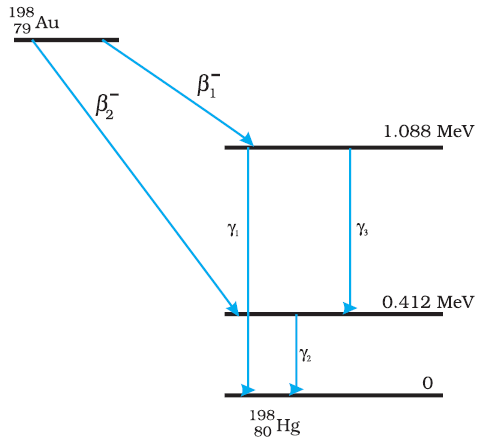
AnswerIt can be observed from the given $\gamma-$ decay diagram that $\gamma_1$ decays from the $1.088\ \text{MeV}$ energy level to the $\text{O MeV}$ energy level.
Hence, the energy corresponding to $\gamma_1-$ decay is given as:
$\text{E}_1=1.088-0=1.088 \text{ Mev}$
$\text{hv}_1=1.088\times1.6\times10^{-19}\times10^6\text{ J}$
Where,
$h =$ Planck's constant $= 6.6 x 10^{-34} Js$
$v_1 =$ Frequency of radiation radiated by $\gamma_1-$ decay
$\therefore\ \text{V}_1=\frac{\text{E}_1}{\text{h}}$
$=\frac{1.088\times1.6\times10^{-19}\times10^6}{6.6\times10^{-34}}=2.637\times10^{20}\text{ Hz}$
It can be observed from the given $\gamma$-decay diagram that $\gamma_2$ decays from the $0.412\ \text{MeV}$ energy level to the $0 \text{ MeV}$ energy level.
Hence, the energy corresponding to $\gamma_2-$ decay is given as:
$\text{E}_2=0.412-0=0.412\text{ MeV}$
$\text{hv}_2=0.412\times1.6\times10^{-19}\times10^6\text{ J}$
Where,
$v_2 =$ Frequency of radiation radiated by $\gamma_2$-decay
$\therefore\ \text{V}_2=\frac{\text{E}_2}{\text{h}}$
$=\frac{0.412\times1.6\times10^{-19}\times10^6}{6.6\times10^{-34}}=9.988\times10^{19}\text{ Hz}$
It can be observed from the given $\gamma-$ decay diagram that $\gamma_3$ decays from the $1.088 MeV$ energy level to the $0.412 \text{MeV}$ energy level.
Hence, the energy corresponding to $\gamma_3$ decay is given as:
$\text{E}_3=1.088-0.412=0.676\text{ MeV}$
$\text{hv}_3=0.676\times10^{-19}\times10^6\text{ J}$
Where,
$v_3 =$ Frequency of radiation radiated by $\gamma_3-$ decay
$\therefore\ \text{V}_3=\frac{\text{E}_3}{\text{h}}$
$=\frac{0.676\times1.6\times10^{-19}\times10^6}{6.6\times10^{-34}}=1.639\times10^{20}\text{ Hz}$
Mass of $\text{m}(^{198}_{78}\text{Au})=197.968233\text{ u}$
Mass of $\text{m}(^{198}_{80}\text{Hg})=197.966760\text{ u}$
$1 u = 931.5\ MeV/c^2$
Energy of the highest level is given as:
$\text{E}=\Big[\text{m}(^{198}_{78}\text{Au})-\text{m}(^{190}_{80}\text{Hg})\Big]$
$= 197.968233 - 197.966760 = 0.001473 u$
$= 0.001473 \times 931.5 = 1.3720995\ \text{MeV}$
$\beta_1$ decays from the $1.3720995\ \text{MeV}$ level to the $1.088\ \text{MeV}$ level
$\therefore\ $Maximum kinetic energy of the $\beta_1$ particle $= 1.3720995 - 1.088
= 0.2840995\ \text{MeV}$
$\beta_2$ decays from the $1.3720995\ \text{MeV}$ level to the $0.412\ \text{MeV}$ level
$\therefore\ $Maximum kinetic energy of the $\beta_2$ particle $= 1.3720995 - 0.412$
$= 0.9600995\ \text{MeV}$
View full question & answer→Question 125 Marks
Consider the $D–T$ reaction $($deuterium $–$ tritium fusion$)$ $^2_1\text{H}+^3_1\text{H}\rightarrow^4_2\text{He}+\text{n} $
- Calculate the energy released in $\text{MeV}$ in this reaction from the data:
$\text{m}(^2_1\text{H})=2.014102\text{ u}$
$\text{m}(^3_1\text{H})=3.016049\text{ u}$
- Consider the radius of both deuterium and tritium to be approximately $2.0 fm$. What is the kinetic energy needed to overcome the coulomb repulsion between the two nuclei? To what temperature must the gas be heated to initiate the reaction? $($Hint: Kinetic energy required for one fusion event $=$ average thermal kinetic energy available with the interacting particles $= 2(3kT/2); k =$ Boltzman’s constant $, T =$ absolute temperature.$)$
Answer
- Take the $D-T$ nuclear reaction: $^2_1\text{H}+^3_1\text{H}\rightarrow^4_2\text{He}+\text{n} $
It is given that:
Mass of $^2_1\text{H },\ \text{m}_1=2.014102\text{ u}$
Mass of $^3_1\text{H },\ \text{m}_2=3.016049\text{ u}$
Mass of $^4_2\text{He },\ \text{m}_3=4.002603\text{ u}$
Mass of $^1_0\text{n },\text{m}_4=1.008665\text{ u}$
$Q-$ value of the given $D-T$ reaction is:
$\text{Q}=\big[\text{m}_1+\text{m}_2-\text{m}_3-\text{m}_4\big]\text{c}^2$
$= [2.014102 + 3.016049 - 4.002603 - 1.008665]c^2$
$= [0.018883 c^2] u$
But $1 u = 931.5 MeV/c^2$
$\therefore\ =0.018883\times931.5=17.59 \text{ MeV}$
- Radius of deuterium and tritium, $\text{r}\approx2.0\text{ fm}=2\times10^{-15}\text{m}$
Distance between the two nuclei at the moment when they touch each other $, d = r + r = 4 \times 10^{-15} m$
Charge on the deuterium nucleus $= e$
Charge on the tritium nucleus $= e$
Hence, the repulsive potential energy between the two nuclei is given as:
$\text{V}=\frac{\text{e}^2}{4\pi\in_0(\text{d})}$
Where,
$\in_0 =$ Permittivity of free space
$\frac{1}{4\pi\in_0}=9\times10^9\text{N m}^2\text{c}^{-2}$
$\therefore\ \text{V}=\frac{9\times10^9\times(1.6\times10^{-19})^2}{4\times10^{-15}}=5.76\times10^{-14}\text{ J}$
$=\frac{5.76\times10^{-14}}{1.6\times10^{-19}}=3.6\times10^5\text{ eV}=360\text{ keV}$
Hence $, 5.76 \times 10^{-14} J or 360 \text{keV}$ of kinetic energy $(KE)$ is needed to overcome the Coulomb repulsion between the two nuclei.
However, it is given that:
$\text{KE}=2\times\frac{3}{2}\text{ kT}$
Where,
$k =$ Boltzmann constant $= 1.38 \times 10^{-23} m^2\ kg s^{-2} k^{-1}$
$T =$ Temperature required for triggering the reaction
$\therefore\ \text{T}=\frac{\text{KE}}{3\text{K}}$
$=\frac{5.76\times10^{-14}}{3\times1.38\times10^{-23}}=1.39\times^9\text{K}$
Hence, the gas must be heated to a temperature of $1.39 \times 10^9 K$ to initiate the reaction. View full question & answer→Question 135 Marks
Calculate and compare the energy released by $a ($ fusion of $1.0 \ kg$ of hydrogen deep within Sun and $b)$ the fission of $1.0 \ kg$ of $^{235}\text{U}$ in a fission reactor.
Answer
- Amount of hydrogen $, m = 1 \ kg = 1000 g$
1 mole, i.e., $1 g$ of hydrogen $(^1_1\text{H})$ contains $6.023 \times 10^{23}$ atoms.
$\therefore\ 1000 q$ of, $^1_1\text{H}$ contains $6.023 x 10^{23} \times 1000$ atoms.
Nithin the sun, four $^1_1\text{H}$ nuclei combine and form one $^4_2\text{He}$ nucleus. In this process $26 \text{ MeV}$ of energy is released.
Hence, the energy released from the fusion of $1 \ kg 1_1\text{H}$ is:
$\text{E}_1=\frac{6.023\times10^{23}\times26\times10^3}{4}$
$= 39.149 \times 1026\ \text{MeV}$
- Amount of $^{235}_{92}\text{U} = 1 \ kg 1000 g$
1 mole, i.e., $235 g$ of $^{235}_{92}\text{U}$ contains $6. 023 \times 10^{23}$ atoms.
$\therefore\ 1000\text{ g of }\ ^{235}_{92}\text{U}\ \text{contains}\frac{6.023\times10^{23}\times1000}{235}$ atoms
It is known that the amount of energy released in the fission of one atom of $^{235}_{92}\text{U}$ is $200\ \text{MeV}.$
Hence, energy released from the fission of $1 \ kg$ of $^{235}_{92}\text{U}$ is:
$\text{E}_2=\frac{6\times10^{23}\times1000\times200}{235}$
$= 5.106 \times 10^{26}\ \text{MeV}$
$\therefore\ \frac{\text{E}_1}{\text{E}_1}=\frac{39.1495\times10^{26}}{5.106\times10^{26}}=7.67\approx8$
Therefore, the enerqv released in the fusion of $1 \ kg$ of hydrogen is nearly $8$ times the energy released in the fission of $1 \ kg$ of uranium. View full question & answer→Question 145 Marks
Answer the following questions:
(a) Are the equations of nuclear reactions (such as those given in Section 13.7) 'balanced' in the sense a chemical equation (e.g., $2 H _2+ O _2 \rightarrow 2 H _2 O$ ) is? If not, in what sense are they balanced on both sides?
(b) If both the number of protons and the number of neutrons are conserved in each nuclear reaction, in what way is mass converted into energy (or vice-versa) in a nuclear reaction?
(c) A general impression exists that mass-energy interconversion takes place only in nuclear reaction and never in chemical reaction. This is strictly speaking, incorrect. Explain.
Answer(a) A chemical equation is balanced in the sense that the number of atoms of each element is the same on both sides of the equation. A chemical reaction merely alters the original combinations of atoms. In a nuclear reaction, elements may be transmuted. Thus, the number of atoms of each element is not necessarily conserved in a nuclear reaction. However, the number of protons and the number of neutrons are both separately conserved in a nuclear reaction. [Actually, even this is not strictly true in the realm of very high energies - what is strictly conserved is the total charge and total 'baryon number'. We need not pursue this matter here.] In nuclear reactions (e.g., Eq. 13.10), the number of protons and the number of neutrons are the same on the two sides of the equation.
(b) We know that the binding energy of a nucleus gives a negative contribution to the mass of the nucleus (mass defect). Now, since proton number and neutron number are conserved in a nuclear reaction, the total rest mass of neutrons and protons is the same on either side of a reaction. But the total binding energy of nuclei on the left side need not be the same as that on the right hand side. The difference in these binding energies appears as energy released or absorbed in a nuclear reaction. Since binding energy contributes to mass, we say that the difference in the total mass of nuclei on the two sides get converted into energy or vice-versa. It is in these sense that a nuclear reaction is an example of massenergy interconversion.
(c) From the point of view of mass-energy interconversion, a chemical reaction is similar to a nuclear reaction in principle. The energy released or absorbed in a chemical reaction can be traced to the difference in chemical (not nuclear) binding energies of atoms and molecules on the two sides of a reaction. Since, strictly speaking, chemical binding energy also gives a negative contribution (mass defect) to the total mass of an atom or molecule, we can equally well say that the difference in the total mass of atoms or molecules, on the two sides of the chemical reaction gets converted into energy or vice-versa. However, the mass defects involved in a chemical reaction are almost a million times smaller than those in a nuclear reaction. This is the reason for the general impression, (which is incorrect) that mass-energy interconversion does not take place in a chemical reaction.
View full question & answer→Question 155 Marks
Asha’s mother read an article in the newspaper about a disaster that took place at Chernobyl. She could not understand much from the article and asked a few questions from Asha regarding the article. Asha tried to answer her mother’s questions based on what she learnt in Class XII Physics.
- What was the installation at Chernobyl where the disaster took place? What, according to you, was the cause of this disaster?
- Explain the process of release of energy in the installation at Chernobyl.
- What, according to you, were the values displayed by Asha and her mother?
Answer
-
- Nuclear Power Plant: /‘Set-up’ for releasing Nuclear Energy/Energy Plant.
- Leakage in the cooling unit/Some defect in the set up.
- Nuclear Fission/Nuclear Energy Break up (/Fission) of Uranium nucleus into fragments.
- Asha: Helpful, Considerate, Keen to Learn, Modest.
Mother: Curious, Sensitive, Eager to Learn, Has no airs.
View full question & answer→Question 165 Marks
Calculate the Q-values of the following fusion reactions:
- $\text{ }^2_1\text{H}+\text{ }^2_1\text{H}\rightarrow\text{ }^3_1\text{H}+\text{ }^1_1\text{H}$
- $\text{ }^2_1\text{H}+\text{ }^2_1\text{H}\rightarrow\text{ }^3_2\text{H}+\text{n}$
- $\text{ }^2_1\text{H}+\text{ }^3_1\text{H}\rightarrow\text{ }^4_1\text{H}+\text{n}$
Atomic masses are
$\text{m}\big(\text{ }^2_1\text{H}\big)=2.014102\text{u}$
$\text{m}\big(\text{ }^3_1\text{H}\big)=3·016049\text{u}$
$\text{m}\big(\text{ }^3_2\text{H}\big)=3.016029\text{u}$
$\text{m}\big(\text{ }^4_2\text{He}\big)=4·002603\text{u}$ Answer
- $\text{ }^2_1\text{H}+\text{ }^2_1\text{H}\rightarrow\text{ }^3_1\text{H}+\text{ }^1_1\text{H}$
Q value $=2\text{M}\big(\text{ }^2_1\text{H}\big)=\big[\text{M}\big(\text{ }^3_1\text{H}\big)+\text{M}\big(\text{ }^{3}_1\text{H}\big)\big]$
$=[2\times2.014102-(3.016049 + 1.007825)]\text{u}$
$= 4.0275\text{Mev} = 4.05\text{Mev.}$
- $\text{ }^2_1\text{H}+\text{ }^2_1\text{H}\rightarrow\text{ }^3_2\text{H}+\text{n}$
Q value $=2\big[\text{M}\big(\text{ }^2_1\text{H}\big)-\text{M}\big(\text{ }^3_2\text{He}\big)+\text{M}_{\text{n}}\big]$
$=[2\times2.014102 -(3.016049 + 1.008665)]\text{u}$
$=3.26\text{Mev}= 3.25\text{Mev.}$
- $\text{ }^2_1\text{H}+\text{ }^3_1\text{H}\rightarrow\text{ }^4_1\text{H}+\text{n}$
Q value $=\big[\text{M}\big(\text{ }^2_1\text{H}\big)+\text{M}\big(\text{ }^3_1\text{He}\big)-\text{M}\big(\text{ }^4_2\text{He}\big)+\text{M}_{\text{n}}\big]$
$=(2.014102 + 3.016049)-(4.002603 + 1.008665)]\text{u}$
$=17.58\text{Mev} = 17.57\text{Mev.}$ View full question & answer→Question 175 Marks
A town has a population of $1$ million. The average electric power needed per person is $300W$. A reactor is to be designed to supply power to this town. The efficiency with which thermal power is converted into electric power is aimed at $25\%$.
- Assuming $200\ \text{MeV}$ to thermal energy to come from each fission event on an average, find the number of events that should take place every day.
- Assuming the fission to take place largely through ${235}U,$ at what rate will the amount of ${235}U$ decrease? Express your answer in $\ kg$ per day.
- Assuming that uranium enriched to $3\%$ in $^{235}U$ will be used, how much uranium is needed per month $(30$ days$)$?
Answer
- Energy radiated per fission $=2\times10^8\text{ev}$
Usable energy $=2\times10^8\times\frac{25}{100}=5\times10^7\text{ev}=5\times1.6\times10^{-12}$
Total energy needed $300\times10^8 =3\times10^8 \text{J/s}$
No. of fission per second $=\frac{3\times10^8}{5\times1.6\times10^{-12}}=0.375\times10^{20}$
No. of fission per day $=0.375\times10^{20}\times3600\times24 = 3.24\times10^{24}$ fissions
- From ‘a’ No. of atoms disintegrated per day $= 3.24 \times 10^{24}$
We have, $6.023 \times 10^{23}$ atoms for $235g$
for $3.24 \times 10^{24} \text{ atom}=\frac{235}{6.023\times10^{23}}\times3.24\times10^{24}\text{g}$
$=1264\text{g/day}=1.264\text{kg/day}$
- Total uranium needed per month $= 1.264 \times 30\ kg$
Let $x \ kg$ of uranium enriched to $3\%$ in $^{235}U$ be used.
$\Rightarrow\text{x}\times\frac{3}{100}=1.264\times30$
$\Rightarrow\text{x}=1264\text{kg}$ View full question & answer→Question 185 Marks
The count rate of nuclear radiation coming from a radiation coming from a radioactive sample containing $^{128}I$ varies with time as follows.
| Time $t($minute$)$ : |
$0$ |
$25$ |
$50$ |
$75$ |
$100$ |
| Ctount rate $R(10^9s^{-1})$ : |
$30$ |
$16$ |
$8.0$ |
$3.8$ |
$2.0$ |
- Plot In $\Big(\frac{\text{R}_0}{\text{R}}\Big)$ against $t$.
- From the slope of the best straight line through the points, find the decay constant $\lambda.$
- Calculate the half$-$life $\text{t}_{\frac{1}{2}}.$
Answer
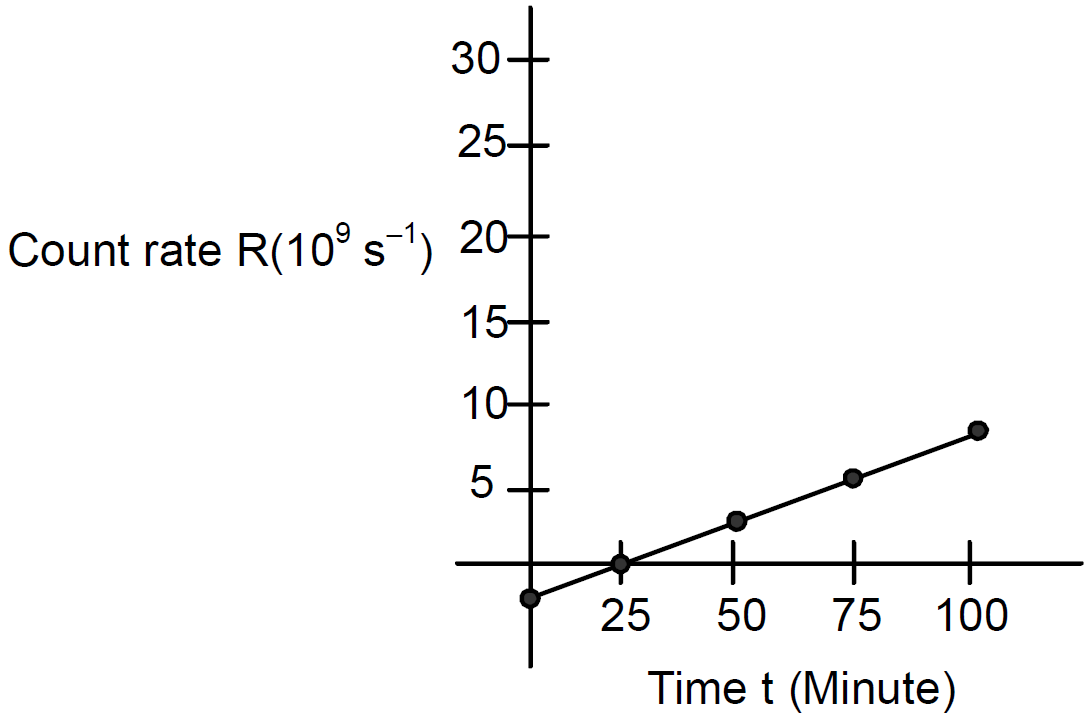
- Here we should take $R_0$ at time is $t_0 = 30 \times 10^9s^{-1}$
- $\text{ln}\Big(\frac{\text{R}_0}{\text{R}_1}\Big)=\text{ln}\Big(\frac{30\times10^9}{30\times10^9}\Big)=0$
- $\text{ln}\Big(\frac{\text{R}_0}{\text{R}_2}\Big)=\text{ln}\Big(\frac{30\times10^9}{16\times10^9}\Big)=0.63$
- $\text{ln}\Big(\frac{\text{R}_0}{\text{R}_3}\Big)=\text{ln}\Big(\frac{30\times10^9}{8\times10^9}\Big)=1.35$
- $\text{ln}\Big(\frac{\text{R}_0}{\text{R}_4}\Big)=\text{ln}\Big(\frac{30\times10^9}{3.8\times10^9}\Big)=2.06$
- $\text{ln}\Big(\frac{\text{R}_0}{\text{R}_5}\Big)=\text{ln}\Big(\frac{30\times10^9}{2\times10^9}\Big)=2.7$
- $\therefore$ The decay constant $\lambda=0.028\text{min}^{-1}$
- $\therefore$ The half life period $\text{t}_{\frac{1}{2}}$
$\text{t}_{\frac{1}{2}}=\frac{0.693}{\lambda}=\frac{0.693}{0.028}=25\text{min}.$ View full question & answer→Question 195 Marks
Potassium $-40$ can decay in three modes. It can decay by $\beta^-$ emission, $\beta^+$ emission of electron capture.
- Write the equations showing the end products.
- Find the $Q-$ values in each of the three cases. Atomic masses of $\text{ }^{40}_{18}\text{Ar},\text{ }^{40}_{19}\text{K}$ and $\text{40}_{20}\text{Ca}$ are $39.9624u \ \ 39.9640u$ and $39.9626u$ respectively.
Answer
- Decay of potassium $-40$ by $\beta^-$ emission is given by
$\text{ }_{19}\text{K}^{40}\rightarrow\text{ }_{20}\text{Ca}^{40}+\beta^-+\bar{\text{v}}$
Decay of potassium-40 by $\beta^+$ emission is given by
$\text{ }_{19}\text{K}^{40}\rightarrow\text{ }_{18}\text{Ar}^{40}+\beta^++\text{v}$
Decay of potassium-40 by electron capture is given by
$\text{ }_{19}\text{K}^{40}+\text{e}^-\rightarrow\text{ }_{18}\text{Ar}^{40}+\text{v}$
- $Q_{value}$ in the $\beta^-$ decay is given by
$Q_{value} = [m(_{19}K^{40}) - m(_{20}Ca^{40})]c^2$
$= [39.9640u - 39.9626u]c^2$
$= 0.0014 \times 931\ \text{MeV}$
$= 1.3034\ \text {MeV}$
$Q_{value}$ in the $\beta^+$ decay is given by
$Q_{value} = [m(_{19}K^{40}) - m(_{20}Ar^{40}) - 2m_e]c^2$
$= [39.9640u - 39.9624u - 0.0021944u]c^2$
$= (39.9640 - 39.9624)931\ \text{MeV} - 1022\ \text{keV}$
$= 1489.96keV - 1022\ \text{keV}$
$= 0.4679\ \text{MeV}$
$Q_{value}$ in the electron capture is given by
$Q_{value} = [m(_{19}K^{40}) - m(_{20}Ar^{40})]c^2$
$= (39.9640 - 39.9624)uc^2$
$= 1.4890 = 1.49\ \text{MeV}$ View full question & answer→Question 205 Marks
The activity R of an unknown radioactive nuclide is measured at hourly intervals. The results found are tabulated as follows:
| t(h) |
0 |
1 |
2 |
3 |
4 |
| R(MBq) |
100 |
35.36 |
12.51 |
4.42 |
1.56 |
- Plot the graph of R versus t and calculate half-life from the graph.
- Plot the graph of 0 ln $\Big(\frac{\text{R}}{\text{R}_0}\Big)$ versus t and obtain the value of half-life from the graph.
Answer
In the table given below, we have listed values of R(MBq) and in $\Big(\frac{\text{R}}{\text{R}_0}\Big)$.
| t(h) |
0 |
1 |
2 |
3 |
4 |
| R(MBq) |
100 |
35.36 |
12.51 |
4.42 |
1.56 |
| $\frac{\text{R}}{\text{R}_0}$ |
- |
-1.04 |
-2.08 |
-3.11 |
-4.16 |
- When we plot the graph of R versus t, we obtain an exponential curve as shown.
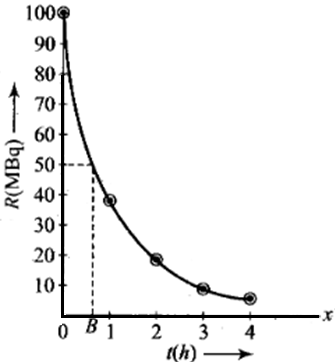
From the graph we can say that activity R reduces to 50% in t - OB ≈ 40 min
So, half-life $\text{t}_\frac{1}{2}\approx40\text{min}$.
- The adjecent figure shows the graph of in $\Big(\frac{\text{R}}{\text{R}_0}\Big)$ versus t.
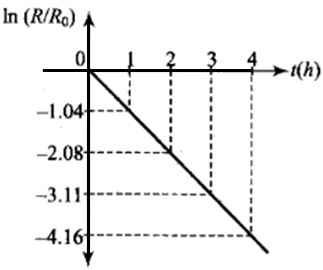
Slope of thid graph = $-\lambda$
From the graph,
$\lambda=-\Big(\frac{-4.16-3.11}{1}\Big)=1.05\text{h}^{-1}$
Hence half-life $\text{T}_\frac{1}{2}=\frac{0.693}{\lambda}=\frac{0.693}{1.05}=0.66\text{h}$
$=39.6\text{min}\approx40\text{min}$ View full question & answer→Question 215 Marks
Nuclei with magic no. of proton $Z = 2, 8, 20, 28, 50, 52$ and magic no. of neutrons $N = 2, 8, 20, 28, 50, 82$ and $126$ are found to be very stable.
- Verify this by calculating the proton separation energy $Sp$ for $^{120}Sn (Z = 50)$ and $^{121}Sb = (Z = 51)$. The proton separation energy for a nuclide is the minimum energy required to separate the least tightly bound proton from a nucleus of that nuclide. It is given by,
$\ce{Sp = (M_{Z-1' N} + M_H - M_{Z,N}) c^2}.$
Given $^{119}In = 118.9058u, ^{120}Sn = 119.902199u, ^{121}Sb = 120.903824u, ^1H = 1.0078252u.$
- What does the existance of magic number indicate
Answer
- The proton separation energy is given by
$\ce{S_{pSn} = (M_{119.70} + M_H - M_{120.70})C^2}$
$= (118.9058 + 1.0078252 - 119.902199)c^2$
$= 0.0114362c2$
Similarly $\ce{S_{pSp} = (M_{120.70} + M_H - M_{120.70})c^2}$
$= (118.9058 + 1.0078252 - 119.902199)c^2$
$= 0.0059912c^2$
Since $, S_{pSn} > S_{pSb},$ Sn sucleus is more stable than $Sb$ nucleus.
- The existence of magic numbers indicates that the shell structure of nucleus similar to the shell structure of an atom.
- This also explains the peaks in binding energy/nucleon curve.
Important point : "Magic Numbers" in Nuclear Structure Careful observation of the nuclear properties of elements, showed certain patterns that seemed to change abruptly at specific key elements.
Mayer noticed that magic numbers applied whether one counts the number of neutrons $(A)$. the atomic number $(Z),$ or the sum of the two, known as mass number $(A). I-$ xamples are,
Helium $Z = 2,$ Lead $Z = 82,$ Helium $A = 2,$ Oxygen $N = 8,$ Lead $A = 126,$ Neon $A = 20,$ Silicon $A = 28.$
Magic numbers in the nuclear structure have been coming up during all this time, but no plausible explanation for their existence has ever been given.
Interestingly, there are peaks and dips for binding energy, repeating every fourth nucleon.
This periodicity is one clear indication of a geometrical structure within the nucleus. In particular, those nuclei that can be thought of as containing an exact number of alpha particles $(2P + 2A),$ are more tightly bound than their neighbours.
This effect is more pronounced for the lightest nuclei, but is still perceptible up to $A – 28$.
For those nuclei with $ A > 20,$ the number of neutrons exceeds the number of protons, so some sort of distortion occurs wi thin the cluster.
It is found that nuclei with even numbers of protons and neutrons are more stable than those with odd numbers.
This comes from the fact that the physical structure must have an even number of vertices. A type of regular polyhedron would satisfy this condition, since no regular polyhedron exists with an odd number of vertices.
These specific "magic numbers" of neutrons or protons which seem to be particularly favoured in terms of nuclear stability are:
$2, 8. 20. 28, 50, 82, 126.$
Note that the structure must apply to both protons and neutrons individually, so that we can speak of "magic nuclei" where any one nucleon type, or their sum, is at a magic number.
The existence of these magic numbers suggests closed shell configurations, like the shells in atomic structure. They represent one line of reasoning which led to the development of a shell model of the nucleus.
Other forms $–$ of evidence suggesting shell structure include the following.
- Enhanced abundance of those elements for which $Z$ or $N$ is a magic number.
- The stable elements at the end of the naturally occurring radioactive series all have a “magic number” of neutrons or protons.
- The neutron absorption cross-sections for isotopes where $N =$ magic number are much lower than surrounding isotopes.
- The binding energy for the last neutron is a maximum for a magic neutron number and drops sharply for the next neutron added.
- Electric quadrupole moments are near zero for magic number nuclei.
- The excitation energy from the ground nuclear state to the first excited state is greater for closed shells.
Visualizing the densely packed nucleus in terms of orbits and shells seems much less plausible than the corresponding shell model for atomic electrons.
You can easily believe that an atomic electron can complete many orbits without running into anything, but you expect protons and neutrons in a nucleus to be in a continuous process of collision with each other.
But dense $-$ gas type models of nuclei with multiple collisions between particles didn’t fit the data, and remarkable patterns like the "magic numbers" in the stability of nuclei suggested the seemingly improbable shell structure. View full question & answer→Question 225 Marks
The half $-$ life of $^{199}Au$ is $2.7$ days.
- Find the activity of a sample containing $1.00\mu\text{g}$ of $^{198}Au.$
- What will be the activity after $7$ days? Take the atomic weight of ${198}Au$ to be $198g/mol$.
Answer
- $198$ grams of $Ag$ contains $\rightarrow N_0$ atoms.
- $1\mu\ \text{g}$ of $Ag$ contains $\rightarrow\frac{\text{N}_0}{198}\times1\mu\text{g}=\frac{6\times10^{23}\times1\times10^{-6}}{198}$ atoms
Activity $=\lambda\text{N}=\frac{0.963}{\text{t}_{\frac{1}{2}}}\times\text{N}=\frac{0.693\times6\times10^{17}}{198\times2.7}\ \text{disintegrations/day}.$
$=\frac{0.693\times6\times10^{17}}{198\times2.7\times3600\times24}\ \text{disintegration}/\sec$
$=\frac{0.693\times6\times10^{17}}{198\times2.7\times36\times24\times3.7\times10^{10}}$ curie $= 0.244$ Curie.
- $\text{A}=\frac{\text{A}_0}{2\text{t}_{\frac{1}{2}}}=\frac{0.244}{2\times\frac{7}{2.7}}=0.0405=0.040$ Curie.
View full question & answer→Question 235 Marks
Natural water contains a small amount of tritium $\big(\text{ }^3_1\text{H}\big).$ This isotope beta-decays with a half $-$ life of $12.5$ years. A mountaineer while climbing towards a difficult peak finds debris of some earlier unsuccessful attempt. Among other things he finds a sealed bottled of whisky. On returning, he analyses the whisky and finds that it contains only $1.5$ per cent of the $\text{}^3_1\text{H}$ radioactivity as compared to a recently purchased bottle marked $'8$ years old'. Estimate the time of that unsuccessful attempt.
AnswerThe activity when the bottle was manufactured $= A_0$
Activity after $8$ years $=\text{A}_0\text{e}^{\frac{-0.693}{12.5}}\times8$
Let the time of the mountaineering $= t$ years from the present
$\text{A = A}_0\text{e}^{\frac{-0.693}{12.5}\times\text{t}}; A =$ Activity of the bottle found on the mountain.
$A = ($Activity of the bottle manufactured $8$ years before$) \times 1.5\%$
$\Rightarrow\text{A}_0\text{e}^{\frac{-0.693}{12.5}}=\text{A}_0\text{e}^{\frac{-0.693}{12.5}\times8}\times0.015$
$\Rightarrow\frac{-0.693}{12.5}\text{t}=\frac{-0.693\times8}{12.5}+\text{In}[0.015]$
$\Rightarrow0.05544\text{t = 0.44352 + 4.1997}$
$\Rightarrow\text{t}=83.75\text{ years}.$
View full question & answer→Question 245 Marks
$\text{ }^{212}_{33}\text{Bi}$ can disintegrate either by emitting an $\alpha-$ particle of by emitting a $\beta^-$ particle.
- Write the two equations showing the products of the decays.
- The probabilities of disintegration $\alpha$ and $\beta -$ decays are in the ratio $\frac{7}{13}.$ The overall half $-$ life of $^{212}Bi$ is one hour. If $1g$ of pure $^{212}Bi$ is taken at $12.00$ noon, what will be the composition of this sample at $1P.m$. the same day?
Answer$\text{ }^{212}_{83}\text{Bi}\rightarrow\text{ }^{208}_{81}\text{Ti}+\text{ }^{4}_2\text{He}(\alpha)$
$\text{ }^{212}_{83}\text{Bi}\rightarrow\text{ }^{212}_{84}\text{Bi}\rightarrow\text{ }^{212}_{84}\text{P}_0+\text{e}^-$
$\text{t}_{\frac{1}{2}}=1\text{h}.$ Time elapsed $= 1$ hour
at $t = 0 Bi^{212}$ Present $= 1g$
$\therefore$ at $t = 1 Bi^{212}$ Present $= 0.5g$
Probability $\alpha-$ decay and $\beta-$ decay are in ratio $\frac{7}{13}.$
$\therefore Tl$ remained $= 0.175g$
$\therefore P_0$ remained $= 0.325g$
View full question & answer→Question 255 Marks
The half $-$ life of ${40}K$ is $1.30 \times 10^9y$. A sample of $1.00g$ of pure $\text{KCI}$ gives $160\ \text{counts/ s}$. Calculate the relative abundance of ${40}K ($fraction of ${40}K$ present$)$ in natural potassium.
AnswerGiven: Half life period $\text{t}_{\frac{1}{2}}=1.30\times10^9\text{year}$
$\text{A}=160\text{ count/s}=1.30\times10^9\times365\times86400$
$\therefore\text{A}=\lambda\text{N}$
$\Rightarrow160=\frac{0.693}{\text{t}_{\frac{1}{2}}}\text{N}$
$\Rightarrow\text{N}=\frac{160\times1.30\times365\times86400\times10^9}{0.693}=9.5\times10^{18}$
$\therefore6.023\times10^{23}$ No. of present in $40$ grams.
$6.023\times10^{23}=40\text{g}$
$\Rightarrow1=\frac{40}{6.023\times10^{23}}$
$\therefore9.5\times10^{18}$ present in $=\frac{40\times9.5\times10^{18}}{6.023\times10^{23}}=6.309\times10^{-4}=0.00063$
$\therefore$ The relative abundance at $40k$ in natural potassium $=(2 \times 0.00063 \times 100)\%=0.12\%$
View full question & answer→Question 265 Marks
In beta decay, an electron (or a positron) is emitted by a nucleus. Does the remaining atom get oppositely charged?
AnswerIn beta decay, a neutron from the nucleus is converted to a proton releasing an electron and an antineutrino or a proton is converted to a neutron releasing a positron and a neutrino.
$\beta^-\text{decay:}\text{ n}\rightarrow\text{p + e + }\vec{\text{v}}$
$\beta^+\text{decay:}\text{ p}\rightarrow\text{n + e}^+ + \text{v}$
Since the number of valence electrons present in the parent atom do not change, the remaining atom does not get oppositely charged. Instead, due to a change in the atomic number, there's a formation of a new element.
View full question & answer→Question 275 Marks
A neutron star has a density equal to that of the nuclear matter. Assuming the star to be spherical, find the radius of a neutron star whose mass is $4.0 \times 10^{30}kg ($twice the mass of the sun$).$
Answer$\text{f}=\frac{\text{M}}{\text{v}}\Rightarrow\text{V}=\frac{\text{M}}{\text{f}}=\frac{4\times10^{30}}{2.4\times10^{17}}$
$=\frac{1}{0.6}\times10^{13}=\frac{1}{6}\times10^{14}$
$\text{V}=\frac{4}{3}\pi\text{R}^3.$
$\Rightarrow\frac{1}{6}\times10^{14}=\frac{4}{3}\pi\times\text{R}^3$
$\Rightarrow\text{R}^3=\frac{1}{6}\times\frac{3}{4}\times\frac{1}{\pi}\times10^{14}$
$\Rightarrow\text{R}^3=\frac{1}{8}\times\frac{100}{\pi}\times10^{12}$
$\therefore\text{R}=\frac{1}2{}\times10^4\times3.17=1.585\times10^4\text{m}=15\text{km}.$
View full question & answer→Question 285 Marks
What is the difference between cathode rays and beta rays? When the two are travelling in space, can you make out which is the cathode ray and which is the beta ray?
AnswerCathode rays consist of electrons that are accelerated using electrodes. They do not carry high energy and do not harm human body. On the other hand, beta rays consist of highly energetic electrons that can even penetrate and damage human cells. Beta rays are produced by the decay of radioactive nuclei. If the two are travelling in space, they can be distinguished by the phenomenon named production of Bremsstrahlung radiation, which is produced by the deceleration of a high energy particle when deflected by another charged particle, leading to the emission of blue light. Only beta rays are capable of producing it.
View full question & answer→Question 295 Marks
In an agricultural experiment, a solution containing 1 mole of a radioactive material $\Big(\text{t}_{\frac{1}{2}}=14.3\text{ days}\Big)$ was injected into the roots of a plant. The plant was allowed 70 hours to settle down and then activity was measured in its fruit. If the activity measured was $1\mu\text{Ci},$ what per cent of activity is transmitted from the root to the fruit in steady state?
Answer$\text{n}=1\text{ mole}=6\times10^{23}\text{ atoms},\text{ t}_{\frac{1}{2}}=14.3\text{ days}$
$\text{t}=70\text{ hours},\frac{\text{dN}}{\text{dt}}$ in root after time $\text{t}=\lambda\text{N}$
$\text{N = No e}^{-\lambda\text{t}}=6\times10^{23}\times\text{e}^{\frac{-0.693\times70}{14.3\times24}}$
$=6\times10^{23}\times0.868=5.209\times10^{23}$
$5.209\times10^{23}\times\frac{-0.693}{14.3\times24}=\frac{0.0105\times10^{23}}{3600}\text{dis/hour.}$
Fraction of activity transmitted $=\Big(\frac{1\mu\text{ci}}{2.9\times10^{17}}\Big)\times100\%$
$\Rightarrow\Big(\frac{1\times3.7\times10^8}{2.9\times10^{11}}\times100\Big)\%=1.275\times10^{-11}\%$
View full question & answer→Question 305 Marks
If the nucleons of a nucleus are separated from each other, the total mass is increased. Where does this mass come from?
AnswerWhen the nucleons of a nucleus are separated, a certain amount of energy is to be given to the nucleus, which is known as the binding energy.
Binding energy = [(Number of nucleons) × (Mass of a nucleon) - (Mass of the nucleus)]
When the nucleons of a nucleus are separated, the increase in the total mass comes from the binding energy, which is given to the nucleus to break-off its constituent nucleons as energy is related to mass by the relation given below.
$\text{E}=\Delta\text{mc}^2$
View full question & answer→Question 315 Marks
Compare and contrast the nature of $\alpha-, \beta-$ and $\gamma-$radiations.
AnswerComparison of Properties of $\alpha-, \beta-$ and $\gamma-$rays.
|
S. No.
|
Property
|
$\alpha-$particle
|
$\beta-$particle
|
$\gamma-$rays
|
| $1.$ |
Nature
|
Nucleus of Helium
|
Very fast-moving electron $(e^-)$
|
Electromagnetic wave of wavelength
|
| $2.$ |
Charge
|
$+2e$
|
$-e$
|
No charge
|
| $3.$ |
Rest mass
|
$6.6 \times 10^{-27}kg$
|
$9.1 \times 10^{-31}kg$ |
Zero
|
| $4.$ |
Velocity
|
$1.4 \times 10^7m/ s to2.2 \times 10^7m/ s$ |
$0.3c$ to $0.98c$ |
$c = 3 \times 10^8m/ s$ |
| $5.$ |
Ionising Power
|
high, $100$ times that of $\beta-$particle
|
$100$ times more than $\gamma-$rays
|
Very small
|
| $6.$ |
Penetrating Power
|
very small
|
High, $100$ times more than $\alpha-$particles
|
Very high, $100$ times more than $\beta-$particles
|
View full question & answer→Question 325 Marks
Which one of the following cannot emit radiation and why? Excited nucleus, excited electron.
AnswerKey concept: The energy of internal motion of a nucleus is quantized. A typical nucleus has a set of allowed energy levels, including a ground state (state of lowest energy) and several excited states. Because of the great strength of nuclear interactions, excitation energies of nuclei are typically of the order of the order of 1MeV, compared with a few eV for atomic energy levels. In ordinary physical and chemical transformations the nucleus always remains in its ground state. When a nucleus is placed in an excited state, either by bombardment with high-energy particles or by a radioactive transformation, it can decay to the ground state by emission of one or more photons called gamma rays or gamma-ray photons, with typical energies of 10keV to 5MeV. This proceks is called gamma (γ) decay.
Excited electron cannot emit radiation because energy of electronic energy levels is in the range of eV and not MeV ( mega electron volt), y-radiations have energy of the order of MeV.
View full question & answer→Question 335 Marks
A vessel of volume $125\ cm^3$ contains tritium $\big(\text{ }^3\text{H,t}_{\frac{1}{2}}=12.3\text{y}\big)$ at $500\ \text{kPa}$ and $300K$. Calculate the activity of the gas.
Answer$\text{V}=125\text{ cm}^3=0.125\text{L, P}=500\ \text{kPa}=5\text{ atm}.$
$\text{T}=300\text{K},\text{t}_{\frac{1}{2}}=12.3\text{ years}$
$=3.82\times10^8\sec$.
Activity $=\lambda\times\text{N}$
$\text{N = n}\times6.023\times10^{23}=\frac{5\times0.125}{8.2\times10^{-2}\times3\times10^2}$
$\times6.023\times10^{23}=1.5\times10^{22}\text{ atoms}.$
$\lambda=\frac{0.693}{3.82\times10^8}=0.1814\times10^{-8}=1.81\times10^{-9}\text{s}^{-1}$
Activit y $=\lambda\text{N}=1.81\times10^{-9}\times1.5\times10^{22}=2.7\times10^3 \text{disintegration/sec}$
$=\frac{2.7\times10^{13}}{3.7\times10^{10}}\text{Ci}=729\text{Ci}$
View full question & answer→Question 345 Marks
If neutrons exert only attractive force, why don't we have a nucleus containing neutrons alone?
AnswerNuclear forces are short range strong attractive forces that act between two proton-proton, neutron-proton and neutron-neutron pairs. Two protons have strong nuclear forces between them and also exert electrostatic repulsion on each other. However, electrostatic forces are long ranged and have very less effect as compared to the strong nuclear forces.
So, in a nucleus (that is very small in dimension), there's no such significance of repulsive force as compared to the strong attractive nuclear force. On the other hand, an atom contains electrons revolving around its nucleus. These electrons are kept in their orbit by the strong electrostatic force that is exerted on them by the protons present inside the nucleus. Hence, a nucleus contains protons as well as neutrons.
View full question & answer→Question 355 Marks
The deuteron is bound by nuclear forces just as H-atom is made up of p and e bound by electrostatic forces. If we consider the force between neutron and proton in deuteron as given in the form of a Coulomb potential but with an effective charge e':
$\text{F}=\frac{1}{4\pi\epsilon_0}\frac{\text{e}'^2}{\text{r}}$
estimate the value of (e’/e) given that the binding energy of a deuteron is 2.2MeV.
AnswerThe Binding energy in H-atom $\text{E}=\frac{\text{me}^4}{\pi\epsilon_0^2\text{h}^2}=13.6\text{eV}\ .....(1)$
If proton and neutron hed charge e, each and were governed by the same electrostatic force, then in the above equation we would need to replace electronic mass m by the reduced mass m, of proton-neutron and the electronic charge e by e'.
$\text{m}'=\frac{\text{M}}{2}=\frac{1836\text{m}}{2}=918\text{m}$
Binding energy $=\frac{918\text{m}(\text{e}')}{8\epsilon_0^2\text{h}^2}=2.2\text{MeV}\ .....(2)$
Dividing equations .....(2) by .....(1), we get
$918\Big(\frac{\text{e}'}{\text{e}}\Big)^4=\frac{2.2\text{MeV}}{13.6\text{eV}}=\frac{2.2\times10^{6}}{13.6}$
$\Rightarrow\ \Big(\frac{\text{e}'}{\text{e}}\Big)^4=\frac{2.2\text{MeV}}{13.6\times918}=176.21$
$\Rightarrow\ \frac{\text{e}'}{\text{e}}=(176.21)^\frac{1}{4}=3.64$
View full question & answer→Question 365 Marks
A compound microscope consists of an objective lens of focal length $2.0 \ cm$ and an eyepiece of focal length $6.25 \ cm$ separated by a distance of $15 \ cm$. How far from the objective should an object be placed in order to obtain the final image at
(a) the least distance of distinct vision $(25 \ cm),$ and
(b) at infinity? What is the magnifying power of the microscope in each case?
AnswerFocal length of the objective lens $, f_1 = 2.0 \ cm$ Focal length of the eyepiece $, f_2 = 6.25 \ cm$ Distance between the objective lens and the eyepiece $, d = 15 \ cm$
- Least distance of distinct vision $, d\ ' = 25 \ cm$
$\therefore$ Image distance for the eyepiece $, v_2 = -25 \ cm$
Object distance for the eyepiece $= u_2$
According to the lens formula, we have the relation:
$\frac{1}{\text{v}_2}-\frac{1}{\text{u}_2}=\frac{1}{\text{f}_2}$
$\frac{1}{\text{u}_2}=\frac{1}{\text{v}_2}-\frac{1}{\text{f}_2}$
$=\frac{1}{-25}-\frac{1}{6.25}=\frac{-1-4}{25}=\frac{-5}{25}$
$\therefore \ \text{u}_2=-5 \ \text{ cm}$
Image distance for the objective lens, $\text{v}_1=\text{d}+\text{u}_2=15-5=10 \ \text{ cm}$
Object distance for the objective lens $= u_2$
According to the lens formula, we have the relation:
$\frac{1}{\text{v}_1}-\frac{1}{\text{u}_1}=\frac{1}{\text{f}_1}$
$\frac{1}{\text{u}_1}=\frac{1}{\text{v}_1}-\frac{1}{\text{f}_1}$
$=\frac{1}{10}-\frac{1}{2}=\frac{1-5}{10}=\frac{-4}{10}$
$\therefore \ \text{u}_1=-2.5\ \text{ cm}$
Magnitude of the object distance $, |u_1| = 2.5 \ cm$
The magnifying power of a compound microscope is given by the relation:
$\text{m}=\frac{\text{v}_1}{|\text{u}_1|}\Big(1+\frac{\text{d}'}{\text{f}_2}\Big)$
$=\frac{10}{2.5}\Big(1+\frac{25}{6.25}\Big)=4(1+4)=20$
Hence, the magnifying power of the microscope is $20.$
- The final image is formed at infinity.
$\therefore$ Image distance for the eyepiece $, v_2 = \infty$
Object distance for the eyepiece $= u_2$
According to the lens formula, we have the relation:
$\frac{1}{\text{v}_1}-\frac{1}{\text{u}_1}=\frac{1}{\text{f}_1}$
$\frac{1}{\text{v}_2}-\frac{1}{\text{u}_2}=\frac{1}{\text{f}_2}$
$\frac{1}{\infty}-\frac{1}{\text{u}_2}=\frac{1}{6.25}$
$\therefore \ \text{u}_2=-6.25\ \text{ cm}$
Image distance for the objective lens, $\text{v}_1=\text{d}+\text{u}_2=15-6.25=8.75 \ \text{ cm}$
Object distance for the objective lens $= u_1$
According to the lens formula, we have the relation:
$\frac{1}{\text{v}_1}-\frac{1}{\text{u}_1}=\frac{1}{\text{f}_1}$
$\frac{1}{\text{u}_1}=\frac{1}{\text{v}_1}-\frac{1}{\text{f}_1}$
$=\frac{1}{8.75}-\frac{1}{2.0}=\frac{2-8.75}{17.5}$
$\therefore \ \text{u}_1=-\frac{17.5}{6.75}=-2.59\ \text{ cm}$
Magnitude of the object distance $, u_1 = 2.59 \ cm$
The magnifying power of a compound microscope is given by the relation:
$\text{m}=\frac{\text{v}_1}{|\text{u}_1|}\Bigg(\frac{\text{d}'}{|\text{u}_2|}\Bigg)$
$=\frac{8.75}{2.59}\times\frac{25}{6.25}=13.51$
Hence, the magnifying power of the microscope is $13.51.$ View full question & answer→Question 375 Marks
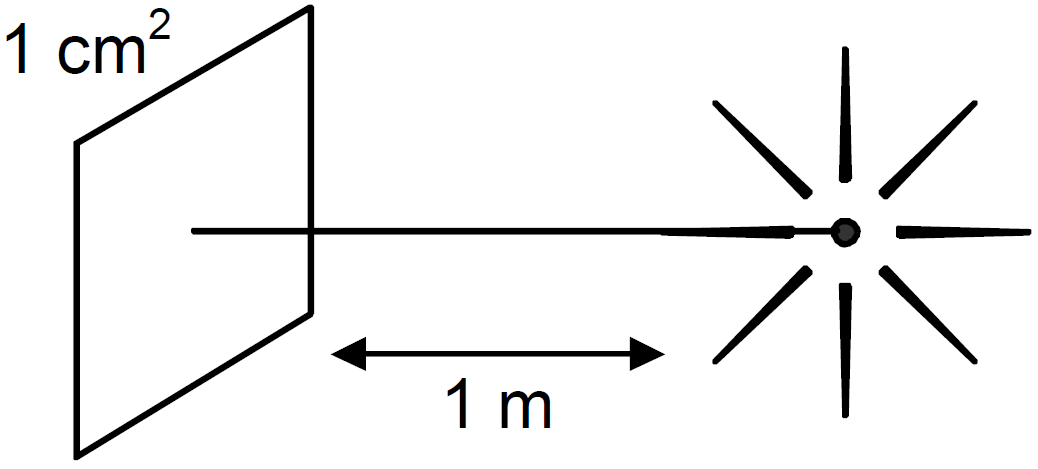
A point source emitting alpha particles is placed at a distance of $1m$ from a counter which records any alpha particle falling on its $1\ cm^2$ window. If the source contains $6.0 \times 10^{16}$ active nuclei and the counter records a rate of $50000$ counts/ second, find the decay constant. Assume that the source emits alpha particles uniformly in all directions and the alpha particles fall nearly normally on the window.
AnswerCounts received per $\ cm^2 = 50000\ \text{Counts/sec}$.
$N = N_30$ of active nucleic $= 6 \times 10^{16}$
Total counts radiated from the source $=$ Total surface area $\times 50000\ \text{counts/cm}^2$
$= 4 \times 3.14 \times 1 \times 10^4 \times 5 \times 10^4 = 6.28 \times 10^9$
$\text{Counts}=\frac{\text{dN}}{\text{dt}}$
We know, $\frac{\text{dN}}{\text{dt}}=\lambda\text{N}$
$\lambda=\frac{6.28\times10^9}{6\times10^{16}}=1.0467\times10^{-7}=1.05\times10^{-7}\text{s}^{-1}$
View full question & answer→Question 385 Marks
Before the neutrino hypothesis, the beta decay process was throught to be the transition,
$\text{n}\rightarrow\ \text{p}+\overline{\text{e}}$
If this was true, show that if the neutron was at rest, the proton and electron would emerge with fixed energies and calculate them.Experimentally, the electron energy was found to have a large range.
AnswerLet us consider the cases before and after $\beta-\text{decay}$
Before $\beta-\text{decay};$ if the neutron was at rest.
Hence $, E_n = m_nc^2, p_n = 0$
After $\beta-\text{decay};\text{p}_\text{n}=\text{p}_\text{p}+\text{p}_\text{e}$
or, $0=\text{p}_\text{p}+\text{p}_\text{e}$
$\Rightarrow\ |\text{p}_\text{p}|=|\text{p}_\text{e}|=\text{p}$
Also, $\text{E}_\text{p}=\big(\text{m}_\text{p}^2\text{c}^4+\text{p}_\text{p}^2\text{c}^2\big)^\frac{1}{2}$
$\text{E}_\text{e}=\big(\text{m}_\text{e}^2\text{c}^4+\text{p}_\text{p}^2\text{c}^2\big)^\frac{1}{2}=\big(\text{m}_\text{e}^2\text{c}^4+\text{p}_\text{e}^2\text{c}^2\big)^\frac{1}{2}$
Now applying conservation of energy,
$\big(\text{m}_\text{e}^2\text{c}^4+\text{p}^2\text{c}^2\big)^\frac{1}{2}=\big(\text{m}_\text{e}^2\text{c}^4+\text{p}^2\text{c}^2\big)^\frac{1}{2}=\text{m}_\text{n}\text{c}^2$
$\text{m}_\text{p}\text{c}^2\approx936\ \text{MeV},\text{m}_\text{e}\text{c}^2\approx938\ \text{MeV}$ and $\text{m}_\text{e}\text{c}^2=0.51\ \text{MeV}$
Since, the energy difference between $n$ and $p$ is small $, pc$ will be small $, pc < < < m_pc^2,$ while pc may be greater than $m_ec^2.$
$\Rightarrow\ \text{m}_\text{p}\text{c}^2+\frac{\text{p}^2\text{c}^2}{2\text{m}^2_\text{p}\text{c}^4}\simeq\text{m}_\text{n}\text{c}^2-\text{pc}$
To first otder $pc = m_nc^2 - m_pc^2 = 938\ \text{MeV} - 936\ \text{MeV} = 2\ \text{MeV}.$
This given the momentum of proton or neutron. Then,
$\text{E}_\text{p}=\big(\text{m}_\text{p}^2\text{c}^4+\text{p}^2\text{c}^2\big)^\frac{1}{2}=\sqrt{936^2+2^2}\approx936\ \text{MeV}$
$\text{E}_\text{e}=\big(\text{m}_\text{e}^2\text{c}^4+\text{p}^2\text{c}^2\big)^\frac{1}{2}=\sqrt{(0.51)^2+2^2}= 2.06\ \text{MeV}$
View full question & answer→Question 395 Marks
Are the nucleons fundamental particles, or do they consist of still smaller parts? One way to find out is to probe a nucleon just as Rutherford probed an atom. What should be the kinetic energy of an electron for it to be able to probe a nucleon? Assume the diameter of a nucleon to be approximately $10^{-15}m.$
AnswerKey concept : A nucleon is one of the particles that makes up the atomic nucleus.
Each atomic nucleus consists of one or more nucleons, and each atom in turn consists of a cluster of nucleons surrounded by one of more electrons.
There are two known kinds of nucleon: the neutron and the proton.
The mass number of a given atomic isotope is identical to its number of nucleons.
Thus the term nucleon number may be used in place of the more common terms mass number or atomic mass number.
For resolving two objects separated by distance $d,$ the wavelength $A$ of the proving signal must be less than $d$.
Therefore, to detect separate parts inside a nucleon, the electron must have a wavelength less than $10^{-15}m.$
We knoe that, $\lambda=\frac{\text{h}}{\text{p}}$ and ${KE}=\text{PE}\ .....(\text{i})$
Energy, $\text{E}=\frac{\text{hc}}{\lambda}\ .....(\text{ii})$
From Eq. $(i)$ and Eq.$(ii),$
$\text{KE}=\text{PE}=\frac{\text{hc}}{\lambda}-\frac{6.6\times10^{-34}\times3\times10^{8}}{10^{-15}\times1.6\times10^{-19}}\text{eV}$
$\text{KE}=10^9\text{eV}$
Important point : Until the $1960s,$ nucleons were thought to be elementary particles, each of which would not then have been made up of smaller parts.
Now they are known to be composite particles, made of three quarks bound together by the so $-$ called strong interaction.
The interaction between two or more nucleons is called intemucleon interactions or nuclear force, which is also ultimately caused by the strong interaction.
$($Before the discovery of quarks, the term “strong interaction” referred to just intemucleon interactions.$)$
View full question & answer→Question 405 Marks
Deuteron is a bound state of a neutron and a proton with a binding energy $B = 2.2\ \text{MeV}. A γ-$ ray of energy $E$ is aimed at a deuteron nucleus to try to break it into a $($neutron $+$ proton$)$ such that the $n$ and $p$ move in the direction of the incident $γ-$ray. If $E = B,$ show that this cannot happen. Hence calculate how much bigger than $B$ must $E$ be for such a process to happen.
AnswerFrom the law of conservation of energy.
$\text{E}-\text{B}=\text{K}_\text{n}+\text{k}_\text{p}=\frac{\text{p}_\text{n}^2}{2\text{m}}+\frac{\text{p}_\text{p}^2}{2\text{m}}\ .....\text{(i)}$
From conservation of momentum,
$\text{p}_\text{n}+\text{p}_\text{p}=\frac{\text{E}}{\text{C}}\ .....(\text{ii})$
If $, E = B,$ then the tirst equation gives $p_n = p_p = 0$ and hence the second equation cannot be satisfied, and the process cannot take place.
For the process to take palce, Let $\text{E}=\text{B}+\lambda,$ where $\lambda$ would be $< < B.$
Then, substituting for $p_n$ from Equation $(2)$ into Equation $(1)$.
$\lambda=\frac{1}{2\text{m}}(\text{p}_\text{p}^2+\text{p}_\text{n}^2)=\frac{1}{2\text{m}}\Big(\text{p}_\text{p}^2+\Big(\text{p}_\text{p}-\frac{\text{E}}{\text{C}}\Big)^2\Big)$
$\therefore\ 2\text{p}_\text{p}^2-\frac{2\text{E}}{\text{c}}\text{p}_\text{p}+\Big(\frac{\text{E}^2}{\text{c}^2}-2\text{mX}\Big)=0$
$\therefore\ \text{p}_\text{p}=\frac{\frac{2\text{E}}{\text{c}}\pm\sqrt{\frac{4\text{E}^2}{\text{c}^2}-8\Big(\frac{\text{E}^2}{\text{c}^2}-2\text{mX}\Big)}}{4}$
Sicne the determinant must be positive for $p_p$ to be real:
$\frac{4\text{E}^2}{\text{c}^2}-8\Big(\frac{\text{E}^2}{\text{c}^2}-2\text{m}\lambda\Big)=0$
or $16\text{m}\lambda=\frac{4\text{E}^2}{\text{c}^2}$
$\lambda=\frac{\text{E}^2}{4\text{mc}^2}\approx\frac{\text{B}^2}{4\text{mc}^2}$
View full question & answer→Question 415 Marks
A nuclide $1$ is said to be the mirror isobar of nuclide $2$ if $\text{Z_1 =N_2}$ and $\text{Z_2 =N_1}.$
- What nuclide is a mirror isobar of ${11}^{23}Na$ ?
- Which nuclide out of the two mirror isobars have greater binding energy and why?
AnswerKey concept : Mirror nuclei are nuclei where the number of protons of element one $(Z_1)$ equals the number of neutrons of element two $(N_2)$, the number of protons of element two $(Z_2)$ equal the number of neutrons in element one $(N_1)$ and the mass number is the same.
Pairs of mirror nuclei have the same spin and parity. If we constrain to odd number of nuclcons $(A),$ then w find mirror nuclei that differ one another by exchanging a proton by a neutron. Interesting to observe is their binding energy which is mainly due to the strong interaction and also due to Coulomb interaction.
Since the strong interaction is invariant to protons and neutrons one can expect these mirror nuclei to have very similar binding energies.
- According to question, a nuclide a is said to be mirror isobar of nuclide $2,$ if $\text{Z_1 = N_2}$ and $\text{Z_2 = N_1}$.
Now in $\text{{11}Na^{23}, Z_1= 11, N_1, = 23 - 11 = 12}$
$\therefore$ Mirror isobar of ${11}\ Na^{23}$ is ${12}\ Mg^{23},$ for which $Z_2 = 12 = N_1$ and $N_2 = 23 - 12 = 11$
$= Z_1.$
- We know $1123 \ Mg$ contains even number of protons $(12)$ againsr ${11}^{23}Na$ which has ptld number of protons $(11),$ therefore ${11}^{23}Mg \ \ Mg$ has greater binding energy than ${11}Na^{23}.$
View full question & answer→Question 425 Marks
Sometimes a radioactive nucleus decays into a nucleus which itself is radioactive. An example is:
$^{38}\text{Sulphur}\xrightarrow [=2.48\text{h}]{\text{half-life}}\ \ ^{38}\text{Cl}\ \xrightarrow[=0.62\text{h}]{\text{half-life}}\ ^{38}\text{Ar}(\text{stable})$
Assume that we start with $1000^{38}S$ nuclei at time $t = 0$. The number of ${38}Cl$ is of count zero at $t = 0$ and will again be zero at $t = \infty$ . At what value of $t,$ would the number of counts be a maximum?
AnswerSuppose decay is given as shown below:
$^{38}\text{S}\xrightarrow[=2.48]{}\ \ ^{38}\text{Cl}\ \xrightarrow[0.62\text{h}]{}\ ^{38}\text{Ar}$
At any time $t,$ let ${38}S$ have $N_1(t)$ active nuclei and ${38}Cl $ have $N_2 (t)$ active nuclei.
$\frac{\text{dN}_1}{\text{dt}}=-\lambda_1\text{N}_1=$ rate of formation of $Cl^{38}.$
Also, $\frac{\text{dN}_2}{\text{dt}}=-\lambda_\text{1}\text{N}_2=\lambda_1\text{N}_1$
But $\text{N}_1=\text{N}_0\text{e}^{-\frac{\lambda}{\text{t}}}$
$\frac{\text{dN}_2}{\text{dt}}=-\lambda_1\text{N}_0\text{e}^{-\frac{\lambda}{\text{t}}}-\lambda_2\text{N}_2\ .....(\text{i})$
Multiplying by $\text{e}^{\lambda2\text{t}}\text{ dt}$ and rearranging
$\text{e}^{\lambda_2\text{t}}\text{dN}_2+\lambda_2\text{N}_2\text{e}^{\lambda_2\text{t}}\text{dt}=\lambda_1\text{N}_0\text{e}^{(\lambda_2-\lambda_1)\text{t}}\text{dt}$
Integrating both sides
$\text{N}_2\text{e}^{\lambda_2\text{t}}=\frac{\text{N}_0\lambda_1}{\lambda_0-\lambda_1}\text{e}^{(\lambda_1-\lambda_1)\text{t}}+\text{C}$
Since, at $t = 0, N_2 = 0, \text{C}=-\frac{\text{N}_0\lambda_1}{\lambda_2-\lambda_1}$
$\therefore\ \text{N}_2\text{e}^{\lambda_2\text{t}}=\frac{\text{N}_0\lambda_1}{\lambda_2-\lambda_1}\big(\text{e}^{(\lambda_2-\lambda_1)\text{t}}-1\big)$
$\text{N}_2=\frac{\text{N}_0\lambda_1}{\lambda_2-\lambda_1}{(\text{e}^{\lambda_1\text{t}}-\text{e}^{\lambda_2\text{t}})}$
For maximum count, $\frac{\text{dN}_2}{\text{dt}}=0$
By using concepts of calculus and solving, we will get,
$\text{t}=\frac{\Big(\text{In}\frac{\lambda_1}{\lambda_2}\Big)}{(\lambda_1-\lambda_2)}$
$=\frac{\text{In}\Big(\frac{2.48}{0.62}\Big)}{(2.48-0.62)}$
$=\frac{\text{In}4}{1.86}=\frac{2.303\log4}{1.86}\ \ \bigg(\because\ \lambda=\frac{0.696}{\text{T}_{\frac{1}{2}}}\bigg)$
$=0.745\text{s}.$
View full question & answer→Question 435 Marks
State Soddy $-$ Fajan’s displacement laws for radioactive transformations.
AnswerThe atoms of radioactive element are unstable. When an atom of a radioactive element disintegrates, an entirely new element is formed.
This new element possesses entirely new chemical and radioactive properties.
The disintegrating element is called the parent element and the resulting product after disintegration is called the daughter element.
Soddy and Fajan studied the successive product elements of disintegration of radioactive elements and gave the following conclusions:
- Alpha $-$ Emission:
- $a -$ particle is nucleus of a helium atom having atomic number $2$ and atomic weight $4$. It is denoted by $_2He^4$.
- Therefore when an $\alpha-$ particle is emitted from a radioactive parent atom $(X),$ its atomic number is reduced by $2$ and atomic weight is reduced by $4$.
- Thus the daughter element has its place two groups lower in the periodic table.
- Thus the process of $a-$ emission may be expressed as:
$_\text{Z}\text{X}^\text{A}\ \rightarrow \ _{\text{z}-2}\text{Y}^{\text{A}-4}\ +\ _2\text{He}^4$
$\ \ \ \ \ \ \ \ \ \ \ \ \ \ \ \ \ \ \ \ \ \ \ \ \ \ \ \ \ \ \ \ \ \ \ \ \ (\alpha-\text{particle})$
Examples:
$\text{92U238 \ 90Th234 + _2He^4}$
$\text{80Ra226 \ 86Rn222 + _2He^4}$
- Beta $-$ Emission:
- $\beta-$ particle is an electron $(e)$ and is denoted by $_{-1}\beta^0.$ When a $\beta-$particle is emitted from a parent atom $(X),$ it atomic number increases by $1$. while atomic weight remains unchanged.
- As a result the doughter element $(Y)$ has a place one group higher in the periodic table. Thus the process of $\beta-$ emission may be expressed as:
$_\text{Z}\text{X}^\text{A}\rightarrow_{\text{Z}+1}\text{Y}^\text{A}+_{-1}\beta^0+\bar{\text{v}}$
where $\bar{\text{v}}$ is a fundamental particle called antineutrino which is massless and chargeless.
Example:
$_{90}\text{Th}^{228}\rightarrow_{89}\text{Ac}^{228}+_{-1}\text{b}^0+\bar{\text{v}}$
- Gamma $-$ Emission:
- The emission of $\lambda-$ray from a radioactive atom neither chages its atomic number nor its atomic weight.
- Therefore its place in periodic table remains undisplaced. In natural radioactivity $\lambda-$ radiation is accompanied with either $\alpha$ or $\beta-$ emission.
View full question & answer→Question 445 Marks
$^{238}U$ decays to $^{206}Pb$ with a half$-$life of $4.47 \times 10^9y$. This happens in a number of steps. Can you justify a single half for this chain of processes? A sample of rock is found to contain $2.00\ mg$ of $^{238}U$ and $0.600\ mg$ of $^{206}Pb$. Assuming that all the lead has come from uranium, find the life of the rock.
AnswerHalf life period can be a single for all the process. It is the time taken for $\frac{1}{2}$ of the uranium to convert to lead.
No. of atoms of $U^{238} =\frac{6\times10^{23}\times2\times10^{-3}}{238}=\frac{2}{238}\times10^{20}=0.05042\times10^{20}$
No. of atoms in $Pb =\frac{6\times10^{23}\times0.6\times10^{-3}}{206}=\frac{3.6}{206}\times10^{20}$ Initially total no. of uranium atoms $=\Big(\frac{12}{235}+\frac{3.6}{206}\Big)\times10^{20}=0.06789$
$\text{N = N}_0\text{e}^{-\lambda\text{t}}$
$\Rightarrow\text{N = N}_0\text{e}^{\frac{-0.693}{\frac{\text{t}}{\text{t}_{\frac{1}{2}}}}}$
$\Rightarrow0.05042=0.06789\text{e}^{\frac{-0.693}{4.47\times10^9}}$
$\Rightarrow\log\Big(\frac{0.05042}{0.06789}\Big)=\frac{-0.693\text{t}}{4.47\times10^9}$
$\Rightarrow\text{t}=1.92\times10^9\text{ years}.$
View full question & answer→Question 455 Marks
$4 \times 10^{23}$ tritium atoms are contained in a vessel. The half$-$life of decay tritium nuclei is $12.3y$. Find:
- The activity of the sample.
- The number of decay in the next $10$ hours.
- The number of decays in the next $6.15y$.
Answer$\text{N}=4\times10^{23};\text{t}_{\frac{1}{2}}=12.3$ years.
- Activity $=\frac{\text{dN}}{\text{dt}}=\lambda\text{n}=\frac{0.693}{\text{t}_{\frac{1}{2}}}\text{N}=\frac{0.693}{12.3}\times4\times10^{23}$ dis/year.
$=7.146\times10^{14}\text{dis/sec}.$
- $\frac{\text{dN}}{\text{dt}}=7.146\times10^{14}$
No. of decays in next $10$ hours $=7.146\times10^{14}\times10\times36$
$=257.256\times10^{17}=2.57\times10^{19}$
- $\text{N = N}_0\text{e}^{-\lambda\text{t}}=4\times10^{23}\times\text{e}^{\frac{-0.693}{20.3}\times6.16}$
$=2.82\times10^{23} =$ No. of atoms remained
No. of atoms disintegrated $=(4-2.82)\times10^{23}=1.18\times10^{23}$ View full question & answer→