Question
State Soddy-Fajan’s displacement laws for radioactive transformations.

Answer

The atoms of radioactive element are unstable. When an atom of a radioactive element disintegrates, an entirely new element is formed. This new element possesses entirely new chemical and radioactive properties. The disintegrating element is called the parent element and the resulting product after disintegration is called the daughter element. Soddy and Fajan studied the successive product elements of disintegration of radioactive elements and gave the following conclusions:
  1. Alpha-Emission: a-particle is nucleus of a helium atom having atomic number 2 and atomic weight 4. It is denoted by $_2He^4.$ Therefore when an $\alpha-$particle is emitted from a radioactive parent atom (X), its atomic number is reduced by 2 and atomic weight is reduced by 4. Thus the daughter element has its place two groups lower in the periodic table. Thus the process of a-emission may be expressed as:
$_\text{Z}\text{X}^\text{A}\ \rightarrow \ _{\text{z}-2}\text{Y}^{\text{A}-4}\ +\ _2\text{He}^4\\\ \ \ \ \ \ \ \ \ \ \ \ \ \ \ \ \ \ \ \ \ \ \ \ \ \ \ \ \ \ \ \ \ \ \ \ \ (\alpha-\text{particle})$
Examples:
92U238 90Th234 $+ _2He^4$
80Ra226 86Rn222 $+ _2He^4​​​​​​​$​​​​​​​
  1. Beta-Emission: $\beta-$particle is an electron (e) and is denoted by $_{-1}\beta^0.$ When a $\beta-$particle is emitted from a parent atom (X), it atomic number increases by 1. while atomic weight remains unchanged. As a result the doughter element (Y) has a place one group higher in the periodic table. Thus the process of $\beta-$emission may be expressed as:
$_\text{Z}\text{X}^\text{A}\rightarrow_{\text{Z}+1}\text{Y}^\text{A}+_{-1}\beta^0+\bar{\text{v}}$
where $\bar{\text{v}}$ is a fundamental particle called antineutrino which is massless and chargeless.
Example: $_{90}\text{Th}^{228}\rightarrow_{89}\text{Ac}^{228}+_{-1}\text{b}^0+\bar{\text{v}}$
  1. Gamma-Emission: The emission of $\lambda-$ray from a radioactive atom neither chages its atomic number nor its atomic weight. Therefore its place in periodic table remains undisplaced. In natural radioactivity $\lambda-$radiation is accompanied with either $\alpha$ or $\beta-$emission.

Need a full question paper?

Generate a complete, print-ready paper with questions like this in minutes — across 16+ boards, with answer keys.
Start Generating Free

Similar questions

The densities of wood and benzene at $0^{\circ} \mathrm{C}$ are $880 \mathrm{~kg} \mathrm{~m}^{-3}$ and $900 \mathrm{~kg} \mathrm{~m}^{-3}$ respectively. The coefficients of volume expansion are $1.2 \times 10^{-3}{ }^{\circ} \mathrm{C}^{-1}$ for wood and $1.5 \times 10^{-3}{ }^{\circ} \mathrm{C}^{-1}$ for benzene. At what temperature will a piece of wood just sink in benzene?
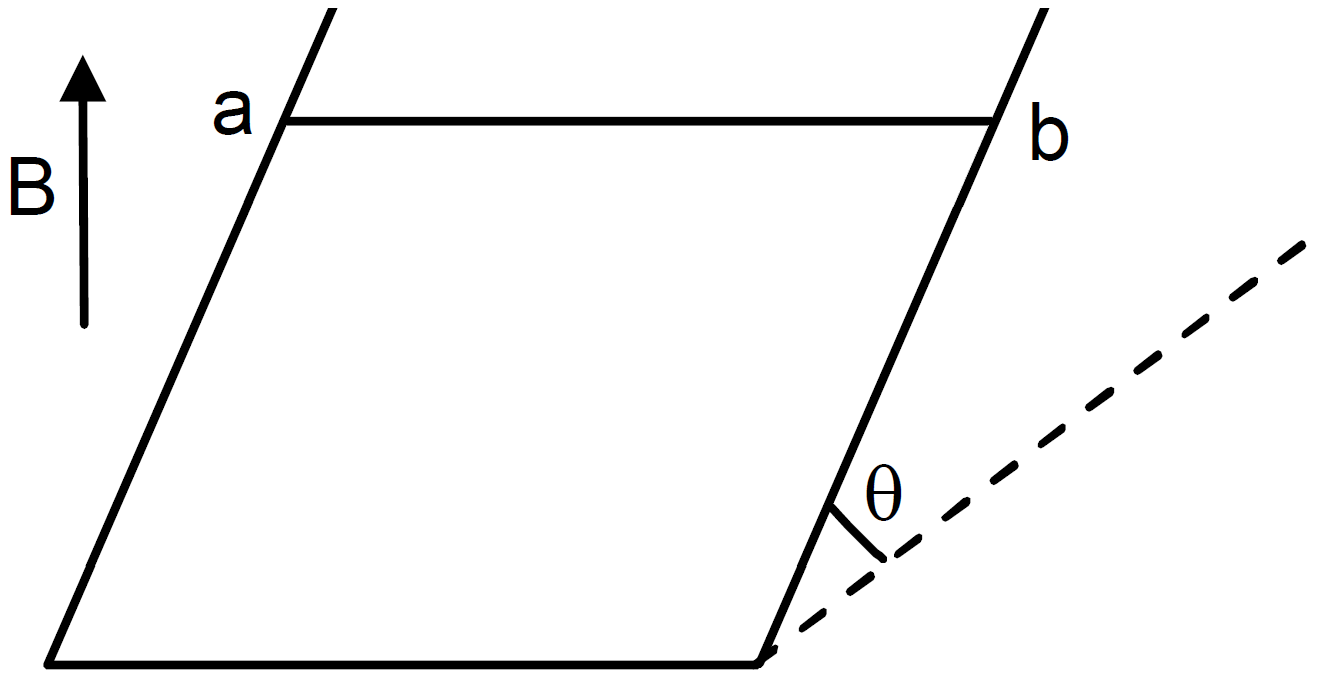
A wire ab of length l, mass m and resistance R slides on a smooth, thick pair of metallic rails joined at the bottom as shown in figure. The plane of the rails makes an angle θ with the horizontal. A vertical magnetic field B exists in the region. If the wire slides on the rails at a constant speed v, show that $\text{B}=\sqrt{\frac{\text{mgR}\sin\theta}{\text{vl}^2\cos^2\theta}}$
A capacitor having a capacitance of $100\mu\text{F}$ is charged to a potential difference of 24V. The charging battery is disconnected and the capacitor is connected to another battery of emf 12V with the positive plate of the capacitor joined with the positive terminal of the battery:
  1. Find the charges on the capacitor before and after the reconnection.
  2. Find the charge flown through the 12V battery.
  3. Is work done by the battery or is it done on the battery? Find its magnitude.
  4. Find the decrease in electrostatic field energy.
  5. Find the heat developed during the flow of charge after reconnection.
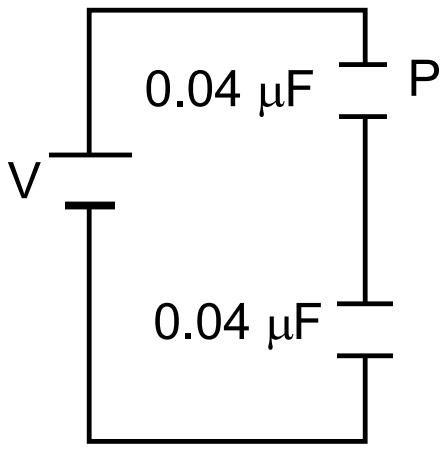
The particle P shown in figure has a mass of 10mg and a charge of $-0.01\mu\text{C}.$ Each plate has a surface area $100cm^2$ on one side. What potential difference V should be applied to the combination to hold the particle P in equilibrium?
What are circular and elliptically polarized light?
Two particles A and B, each carrying a charge Q, are held fixed with a separation d between them. A particle C having mass m and charge q is kept at the middle point of the line AB.
  1. If it is displaced through a distance x perpendicular to AB, what would be the electric force experienced by it.
  2. Assuming x << d, show that this force is proportional to x.
  3. Under what conditions will the particle C execute simple harmonic motion if it is released after such a small displacement?
Find the time period of the oscillations if these conditions are satisfied.
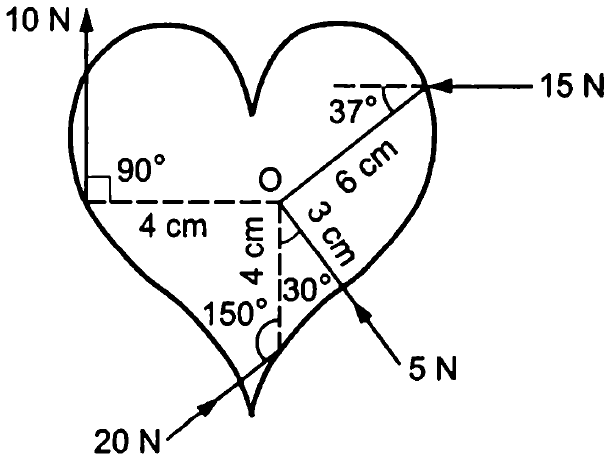
Calculate the total torque acting on the body shown in figure about the point O.
A uniform magnetic field B exist in a region. An electron projected perpendicular to the field goes in a circle. Assuming Bohr's quantization rule for angular momentum, calculate (a) the smallest possible radius of the electron (b) the radius of the nth orbit and (c) the minimum possible speed of the electron.
What are the values of the self-induced emf in the circuit of the previous problem at the times indicated therein?
A torsional pendulum consists of a solid disc connected to a thin wire$\Big(\alpha=2.4\times10^{-5}\ ^\circ\text{C}^{-1}\Big)$at its centre. Find the percentage change in the time period between peak winter $(5^\circ C)$ and peak summer $(45^\circ C)$.