Question
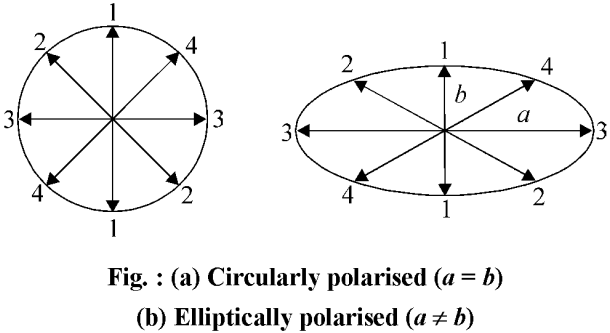
What are circular and elliptically polarized light?

Need a full question paper?

Generate a complete, print-ready paper with questions like this in minutes — across 16+ boards, with answer keys.

Start Generating Free

Similar questions

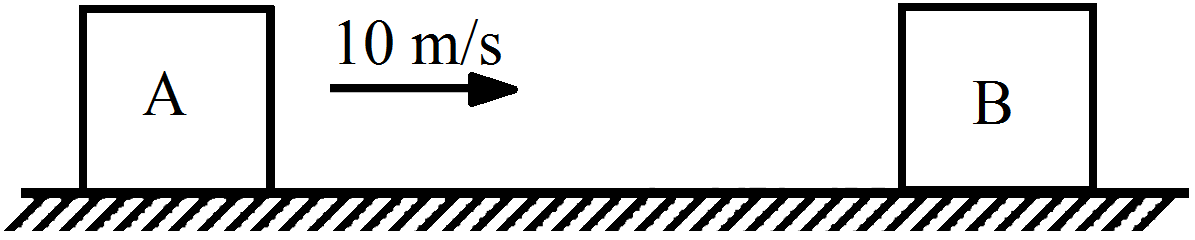
The blocks shown in figure have equal masses. blocks in the process. The surface of A is smooth but that of B has a friction coefficient of 0.10 with the floor. Block A is moving at a speed of 10m/s towards B which is kept at rest. Find the distance travelled by B if
  1. The collision is perfectly elastic
  2. The collision is perfectly inelastic. $($Take $g = 10m/s^2)$
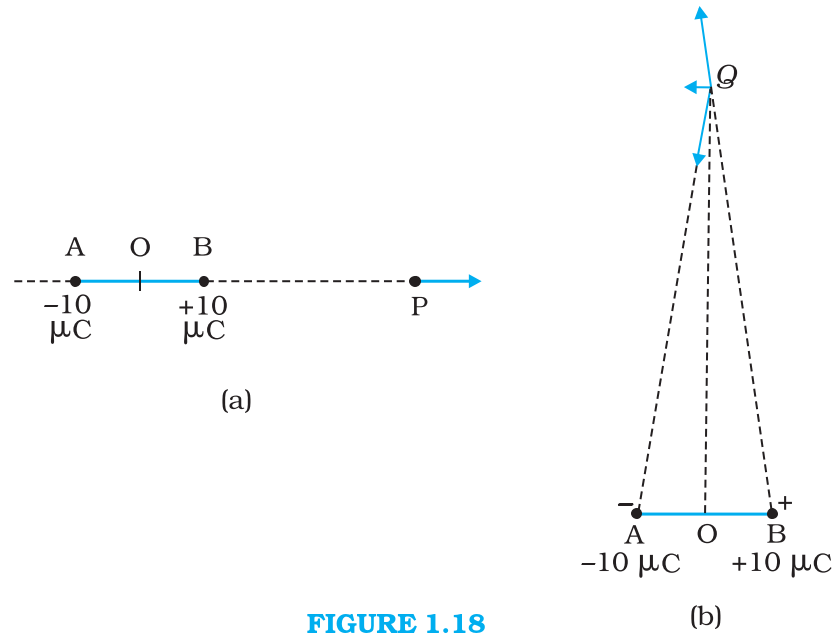
Two charges $\pm 10 \mu C$ are placed $5.0 mm$ apart. Determine the electric field at $(a)$ a point $P$ on the axis of the dipole $15 \ cm$ away from its centre $O$ on the side of the positive charge, as shown in Fig. $1.18( a ),$ and $(b)$ a point $Q , 15 \ cm$ away from $O$ on a line passing through $O$ and normal to the axis of the dipole, as shown in Fig. $1.18(b)$.
Image
A person stands on a spring balance at the equator.
  1. By what fraction is the balance reading less than his true weight?
  2. If the speed of earth's rotation is increased by such an amount that the balance reading is half the true weight, what will be the length of the day in this case?
A myopic adult has a far point at 0.1m. His power of accomodation is 4 diopters.
  1. What power lenses are required to see distant objects?
  2. What is his near point without glasses?
  3. What is his near point with glasses? (Take the image distance from the lens of the eye to the retina to be 2cm.)
A pin of length 2.0cm lies along the principal axis of a converging lens, the centre being at a distance of 11cm from the lens. The focal length of the lens is 6cm. Find the size of the image.
The position, velocity and acceleration of a particle executing simple harmonic motion are found to have magnitudes 2cm, 1m/s and $10m/s^2$ at a certain instant. Find the amplitude and the time period of the motion.
A person standing on the floor of an elevator drops a coin. The coin reaches the floor of the elevator in a time $t_1$ if the elevator is stationary and in time $t_2$ if it is moving uniformly. Then :
Suppose we want to verify the analogy between electrostatic and magnetostatic by an explicit experiment. Consider the motion of (i) electric dipole p in an electrostatic field E and (ii) magnetic dipole m in a magnetic field B. Write down a set of conditions on E, B, p, m so that the two motions are verified to be identical. (Assume identical initial conditions.)
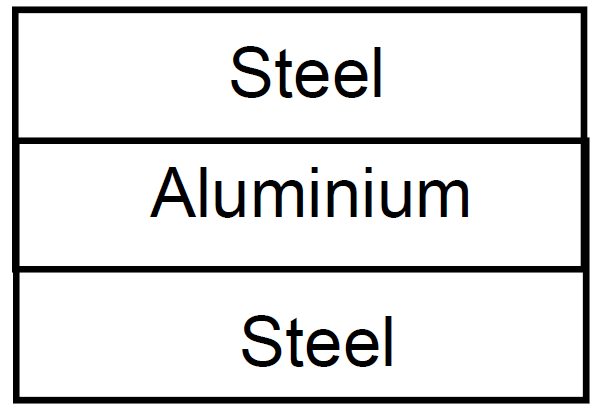
Two steel rods and an aluminium rod of equal length $l_0$ and equal cross section are joined rigidly at their ends as shown in the figure below. All the rods are in a state of zero tension at $0^\circ C$. Find the length of the system when the temperature is raised to $\theta$. Coefficient of linear expanaion of aluminium and steel are $\alpha_\text{a}$ and $\alpha_\text{s}$respectively. Young's modulus of aluminium is $Y_a$ and of steel is $Y_s.$​​​​​​​
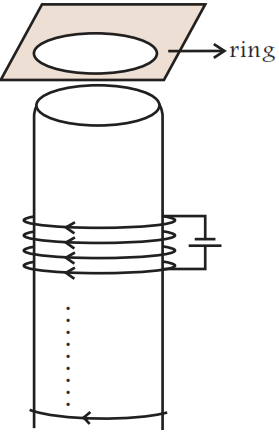
Consider a metal ring kept on top of a fixed solenoid (say on a carboard) (Fig). The centre of the ring coincides with the axis of the solenoid. If the current is suddenly switched on, the metal ring jumps up. Explain.