Question
State the amount of work done by an object when it moves in a circular path for one complete rotation. Give a reason to justify your answer.

Answer

Amount of work done is equal to zero.
Work is said to be done only when there is displacement produced. In the case of a body moving in a circular path, the body comes to its original place, therefore, there is no displacement, and hence work is zero.

Need a full question paper?

Generate a complete, print-ready paper with questions like this in minutes — across 16+ boards, with answer keys.
Start Generating Free

Similar questions

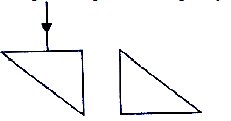
Two isosceles right –angles glass prisms are placed near each other as shown in Fig. 4.63. Complete the path of the light ray entering the first prism till it emerges out of the second prism.

60 joules of heat was dissipated in a resistor when 20 C flowed for 5 s. Calculate:
(a) P.d. across the resistor,
(b) Resistance of the resistor, and
(c) Average power dissipated in the resistor.
Classify as real or virtual, the image of a candle flame formed on a screen by a convex lens. Draw a ray diagram to illustrate how the image is formed.
State Ohm’s law and draw a neat labelled circuit diagram containing a battery, a key, a voltmeter, an ammeter, a rheostat and an unknown resistance to verify it.
Calculate the amount of heat given out while converting 100 g of water at 50°C into ice at -5°C. (refer Q.9 for data).
State the sign convention to measure the distances for a lens.
What are ohmic conductors? Give one exmaple. Draw a graph showing the current-voltage relationship for an ohmic conductor.
Do we expect any change in the position, nature, and size of the image
(i) formed by a concave lens,
(ii) with a change in the position of the object?
Define the term refractive index of a medium. What do you understand by the statement 'the refractive index of glass is 1.5 for white light'?
Draw a labelled diagram of an arrangement of two pulleys, one fixed and other movable. In the diagram, mark the directions of al forces acting on it. What is the ideal mechanical advantage of the system? How can it be achieved?