Questions · Page 1 of 2

[3 Mark Question Answer]

🎯

Test yourself on this topic

50 questions · timed · auto-graded

Question 13 Marks
Calculate the change in the Kinetic energy of a moving body if its velocity is reduced to $1/3rd$ of the initial velocity.
Answer
$K . E _1=\frac{1}{2} mv ^2$
K.E. $2=\frac{1}{2} m \left(\frac{1}{3} v \right)^2$
$KE_1 : KE_2$​​​​​​​
$\frac{1}{2} mv ^2=\frac{1}{2} m \frac{1 v ^2}{9}$
$\frac{ mv ^2}{2}=\frac{ mv ^2}{18}=18: 2=9: 1$
View full question & answer
Question 23 Marks
A couple of 15 N force acts on a rigid body, such that arm of couple is 85 cm. Calculate moment of couple in the SI system.
Answer
Moment of couple = Force × Arm of couple
= 15 × 85 N-cm.
$=15 \times 85 \times \frac{1}{100} Nm$.
= 15 × 0.85
= 12.75 Nm.
View full question & answer
Question 33 Marks
A moving body weighing $400 \ N$ possesses $500 \ J$ of kinetic energy. Calculate the velocity with which the body is moving. $(g = 10 ms^2)$
Answer
Given : Weight $= 400 N,$
$W = mg$
$400 = m \times 10$
$m = 40 kg$
Now, Kinetic Energy $=\frac{1}{2} mv ^2$
$500=\frac{1}{2} \times 40 \times v ^2$
$v = 5 m/s$
View full question & answer
Question 43 Marks
A ball of mass $0.20$ kg is thrown vertically upwards with an initial velocity of $20 m s ^{-1}$. Calculate the maximum potential energy it gains as it goes up.
Answer
Potential energy at the maximum height= initial kinetic energy
$=\frac{1}{2} m v^2$
$=\frac{1}{2} \times 0.20 \times 20 \times 20=40 J$.
View full question & answer
Question 53 Marks
A man can open a nut by applying a force of $150 N$ by using a lever handle of length $0.4 m$. What should be the length of the handle if he is able to open it by applying a force of $60 N?$
Answer
Given,
$F_1 = 150N$
$l_1 = 0.4m$
$F_2 = 60N$
$l_2 = ?$
$\because$ Force × perpendicular distance = constant
$F_1 \times l_1 = F_2 \times l_2$
$150 \times 0.4 = 60 \times l_2$
$l_2 = 1m$
View full question & answer
Question 63 Marks
State the $C.G.S$. unit of work. How it is related to its S.I. unit?
Answer
The C.G.S. unit of work is erg. $1 erg =1$ dyne $\times 1 cm$.
The S.I. unit of work is the joule. 1 joule $=1$ Newton $\times 1$ metre
Relationship: $1 J=1 N \times 1 m$
$=10^5$ dyne $\times 100 cm=10^7$ erg.
View full question & answer
Question 73 Marks
A machine raises a load of 750 N through a height of 16 m in 5 seconds. Calculate the power at which the machine works.
Answer
Power $=\frac{\text { Force } \times \text { Distance }}{\text { Time }}$
$=\frac{750 \times 16}{5}$ watt
= 2400 watt.
= 2.4 KW.
View full question & answer
Question 83 Marks
A man having a box on his head, climbs up a slope and another man having an identical box walks the same distance on a levelled road.
Who does more work against the force of gravity and why?
Answer
Man having a box on his head who climbs up a slope does more work against the force of gravity because he has more potential energy by virtue of his position i.e., height.
As, P.E. = W.D. = F × S
= mg × h
View full question & answer
Question 93 Marks
The work done by the heart is 1 Joule per beat. Calculate the power of the heart if it beats 72 times in one
Answer
Total work done by the heart in one minute (i.e. 60 s.) is 72 beats or 72 joules.
∴ Power of heart =
$\frac{ W \text { (in Joules) }}{\text { Time(in s) }}=\frac{72}{60}$ watts $=1.2$ watts.

View full question & answer
Question 103 Marks
The world record for weight lifting was held by Sergei Didyk of the USSR. He lifted $261$ kg to a height of $2.3 \ m$ in 4s; find:
(a) Weight lifted by him
(b) Work done by him
(c) Power developed by him. $(g = 10m/s^2)$
Answer
(a) Weight lifted by him $= m \times g = 261 \times 10 = 2610 N.$
(b) Work done by him $= F \times d = 261 \times 2.3 J = 6003 J.$
(c) Power developed by him =
$\frac{\text { Work in } J }{\text { Time in } s }=\frac{6003}{4} Watt =1500.75 W$.
View full question & answer
Question 113 Marks
Derive a relation between the $S.I.$ and $C.G.S$. unit of force.
Answer
We have Force = Mass × Acceleration
$\therefore \frac{\text { S.I. unit of force }}{\text { C.G.S unit of force }}=\frac{ kg \times ms ^{-2}}{ g \times cm s ^{-2}}=\left(\frac{ kg }{ g }\right)\left(\frac{ m }{ cm }\right)=10^3 \times 10^2=10^5$
$\therefore$ S.I. unit of force (Newton) $= 10^5 C.G.S$. unit of force (dyne)
Or $1$ Newton $= 10^5$dyne.
View full question & answer
Question 123 Marks
Explain, why submarines are able to dive underwater as well as a sail on the surface of the water?
Answer
Submarines are provided with ballast tanks. When required to dive, the water is allowed to enter the tanks. And when required to sail, the water is forced out by compressed air.
Work is a scalar quantity.
View full question & answer
Question 133 Marks
Name a device in which solar energy is converted into electricity state its two uses.
Answer
Solar cell.
Its two uses are:
(i) All artificial satellites and space probes mainly depend upon electricity generated by solar cells.
(ii) Solar cells are used for lighting, operating water pumps, running radio and television sets in remote areas and traffic signals, etc.
View full question & answer
Question 143 Marks
Why using wood as fuel is not advisable although wood is a renewable source of energy?
Answer
It is not advisable to use wood as fuel even though it can be replenished because the burning of wood produces smoke that causes pollution which results in environmental imbalance.
View full question & answer
Question 153 Marks
State the law of conservation of energy.
Answer
The law of conservation of energy states that energy cannot be created or destroyed; the sum total of energy in a closed system remains unchanged. Energy only changes from one form to another.
View full question & answer
Question 163 Marks
Give three examples of bodies possessing potential energy.
Answer
(i) An object kept at a height above the ground.
(ii) A compressed spring, and
(iii) A stretched catapult.
View full question & answer
Question 173 Marks
What happens to the $K.E$. when
(i) the mass of the body is doubled at a constant velocity and
(ii) the velocity of the body is doubled at constant mass?
Answer
We have, K.E. $=1 / 2 mv ^2$
Hence,
(i) On doubling the mass, at a constant velocity, the $K.E.$ becomes double its original value.
(ii) On doubling the velocity, at constant mass, the $K.E.$ becomes $(2)^2$ i.e., 4 times its original value.
View full question & answer
Question 183 Marks
Obtain an expression for the potential energy of a body of mass m at a height h above the ground.
Answer
Force due to gravity on the body F = mg
Work done in lifting the body against the force of gravity to a height h above the ground
W = F × d = mg × h = mgh
Thus, the potential energy of the body = mgh.
View full question & answer
Question 193 Marks
Write five forms of energy.
Answer
(i) Mechanical energy
(ii) Chemical energy
(iii) Solar energy
(iv) Heat energy
(v) Light energy.
View full question & answer
Question 203 Marks
What do you understand by the term energy? Is energy a scalar or vector? How is the energy possessed by a body measured?
Answer
Energy is defined as the capacity of a body to do work. Energy is a scalar quantity. The energy possessed by a body is measured by the amount of work done by a body while changing its state of rest or state of motion.
View full question & answer
Question 213 Marks
What happens to the power if the time for doing work is reduced from t second to t/10 second?
Answer
The power becomes 10 times its initial value. This is because of power = work/time. Thus, power α 1/time for a given work. Reducing the time by a factor of 10 thus increases the power 10 times.
View full question & answer
Question 223 Marks
Justify the statement. “Power can be expressed as the product of force and velocity.”
Answer
Power $=\frac{\text { Work }}{\text { Time }}=\frac{\text { Force } \times \text { Displacement }}{\text { Time }}$
$=$ Force $\times \frac{\text { Displacement }}{\text { Time }}$
= Force × Velocity.
(Since rate of change of displacement is velocity).
View full question & answer
Question 233 Marks
What is the S.I. unit of work? Define it.
Answer
The S.I. unit of work is newton-metre or joule (J).
1 Joule = 1 N × 1 m.
1 J of work is said to be done by a force of 1 N if it displaces a body by 1 m in the direction of the force.
View full question & answer
Question 243 Marks
State the amount of work done by an object when it moves in a circular path for one complete rotation. Give a reason to justify your answer.
Answer
Amount of work done is equal to zero.
Work is said to be done only when there is displacement produced. In the case of a body moving in a circular path, the body comes to its original place, therefore, there is no displacement, and hence work is zero.
View full question & answer
Question 253 Marks
Define power.
Answer
Power is defined as the rate of doing work or work done per second.
i.e., Power $=\frac{\text { Work done in joule }}{\text { Times in second }}$
or, $p=\frac{W \text { (in joule) }}{t(\text { in second })}$
View full question & answer
Question 263 Marks
What do you understand by work? Is work a scalar or a vector quantity?
Answer
Work is said to be done when a force displaces a body through some distance, in its own direction, i.e.,
Work = Force × Displacement
W = F × d
Work is a scalar quantity.
View full question & answer
Question 273 Marks
Explain why a ship loaded with light goods is more liable to be overturned than the one loaded with heavy goods.
Answer
A ship loaded with light goods is more liable to be overturned than the one loaded with heavy goods. This is because the CG in the former case is high and so a slight displacement due to water current may cause the vertical line passing through the CG to fall outside the base, thereby overturning the ship.
View full question & answer
Question 283 Marks
Explain why It is easier to knock down a boy who is standing on one foot than one who is standing on two.
Answer
It is easier to knock down a boy who is standing on one foot than one who is standing on two because boy standing on both feet has a larger base area and hence it has a more stable equilibrium than a boy standing on one foot.
View full question & answer
Question 293 Marks
Can the CG be situated outside the material of the body? Give an example.
Answer
The position of CG of a body depends on the distribution of mass in the body. It can be situated outside or inside the material of the body.
For example, The CG of wire is at its mid-point but CG of a ring lies at the centre where there is no material.
View full question & answer
Question 303 Marks
What is meant by the term ‘moment of force’? If the moment of force is assigned a negative sign then will the turning tendency of the force be clockwise or anti-clockwise?
Answer
It is equal to the product of the magnitude of the force and the perpendicular distance of the line of action of a force from the axis of rotation. If the moment of force is assigned a negative value, it means the clockwise tendency of force.
View full question & answer
Question 313 Marks
Two similar vehicles are moving with the same velocity on the road, such that one of thus is loaded and the other one is empty which of the two vehicles will require larger force to stop?
Answer
A large force is required to stop the loaded vehicle. It is because the loaded vehicle has greater momentum than the empty vehicle as the mass of the loaded vehicle is more than that of the empty one. So, it requires more force to stop.
View full question & answer
Question 323 Marks
A bullet fired against a window glass pane makes a hole in it without any cracks while a stone striking the same glass pane smashes it; explain with reason.
Answer
When the bullet strikes the glass, the part of the glass coming in contact with the bullet immediately shares the large velocity of the bullet and makes a hole in it while the rest of the glass pane, due to the inertia of rest, remains at rest and so is not smashed. But when a stone strikes the same glass pan, the surrounding part of the glass gets time to share the comparatively low velocity of stone and so it is smashed.
View full question & answer
Question 333 Marks
What is Gravitational force? Give gravitational units of force.
Answer
Earth exerts a force of attraction on each object. This force is due to gravity and its magnitude is directly proportional to the mass of the object. This force is known as gravitational force and its units are gravitational units.
In the MKS system, the gravitational unit of force is kilogramme force i.e., kgf. In CGS system it is gramme force, gf.
View full question & answer
Question 343 Marks
State the energy changes which take place when:
Water stored in dams rotates turbine connected to a dynamo.
Answer
The potential energy of stored water changes to kinetic energy of flowing water, The kinetic energy of the flowing water rotates turbine. The turbine, in turn, rotates the coil of the generator and changes into electric energy.
View full question & answer
Question 353 Marks
A coolie is pushing a box weighing 1500 N up an inclined plane 7.5 m long on to a platform, 2.5 m above the ground.
(i) Calculate the mechanical advantage of the inclined plane. (ii) Calculate the effort applied by the coolie.
(iii) In actual practice, the coolie needs to apply more effort than what is calculated. Give one reason why you think the coolie needs to apply more effort.
Answer
(i) Mechanical Advantage (M.A.) $=\frac{ l }{ h }$
M.A. $=\frac{7.5}{2.5}=3$
(ii) M.A. $=\frac{\operatorname{Load}( L )}{\operatorname{Effort}( E )}$
$3=\frac{1,500}{E}$
E = 500 N.
(iii) More effort is required becaues of friction.
View full question & answer
Question 363 Marks
A boy of mass $40 \ kg$ runs up a height of $30$ steps, each $20 \ cm$ high. Find:
(i) The force of gravity acting on the boy.
(ii) The work done by the boy against gravity. (Take $g = 9.8 ms^{−2})$
Answer
Given : $m = 40 kg, g = 9.8 ms^{−2}$​​​​​​​
Distance moved, $d = 30 \times 20 cm = 600 cm = 6 m.​​​​​​​$
(i) The force of gravity, $F = mg = 40 \times 9.8 = 392 N.​​​​​​​$​​​​​​​
(ii) The work done by the boy, $W = F \times d = 392 \times 6 = 2352 J.$
View full question & answer
Question 373 Marks
A body of mass m is taken from a height h to 2h. What is the increase in its potential energy?
Answer
Initial potential energy = mgh
Final potential energy = mg × 2h = 2mgh
Increase in potential energy = Final potential energy – Initial potential energy
= 2mgh – mgh = mgh.
View full question & answer
Question 383 Marks
Obtain an expression for the kinetic energy of a body of mass m moving with a velocity v?
Answer
Let the body is brought to rest by a retarding force F after traveling a distance s.
From relation $v^2= u^2 + 2aS$, retardation a $=\frac{ v ^2}{2 S }$
$\therefore$ Retarding force F = ma
$= m \times \frac{ v ^2}{2 S }=\frac{1}{2} \frac{ mv ^2}{ S }$
Work done $W = F \times S$
 
View full question & answer
Question 393 Marks
A body of mass $m$ falls from a height $h_1$ to a height $h_2$, above the ground $\left(h_1>h_2\right)$. What is the loss of potential energy?
Answer
At height $h_1,$ initial potential energy of body $= mgh_1$
At height $h_2,$ final potential energy of body $= mgh_2​​​​​​​$​​​​​​​
Loss in potential energy = Initial potential energy − Final potential energy
$= (mgh_1 − mgh_2)$
$= mg (h_1 − h_2)$
View full question & answer
Question 403 Marks
A body of mass $50\ kg$ has a momentum of $3000 kg^{-1} ms$. Calculate:
(j) the kinetic energy of the body.
(ii) the velocity of the body.
Answer
(i) $m=50 kg, p=3000\ kg ms^{-1}$
$p=mv$
$v=\frac{P}{m}=\frac{3000}{50}=60\ ms^{-1}$
Kinetic energy of the body $=\frac{1}{2} m v^2$
$=\frac{1}{2} \times 50 \times(60)^2=25 \times 3600$
$=90000 J$
(ii) Velocity of the body $v =60\ ms^{-1}$
View full question & answer
Question 413 Marks
Calculate the kinetic energy of a body of mass 0.1 kg. and momentum 40kg m/s.
Answer
K.E. $=\frac{1}{2} m v^2$ and momentum $P=m v$
Eliminating $v$, K.E. $=\frac{1}{2} m \times\left(\frac{ P }{ m }\right)=\frac{ P ^2}{2 m }$
Given : P = 40 kg m/s, m = 0.1 Kg.
K.E. $=\frac{(40)^2}{2 \times 0.1}=8000 J =8 \times 10^3 J$
View full question & answer
Question 423 Marks
For the same kinetic energy of a body, what should be the change in its velocity if its mass is increased nine times?
Answer
Let initial mass $m_1 = m$, initial velocity $v_1 = v$
Final mass $m_2 = 4m$, Find velocity $= v_2$
For the same kinetic energy,
$\frac{1}{2} m_1 v_1^2=\frac{1}{2} m_2 v_2^2$ or $\frac{1}{2} m v^2=\frac{1}{2} \times 9 m$
$v 2=\sqrt{\frac{1}{9} v ^2}=\frac{1}{3} v$
View full question & answer
Question 433 Marks
An electric motor pump is 60% efficient and is rated 2.5 H.P. Calculate the maximum load it can lift through a height of 10m in 8 sec. (1 H.P. = 750 W).
Answer
Useful power supplied by the motor =
$\frac{2.5 \times 750 \times 60}{100}$ watt
= 1125 watt
If maximum load lifted is W kg, then :
Work done in lifting up the load = W × 10 × 10 J
And Work done by the pump = 1125 × 8
Or Load lifted; $W=\frac{1125 \times 8}{10 \times 10}=90 kg$.

View full question & answer
Question 443 Marks
A water pump raises $50 \ kg$ of water through a height of $25 \ m$ in 5s. Calculate the power supplied by the pump (Take: $g = 10 N kg^{−1}).$
Answer
Given $m = 50 kg, g = 10N kg^{−1}, d = 25 m, t = 5s.$
Force of gravity F = mg
$= 50 \times 10$
$= 500 N$
Work done $W = F \times d$
$= 500 \times 25$
$= 12,500 J$
Power $P =\frac{ W }{ t }=\frac{12,500}{5}=2500 W$.
View full question & answer
Question 453 Marks
A man weighing $700 \ N$ runs up a flight of $15$ steps, each $20 \ cm$ high, in $5$ seconds. Calculate the power of the man.
Answer
Total height covered $= 15 \times 20 cm$
$= 300 cm$
$= 3 m$
Work done = Force × distance
$= 700 N \times 3 m$
$= 2100 J$
Since the time taken is 5s, the power of the man is
Power $= (2100/5) Js^{−1}$
$= 420 W.$
View full question & answer
Question 463 Marks
What is meant by equilibrium and state the conditions of equilibrium of a body?
Answer
When a number of forces acting on a body produce no change in its state of rest or of uniform motion the body is said to be in equilibrium.
The two conditions of equilibrium of a body:
(i) The resultant of all the forces acting on the body should be equal to zero.
(ii) The resultant moment of all the forces acting on the body about a point should be zero.
View full question & answer
Question 473 Marks
State the effects that a force can produce. Given one example of each.
Answer
A force can produce the following three effects:
(i) It can bring changes in dimensions. For example, in stretching a spring its length increases.
(ii) It can start or stop motion. For example, a ball moves when kicked.
(iii) It can change the speed or direction of motion. For example, a hockey player changes the speed and direction of the motion of the ball by his stick.
View full question & answer
Question 483 Marks
The moment of a force of 10 N about a fixed point O is 5 N m. Calculate the distance of the point O from the line of action of the force.
Answer
Moment of force = force x perpendicular distance of from point O
Moment of force = F x r
5Nm = 10 x r
R = 5/10 = 0.5 m
View full question & answer
Question 493 Marks
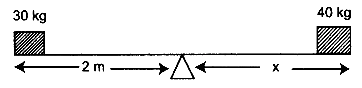
A boy of mass 30 kg is fitting at a distance of 2 m from the middle of a see-saw. Where should a boy of mass 40 kg sit so as to balance the see-saw?
Answer

By the principle of moments 30 × 2 = x × 40
∴ Other boys should sit at a distance
$x=\frac{30 \times 2}{40}$
= 1.5 m
View full question & answer
Question 503 Marks
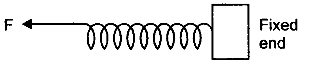
One end of a spring is kept fixed while the other end is stretched by a force as shown in the diagram.

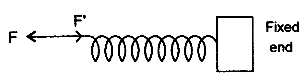
(i) Copy the diagram and mark on it the direction of the restoring force.
(ii) Name one instrument which works on the above principle.
Answer

(i) F’ in the fig. shows the direction of restoring force.
(ii) Spring balance.
View full question & answer
[3 Mark Question Answer] - Physics STD 10 Questions - Vidyadip