Question
$\triangle\text{ABC}\sim\triangle\text{DEF}$ such that $\text{ar}(\triangle\text{ABC})=64\text{cm}^2$ and $\text{ar}(\triangle\text{DEF})=169\text{cm}^2.$ If BC = 4cm, find EF.

Answer

$\triangle\text{ABC}\sim\triangle\text{DEF}$
$\Rightarrow\frac{\text{ar}(\triangle\text{ABC})}{\text{ar}(\triangle\text{DEF})}=\frac{\text{BC}^2}{\text{EF}^2}$
$\Rightarrow\frac{64}{169}=\frac{4^2}{\text{EF}^2}$
$\Rightarrow\text{EF}^2=\frac{16\times169}{64}$
$\Rightarrow\text{EF}=\sqrt{\frac{16\times169}{64}}$
$\Rightarrow\text{EF}=\frac{4\times13}{8}$
$\Rightarrow\text{EF}=6.5\text{cm}$

Need a full question paper?

Generate a complete, print-ready paper with questions like this in minutes — across 16+ boards, with answer keys.
Start Generating Free

Similar questions

Find the length of the medians of a ΔABC having vertices at A(0, -1), B(2, 1) and C(0, 3).
Prove the following trigonometric identities.
Given that: $(1+\cos\alpha)(1+\cos\beta)(1+\cos\gamma)=(1-\cos\alpha)(1-\cos\alpha)(1-\cos\beta)(1-\cos\gamma)$
Show that one of the values of each member of this equality is $\sin\alpha\sin\beta\sin\gamma.$
If $A(-4,8), B(-3,-4), C(0,-5)$ and $D(5,6)$ are the vertices of a quadrilateral $A B C D$, find its area.
The product of Tanvy's age (in years) 5 years ago and her age 8 years later is 30. Find her present age.
A jeweller has bars of 18-carat gold and 12-carat gold. How much of each must be melted together to obtain a bar of 16-carat gold, weighing 120 g? (Given: Pure gold is 24-carat).
Solve the following system of equations graphically:
Shade the region between the lines and the y-axis.
3x - 4y = 7,
5x + 2y = 3.
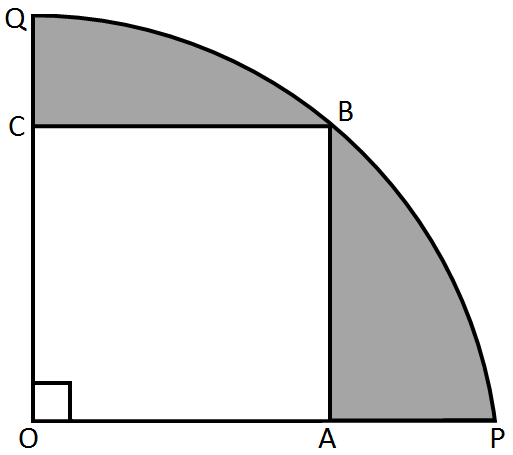
In the following figure a square OABC is inscribed in a quadrant OPBQ of a circle. If OA = 21cm, find the area of the shaded region.
The radii of the ends of a bucket 30cm high are 21cm and 7cm. Find its capacity in litres and the amount of sheet required to make this bucket.
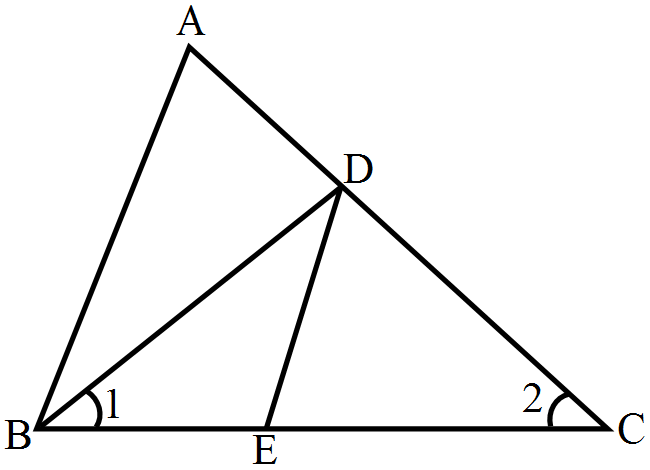
In the given figure, $\angle1=\angle2$ and $\frac{\text{AC}}{\text{BD}}=\frac{\text{CB}}{\text{CE}}$
Prove that $\triangle\text{ACB}\sim\triangle\text{DCE}.$
ABCD is a rectangle formed by joining the points A(-1, -1), B(-1, 4) C(5, 4) and D(5, -1). P, Q, R and S are the mid-points of sides AB, BC, CD and DA respectively. Is the quadrilateral PQRS a square? a rectangle? or a rhombus? Justify your answer.