Question
State the kinematic equations for uniformly accelerated motion.
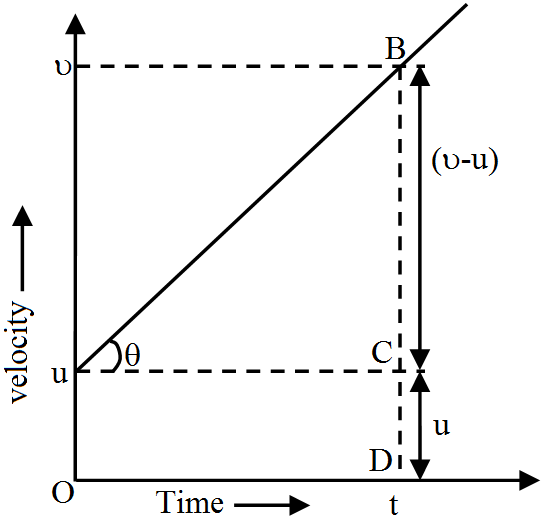
Let u be the initial velocity of the particle at t = 0 and v is the final velocity of the particle after time t. Consider two points A and B on the curve corresponding to t = 0 and t = t respectively.
Draw BD perpendicular to time axis. Also draw AC perpendicular to BD.
$\therefore$ OA = CD = u;
BC = (v - u) and OD = t
Now slope of v-t graph = acceleration (a)
$\therefore$ a = slope of v-t graph $=\tan\theta=\frac{\text{BC}}{\text{AC}}=\frac{\text{BC}}{\text{OD}}$ [$\because$ AC= OD]
$\therefore \text{a}=\frac{\text{v}-\text{u}}{\text{t}}$
$\text{v}-\text{u}=\text{at}$
or $\text{v}=\text{u}+\text{at}$
Let, x0 = position of the particle at t = 0 from the origin.
x = position of the particle at t = t from the origin.
$\therefore$ (x - x0) = S = distance travelled by the particle in the time interval (t - 0) = t
We know, distance travelled by a particle in the given time
Interval = area under velocity-time graph
$\therefore$ (x – x0) = Area OABD (see fig, above) = Area of trapezium OABD
$=\frac{1}{2}$ [Sum of parallel sides × perpendicular distance between parallel sides]
$=\frac{1}{2}(\text{OA}+\text{BD})\times\text{AC}=\frac{1}{2}(\text{u}+\text{v})\times\text{t}$
Since $\text{v}=\text{u}+\text{at}$
$\therefore(\text{x}-\text{x}_0)=\frac{1}{2}(\text{u}+\text{u}+\text{at})\times\text{t}$
$=\frac{1}{2}(2\text{u}+\text{at})\times\text{t}=\text{ut}+\frac{1}{2}\text{at}^2$
Since $\text{x}-\text{x}_0=\text{S}$
$\therefore \text{S}=\text{ut}+\frac{1}{2}\text{at}^2$
S = Area under v-t graph (see fig.) or
S = area of trapenium OABD
$=\frac{1}{2}$ (sum of parallel sides) × perpendicular distance between these para
$\text{S}=\frac{1}{2}(\text{OA}+\text{BD})\times\text{ACs}\ \dots(\text{i})$
Now, acceleratiory a = slope of v- t graph
$\text{a}=\frac{\text{BC}}{\text{AC}}=\frac{\text{BD}-\text{CD}}{\text{AC}}=\frac{\text{v}-\text{u}}{\text{AC}}$
$\text{AC}=\Big(\frac{\text{v}-\text{u}}{\text{a}}\Big)\text{s}$
Also, OA = u and BD = v
Using equations (ii) and (iii) in equation (i), we get
$\text{S}=\frac{1}{2}(\text{v}+\text{u})\frac{(\text{v}-\text{u})}{\text{a}}=\frac{\text{v}^2-\text{u}^2}{2\text{a}}$
$\text{v}^2-\text{u}^2=2\text{as}$
Generate a complete, print-ready paper with questions like this in minutes — across 16+ boards, with answer keys.