Question
  1.  
  1. State the principle on which a potentiometer works. How can a given potentiometer be made more sensitive?
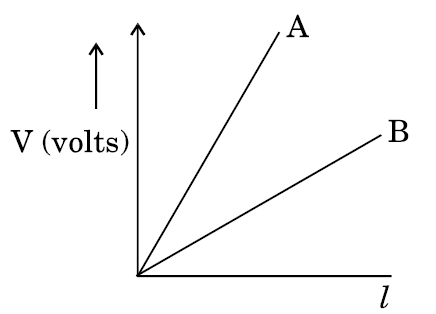
  2. In the graph shown below for two potentiometers, state with reason which of the two potentiometers, A or B, is more sensitive.
  1. Two metallic wires, P1 and P2 of the same material and same length but different cross-sectional areas, A1 and A2 are joined together and connected to a source of emf. Find the ratio of the drift velocities of free electrons in the two wires when they are connected (i) in series, and (ii) in parallel.
Answer

Get the step-by-step solution for this question inside the Vidyadip app.

Get the answer in the app

Need a full question paper?

Generate a complete, print-ready paper with questions like this in minutes — across 16+ boards, with answer keys.

Start Generating Free

Similar questions

Three identical charges, each having a value 1.0 × 10-8C, are placed at the corners of an equilateral triangle of side 20cm. Find the electric field and potential at the centre of the triangle.
Consider N = n1n2 identical cells, each of emf $\in$ and internal resistance r. Suppose n1 cells are joined in series to form a line and n2 such lines are connected in parallel. The combination drives a current in an external resistance R. (a) Find the current in the external resistance. (b) Assuming that n1 and n2 can be continuously varied, find the relation between n1, n2, R and r for which the current in R is maximum.
Consider a neutron and an electron bound to each other due to gravitational force. Assuming Bohr's quantization rule for angular momentum to be valid in this case, derive an expression for the energy of the neutron-electron system.
A long, straight wire is fixed horizontally and carries a current of 50.0A. A second wire having linear mass density 1.0 × 10⁻⁴kg/m is placed parallel to and directly above this wire at a separation of 5.0mm. What current should this second wire carry such that the magnetic repulsion can balance its weight?
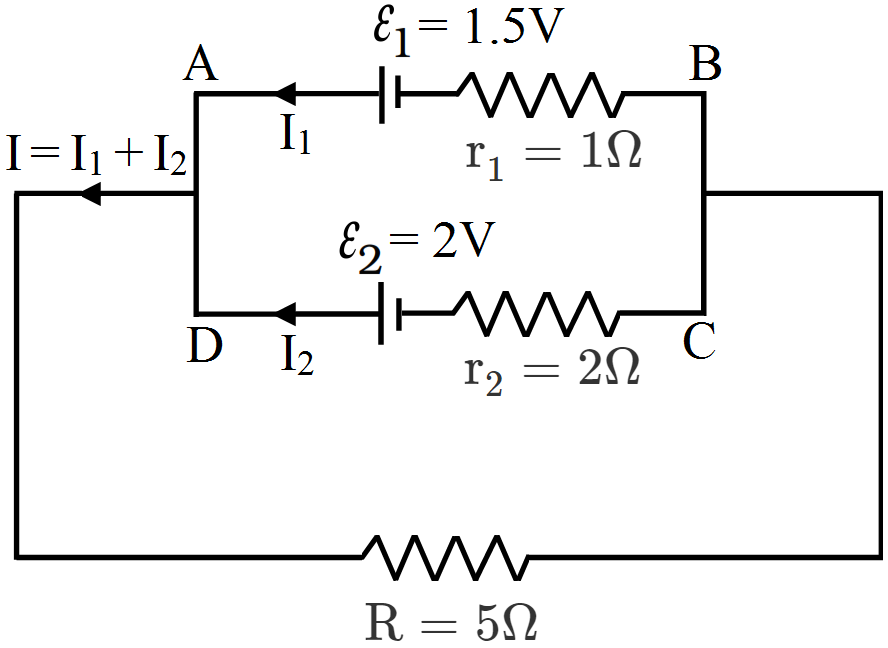
Two cells of emf 1.5V and 2V and internal resistance $1\Omega$ and $2\Omega$ respectively are connected in parallel to pass a current in the same direction through an external resistance of $5\Omega.$

  1. Draw the circuit diagram.
  2. Using Kirchhoff’s laws, calculate the current through each branch of the circuit and potential difference across $5\Omega$ resistor.

​​​​​​​

Two point charges qA = 3 μC and qB = –3 μC are located 20 cm apart in vaccum.
  1. What is the electric field at the midpoint O of the line AB joining the two charges?
  2. If a negative test charge of magnitude 1.5 × 10⁻⁹ C is placed at this point, what is the force experienced by the test charge?
Draw the symbolic representation of a (i) p-n-p, (ii) n-p-n transistor. Why is the base region of transistor thin and lightly doped? With proper circuit diagram, show the biasing of a p-n-p transistor in common base configuration. Explain the movement of charge carriers through different parts of the transistor in such a configuration and show that $\text{I}_{E}= \text{I}_{C} =\text{I}_{B}$.
Test if the following equations are dimensionally correct:

  1. $\text{h}=\frac{2\text{S}\cos\theta}{\rho\text{rg}}$

  2. $\text{u}=\sqrt{\frac{\text{P}}{\rho}}$

  3. $\text{V}=\frac{\pi\text{Pr}^4\text{t}}{8\eta l}$

  4. $\text{v}=\frac{1}{2\pi}\sqrt{\frac{\text{mg}l}{\text{I}}}$

where h = height, S = surface tension, $\rho$ = density, P = pressure, V = volume, $\eta$ = coefficient of viscosity, v = frequency and I = moment of inertia.

  1. Compare the individual dipole moment and the specimen dipole moment for H2O molecule and O2 molecule when placed in:
  1. Absence of external electric field.
  2. Presence of external eclectic field. Justify your answer.
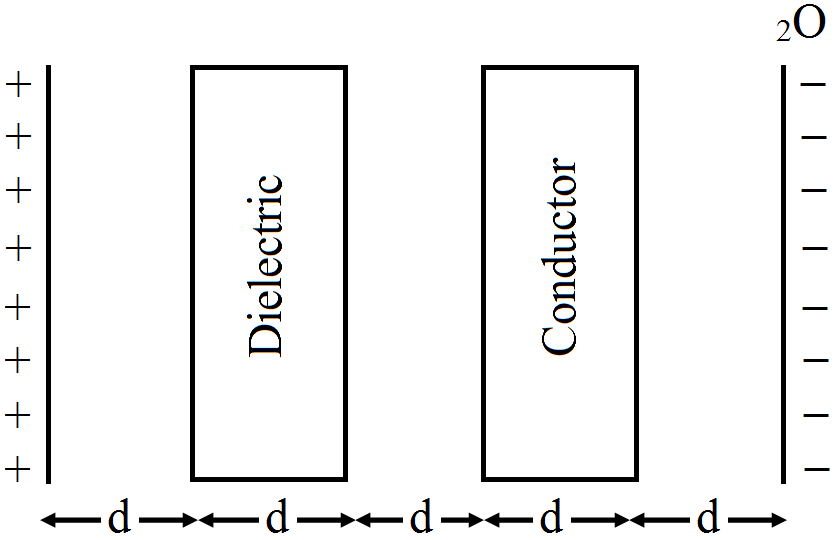
  1. Given two parallel conducting plates of area A and charge densities $+\sigma$ and $-\sigma.$ A dielectric slab of constant K and a conducting slab of thickness d each are inserted in between them as shown.

  1. Find the potential difference between the plates.
  2. Plot E versus x graph, taking x = 0 at positive plate and x = 5d at negative plate.
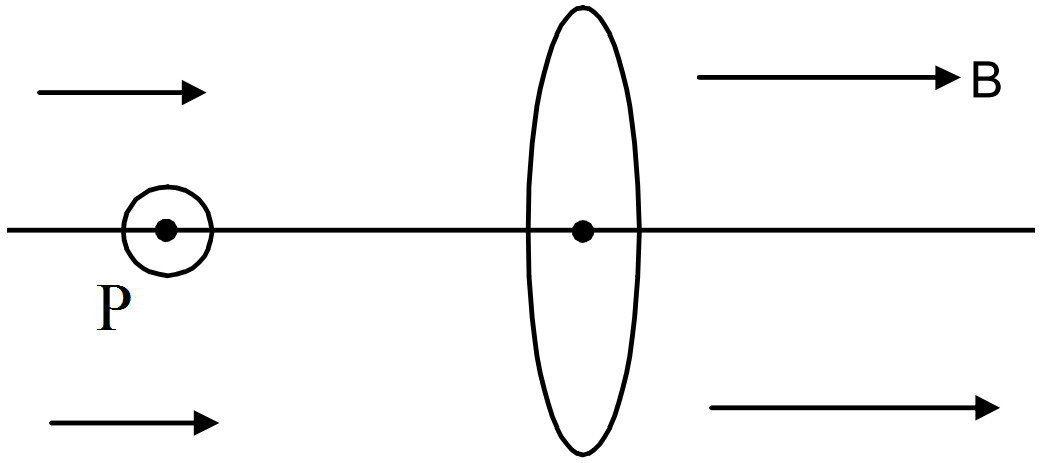
Shows a convex lens of focal length 12cm lying in a uniform magnetic field B of magnitude 1.2T parallel to its principal axis. A particle with charge 2.0 × 10⁻³C and mass 2.0 × 10⁻⁵ kg is projected perpendicular to the plane of the diagram with a speed of 4.8 ms-1. The particle moves along a circle with its centre on the principal axis at a distance of 18cm from the lens. Show that the image of the particle moves along a circle and find the radius of that circle.