Question
  1. State the two Kirchhoff's laws. Explain briefly how these rules are justified.
  2. The current is drawn from a cell of emf E and internal resistance r connected to the network of resistors each of resistance r as shown in the figure. Obtain the expression for (i) the current draw from the cell and (ii) the power consumed in the network.
Answer

  1. Junction Rule: At any Junction, the sum of currents, entering the junction, is equal to the sum of currents leaving the junction.

Loop Rule: The Algebraic sum, of changes in potential, around any closed loop involving resistors and cells, in the loop is zero.

$\sum(\triangle V)=0$

Justification: The first law is in accord with the law of conservation of charge.

The Second law is in accord with the law of conservation of energy.

  1. Equivalent resistance of the loop

$\text{R}=\frac{r}{3}$

Hence current drawn from the cell

$\text{I}=\frac{E}{\frac{r}{3}+r}=\frac{3E}{4r}$

Power consumed $\text{P}=I^2(\frac{r}{3})$

$=\frac{9E^2}{16r^2}\times\frac{4r}{3}=\frac{3E^2}{4r}$

Need a full question paper?

Generate a complete, print-ready paper with questions like this in minutes — across 16+ boards, with answer keys.

Start Generating Free

Similar questions

A uniform electric field $\vec{\text{E}}=\text{E}_\text{x}\hat{\text{i}}$ N/ C for x > 0 and $\vec{\text{E}}=-\text{E}_\text{x}\hat{\text{i}}$ N/ C for x < 0 are given. A right circular cylinder of length l cm and radius r cm has its centre at the origin and its axis along the X-axis. Find out the net outward flux. Using Gauss’s law, write the expression for the net charge within the cylinder.
One mole of an ideal gas undergoes a process $\text{p}=\frac{\text{p}_0}{1+\Big(\frac{\text{V}}{\text{V}_0}\Big)^2}$ where P0 and V0 are constants. Find the temperature of the gas when V = V0.
Define the term ‘resolving power’ of an astronomical telescope. How does it get affected on:
  1. Increasing the aperture of the objective lens?
  2. Increasing the wavelength of light used?
  3. Increasing the focal length of the objective lens?
 Justify your answer in each case.
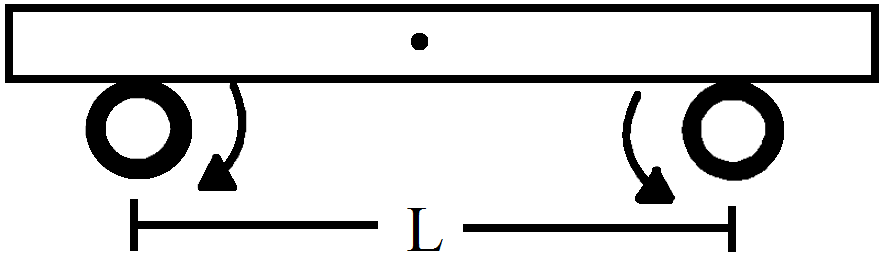
A uniform plate of mass M stays horizontally and symmetrically on two wheels rotating in opposite directions figure The separation between the wheels is L. The friction coefficient between each wheel and the plate is N. Find the time period of oscillation of the plate if it is slightly displayed along its length and released.

Find the wavelength of the radiation emitted by hydrogen in the transitions (a) n = 3 to n= 2, (b) n = 5 to n = 4 and (c) n = 10 to n = 9.
A myopic adult has a far point at 0.1m. His power of accomodation is 4 diopters.
  1. What power lenses are required to see distant objects?
  2. What is his near point without glasses?
  3. What is his near point with glasses? (Take the image distance from the lens of the eye to the retina to be 2cm.)
Answer the following questions:
(a) Are the equations of nuclear reactions (such as those given in Section 13.7) 'balanced' in the sense a chemical equation (e.g., $2 H _2+ O _2 \rightarrow 2 H _2 O$ ) is? If not, in what sense are they balanced on both sides?
(b) If both the number of protons and the number of neutrons are conserved in each nuclear reaction, in what way is mass converted into energy (or vice-versa) in a nuclear reaction?
(c) A general impression exists that mass-energy interconversion takes place only in nuclear reaction and never in chemical reaction. This is strictly speaking, incorrect. Explain.
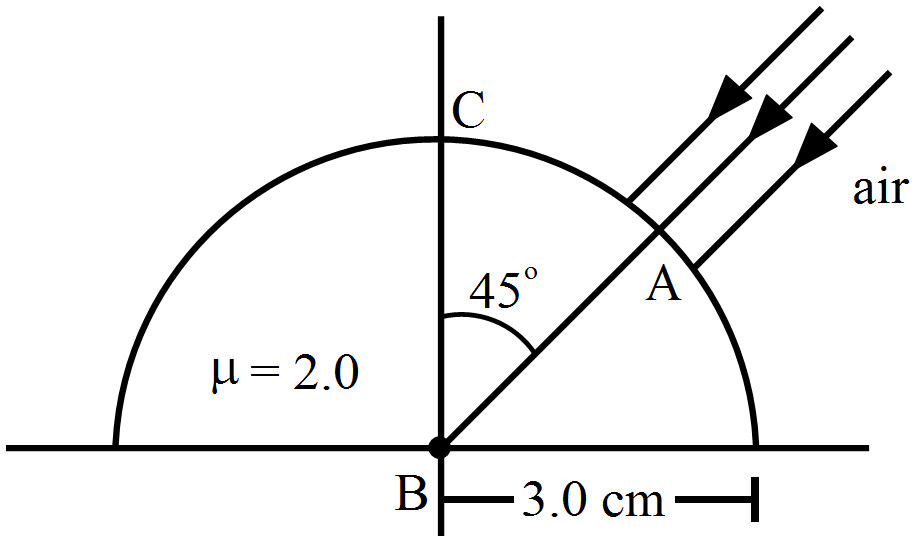
Figure shows a transparent hemisphere of radius 3.0cm made of a material of refractive index 2.0.
  1. A narrow beam of parallel rays is incident on the hemisphere as shown in the figure. Are the rays totally reflected at the plane surface?
  2. Find the image formed by the refraction at the first surface.
  3. Find the image formed by the reflection or by the refraction at the plane surface.
  4. Trace qualitatively the final rays as they come out of the hemisphere.

A closed coil having 100 turns is rotated in a uniform magnetic field B = 4.0 × 10⁻⁴T about a diameter which is perpendicular to the field. The angular velocity of rotation is 300 revolutions per minute. The area of the coil is 25cm2 and its resistance is $4.0\Omega.$ Find
  1. The average emf developed in half a turn from a position where the coil is perpendicular to the magnetic field.
  2. The average emf in a full turn.
  3. The net charge displaced in part (a).