Question
State the use of galvanometer as a voltmeter.

Answer

A galvanometer can also be used as a voltmeter.

Image

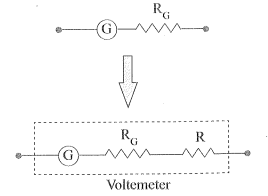
For using galvanometer as a voltmeter it is connected in parallel with that component of the circuit.
A galvanometer is a very sensitive device, so to avoid damage the current passing through it should be very small.
For this a large resistance is connected in series with galvanometer, as shown in the figure.
The resistance of voltmeter is $R _{ G }+ R$
But $R \gg R _{ G }$,
So, $R _{ G }$ can be neglected as compare to R so the resistance of the voltmeter becomes $\approx R$.

Need a full question paper?

Generate a complete, print-ready paper with questions like this in minutes — across 16+ boards, with answer keys.
Start Generating Free

Similar questions

Draw the series L-C-R AC circuit and obtain the relationship between voltage and current for this circuit. (Derive the necessary equations.)
A square coil of 200 turns of size $\frac{50}{\pi}$ is rotated in a magnetic field of 2.0 weber/ at the speed of 1200 rotations/minute. Calculate the magnitude of maximum induced electromotive force in the coil.
The mutual inductance between two coils is 2.5H. If the current in one coil is changed at the rate of 1A/s, what will be the emf induced in the other coil?
Discuss induced emf produced in a conducting rod during its motion in direction perpendicular to uniform magnetic field with reference to Lorentz force and obtain its expression.
Draw a circuit diagram using a metre bridge and write the necessary mathematical relation used to determine the value of an unknown resistance. Why cannot such an arrangement be used for measuring very low resistances?
Answer the following:
The discharging current in the atmosphere due to the small conductivity of air is known to be 1800A on an average over the globe. Why then does the atmosphere not discharge itself completely in due course and become electrically neutral? In other words, what keeps the atmosphere charged?
Two concentric spherical shells have masses M1, M2 and radii R1, R2 (R1, < R2). What is the force exerted by this system on a particle of mass m1 if it is placed at a distance $\frac{\text{R}_1+\text{R}_2}{2}$ from the centre?
A bullet passes past a person at a speed of 220m/s. Find the fractional change in the frequency of the whistling sound heard by the person as the bullet crosses the person. Speed of sound in air = 330m/s.
X-ray and visible light travel at the same speed in vacuum. Do they travel at the same speed in glass?
Answer the following question:
Ray optics is based on the assumption that light travels in a straight line. Diffraction effects (observed when light propagates through small apertures/slits or around small obstacles) disprove this assumption. Yet the ray optics assumption is so commonly used in understanding location and several other properties of images in optical instruments. What is the justification?