Questions

2 Marks Questions

🎯

Test yourself on this topic

23 questions · timed · auto-graded

Question 12 Marks
Explain Biot-Savart Law.
Answer
Law : "The intensity of magnetic field due to an electric current element I $\overrightarrow{d l}$ at a point having position vector $\vec{r}$ with respect to the electric current element is given by the formula, $d \overrightarrow{ B }=\frac{\mu_0}{4 \pi}=\frac{ I \overrightarrow{d l} \times \hat{ r }}{r^2}, \because$
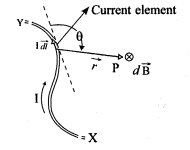
→As shown in the figure, a finite conductor XY carries current I.

Image

→A point P is located at some distance from the conductor. We want to find magnetic field at point P . For this, consider the conductor as divided in to an small elements and choose one small current element $I d \vec{l}$ from conductor.
→$\vec{r}$ is the position vector of point P from this current element $I d \vec{l}$. The angle between $I d \vec{l}$ and the position vector $\vec{r}$ is $\theta$.
→According to Biot-Savart's law, the magnitude of magnetic field $d \overrightarrow{ B }$ is proportional to the current I , the element length $\mid \vec{d} \vec{l}$ and inversely proportional to the square of the distance $r$. It's direction is perpendicular to the plane of $d \vec{l}$ and $\vec{r}$.
→The direction of the magnetic field can be found using the right hand screw rule.
→Vector form,
$\begin{array}{l}
\text { Vector form, } \\
\qquad d \overrightarrow{ B } \propto \frac{ I d \vec{l} \times \vec{r}}{r^3} \\
\therefore \quad d\overrightarrow{ B }=\frac{\mu_0}{4 \pi} \cdot \frac{ I d \vec{l} \times \vec{r}}{r^3}
\end{array}$
Where, $\frac{\mu_0}{4 \pi}$ is a constant of proportionality and its SI unit has the exact value,
$\frac{\mu_0}{4 \pi}=10^{-7} \frac{ Tm }{ A }$
$\mu_0=$ the permeability of free space.
Equation (1) holds when the medium is only vacuum.
→The magnitude of this field is :
$\begin{aligned}
d B & =\frac{\mu_0}{4 \pi} \cdot \frac{ I d l r \sin \theta}{r^3} \\
\therefore \quad d B & =\frac{\mu_0}{4 \pi} \cdot \frac{ I d l \sin \theta}{r^2}
\end{aligned}$
→To obtain the total magnetic field at point $P$ due to entire wire, equation (1) has to be integrated.
$\begin{aligned}
\overrightarrow{ B } & =\int d \overrightarrow{ B } \\
\overrightarrow{ B } & =\frac{\mu_0}{4 \pi} \int \frac{ I d \vec{l} \times \hat{r}}{r^2}
\end{aligned}$
View full question & answer
Question 22 Marks
State the right hand thumb rule for finding the direction of the magnetic field due to a current carrying circular loop.
Answer
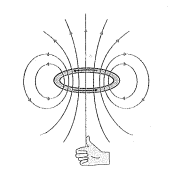
Figure shows the magnetic field lines produced by a current carrying loop, which forms closed loops.

Image

→Rule : "Curl the palm of your right hand around the circular wire with the fingers pointing in the direction of the current. The right hand thumb gives the direction of the magnetic field."
View full question & answer
Question 32 Marks
Give brief information about the solenoid.
Answer
Solenoid : "A helical coil consisting of closely wound turns of insulated conducting wire is called a solenoid."
→If the length of a solenoid is very large as compared to its radius, the solenoid is called long solenoid.
→Solenoid consists of a long wire wound in the form of a helix where the turns are closely spaced. Hence, each turn can be considered as a circular loop.
→The total magnetic field of solenoid is the vector sum of the fields due to all the turns.
→Enamelled wires are used for winding to make turns insulated from each other.

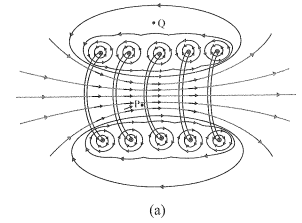
Image

(a) The magnetic field due to a section of the solenoid which has been stretched out for clarity. Only the exterior semicircular part is shown. Notice how the circular loops between neighbouring turns tend to cancel.

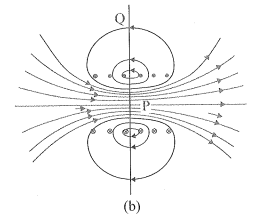
Image

(b) The magnetic field of a finite solenoid.
→Figure shows the magnetic field lines for a finite solenoid.
→It is clear from the figure (a) that the magnetic field of the circular loop between two neighbouring turns cancel out each other (in opposite direction)
→From the figure (b), it can be seen that the magnetic field is uniform, strong and in the direction of its axis at the mid point P inside the solenoid.
→While the magnetic field at the outer mid point Q is weak and almost parallel to the axis of the solenoid.
→ As the solenoid is made longer it looks like a long cylindrical metal sheet.
→Here we assume that for a long solenoid, the magnetic field outside the solenoid is zero, while inside the magnetic field is parallel to the axis every where.
View full question & answer
Question 42 Marks
Discuss the motion of a charged particle in a uniform magnetic field with initial velocity perpendicular to the magnetic field.
###
Explain the principle of cyclotron.
Answer
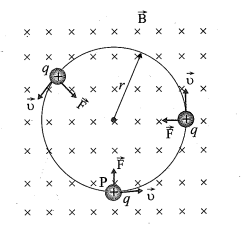
Image

→As shown in the figure the magnetic field is perpendicular to the plane of paper going inside.
→In this magnetic field, A charged particle is introduced perpendicular to the magnetic field with a velocity of $\vec{v}$.
→As a result, a charged particle experiences the magnetic force according to the equation $q(\vec{v} \times \vec{B})$ This force provides a centripetal force on the particle, so that under the effect of this force the charged particle moves in a circular path. Suppose, the radius of the trajectory of the particle is $r$.
→Centripetal force $=$ magnetic force
$\begin{array}{l}
\therefore \quad \frac{m v^2}{r}=q u B \text {. } \\
(\because \vec{v} \perp \vec{B} \text { Therefore }=q \cup B \sin \theta \\
=q \cup B \sin 90=q \cup B ) \\
\therefore \frac{m v}{r}=q B \\
\therefore \quad r=\frac{m \cup}{q B} \\
\end{array}$
→Equation (1) shows that the radius of the circular path of a particle is proportional to the momentum of the particle $( P =m v )$
→So, if the momentum of particle increases, then the radius of the circular path also increases.
→Suppose the angular frequency of particle is $\omega$.
→linear velocity $v=r \omega$ using equation (2) in equation (1)
$\begin{array}{l}
\therefore r=\frac{m(r \omega)}{q B} \\
\therefore 1=\frac{m \omega}{q B} \\
\therefore \quad \omega=\frac{q B}{m}
\end{array}$
→But $\omega=2 \pi \nu$ (where, $v=$ frequency of particle)
$\begin{array}{l}
\therefore 2 \pi v=\frac{q B}{m} \\
\therefore v=\frac{q B}{2 \pi m}
\end{array}$
→Time period of charged particle
$\begin{aligned}
T & =\frac{1}{v} \\
\therefore T & =\frac{2 \pi m}{q B} \text { (From equation (4)) }
\end{aligned}$
→From equation (1) and (4) we can say that if the linear momentum of the charged particle is increased, the radius of the circular path increases but the frequency remains constant. Cyclotron works according to this principle.
View full question & answer
Question 52 Marks
Write the formula for the force per unit length between two parallel current carrying wires. Using it, write the definition of Ampere and Coulomb.
Answer
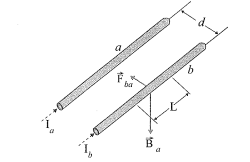
Image
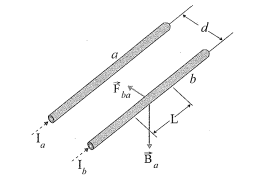
As shown in the figure, two long wires $a$ and $b$ are placed parallel. The (perpendicular) distance between them is $d$. The current passing through them are $I _a$ and $I _b$ respectively.
The force exerted by wire $a$ on a segment of length L on wire $b$ is
$F _{b a}=\frac{\mu_0 I _a I _b L}{2 \pi d}$
Force per unit length
$f_{b a}=\frac{ F _{b a}}{L}=\frac{\mu_0 I _a I _b}{2 \pi d}$
Similarly,
$f_{a b}=\frac{ F _{a b}}{L}=\frac{\mu_0 I _a I _b}{2 \pi d}$
If we take $I _a= I _b=1 A$ and $d=1 m$ in above equation then
$f_{a b}=f_{b a}=2 \times 10^{-7} N$
→Definition of 1 Ampere : "The ampere is the value of that steady current which, when maintained in each of the two very long, straight, parallel conductors of negligible cross-section, and placed one metre apart in vacuum, would produce on each of these conductors a force equal to $2 \times 10^{-7}$ Newtons per metre of length."
→1 Coulomb : "When a steady current of 1 A is set up in a conductor, the amount of charge passing through its cross-section in 1 s is 1 coulomb."
View full question & answer
Question 62 Marks
Derive the equation of the magnetic field produced by a long solenoid.
Answer
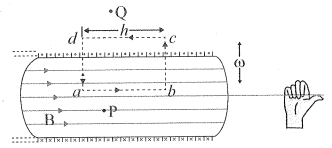
→The figure shows a cross-section area of a small portion of a very long solenoid.

Image

→Here $\odot$ (dot) represents that current leaving the plane and $(x)$ cross represents current entering the plane of paper.
→Here, we shall assume that the magnetic field outside of the solenoid is zero and inside it is constant and parallel to the axis.
→A rectangular Amperian loop $a b c d a$ is assumed in this magnetic field as shown in the figure.
→From the figure it is clear that the magnetic field is zero at the section $c d$ since it is outside the solenoid.
→The sections $b c$ and $a d$ are perpendicular to the magnetic field. Thus, these two sections make no contribution.
→But the section $a b$ is parallel to magnetic field and length of the Amperian loop is $L =h$
→Let $n$ be the number of turns per unit length then,
$\begin{aligned}
n & =\frac{\text { number of turns }}{\text { total length }} \\
& =\frac{ N }{h} \\
\therefore \quad N & =n h
\end{aligned}$
→Consider the current passing through each turn is I , then the total current enclosed by the Amperian loop is,
$I _e=n h I$
→According to Ampere's circuital law,
$\begin{aligned}
BL & =\mu_0 I _c \\
\therefore \quad B (h) & =\mu_0(n h I ) \\
\therefore \quad B & =\mu_0 n I
\end{aligned}\$
→The direction of the magnetic field is given by the right hand rule the solenoid is commonly used to obtain a uniform magnetic field.
View full question & answer
Question 72 Marks
Derive the formula of magnetic field for a current carrying infinite wire using Ampere's circuital law and discuss its interesting cases.
Answer
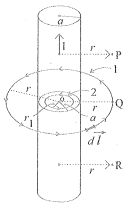
A straight infinite current carrying wire is shown in figure. The current passing through the wire is I.
Image
As shown in the figure, consider an Amperian loop of radius r and the magnetic field is tangential to the circumference of the circle.
From Ampere's circuital law
$\begin{array}{l} \oint \overrightarrow{ B } \cdot d \vec{l}=\mu_0 I \\ \therefore \quad \oint B d l \cos 0=\mu_0 I \\ \therefore B \oint d l=\mu_0 I \\ \therefore B ( L )=\mu_0 I \\ \therefore B (2 \pi r)=\mu_0 I \\ ( L =2 \pi r \text {-length Amperian loop} ) \\ \therefore B =\frac{\mu_0 I }{2 \pi r}\end{array}$
• Interesting Cases :
(i) The equation $B =\frac{\mu_0 I }{2 \pi r}$ shows that (taking wire as axis) the magnetic field has same magnitude at every point on a circle of radius $r$.
(ii) The direction of magnetic field at any point on this circle is tangential to it. Thus, the lines of constant magnitude of magnetic field form concentric circles.
(iii) Although the wire is infinite, the magnetic field, at a very close distance from it, is not infinite. It rapidly increases when it gets very close to the wire. The field is directly proportional to the current (I) and inversely proportional to the distance.
(iv) The direction of the magnetic field induced by a long wire can be obtained using the righthand thumb rule.
• Right hand thumb rule :
→ "Hold the wire in right hand with thumb pointing in the direction of the current, Fingers will curl around in the direction of the magnetic field."
View full question & answer
Question 82 Marks
Write the formula for the torque acting on a current-carrying coil placed in uniform magnetic field and explain its stable and unstable equilibrium states.
Answer
Torque exerted on a current carrying coil placed in a uniform magnetic field.
$\begin{array}{l} 
\vec{\tau}=\vec{m} \times \vec{B} \\
\therefore \quad \tau=m B \sin \theta
\end{array}$
When, $\vec{m}$ and $\overrightarrow{ B }$ are parallel $\left(\theta=0^{\circ}\right)$ then $\tau=0$ this state of coil is called the stable equilibrium.
In this condition, if the coil is rotated by a small angle the coil produces a torque which brings it back to its original position.
When $\vec{m}$ and $\vec{B}$ are anti parallel $(\theta=\pi)$, then $\tau=0$ then it is called the unstable equilibrium state.
In this condition, if the coil is rotated by small angle the coil produces a torque which can not bring it back to its original position.
View full question & answer
Question 92 Marks
Discuss the similarities and differences of BiotSavart law with the Coulomb's law.
Answer
Similarities between Biot-Savart law and Coulomb's law
(1) Both are long range because both depend inversely on the square of distance from the source to a given point.
(2) The principle of superposition applies to both fields.
Differences between Biot-Savart and Coulomb's law
(1) The electric field is produced by a scalar source electric charge Q but the magnetic field is produced by a vector source $I \vec{dl}$.
(2) The electric field is in the direction of displacement vector joining the source and the point in side the field. But the magnetic field is perpendicular to the plane containing the displacement vectors $\vec{r}$ and the current element $I d \vec{l}$.
(3) The Coulomb's law is not angle dependent but the Biot-Savart's law is angle dependent. e.g.,
$d \vec{l} \| \overrightarrow{ B }$ Then $\theta=0, \sin \theta=0$ and $d B=0$
View full question & answer
Question 102 Marks
Derive the formula for the magnetic fieid produced by a current-carrying circular coil as a magnetic dipole on its axis and equator. (Perpendicular bisector.)
Answer
The magnetic field produced at distance $x$ from its axis from the circular coil having radius R and current $I$ is.
$B =\frac{\mu_0 IR ^2}{2\left( R ^2+x^2\right)^{\frac{3}{2}}}$
The direction of this magnetic field can be obtained from right hand rule.
Suppose, $x>>$ R(Pointisvery far)fromequation (1)
$\therefore \quad B=\frac{\mu_0 R ^2}{2 x^3}$
$\therefore \quad B=\frac{\mu_0}{2 \pi} \cdot \frac{\left(\pi R ^2\right) I }{x^3}$
$\therefore \quad B=\frac{\mu_0}{2 \pi} \cdot \frac{I A}{x^3}$
(Where, $\pi R ^2= A$ area of coil)
But $IA =m$ (magnetic dipole moment)
$\therefore B=\frac{\mu_0}{2 \pi} \cdot \frac{m}{x^3}$
In vector form
\begin{aligned}
\overrightarrow{ B } & =\frac{\mu_0}{2 \pi} \cdot \frac{\vec{m}}{x^3} \\
\therefore \quad \overrightarrow{ B } & =\frac{\mu_0}{4 \pi} \cdot \frac{2 \vec{m}}{x^3}
\end{aligned}
This is the formula to find the magnetic field at a distance $x$ on the axis of the magnetic dipole.
Equation (2) is similar to the equation of electric field due to electric dipole for point on its axis.
$\overrightarrow{ E }=\frac{1}{4 \pi \varepsilon_0} \cdot \frac{2 \vec{p}}{x^3}(x \gg a)$
Electric field at a point on equator on electric dipole is
$\overrightarrow{ E }=-\frac{1}{4 \pi \varepsilon_0} \cdot \frac{\vec{p}}{x^3}(x>>a)$
If we replace $\overrightarrow{ E } \rightarrow \overrightarrow{ B } \mu_0 \rightarrow \frac{1}{\varepsilon_0}$ and $\vec{p} \rightarrow \vec{m}$ in above equation we get,
$\therefore \overrightarrow{ B }=-\frac{\mu_0}{4 \pi} \cdot \frac{\vec{m}}{x^3}$
This is the formula to find the magnetic field at a distance $x$ on the equator of magnetic dipole.
View full question & answer
Question 112 Marks
Give the sign convection for electric or magnetic field leaving and entering the plane of the paper.
Answer
A current or electric field or magnetic field emerging (leaving) out of the plane of the paper is depicted by a dot (๑). While a current or an electric (or magnetic) field going in to the plane of the paper is depicted by a cross $(\otimes)$
View full question & answer
Question 122 Marks
Write and explain Ampere's circuital law.
Answer
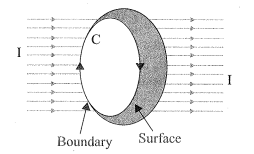
As shown in the figure, Ampere's circuital law considers an open (free) surface with a boundary line.
Image
An electric current is passing through this open surface.
Consider the surface boundary divided into small elements of length dl . At this element, the tangential component of the magnetic field is $B _t$ $(= B \cos \theta)$
The integral of the product of the length element (dl) and the tangential component of the magnetic field is equal to $\mu_0$ times the total current passing through the surface.
$\begin{aligned}
& \oint B _t d l=\mu_0 I \\
\therefore \quad & \oint( B \cos \theta) d l=\mu_0 I \\
\therefore \quad & \oint \overrightarrow{ B } \cdot d \vec{l}=\mu_0 I
\end{aligned}$
Here, the integral is taken over the closed loop coinciding with the boundary C of the surface.
Here, the right hand thumb rule is used for sign - convention of electric currents enclosed by a closed loop.
Fingers of the right hand be curled in the sense the boundary is traversed in the loop then the direction of the thumb gives the sense in which the current is considered as positive and current in the opposite direction is considered negative.
To simplify Ampere's circuital law, the loop is assumed, which is called an amperian loop.
The loop is chosen in such a way that for each point of it, either
(i) $\vec{B}$ is tangential to the loop and B is a nonzero constant.
(ii) $\vec{B}$ is perpendicular (or normal) to the loop
(iii) $\overrightarrow{ B }$ is eliminated (or vanishes)
Now, suppose $L$ is the length of the loop for which $\vec{B}$ is tangential and the current enclosed
by the loop is $I _e$ then equation (1) becomes.
$BL =\mu_0 I _e$
This equation is a special representation of Ampere's circuital law.
View full question & answer
Question 132 Marks
Explain current sensitivity and voltage sensitivity of galvanometer.
Answer
Current Sensitivity :
For moving coil Galvanometer,
$\phi=\frac{ NBA }{k} \cdot I$
Where, $N =$ number of turns in coil
$A =$ area of coil
$k=$ the torsional constant of spring
$B =$ magnetic field
$I=$ current passing through the coil.
The deflection per unit current is called the current sensitivity of the galvanometer.
$\therefore \frac{\phi}{ I }=\frac{ BAN }{k}$
From, equation (2) it is clear that to increase the current sensitivity of galvanometer of coil, number of turns $( N )$ are increased.
Voltage Sensitivity :
Multiplying $\frac{1}{R}$ on the both sides of equation (2), we get.
$\begin{aligned}
\frac{\phi}{ IR } & =\frac{ BAN }{k R } \\
\therefore \quad \frac{\phi}{ V } & =\frac{ BAN }{k R }
\end{aligned}$
The deflection per unit voltage is known as the voltage sensitivity of galvanometer.
Equation (3) shows that if the number of turns in the coil is increased, the resistance of coil also increases, So that the voltage sensitivity remains constant.
View full question & answer
Question 142 Marks
Prove that $\varepsilon_0 \mu_0=\frac{1}{c^2}\left(\right.$ or $\left.c=\frac{1}{\sqrt{\varepsilon_0 \mu_0}}\right)$. ###
Derive the relation between the permittivity of free space $\left(\varepsilon_0\right)$, the permeability of free space $\left(\mu_0\right)$ and the speed of light $(c)$.
Answer
By taking product, $\varepsilon_0 \mu_0$
$\begin{aligned}
& \therefore \quad \varepsilon_0 \mu_0 & =\left(\frac{\mu_0}{4 \pi}\right)\left(4 \pi \varepsilon_0\right)=10^{-7} \times \frac{1}{9 \times 10^9} \\
& \varepsilon_0 \mu_0 & =\frac{1}{9 \times 10^{16}} \\
& \therefore \quad \mu_0 \varepsilon_0 & =\frac{1}{\left(3 \times 10^8\right)^2} \\
& \therefore \quad \mu_0 \varepsilon_0 & =\frac{1}{c^2} \\
& \therefore \quad c & =\frac{1}{\sqrt{\mu_0 \varepsilon_0}}
\end{aligned}$
View full question & answer
Question 152 Marks
Define the SI unit of the magnetic field.
Answer
The SI unit of magnetic field is Tesla (T)
The magnetic force $F _m=q \cup B \sin \theta$ $B =\frac{ F _m}{q v}\left(\theta=90^{\circ}\right)$
When the force acting on a unit charge ( 1 C) moving perpendicular to magnetic field with a speed of $1 m / s$ is 1 N then the magnitude of magnetic field $(\vec{B})$ is to be $1 T$.
Tesla is a large unit of magnetic field. The smaller unit (CGS) is called gauss.
$1 \text { gauss }=10^{-4} T$
The earth's magnetic field is about $3.6 \times 10^{-5} T$
View full question & answer
Question 162 Marks
State the research done by scientists on electromagnetism after Oersted's observation.
Answer
After the observation of Oersted, in 1864 James Maxwell examined the laws governing electricity and magnetism and concluded that light is an electromagnetic wave.
Scientist Hertz discovered radio waves and, Jagdish Bose, Marconi produced radio waves experimentally by the end of the $19^{\text {th }}$ century.
This led to the invention of devices for generation, amplification, transmission and detection of electromagnetic waves in the $20^{\text {th }}$ century.
View full question & answer
Question 172 Marks
What is magnetic dipole moment? Write its Sl unit and dimensional formula.
Answer
The product of the current flowing in the coil and its area vector is called the magnetic dipole moment of the coil.
Let I be the current passing through the coil and area A , then its magnetic dipole moment $\vec{m}=I \vec{A}$
Suppose there are N turns in the coil and the current passing through each turn is I, then the magnetic dipole moment of the coil,
$\vec{m}= NI \overrightarrow{ A }$
The magnetic dipole moment is vector quantity and its direction is in the direction of area vector. The SI unit of dipole moment is $Am ^2$ and its dimensional formula is $M ^0 L^2 T^0 A^1$.
View full question & answer
Question 182 Marks
State the use of galvanometer as a voltmeter.
Answer
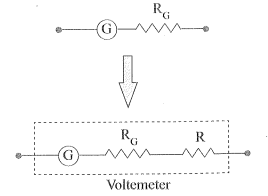
A galvanometer can also be used as a voltmeter.

Image

For using galvanometer as a voltmeter it is connected in parallel with that component of the circuit.
A galvanometer is a very sensitive device, so to avoid damage the current passing through it should be very small.
For this a large resistance is connected in series with galvanometer, as shown in the figure.
The resistance of voltmeter is $R _{ G }+ R$
But $R \gg R _{ G }$,
So, $R _{ G }$ can be neglected as compare to R so the resistance of the voltmeter becomes $\approx R$.
View full question & answer
Question 192 Marks
A galvanometer cannot be used directly to measure current - why ? Explain the solution of this problem.
###
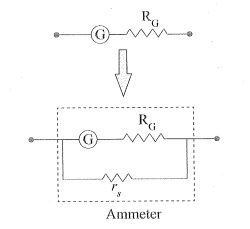
State the difficulties occured and their solution when galvanometer is directly used as ammeter.
Answer
There are two reasons why a galvanometer cannot be used directly as an ammeter

Image
(i) Galvanometer is a very sensitive device. It also shows the full scale deflection for a current of the order of $\mu A$.
(ii) To measure current, a galvanometer has to be connected in series but its resistance is high, so that it changes the value of the current flowing in the circuit.
To overcome these difficulties, a small resistance called a shunt is connected to the galvanometer.
The shunt is connected in parallel with the galvanometer. Due to this, most of the current passes through the shunt.
The resistance of this arrangement is $=\frac{R_{ G } r_{ S }}{ R _{ G }+r_{ S }}$ But $R _{ G } \gg r_{ S }$
So, we can neglect $r_{ S }$ as compared to $R _{ G }$
So, $\frac{ R _{ G } r_{ S }}{ R _{ G }} \approx r_{ S }$
Since, the value of $r_{ S }$ very small, the original current does not change and the true value of current can be measured.
View full question & answer
Question 202 Marks
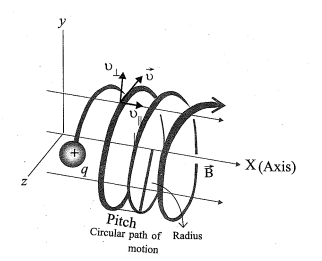
Illustrate by drawing the helical motion of a charged particle in a uniform magnetic field and derive the equations of pitch and radius of helix.
###
Discuss the path of motion of a charged particle entering with velocity at angle $\theta$ with uniform magnetic field. (where $\theta \neq 0, \frac{\pi}{2}, \pi$ )
Answer
Image

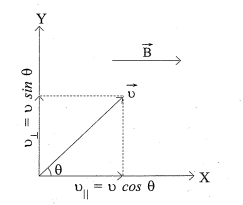
A charged particle enters in a uniform magnetic field with velocity $\vec{v}$ in a direction making an angle $\theta$ with the magnetic field as shown in the figure. (Where, $\theta \neq 0, \theta \neq 180^{\circ}, \theta \neq 90^{\circ}$ )


Image

As the result two perpendicular components of velocity have to be considered.
(i) $v_{\|}=v \cos \theta$ (Parallel component)
Since this component is parallel to the magnetic field there will be no effect due 1 to magnetic field.
This parallel component causes the charge particle to move linearly along with direction of the magnetic field.
(ii) $v_{\perp}=v \sin \theta$ (Perpendicular component)
Since this component is perpendicular to magnetic field, this component is responsible for the circular motion of particle.
Thus, the trajectory of the charged particle under the influence of these two components is helical (spiral).
Time period of particle $T =\frac{2 \pi m}{q B}$
The distance traveled by a charged particle in the direction of the magnetic field during one rotation is called the pitch.
$\begin{array}{l}
\therefore p=v_{\|} T \\
\therefore p=(v \cos \theta)\left(\frac{2 \pi m}{q B}\right) \\
\therefore p=\frac{2 \pi m v \cos \theta}{q B}
\end{array}$
The radius of the circular component of the particle's motion is called the radius of the helix.
$\begin{array}{l}
\therefore r=\frac{m v_{\perp}}{q B} \\
\therefore r=\frac{m \cup \sin \theta}{q B} \\
\end{array}$
View full question & answer
Question 212 Marks
Explain the sources of electric and magnetic field.
Answer
A steady charge Q produces an electric field (from chapter-1) E.
The electric field on point at a distance $r$ from the point charge $Q$ is
$\therefore \overrightarrow{ E }=\frac{1}{4 \pi \varepsilon_0} \cdot \frac{ Q }{r^2} \cdot \hat{r}\left(\text { or } \frac{ KQ }{r^2} \hat{r}\right)$
Apart from being dependent on every point in space, the electric field can vary with time.
If more than one electric field converge near a point, the resultant electric field at the point is equal to the vector sum of all the electric field.
Just as static charges produce an electric field, moving charges or current produces a magnetic field denoted by $\overrightarrow{ B }(\vec{r})$.
Similar to electric field, the magnetic field can also be defined at every point in space and it also follows the principle of superposition.
View full question & answer
Question 222 Marks
State the Oersted's observation.
Answer
Image

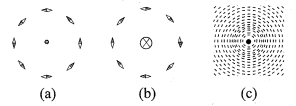
→Oersted observed that a current in a straight wire caused deflection in a nearby magnetic compass needle.
→As shown in the figure (a), the wire is perpendicular to the plane of the paper. Electric current is emerging out of the plane of the paper.
→In this condition, the alignment of the needle is tangential to an imaginary circle which has straight wire as its centre and plane perpendicular to the wire.
→Here, since the current passing through the wire is relatively large, the resulting magnetic field is relatively strong, so the Earth's magnetic field can be neglected.
→As shown in figure (b), by reversing the direction of the current (going in to the plane of paper)the orientation of the needle is also reversed.
→The deflection of needle increases on increasing the current or bringing the needle closer to the wire. it indicates that the magnetic field increases in magnitude.
→As shown in figure (c). If iron ear fillings sprinkled around the wire arrange themselves in concentric circles with the wire as the centre.
→From all of these experiments, Oersted concluded that moving charges or currents produced a magnetic field in the surrounding space.
View full question & answer
Question 232 Marks
Derive the equation for the force acting on two parallel current carrying wires.
View full question & answer
2 Marks Questions - Physics STD 12 Science Questions - Vidyadip