Question
State the utility of oxygen for respiration in plants

Answer

Respiration in plants:
  1. Plants respire during the day and night.
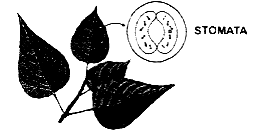
  2. Plants respire through tiny pores on the surface of the leaves called ‘stomata’.
  3. The stomata help in taking in the oxygen of the air and giving out carbon dioxide. Thus, they function as respiratory organs.
  4. Plants do not perform bodily activities and hence need less energy than animals. The rate of respiration in plants is thereby slower than in animals.

Photosynthesis in plants:
Photosynthesis is a process by which green plants prepare their own food in the presence of sunlight and chlorophyll.
  1. In the leaf of a green plant are present leaf cells which contain chloroplasts in which is present a green pigment called chlorophyll.
  2. During photosynthesis which occurs during daytime, carbon dioxide and water in the presence of sunlight and chlorophyll is changed into glucose, and oxygen is released out.
    Image
  3. Hence oxygen in the air is renewed by photosynthesis and therefore the amount of oxygen in the air does not get depleted or removed from the air.

Need a full question paper?

Generate a complete, print-ready paper with questions like this in minutes — across 16+ boards, with answer keys.

Start Generating Free

Similar questions

State what is meant by the term ‘conservation of water’.
State a few water-saving methods, which may be used in the home to conserve water.
If ‘X’ g. of potassium nitrate is added to 100 g. of water at 60°C and the salt dissolves completely then :
(a) is ‘X’ g. the solubility of potassium nitrate at 60°C.
(b) is the solution formed – saturated or unsaturated
(c) if on addition ‘X’ + ‘Y’ g. of potassium nitrate to the same amount of water at the same temperature and the solute now just remains behind after stirring then –
(d) is the solution now – saturated or unsaturated
(e) is ‘X’ + ‘Y’ g. the solubility of potassium nitrate.
Explain the importance of carbon dioxide for (a) photosynthesis (b) warming the earth’s environment. State what would happen if excess carbon dioxide as a pollutant is released into the atmosphere.
Differentiate between chemical pollution and thermal pollution.
Explain in brief the importance of Chemistry in agriculture.
State the technique of separation of immiscible liquids using a separating funnel.
Describe simple experiments to prove that solids occupy space
Explain the term ‘sieving’. State the structure of a sieve and explain the separation of different sized particles by sieving.
Differentiate between homogeneous and heterogeneous mixtures with suitable examples.
State what would you observe if
(a) sugar is added to pebbles take in a plastic beaker
(b) sand is added to glass balls in a beaker. What would you conclude from this imaginative demonstration?