Questions

[5 Mark Question Answer]

Take a timed test

10 questions · self-marked practice — reveal the answer and mark yourself.

Question 15 Marks
State two similarities and two differences between respiration and burning.
Answer
Similarities:
Burning
  1. Oxygen is needed to combine with carbon and hydrogen in compound.
  2. .CO2 and H2O are formed with release of energy.

Respiration

  1. Oxygen is needed to combine with C and H2 of food.
  2. CO2 and H2O are formed with release of energy.

Differences:
Burning

  1. It occurs at higher temperatures.
  2. It is a fast process.
  3. A natural and continuous process.

Respiration

  1. It occurs at body temperature.
  2. It is a slow process.
  3. An artificial & discontinuous process.
View full question & answer
Question 25 Marks
State the full form of LPG and CNG? How are the two different in their composition?
Answer
LPG (Liquefied Petroleum Gas): It is obtained from crude petroleum oil. It mainly contains gaseous compounds known as isobutane and butane. Popularly it is known as cooking gas. It is the best fuel for domestic purposes and in laboratories. It is available in cylinders. It is also supplied through pipes in big cities.
CNG (Compressed Natural Gas): It is produced along with crude oil. It mainly contains methane gas. It has become a popular fuel for vehicles like three-wheeler scooters, cars, and buses. It is a cheap fuel as well as pollution-free. It is used as a substitute for petrol. The difference in composition
LPG is obtained from crude petroleum oil. It mainly contains gaseous compounds known as isobutane and butane. While
CNG is produced along with crude oil. It mainly contains methane gas.
View full question & answer
Question 35 Marks
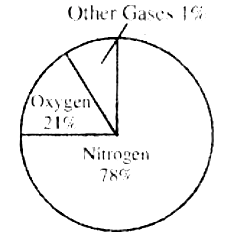
Write down the composition of three main gases present in air by volume.
Answer
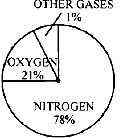
Composition of air by volume
Nitrogen 78%
Oxygen 21%
Carbon dioxide 0.03-0.04%
Inert gases 0.9%
Water vapours Variable
Bust particles Variable
Other impurities Variable
OR
Gases Percentage Figure
Nitrogen 78%
Oxygen 21%
Carbon dioxide 0.03-0.04%
Inert gases 0.9%
Water vapours Variable
Bust particles Variable
Other impurities Variable
View full question & answer
Question 45 Marks
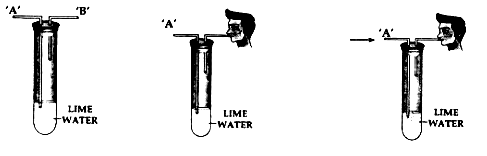
You are given a test tube with two outlets and a bottle of lime water. Using same, how would you demonstrate experimentally the presence of carbon dioxide in air.
Answer
Procedure:
  1. Take lime water in a test tube with two outlets ‘A’ and ‘B’ as shown above.
  2. Air is sucked slowly through the outlet ‘B’.
  3. Air moves in through end ‘A’ and passes through the lime water

Observation: The line water in the test tube turns milky.
Conclusion:Air which is sucked in from and ‘A’ contains carbon dioxide which turns the lime water milky. Hence, air contains – carbon dioxide.
View full question & answer
Question 55 Marks
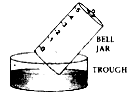
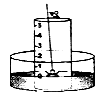
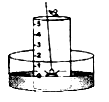
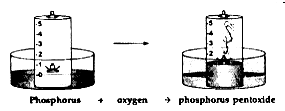
With the help of a labeled diagram, describe a simple experiment to show the presence of oxygen and nitrogen in air using a piece of white phosphorus.
Answer
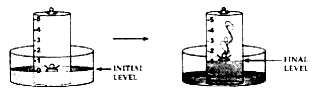
Activity to show the presence of oxygen and nitrogen in the air using a piece of white phosphorous

1. A trough is taken and filled with water
2. Over it is placed a bell-jar marked with five equal parts
.
3. A crucible containing white phosphorus is placed on a cork
4. The cork is made to float on the water.

5. A heated iron rod is them taken.
6. The phosphorus is ignited with the heated rod.
Observations: Dense white fumes of phosphorus pentoxide ($P_2O_5$​​​​​​​) are formed when the phosphorus (P) burns in the active component of air (oxygen).

The rise in the level of water in the bell-jar is by $1/5$​​​​​​​
Oxygen(active compound) 1/5 (approx volume) Supports combustion Used up in burning
Nitrogen(In active component bell - jar) 4/5 (approx volume) Does not support combustion Remains behind in the combustion
View full question & answer
Question 65 Marks
Name the components of air with their approximate percentage by volume in air. Does the percentage by volume of each component remain the same, in the atmosphere of different parts of the world? Explain with reasons.
Answer
The main components of the air are :
1. Nitrogen
2. Oxygen
Composition of air by volume:
Nitrogen: 78% or 4/5 th
Oxygen: 21% or 1/5 th
Carbon dioxide: 0.03 - 0.04%
Inert gases: 0.9%
[Water vapours, dust particles, other impurities]: variable
OR
Gases Percentage Figure
Nitrogen 78%
Oxygen 21%
Carbondioxide 0.03-0.04%
Inert gases 0.90%
Watervapour Varies
Dustparticles Varies
Otherimpurities Varies
Air is a mixture whose composition varies at different intervals of time and different places of the world.
View full question & answer
Question 75 Marks
Explain in brief the different layers of the atmosphere and the basic functions of the main layers.
Answer
Layers of atmosphere Distance from earth (approximate) Basic Function
(i) Troposphere 0 to 10 kilometers The troposphere contains most of the air and oxygen in the atmosphere. This air is fit for respiration and survival of living organisms. Weather conditions are formed in the troposphere.
(ii) Stratosphere 10 to 50 kilometers The stratosphere contains the ozone layer which prevents the harmful effects of the sun (U. V. rays) from reaching the earth.
(iii) Mesosphere 50 to 80 kilometers The mesosphere is a very cold layer and most meteors burn up in this layer and hence are prevented from entering the earth's atmosphere
Thermosphere 80 to 320 kilometers -
View full question & answer
Question 85 Marks
Explain the importance of carbon dioxide for (a) photosynthesis (b) warming the earth’s environment. State what would happen if excess carbon dioxide as a pollutant is released into the atmosphere.
Answer
(a) During photosynthesis which occurs during daytime, carbon dioxide and water in the presence of sunlight and chlorophyll is changed into carbohydrates and oxygen is released out.
Hence oxygen in the air is renewed by photosynthesis and therefore the amount of oxygen in air does not get depleted or removed from air.
(b) Infrared (I.R.), visible rays and ultra violet (U.V.) rays are present in the earth’s surface.
The reflected U.V. rays from the earth’s surface pass through the carbon dioxide in the atmosphere, but the I. R. rays are prevented by the carbon dioxide from being radiated out of the earth’s surface. This results in the earth’s environment staying warm. The thick$CO _2$ layer prevents the heat radiations from being radiated out which results into rise in global temperature.
View full question & answer
Question 95 Marks
State the utility of oxygen for respiration in plants
Answer
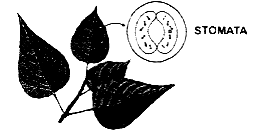
Respiration in plants:
  1. Plants respire during the day and night.
  2. Plants respire through tiny pores on the surface of the leaves called ‘stomata’.
  3. The stomata help in taking in the oxygen of the air and giving out carbon dioxide. Thus, they function as respiratory organs.
  4. Plants do not perform bodily activities and hence need less energy than animals. The rate of respiration in plants is thereby slower than in animals.

Photosynthesis in plants:
Photosynthesis is a process by which green plants prepare their own food in the presence of sunlight and chlorophyll.
  1. In the leaf of a green plant are present leaf cells which contain chloroplasts in which is present a green pigment called chlorophyll.
  2. During photosynthesis which occurs during daytime, carbon dioxide and water in the presence of sunlight and chlorophyll is changed into glucose, and oxygen is released out.
    Image
  3. Hence oxygen in the air is renewed by photosynthesis and therefore the amount of oxygen in the air does not get depleted or removed from the air.
View full question & answer
Question 105 Marks
State the utility of oxygen for respiration in living organisms
Answer
Respiration in living organisms :
Respiration: It is a process whereby living things
  1. Use oxygen from their air to oxidize food substances mainly glucose, in their body cells.
  2. Release energy in the form of heat.
  3. Carbon dioxide and water vapour are also produced and released in the exhaled air
Image

Process:
  1. Inhaled air— Oxygen from inhaled air dissolves in the blood stream in the lungs. It is carried to the cells where the food materials i.e. glucose is oxidized by the oxygen.
  2. Exhaled air— Carbon dioxide, water vapour, and heat energy diffuse out of the lungs as exhaled air.
  3. The energy liberated— The energy liberated is utilized for metabolic activities and maintains body temperature.
     
View full question & answer
[5 Mark Question Answer] - CHEMISTRY STD 6 Questions - Vidyadip