Question
State the various postulates of Dalton’s atomic theory of matter.

Answer

Postulates of Dalton's atomic theory:
  1. All the matter is made up of very small particles called 'atoms'.
  2. Atoms cannot be divided.
  3. Atoms can neither be created nor be destroyed.
  4. Atoms are of various kinds. There are as many kinds of atoms as are elements.
  5. All the atoms of a given element are identical in every respect, having the same mass, size and chemical properties.
  6. Atoms of different elements differ in mass, size and chemical properties.
  7. The 'number' and 'kind' of atoms in a given compound is fixed.
  8. During chemical combination, atoms of different elements combine in small whole numbers to form compounds. Atoms of the same elements can combine in more than one ratio to form more than one compound.

Need a full question paper?

Generate a complete, print-ready paper with questions like this in minutes — across 16+ boards, with answer keys.
Start Generating Free

Similar questions

List five characteristics by which compounds can be distinguished from mixtures.
If one gram of sulphur contains $x$ atoms, calculate the number of atoms in one gram of oxygen element.
(Atomic masses: $S = 32\ u; O = 16\ u)$
Show by using the graphical method that:
$\text{s}=\text{ut}+\frac{1}{2}\text{at}^2$
where the symbols have their usual meanings.
The electronic configuration of an element Z is 2, 8, 8.
  1. What is the atomic number of the element?
  2. State whether element Z is a metal or a non-metal.
  3. What type of ion (if any) will be formed by an atom of element Z? Why?
  4. What is special about the outermost electron shell or the atom of this element?
  5. Give the name and symbol of element Z.
  6. Name the group of elements to which Z belongs.
State Newton’s third law of motion and give two examples to illustrate the law.
The atom of an element $X$ contains $17$ protons, $17$ electrons and $18$ neutrons whereas the atom of an element $Y$ contains $11$ protons, $11$ electrons and $12$ neutrons.
  1. What type of ion will be formed by an atom of element $X$? Write the symbol of ion formed.
  2. What will be the number of (i) protons (ii) electrons, and (iii) neutrons, in the ion formed from $X$?
  3. What type of ion will be formed by an atom of element $Y$? Write the symbol of ion formed.
  4. What will be the number of (i) protons (ii) electrons, and (iii) neutrons, in the ion formed from $Y$?
  5. What is the atomic mas of (i) $X$, and (ii) $Y$?
  6. What could the elements $X$ and $Y$ be?
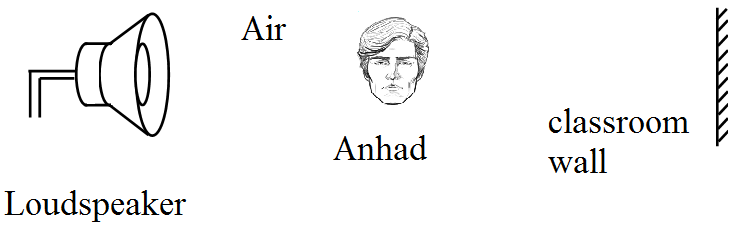
In an experiment, Anhad studies sound waves. He sets up a loudspeaker to produce sound as shown below:
Anhad adjusts the signal to the loudspeaker to give a sound of frequency 200Hz.
  1. What happens to the air in-between Anhas and the loudspeaker?
  2. Explain how Anhad receives sound in both ears.
When extremely small particles X derived from the another of a flower were suspended in a liquid Y and observed through a microscope, it was found that the particles X were moving throughout the liquid Y in a very zig zag way. It was also observed that warmer the liquid Y, faster the particles X moved in its surface.
  1. What could particles X be?
  2. What do you think liquid Y is?
  3. What is the zig-zag movement of particles X?
  4. What is causing the zig-zag movement of particles X?
  5. Name the scientist who discovered this phenomenon.
  6. What does this experiment tell us about the nature of liquid Y?
A body starting from rest travels with uniform acceleration. If it travels 100m in 5s, what is the value of acceleration?
A boy of mass $50\ kg$ running at $5\ m/s$ jumps on to a $20\ kg$ trolley travelling in the same direction at $1.5\ m/s$. What is their common velocity?