Question
Show by using the graphical method that:
$\text{s}=\text{ut}+\frac{1}{2}\text{at}^2$
where the symbols have their usual meanings.
Answer

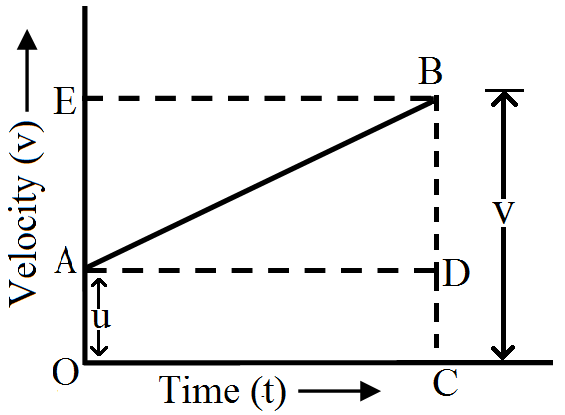
Consider the velocity-time graph of a body shown in figure. The body has an initial velocity u at a point A and then its velocity changes at a uniform rate from A to B in time t. In other words, there is a uniform acceleration a from A to B, and after time t its final velocity becomes v which is equal to BC in the graph. The time t is represented by OC.

Suppose the body travels a distance s in time t. In the figure, the distance travelled by the body is given by the area of the space between the velocity-time graph AB and the time axis OC, which is equal to the area of the figure OABC. Thus:
Distance travelled = Area of figure OABC
= Area of rectangle OABC + area of triangle ABD
Now, we will find out the area of rectangle OABC and area of triangle ABD.
  1. Area of rectangle OADC = OA × OC
= u × t

= ut
  1. Area of triangle ABD $=\Big(\frac{1}{2}\Big)\times\text{Area of rectangle AEBD}$
$=\Big(\frac{1}{2}\Big)\times\text{AD}\times\text{BD}$

$=\Big(\frac{1}{2}\Big)\text{at}^2$
Distance travelled, s = Area of rectangle OADC + Area of triangle ABD
$\text{s}=\text{ut}+\frac{1}{2}\text{at}^2$

Need a full question paper?

Generate a complete, print-ready paper with questions like this in minutes — across 16+ boards, with answer keys.
Start Generating Free

Similar questions

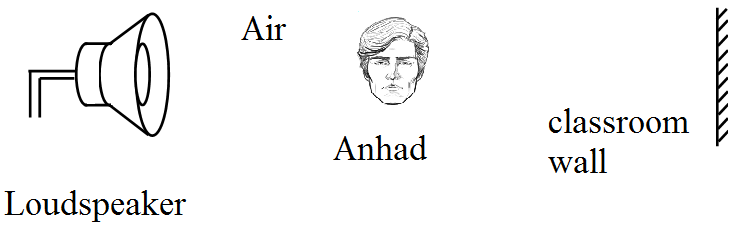
In an experiment, Anhad studies sound waves. He sets up a loudspeaker to produce sound as shown below:
Anhad adjusts the signal to the loudspeaker to give a sound of frequency 200Hz.
  1. What happens to the air in-between Anhas and the loudspeaker?
  2. Explain how Anhad receives sound in both ears.
A ball $X$ of mass 1 kg travelling at $2 m / s$ has a head-on collision with an identical ball $Y$ at rest. $X$ stops and $Y$ moves off. Calculate the velocity of $Y$ after the collision.
Define motion. What do you understand by the terms ‘uniform motion’ and ‘non-uniform motion’? Explain with examples.
Why are we able to sip hot tea or milk faster from a saucer rather than from a cup?
Give the formulate of the compounds formed from the following sets of elements:
  1. Calcium and fluorine.
  2. Hydrogen and sulphur.
  3. Nitrogen and hydrogen.
  4. Carbon and chlorine.
  5. Sodium and oxygen.
  6. Carbon and oxygen.
How will you separate common salt, sand and iron filings from their mixture?
$A, B$ and $C$ are all liquids. Liquid A has a comparatively low boiling point. On heating, liquid a vaporizes completely without leaving behind any residue. Liquid A is being used increasingly as a fuel in motor vehicles either alone or by mixing with petrol. Liquid $B$ has a very high boiling point. It also vaporizes completely on heating, without leaving any residue. Liquid $B$ is a conductor of electricity and used in making thermometers. Liquid $c$ has a moderate boiling point. On heating, liquid C vaporises leaving behind a white solid $D$ which is used in cooking vegetables. The condensation of vapours from $C$ give a liquid $E$ which turns anhydrous $CuSO _4$ to blue.
a. Which liquid could be an element? Name this element.
b. Which liquid could be a mixture? Name this mixture.
c. Which liquid could be a compound? Name this compound.
d. What could the solid $D$ be?
e. What do you think is liquid $E$ ?
A bullet of mass $15\ g$ has a speed of $400\ m/s$. What is its kinetic energy? If the bullet strikes a thick target and is brought to rest in $2\ cm$, calculate the average net force acting on the bullet. What happens to the kinetic energy originally in the bullet?
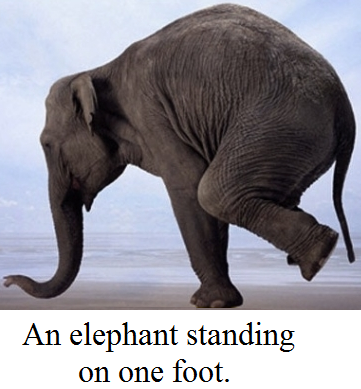
An elephant weighing $40,000\ N$ stands on one foot of area $1000\ cm^2$ whereas a girl weighing $400\ N$ is standing on one ‘stiletto’ heel of area $1cm^2.$​​​​​​​


  1. Which of the two, elephant or girl, exerts a larger force on the ground and by how much?
  2. What pressure is exerted on the ground by the elephant standing on one foot?
  3. What pressure is exerted on the ground by the girl standing on one heel?
  4. Which of the two exerts larger pressure on the ground: elephant or girl?
  5. What is the ratio of pressure exerted by the girl to the pressure exerted by the elephant?
Explain the transformation of energy in the following cases:
  1. A ball thrown upwards.
  2. A stone dropped from the roof of a building.