Question
State the vectors which are :
(i) equal in magnitude
(ii) parallel
(iii) in the same direction
(iv) equal
(v) negatives of one another
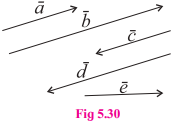
Image

Answer

(i) $\bar{a}, \bar{c}$ and $\bar{e} ; \bar{b}$ and $\bar{d}$
(iv) none are equal
(ii) $\bar{a}, \bar{b}, \bar{c}$ and $\bar{d}$
(v) $\bar{a}$ and $\bar{c}, \bar{b}$ and $\bar{d}$
(iii) $\bar{a}$ and $\bar{b} ; \bar{c}$ and $\bar{d}$

Need a full question paper?

Generate a complete, print-ready paper with questions like this in minutes — across 16+ boards, with answer keys.
Start Generating Free

Similar questions

In $\triangle A B C$ if $a=13, b=14, c=15$ then find the values of(i) $\cos A$
(ii) $\sin \frac{A}{2}$
(iii) $\cos \frac{A}{2}$
(iv) $\tan \frac{A}{2}$
(v) $A (\triangle ABC )$
(vi) $\sin A$
Using truth tables, prove the following logical equivalences
i) $(p \wedge q) \equiv \sim(p \rightarrow \sim q)$
ii) $(p \leftrightarrow q) \equiv(p \wedge q) \vee(\sim p \wedge \sim q)$
iii) $(p \wedge q) \rightarrow r \equiv p \rightarrow(q \rightarrow r )$
iv) $p \rightarrow(q \vee r) \equiv(p \rightarrow$ q $) \vee(p \rightarrow r )$
Are the following set of vectors linearly independent?
(i) $\bar{a}=\hat{i}-2 \hat{j}+3 \hat{k}, \bar{b}=3 \hat{i}-6 \hat{j}+9 \hat{k}$
(ii) $\bar{a}=-2 \hat{i}-4 \hat{k}, \quad \bar{b}=\hat{i}-2 \hat{j}-\hat{k}, \quad \bar{c}=\hat{i}-4 \hat{j}+3 \hat{k}$. Interpret the results.
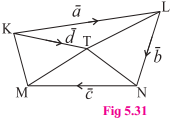
In the diagram $\overline{ KL }=\bar{a}, \overline{ LN }=\bar{b}, \overline{ NM }=\bar{c}$ and $\overline{ KT }=\bar{d}$. Find in terms of $\bar{a}, \bar{b}, \bar{c}$ and $\bar{d}$.(i)
(ii) $\overrightarrow{ KM }$
(iii) $\overline{ TN }$
(iv) $\overline{ MT }$Image
Construct the truth table for each of the following statement patterns.
i) $\quad p \rightarrow(q \rightarrow p)$
Construct the truth table for each of the following statement patterns.
(ii) (~p ∨ ~q) ↔ [~(p ∧ q)]
If $A=\{1,2,3,4,5,6,7\}$, determine the truth value of the following.
i) $\exists x \in A$ such that $x-4=3$
ii) $\forall x \in A , \quad x+1 \geq 3$
iii) $\forall x \in A , 8-x \leq 7$
iv) $\exists x \in A$, such that $x+8=16$
Find the value of $k$ if $2 x+y=0$ is one of the lines represented by $3 x^2+k x y+2 y^2=0$.
Reduce the equation $\bar{r} \cdot(3 \hat{i}-4 \hat{j}+12 \hat{k})=8$ to the normal form and hence find
(i) the length of the perpendicular from the origin to the plane
(ii) direction cosines of the normal.
If statements p, q are true and r, s are false, determine the truth values of the following. i) i) $\sim p \wedge(q \vee \sim r )$
ii) $(p \wedge \sim r ) \wedge(\sim q \vee s )$
iii) $\sim(p \rightarrow q) \leftrightarrow( r \wedge s )$
iv) $(\sim p \rightarrow q) \wedge( r \leftrightarrow s )$