Questions

Do as instructed

Take a timed test

11 questions · self-marked practice — reveal the answer and mark yourself.

Question 11 Mark
Find the value of a for which the vectors $3 \hat{i}+2 \hat{j}+9 \hat{k}$ and $\hat{i}+a \hat{j}+3 \hat{k}$ are (i) perpendicular (ii) parallel
Answer
Let $\bar{p}=3 \hat{i}+2 \hat{j}+9 \hat{k}$ and $\bar{q}=\hat{i}+a \hat{j}+3 \hat{k}$
(i) The two vectors are perpendicular if $\bar{p} \cdot \bar{q}=0$ i.e. $(3 \hat{i}+2 \hat{j}+9 \hat{k}) \cdot(\hat{i}+a \hat{j}+3 \hat{k})=0$
i.e. $3(1)+2(a)+9(3)=0$. i.e. $2 a+30=0$ or $a=-15$.
(ii) The two vectors are parallel if $\frac{3}{1}=\frac{2}{a}=\frac{9}{3}$ i.e $3 a=2$ i.e. $a=\frac{2}{3}$.
View full question & answer
Question 21 Mark
If $\bar{a}=3 \hat{i}+4 \hat{j}-5 \hat{k}$ and $\bar{b}=3 \hat{i}-4 \hat{j}-5 \hat{k}$
(i) find $\bar{a} \cdot \bar{b}$
(ii) the angle between $\bar{a}$ and $\bar{b}$.
(iii) the scalar projection of $\bar{a}$ in the direction of $\bar{b}$.
(iv) the vector projection of $\bar{b}$ along $\bar{a}$.
Answer
Here $\bar{a}=3 \hat{i}+4 \hat{j}-5 \hat{k}$ and $\bar{b}=3 \hat{i}-4 \hat{j}-5 \hat{k}$
i) $\quad \bar{a} \cdot \bar{b}=(3)(3)+(4)(-4)+(-5)(-5)=9-16+25=18$
ii) $|\bar{a}|=\sqrt{a+16+25}=\sqrt{50},|\bar{b}|=\sqrt{9+16+25}=\sqrt{50}$
The angle between $\bar{a}$ and $\bar{b}$ is $\cos \theta=\frac{\bar{a} \cdot \bar{b}}{|d| b \mid}=\frac{18}{50} \therefore \theta=\cos ^{-1}\left(\frac{18}{50}\right)$
iii) The scalar projectio of $\bar{a}$ in the direction of $\bar{b}$ is $\frac{\bar{a} \cdot \bar{b}}{|b|}=\frac{18}{\sqrt{50}}=\frac{18}{5 \sqrt{2}}$.
iv) The vector projection of $\bar{b}$ along is $\bar{a}$ is $=(\bar{a} \cdot \bar{b}) \frac{\bar{a}}{|\bar{a}|^2}=\frac{18}{50}(3 \hat{i}+4 \hat{j}-5 \hat{k})=\frac{9}{25}(3 \hat{i}+4 \hat{j}-5 \hat{k})$.
View full question & answer
Question 31 Mark
What is the distance from the point $(2,3,4)$ to (i) the $XY$ plane? (ii) the $X$-axis? (iii) origin (iv) point $(-2,7,3)$.
Answer
(a) The distance from $(2,3,4)$ to the $X Y$ plane is $|z|=4$ units.
(b) The distance from $(2,3,4)$ to the $X$-axis is $\sqrt{y^2+z^2}=\sqrt{3^2+4^2}=\sqrt{25}=5$ units.
(c) The distance from $(x, y, z)=(2,3,4)$ to origin $(0,0,0)$ is $\sqrt{x^2+y^2+z^2}=\sqrt{2^2+3^2+4^2}=\sqrt{4+9+16}=\sqrt{29}$ units.
(d) The distance from $(2,3,4)$ to $(-2,7,3)$ is $\sqrt{(2+2)^2+(3-7)^2+(4-3)^2}=\sqrt{16+16+9}=\sqrt{41}$ units.
View full question & answer
Question 41 Mark
If $\bar{a}=4 \hat{i}+3 \hat{k}$ and $\bar{b}=-2 \hat{i}+\hat{j}+5 \hat{k}$ find (i) $|\bar{a}|$, (ii) $\bar{a}+\bar{b}$, (iii) $\bar{a}-\bar{b}$, (iv) $3 b$,
(v) $2 \bar{a}+5 \bar{b}$
Answer
(i) $|\bar{a}|=\sqrt{4^2+0^2+3^2}=\sqrt{25}=5$
(ii) $\bar{a}+\bar{b}=(4 \hat{i}+3 \hat{k})+(-2 \hat{i}+\hat{j}+5 \hat{k})=2 \hat{i}+\hat{j}+8 \hat{k}$
(iii) $\bar{a}-\bar{b}=(4 \hat{i}+3 \hat{k})-(-2 \hat{i}+\hat{j}+5 \hat{k})=6 \hat{i}-\hat{j}-2 \hat{k}$
(iv) $3 \bar{b}=3(-2 \hat{i}+\hat{j}+5 \hat{k})=-6 \hat{i}+3 \hat{j}+15 \hat{k}$
(v)
$
\begin{aligned}
2 \bar{a}+5 \bar{b} & =2(4 \hat{i}+3 \hat{k})+5(-2 \hat{i}+\hat{j}+5 \hat{k}) \\
& =(8 \hat{i}+6 \hat{k})+(-10 i+5 j+25 k)=-2 \hat{i}+5 \hat{j}+31 \hat{k}
\end{aligned}
$
View full question & answer
Question 51 Mark
Are the following set of vectors linearly independent?
(i) $\bar{a}=\hat{i}-2 \hat{j}+3 \hat{k}, \bar{b}=3 \hat{i}-6 \hat{j}+9 \hat{k}$
(ii) $\bar{a}=-2 \hat{i}-4 \hat{k}, \quad \bar{b}=\hat{i}-2 \hat{j}-\hat{k}, \quad \bar{c}=\hat{i}-4 \hat{j}+3 \hat{k}$. Interpret the results.
Answer
$(i)$
$ \bar{a}=\hat{i}-2 \hat{j}+3 \hat{k}, \bar{b}=3 \hat{i}-6 \hat{j}+9 \hat{k}$
$\bar{b}=3(\hat{i}-2 \hat{j}+3 \hat{k}) $
$\bar{b}=3 \bar{a}$ Here $\bar{a}$ and $\bar{b}$ linearly dependent vectors. Hence $\bar{a}$ and $\bar{b}$ are collinear.
(ii) $\bar{a}=-2 \hat{i}-4 \hat{k}, \quad \bar{b}=\hat{i}-2 \hat{j}-\hat{k}, \bar{c}=\hat{i}-4 \hat{j}+3 \hat{k}$
Let $x \bar{a}+y \bar{b}+z \bar{c}=\overline{0}$
$ \therefore x(-2 \hat{i}-4 \hat{k})+y(\hat{i}-2 \hat{j}-\hat{k})+z(\hat{i}-4 \hat{j}+3 \hat{k})=\overline{0}$
$-2 x+y+z=0$
$-2 y-4 z=0$
$-4 x-y+3 z=0 $
$\therefore x=0, y=0, z=0$. Here $\bar{a}, \bar{b}$ and $\bar{c}$ are linearly independent vectors.
Hence $\bar{a}, \bar{b}$ and $\bar{c}$ are non-coplanar.
View full question & answer
Question 61 Mark
The non-zero vectors $\bar{a}$ and $\bar{b}$ are not collinear find the value of $\lambda$ and $\mu$ :
(i) $\bar{a}+3 \bar{b}=2 \lambda \bar{a}-\mu \bar{b}$
(ii) $(1+\lambda) \bar{a}+2 \lambda \bar{b}=\mu \bar{a}+4 \mu \bar{b}$
(iii) $(3 \lambda+5) \bar{a}+\bar{b}=2 \mu \bar{a}+(\lambda-3) \bar{b}$
Answer
(i)
$2 \lambda=1,3=-\mu \therefore \lambda=1 / 2, \mu=-3$
(ii)
$ 1+\lambda=\mu, 2 \lambda=4 \mu, \lambda=2 \mu$
$1+2 \mu=\mu, 1=-\mu$
$\therefore \mu=-1, \lambda=-2 $
(iii)
$ 3 \lambda+5=2 \mu, 1=\lambda-3, \therefore \lambda=1+3=4$
$\text { and } 3(4)+5=2 \mu$
$\therefore 2 \mu=17 . \text { So } \mu=\frac{17}{2} $
View full question & answer
Question 71 Mark
Find a unit vector (i) in the direction of $\bar{u}$ and (ii) in the direction opposite of $\bar{u}$. where $\bar{u}=8 \hat{i}+3 \hat{j}-\hat{k}$
Answer
(i) $\hat{u}=\frac{\bar{u}}{|\bar{u}|}=\frac{8 \hat{i}+3 \hat{j}-1 \hat{k}}{\sqrt{74}}$

$=\frac{1}{\sqrt{74}}(8 \hat{i}+3 \hat{j}-\hat{k})$ is the unit vector in direction of $\bar{u}$.

(ii) $-\hat{u}=-\frac{1}{\sqrt{74}}(8 \hat{i}+3 \hat{j}-\hat{k})$ is the unit vector in opposite direction of $\bar{u}$.

View full question & answer
Question 81 Mark
$A (2,3), B (-1,5), C (-1,1)$ and $D (-7,5)$ are four points in the Cartesian plane.(i) Find $\overline{ AB }$ and $\overline{ CD }$.
(ii) Check if, $\overline{ CD }$ is parallel to $\overline{ AB }$.
(iii) $E$ is the point $(k, 1)$ and $\overrightarrow{ AC }$ is parallel to $\overrightarrow{ BE }$. Find $k$.
Answer
$ \text { (i) }=2 \hat{i}+3 \hat{j}, \bar{b}=-\hat{i}+5 \hat{j}, \bar{c}=-\hat{i}+\hat{j}, \bar{d}=-7 \hat{i}+$
$\overline{ AB }=\bar{b}-\bar{a}=(-\hat{i}+5 \hat{j})-(2 \hat{i}+3 \hat{j})=-3 \hat{i}+2 \hat{j}$
$\overline{ CD }=\bar{d}-\bar{c}=(-7 \hat{i}+5 \hat{j})-(-\hat{i}+\hat{j})=-6 \hat{i}+4 \hat{j}$
(ii) $\overline{ CD }=-6 \hat{i}+4 \hat{j}=2(-3 \hat{i}+2 \hat{j}=2 \overline{ AB }$ therefore $\overline{ CD }$ and $\overline{ AB }$ are parallel.
(iii)
$ \overrightarrow{ BE }=(k \hat{i}+\hat{j})-(-\hat{i}+5 \hat{j})=(k+1) \hat{i}-4 \hat{j}$
$\overline{ AC }=(-\hat{i}+\hat{j})-(2 \hat{i}+3 \hat{j})=-3 \hat{i}-2 \hat{j}$
$\overline{ BE }=m \overline{ AC }$
$(k+1) \hat{i}-4 \hat{j}=m(-3 \hat{i}-2 \hat{j}) $
So -4 therefore $2= m$
$\text { and } k+1=-3 m$
$k+1=-3(2)$
$k k=-6-1$
$k=-7 $
View full question & answer
Question 91 Mark
Find the magnitude of following vectors:
(i) $\bar{a}=\hat{i}-2 \hat{j}+4 \hat{k}$
(ii) $\bar{b}=4 \hat{i}-3 \hat{j}-7 \hat{k}$
(iii) a vector with initial point : $(1,-3,4)$; terminal point : $(1,0,-1)$.
Answer
(i)
$|\bar{a}|=\sqrt{1^2+(-2)^2+4^2}=\sqrt{21}$
(ii)
$ |\bar{b}|=\sqrt{4^2+(-3)^2+(-7)^2}$
$|\bar{b}|=\sqrt{16+9+49}=\sqrt{74} $
(iii)
$|\vec{c}|  =(\hat{i}-\hat{k})-(\hat{i}-3 \hat{j}+4 \hat{k})=3 \hat{j}-5 \hat{k} $
$|\vec{c}|  =\sqrt{0+3^2+(-5)^2}=\sqrt{34}$
View full question & answer
Question 101 Mark
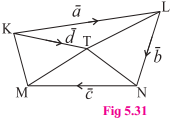
In the diagram $\overline{ KL }=\bar{a}, \overline{ LN }=\bar{b}, \overline{ NM }=\bar{c}$ and $\overline{ KT }=\bar{d}$. Find in terms of $\bar{a}, \bar{b}, \bar{c}$ and $\bar{d}$.(i)
(ii) $\overrightarrow{ KM }$
(iii) $\overline{ TN }$
(iv) $\overline{ MT }$Image
Answer
(i) In $\triangle PTQ$, using triangle law
$ \overline{ KL }+\overline{ LT }=\overline{ KT } \text { i.e. } \bar{a}+\overline{ LT }=\bar{d}$
$\overline{ LT }=\bar{d}-\bar{a} $
(ii) Using polygonal law of addition of vectors for polygon KLNM
$\overline{ KM }  =\overline{ KL }+\overline{ LN }+\overline{ NM } . $
$=\bar{a}+\bar{b}+\bar{c}$
(iii) Using polygonal law of addition of vectors for polygon TKLN
$\overline{ TN }  =\overline{ TK }+\overline{ KL }+\overline{ LN }$
$ =-\bar{d}+\bar{a}+\bar{b}=\bar{a}+\bar{b}-\bar{d}$
(iv) Using polygonal law of addition of vectors for polygon TKLNM
$\overline{ MT }  =\overline{ MN }+\overline{ NL }+\overline{ LK }+\overline{ KT } $
$=-\bar{c}-\bar{b}-\bar{a}+\bar{d} $
$ =\bar{d}-\bar{a}-\bar{b}-\bar{c} .$
View full question & answer
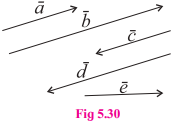
Question 111 Mark
State the vectors which are :
(i) equal in magnitude
(ii) parallel
(iii) in the same direction
(iv) equal
(v) negatives of one another

Image

Answer
(i) $\bar{a}, \bar{c}$ and $\bar{e} ; \bar{b}$ and $\bar{d}$
(iv) none are equal
(ii) $\bar{a}, \bar{b}, \bar{c}$ and $\bar{d}$
(v) $\bar{a}$ and $\bar{c}, \bar{b}$ and $\bar{d}$
(iii) $\bar{a}$ and $\bar{b} ; \bar{c}$ and $\bar{d}$
View full question & answer