Question
State three actions that a total reflecting prism can produce.

Answer

(i) A total reflecting prism can deviate the path of a ray of light by 90°.
(ii) A total reflecting prism can turn a ray of light through 180°.
(iii) A total reflecting prism can invert the rays of light.

Need a full question paper?

Generate a complete, print-ready paper with questions like this in minutes — across 16+ boards, with answer keys.
Start Generating Free

Similar questions

State the conditions for the flow of charge in a circuit from one point to the other.
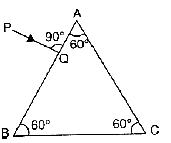
In given figure a ray of light PQ is incident normally on the face AB of an equilateral glass prism. Complete the ray diagram showing its emergence into air after passing through the prism.
(a) Write the angles of incidence at the faces AB and AC of the prism.
(b) name the phenomenon which the ray of light suffers at the face AB, AC and BC of the prism.
A coolie is pushing a box weighing 1500 N up an inclined plane 7.5 m long on to a platform, 2.5 m above the ground.
(i) Calculate the mechanical advantage of the inclined plane. (ii) Calculate the effort applied by the coolie.
(iii) In actual practice, the coolie needs to apply more effort than what is calculated. Give one reason why you think the coolie needs to apply more effort.
1 kg of molten lead at its melting point of $327^{\circ} C$ is dropped in 1 kg of water at $20^{\circ} C$. Assuming no heat is lost; calculate the final temperature of water. (Sp. heat cap. of lead $=130 J / kg ^{\circ} C$, Sp. latent heat of fusion of lead $=27000$ $J / g , Sp$. heat cap. of water $=4200 j / kg ^{\circ} C$ )
Briefly describe an experiment to show that a prism itself produces no colour, during disperssion of white light.
An auto lamp is joined to a battery of e.m.f. 4 V and internal resistance 2.5Ω. A steady current of 0.5 A flows through the circuit. Calculate the
(a) Total energy provided by battery in 10 minutes,
(b) Heat dissipated in the bulb in 10 minutes.
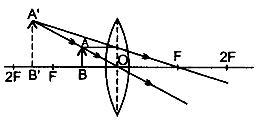
Draw a ray diagram to illustrate the formation of an enlarged and upright image of an object by a lens. Name the lens used. Where should the object be placed relative to the lens? Will the image be real or virtual? Name a device where this action of lens is used.
State three properties of α-rays.
What is nucleus of an atom? Compare its size with that of the atom. Name its constitutents. How is the number of these constituents determined by the atomic number its atomic model.
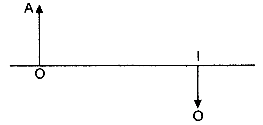
The following diagram shows the object O and the image I formed by a lens. Copy the diagram and on it mark the positions of the lens LL’ and focus (F). Name the lens.