Questions

[3 Mark Question Answer]

🎯

Test yourself on this topic

37 questions · timed · auto-graded

Question 13 Marks
The refractive index of glass with respect to air is $1.5.$ What is the value of the refractive index of air with respect to glass?
Answer
$_a\mu _g = 1.5_g\mu _a = `1/(""_"a"mu_"g")`$
$= `1/1.5`$
$= 0.666$
$= 0.67$
View full question & answer
Question 23 Marks
A ray of light is incident on a glass surface at an angle of $50^\circ $ with the corresponding angle of refraction $30^\circ $. Find the value of the R.I. of glass.
Answer
$R.I. = `\sin"i"/\sin"r"`_a\mu _g = `\sin"i"/\sin"r"$
$=(sin50^\circ )/(sin30^\circ )` ..........(\angle i = 50^\circ and \angle r = 30^\circ )$
$= `0.7660/0.5000`$
$_a\mu _g = 0.1532.$
View full question & answer
Question 33 Marks
A coin placed at the bottom of a beaker appears to be raised by 4.0 cm. If the refractive index of water is 4/3, find the depth of the water in the beaker.
Answer
Let Real depth = x

∵ Refracture Index, μ = `"Real depth"/"Apparent depth"`

⇒ `4/3="x"/("x"-4)`

⇒ 4x − 16 = 3x

∴ x = 16 cm.

View full question & answer
Question 43 Marks
A glass block is having refractive index 3/2, the light ray is incident at an angle 45°. Find the sine of the angle of, refraction inside the glass block.
Answer
∵ According to Snell's law of refraction:

n = `sin"i"/sin"r"`

`3/2=(sin45°)/sin"r"`

⇒ `3/2=(1//sqrt2)/sin"r"`

sin r = `2/(3sqrt2)`

= `sqrt2/3`

View full question & answer
Question 53 Marks
Write the approximate values of speed of light in (i) air and (ii) glass. Use these values to calculate the refractive index of glass with respect to air.
Answer
(i) Speed of light in air $= 3 \times 10^8ms^{-1}$​​​​​​​
(ii) Speed of light in glass $= 2 \times 10^8ms^{-1}​​​​​​​$​​​​​​​Refractive index of glass with respect to air
= `"Speed of light in air"/"Speed of light in glass"`
$= `(3xx10^8)/(2xx10^8)`$
$= `3/2`$
$= 1.5$
View full question & answer
Question 63 Marks
The velocity of light in diamond is $121000 kms^{-1}.$ What is its refractive index?
Answer
Speed of light in diamond $= 121,000 km/s= 121 \times 10^6 m/s$
Refractive index of diamond = `"Speed of light in air"/"speed of light in diamond"`
$= `(3xx10^8)/(121xx10^6"m/s")`$
$= 2.48$
View full question & answer
Question 73 Marks
The speed of light in air is $3 \times 10^8 ms^{-1}$. Calculate the speed of light in water. The refractive index of water is $4 / 3$.
Answer
The refractive index of water `="Speed of light in air"/"Speed of light in water"`∴ Speed of light in water `="Speed of light in air"/"Refractive index of water"`
$= `(3xx10^8)/(4//3)`$
$= 2.25 \times 10^8 ms^{−1}.$
View full question & answer
Question 83 Marks
Glass is transparent in nature. Why does glass powder look opaque? When water is poured over it, it again becomes transparent. Why?
Answer
In the case of powdered glass, irregular reflection takes place from various particles. Thus, light is sent back into the same medium. Therefore, it looks opaque. On putting water over the powder incident light gets refracted through water. That is why it looks transparent.
View full question & answer
Question 93 Marks
Why upper surface of water contained in a beaker and above eye level appears silvery?
Answer
Critical angle for water is 49°. The rays of light entering the water from below, suffer refraction. If these rays strike the water-air surface at an angle which is greater than 48°, they get totally internally reflected. These rays on emerging out of the water, appear to come from the upper surface of the water, which in turn appears silvery.
View full question & answer
Question 103 Marks
State one factor on which a critical angle for a given pair of media depends. The critical angle for the glass-air interface is $45^{\circ}$ for the yellow light. Will it be equal to, less than or greater than $45^{\circ}$ for (i) red light, (ii) blue light?
Answer
The value of the critical angle for a given pair of media depends on the colour of light.
(Hint: Remember $VIBGYOUR$ Violet has minimum $i_c$ whereas Red has maximum).
(i) For red light, the critical angle will be greater than $45^\circ .$
(ii) For blue light, the critical angle will be less than $45 ^\circ .$
View full question & answer
Question 113 Marks
Images formed by totally reflecting prisms are brighter than the image formed by ordinary reflected light, why?
Answer
This is because in total internal reflection 100% of incident light gets reflected. On the other hand, in ordinary reflection, 20% to 30% of incident light is lost. So, images formed in the first case are brighter than the images formed in the second case.
View full question & answer
Question 123 Marks
How does the angle of deviation produced by a prism depend on the colour of light used? Which colour of white light is deviated (i) most, (ii) least, by a prism?
Answer
The angle of deviation produced by a prism increases with the decrease in wavelength of the light used.
(i) Violet light is deviated most by a prism.
(ii) Red light is deviated least by a prism.
View full question & answer
Question 133 Marks
In what condition a prism is said to be in the position of minimum deviation? What is the direction of the refracted ray inside the prism in this condition?
Answer
A prism is said to be in the position of minimum deviation when the angle of incidence of the light ray at the first prism surface is equal to the angle of emergence at the second surface of the prism.
In this condition, the refracted ray inside the prism is parallel to the base of the prism (if the prism is equilateral).
View full question & answer
Question 143 Marks
State three actions that a total reflecting prism can produce.
Answer
(i) A total reflecting prism can deviate the path of a ray of light by 90°.
(ii) A total reflecting prism can turn a ray of light through 180°.
(iii) A total reflecting prism can invert the rays of light.
View full question & answer
Question 153 Marks
Why does a fisherman aim at the tail of fish during spearfishing?
Answer
Due to refraction, when the rays travel from water to air, the apparent image of the fish is formed at a higher level and ahead of the actual position of fish. Thus, when the fisherman aims at the tail of the apparent image of fish, his spear hits the head of actual fish.
View full question & answer
Question 163 Marks
If a ray of light passes from medium I to medium II without any change of direction, what can be said about the refractive indices of these media (angle I is not 0)?
Answer
When a ray of light travels from medium I to medium II without any change of direction, it is possible under either of the following two conditions:
(i) A ray of light is incident normally on the surface separating two media.
(ii) The refractive index of the medium I is equal to the refractive index of medium II.
View full question & answer
Question 173 Marks
Express the refractive index μ of a medium in terms of the angle of incidence i in air and the angle of refraction r in a denser medium.
Answer
If light travels from air into another denser medium, the refractive index ‘μ’ of the medium.

`μ="Sine of the angle of incidence in air"/"Sine of the angle of refraction in the denser medium"`

`μ=sin i/sin r`

View full question & answer
Question 183 Marks
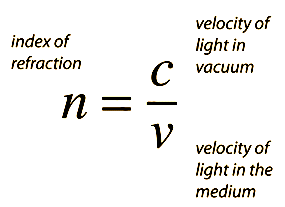
Express the refractive index μ of a medium in terms of the velocity of light.
Answer
The refractive index ‘μ’ of an optical medium is defined as the ratio between the velocity of light in vacuum divided by the velocity of light in the given optical medium. Thus,

`µ="Velocity of light in vacuum"/"Velocity of light in the given optical medium"`

View full question & answer
Question 193 Marks
Why do the faces of persons sitting around campfire appear to shimmer?
Answer
The rays coming from the face of the person, sitting across the campfire, suffer refraction on passing through hot air. Thus, we see the apparent image of the person. Since hot air is in motion, therefore its optical density changes, which in turn shifts the image rapidly. This rapidly shifting image gives a shimmering effect.
View full question & answer
Question 203 Marks
What should be the ratio of the speed of light through the liquid to the speed through the glass so that there is no refraction of light at the boundaries of the glass block when the system is illuminated by the light of one colour?
Answer
Since there is no refraction of light at the boundaries of the glass block, it is possible only when the speed of light through the liquid as well as through the block is the same. Hence the ratio between the speed of light through the liquid to the speed of light through glass must be 1 (one).
View full question & answer
Question 213 Marks
State the relation between the refractive index $\mu$ and the velocity of light $\left( v _{ m }\right)$ in that medium.
Answer
$\mu=\frac{\text { Velocity of light in a vacuum (or air) }}{\text { Velocity of light in the medium }}=\frac{C}{v_m}$
$v _{ m }=\frac{ C }{\mu}$
View full question & answer
Question 223 Marks
State the factors on which the angle of deviation depends.
Answer
The angle of deviation depends upon:
(i) The refracting angle of prism.
(ii) The material of the prism.
(iii) The colour of light.
(iv) The angle of incidence.
View full question & answer
Question 233 Marks
A glass slab is placed over a page on which the word VIBGYOR is printed with each letter in its corresponding colour.
(i) Will the image of all the letters be in the same place?
(ii) If not, the state which letter will be raised to the maximum. Give a reason for your answer.
Answer
The image of all the letters of the word VIBGYOR in their corresponding colours will not be at the same place. In the glass, red colour has the higher speed than violet colour, so red will be raised to the maximum while violet will be at the bottom and the other colours will be raised in the order I-B-G-Y and orange.
View full question & answer
Question 243 Marks
Can light be ‘piped’ like sound in a doctor’s stethoscope?
Answer
Yes, light can be piped from one end to the other with little loss by allowing it to enter one end of a rod of transparent material. The light will undergo total internal reflection at the wall of the rod and will proceed along its axis. This actually being achieved by using a bundle of glass fibers.
View full question & answer
Question 253 Marks
A fish swimming in a pond seems nearer than it really is. Explain.
Answer
This is because a light ray coming from the fish inside the water when suffers refraction at the water-air interface, it bends away from the normal at the point of incidence. The refracted ray appears to be coming from a point at a depth less than the actual depth of the fish. That is why the fish seems to be nearer than it really is.
View full question & answer
Question 263 Marks
State the principle of reversibility of light.
Answer
According to the principle of reversibility, the path of a light ray is reversible.
For e.g. if light travels from air to water along a certain path, then if the path is reversed while travelling from water to air, it will follow exactly the same path.
View full question & answer
Question 273 Marks
Mention one difference between reflection of light from a plane mirror and total internal reflection of light from a prism.
Answer
When total internal reflection occurs from a prism, the entire incident light (100%) is reflected back into the denser medium. Whereas in ordinary reflection from a plane mirror, some light is refracted and absorbed so the reflection is partial.
View full question & answer
Question 283 Marks
The refractive index of air with respect to glass is defined: as $g _{ a }=\sin i / \sin r$ If $r=90^{\circ}$,
what is the corresponding angle i called?
Answer
Given: $_g\mu _a = `Sin "i"/Sin "r"`If r = 90^\circ$
then $_a\mu _g = `(Sin90^\circ )/Sin "i"=1/Sin "i"`$
The corresponding angle i is called the critical angle for the given pair of media.
View full question & answer
Question 293 Marks
The refractive index of air with respect to glass is defined: as ${ }_g \mu_a=\sin i / \sin r$
Write down a similar expression for $a _{ g }$ in terms of angle i and r .
Answer
Given: ${ }_g \mu_a=$ `Sin "i"/Sin "r" Applying the principle of reversibility:
$_{g\mu a} =$ `Sin "r"/Sin "i"`
[for the same value of $\angle i$ and $\angle r$ for a given pair of media]
View full question & answer
Question 303 Marks
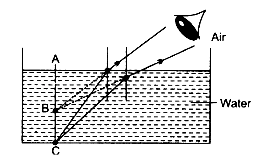
With the help of a well-labelled diagram show that the apparent depth of an object, such as a coin, in water is less than its real depth.
Answer
AB = Apparent depth
AC = Real depth
View full question & answer
Question 313 Marks
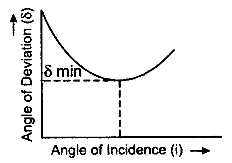
How does the angle of deviation produced by a prism depend on the angle of incidence of light at the prism surface? Draw a graph to illustrate your answer.
Answer
First, the angle of deviation produced by prism decreases with the increasing angle of incidence but on further increasing the angle of incidence the angle of deviation increases. The figure given inside shows the graph for variation of the angle of deviation with the angle of incidence.
View full question & answer
Question 323 Marks
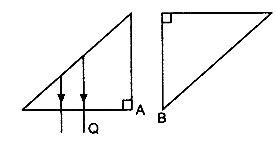
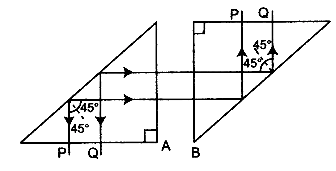
The adjacent diagram shows two right-angled isosceles prisms A and B. Complete the diagram to show the path of rays P and Q emerging out of the prism B. What principles have you used to complete the diagram?
Answer
The completed ray diagram is shown in the figure.
Following two principles are used to complete the diagram:
(1) A ray of light incident normally on the interface of two media passes undeviated.
(2) A ray of light striking the interface of two media (glass and air) from glass, at an angle of incidence, equal to 45° (which is greater than the critical angle = 42°) suffers total internal reflection.
View full question & answer
Question 333 Marks
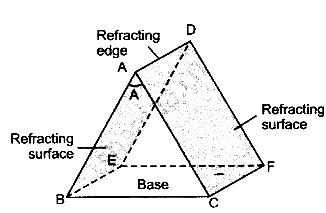
Draw a diagram of a prism and label:
(i) the base,
(ii) the refracting surfaces,
(iii) the refracting edge,
(iv) the refracting angle in it.
Answer

The figure shows a prism, in which BEFC is the refracting edge, and ∠BAC or ∠EDF is the refracting angle of the prism which has been marked by the symbol A.
View full question & answer
Question 343 Marks
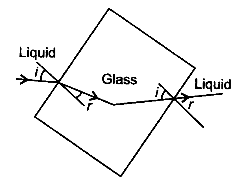
The diagram shows the path of a ray of light through a rectangular glass block placed in a liquid of uniform density.

What should be the rate of the speed of light through the liquid to the speed through the glass so that there is no refraction of light at the boundaries of the glass block when the system is illuminated by the light of one colour?
Answer
Since there is no refraction of light at the boundaries of the glass block, it is possible only when the speed of light through the liquid as well as through the block is the same. Hence the ratio between the speed of light through the liquid to the speed of light through glass must be 1 (one).
View full question & answer
Question 353 Marks
The diagram shows the path of a ray of light through a rectangular glass block placed in a liquid of uniform density.

(a) Does the light speed up or slow down in the glass,
(b) Give the reason for your answer.
Answer
(a) The speed of light, travelling from liquid to glass, slow down.

(b) Speed in liquids = `"Speed of light of air"/"Refractive index of liquid"=(3xx10^8)/"Refractive index of liquid"`

Speed of light in glass = `"Speed of light in air"/"Refractive index of glass"=(3xx10^8)/"Refractive index of glass"`

Since the refractive index in glass is usually higher than that of liquid, hence the speed of light in glass will be less.

View full question & answer
Question 363 Marks
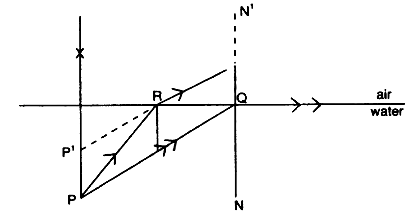
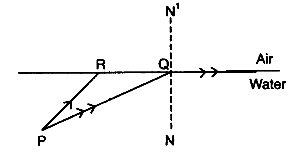
PQ and PR are two light rays emerging from the object as shown in the figure below:

(i) What is the special name given to the angle of incidence (∠PQN) of ray PQ?
(ii) Copy the ray diagram and complete it to show the position of the image of the object P when seen obliquely from above.
(iii) Name the phenomenon that occurs if the angle of incidence ∠PQN is increased still further.
Answer
(i) Critical angle
(ii)

(iii) Total internal reflection of light.
View full question & answer
Question 373 Marks
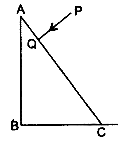
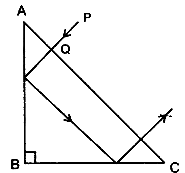
A ray of light PQ is incident normally on the hypotenuse of a right-angled prism ABC as shown in the diagram given below:

(i) Copy the diagram and complete the path of the ray PQ till it emerges from the prism.
(ii) What is the value of the angle of deviation of the ray?
(iii) Name an instrument where this action of the prism is used.
Answer
(i)

(ii) Angle of deviation of the ray = 180°.
(iii) Prism Binoculars.
View full question & answer
[3 Mark Question Answer] - Physics STD 10 Questions - Vidyadip