Question
State three points of difference between Statement of Affairs and Balance Sheet.

Answer

Difference between Balance Sheet and Statement of Affairs Basis Balance Sheet:
S.No.
Basic
Balance Sheet
Statement of Affairs
1.
Objective
The main objective of preparing Balance Sheet is to know about the financial poistion of the business.
The main objective of preparing Statement of Affairs is to know about capital at a point of time.
2.
Accounting System
Balance sheet is prepared when accounts are maintained under Double Entry System.
Statement of Affairs is prepared when account are maintained under Single Entry System.
3.
Accounts and Information
This is prepared exclusively on the basis of ledger accounts.
In view of income accounts, its preparation is based on limited accounts, calculation, estimates and other information.
4.
Reliability
Being based on actual figures, Balance Sheet is regarded as a reliable statement.
Since it is based on the accounts and partly on other information and one's memory, hence, it is not regarded as areliable statement.
5.
Trial Balance
Trial Balance is prepared before Balance Sheet is prepared.
In the case of statement of Affairs, Trial Balance is not prepared.

Need a full question paper?

Generate a complete, print-ready paper with questions like this in minutes — across 16+ boards, with answer keys.
Start Generating Free

Similar questions

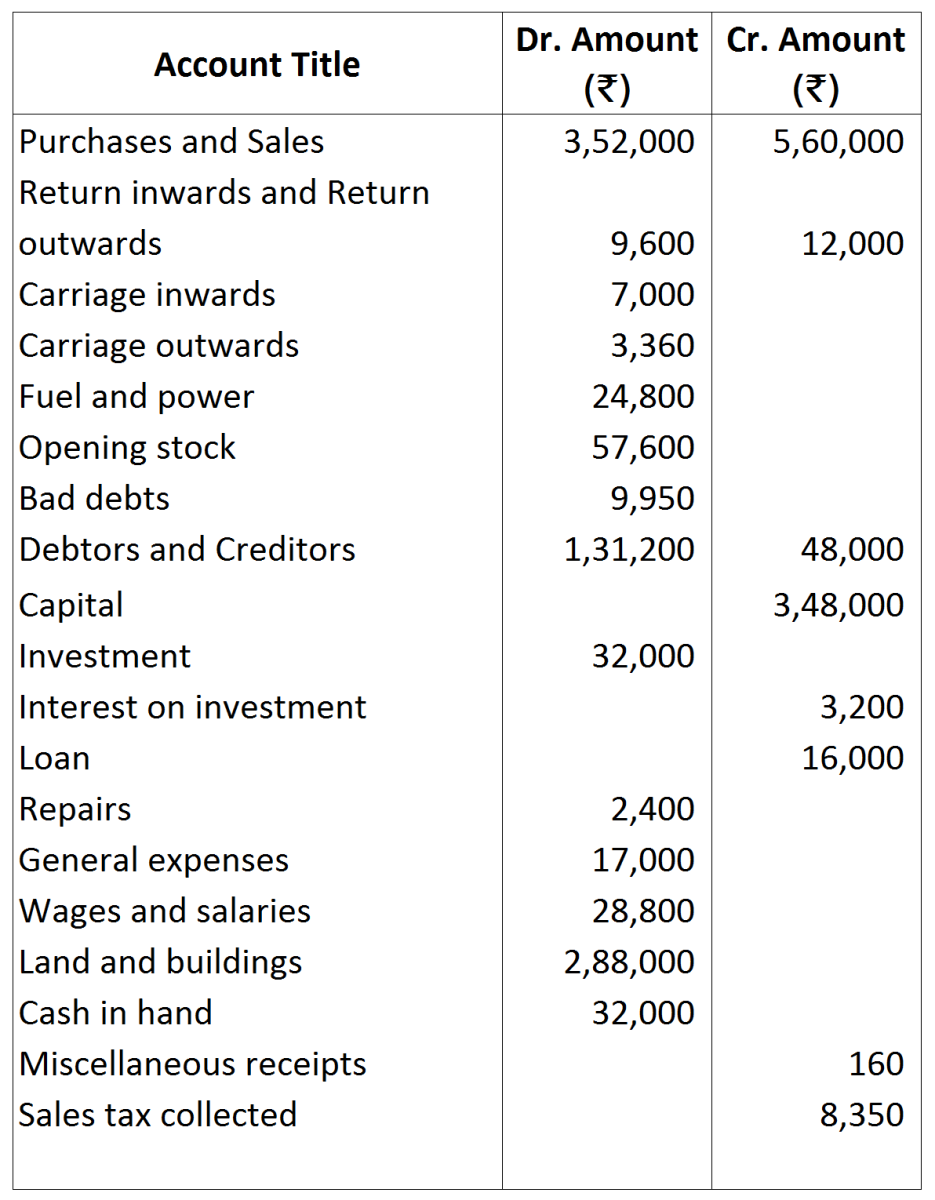
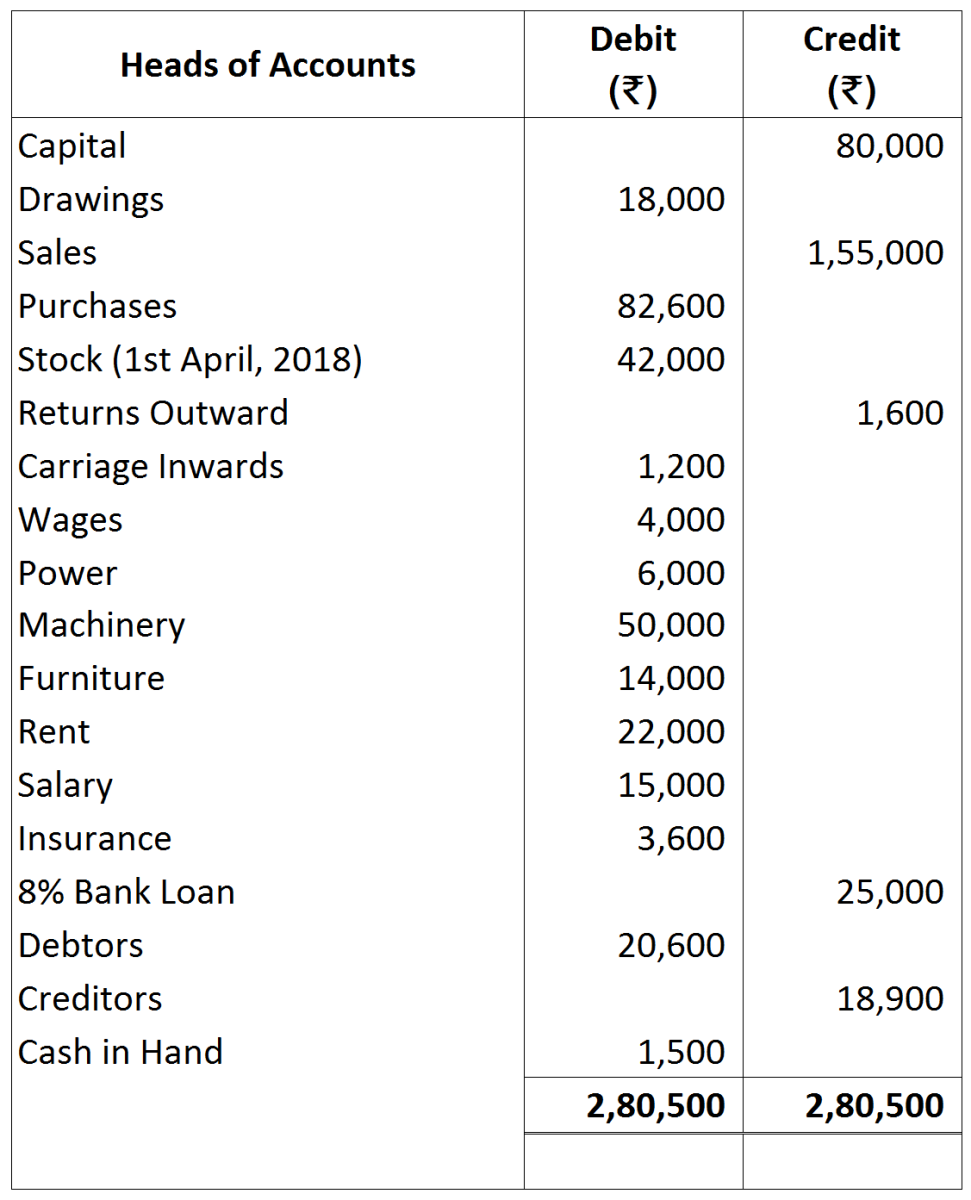
From the following Trial Balance of shradha as on 31st March, 2019, prepare Trading and profit and Loss Account and balance Sheet:

adjustmnet:
  1. Closing Stock ₹ 64,000.
  2. wages outstanding ₹ 2,400.
  3. Bad Debts ₹ 600.
  4. Provision for Doubtful debts to be 5%.
  5. Rent is paid for 11 months.
  6. Insurance premium is paid per annum, ended 31st May, 2019.
  7. Loen from the bank was taken on 1st October, 2018.
  8. Provide depreciation on Machinery @ 10% and on Furniture @ 5%.
Pass the Journal entries rectifying the following errors:
  1. Purchases of ₹ 10,000 was omitted to be recorded.
  2. Purchases of office furniture of ₹ 10,000 was recorded in Purchases Book.
  3. Office Rent of ₹ 15,000 was debited to the Personal Account of the landlord.
  4. Old machine sold for ₹ 5,000 was credited to Sales Account.
  5. Bill for ₹ 800 received from Mukesh for repair of machinery was entered in the Purchases Book as ₹ 700.
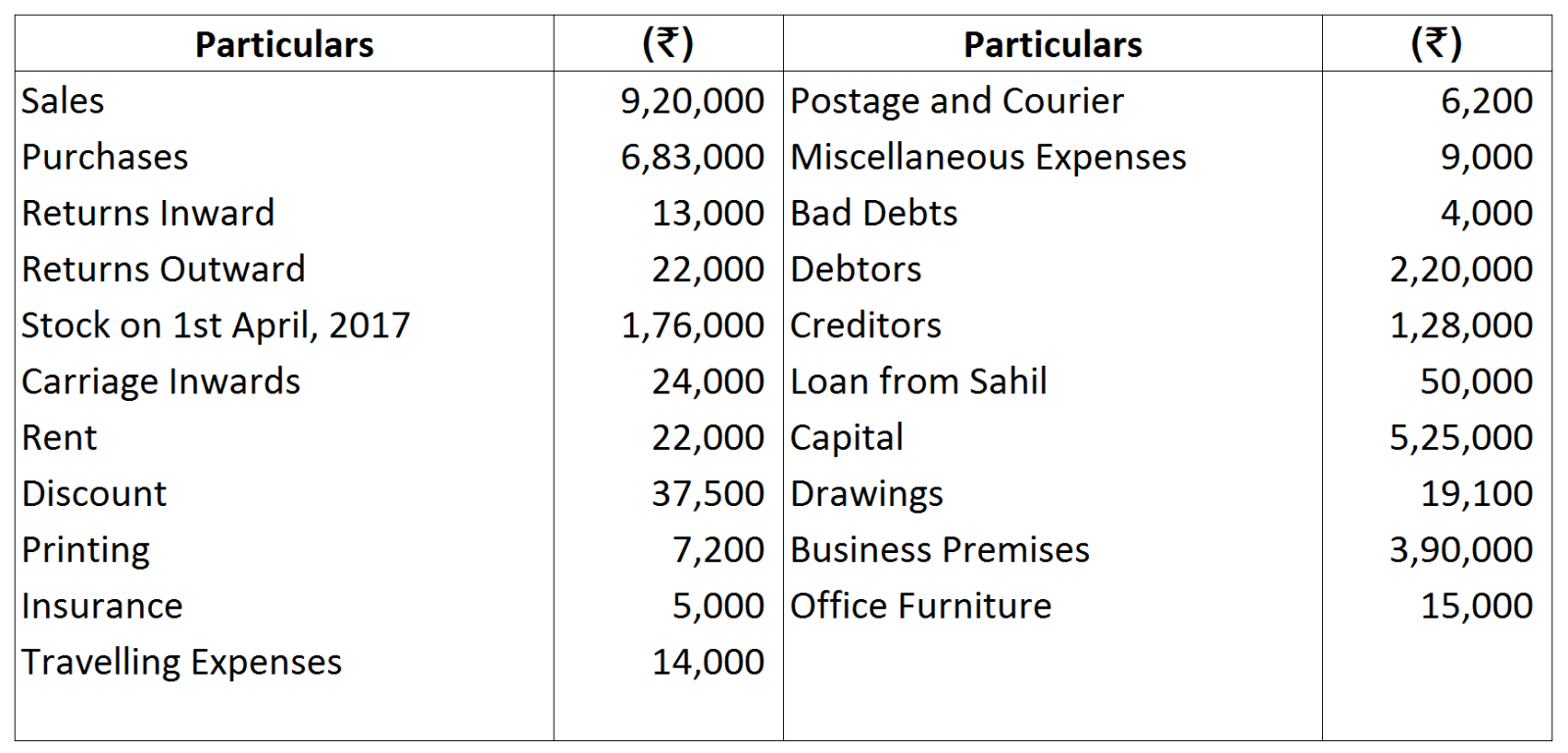
The following are the balances as on $31^{st}$​​​​​​​ March, $2019$ extracted from the books of Dass:

The stock on $31^{st}$​​​​​​​​​​​​​​ March, $2019$ was valued at $₹ 2,40,000$.
You are required to prepare Trading Account, Profit and Loss Account and Balance Sheet as at $31^{st}$​​​​​​​ March, $2019$.
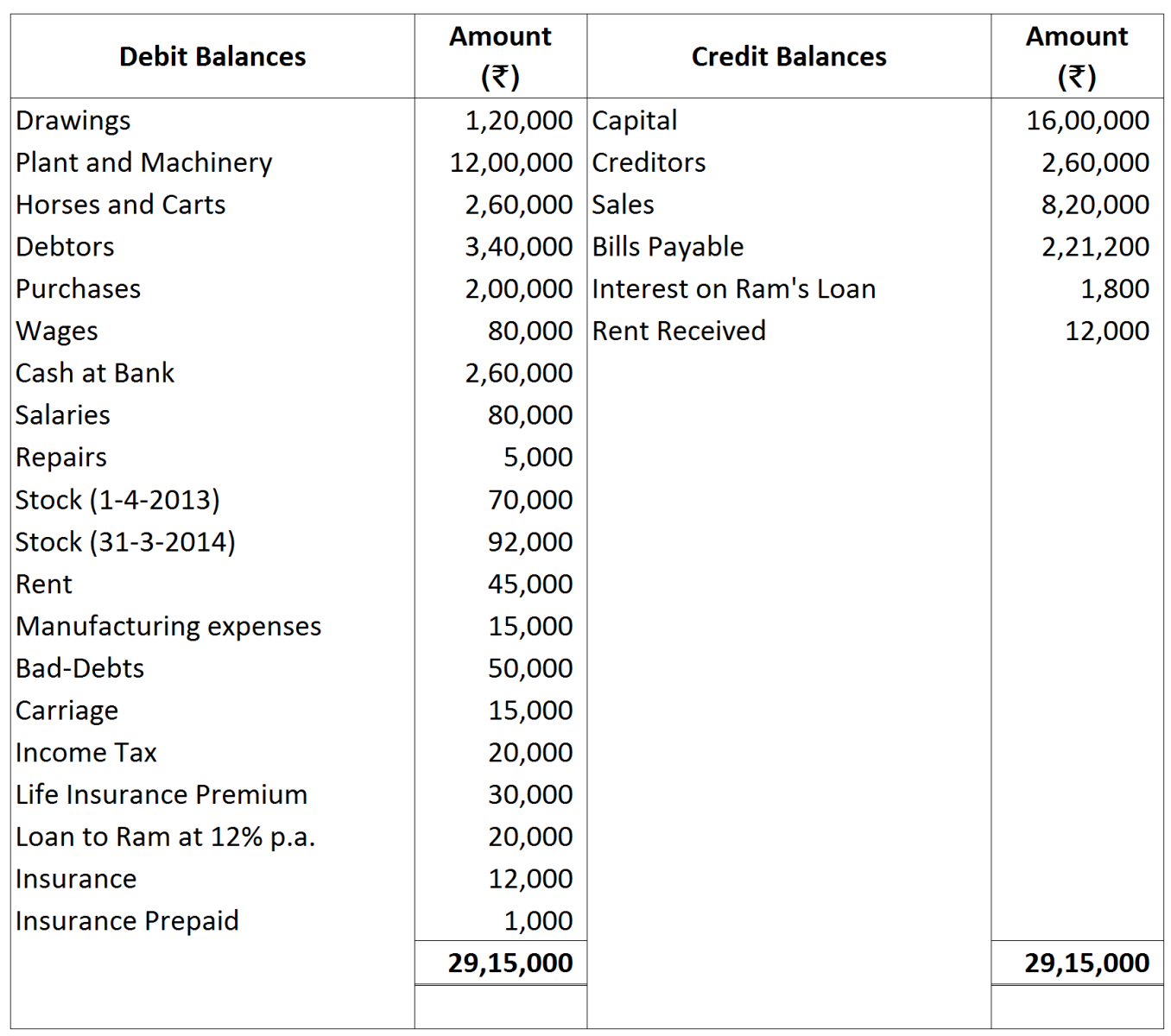
From the following Trial Balance extracted from the books of Sh. Pawan Kumar, prepare a Trading Account, Profit & Loss Account for the year ended 31st March, 2019 and a Balance Sheet as at that date:

Adjustments:
  1. Plant and Machinery includes a new machinery purchased on 1st October, 2018 for ₹ 2,00,000.
  2. Depreciate Plant and Machinery by 10% p.a. and Horses and Carts by 20% p.a.
  3. Salaries for the month of February and March 2019 are outstanding.
  4. Goods worth ₹ 15,000 were sold and despatched on 27th March but no entry was passed to this effect.
  5. Make a provision for Doubtful Debts at 5% on Debtors.
Explain, using examples, the relationship between the organisational MIS and the other functional information system in an organisation. Describe how AIS receives and provides information to other functional MIS.
Vijay commenced business as food grains merchant on 1st April, 2018 with a capital of ₹ 4,00,000. On the same day, he purchased furniture for ₹ 80,000. From the following particulars obtained from his books which do not conform to Double Entry principles, you are required to prepare the Trading and Profit and Loss Account for the year ended 31st March, 2019 and the Balance Sheet as on that date:
 
Sales (including Cash Sales ₹ 2,00,000) 5,00,000
Purchases (including Cash Purchases ₹ 1,20,000 4,00,000
Vijay's Drawings (in Cash) 40,000
Salaries to Staff 48,000
Bad Debts written off 4,000
Trade Expenses paid 16,000
Vijay used goods of ₹ 12,000 for personal purposes during the year. On 31st March, 2019, his Debtors amounted to ₹ 1,40,000 and Creditors ₹ 80,000. Stock-in-Trade on that date was ₹ 1,60,000.
Prepare trading and profit and loss account and balance sheet from the following particulars as on March 31, 2017.

Closing stock ₹ 30,000.
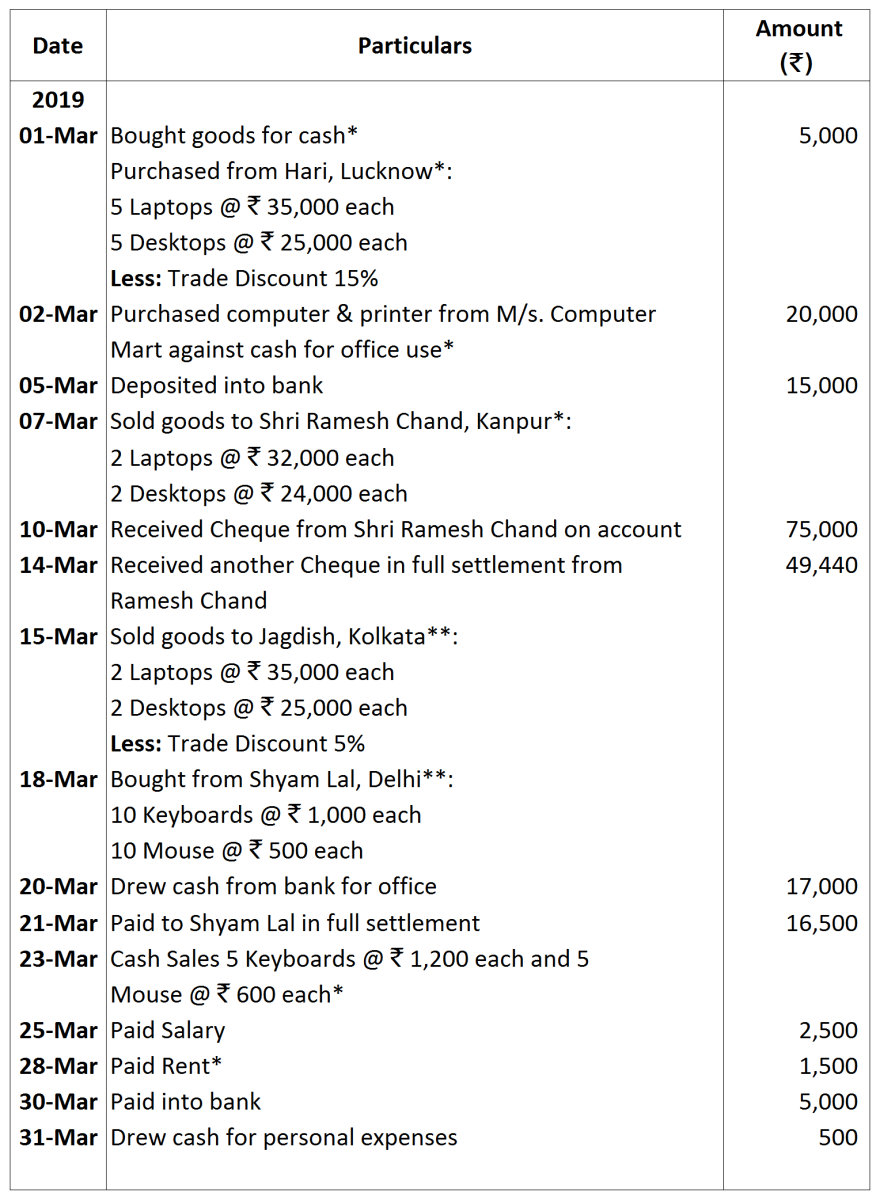
On 1st March, 2019, Shri Kailash Chand, Lucknow commenced business with cash ₹ 50,000. The following are his transactions for the month of March, 2019. Record them in proper books, post them to the Ledger and take out a Trial Balance:
Transactions marked with (*) are intra-state transactions subject to CGST and SGST @ 6% each. Transactions marked with (**) are inter-state transactions subject to IGST @ 12%.
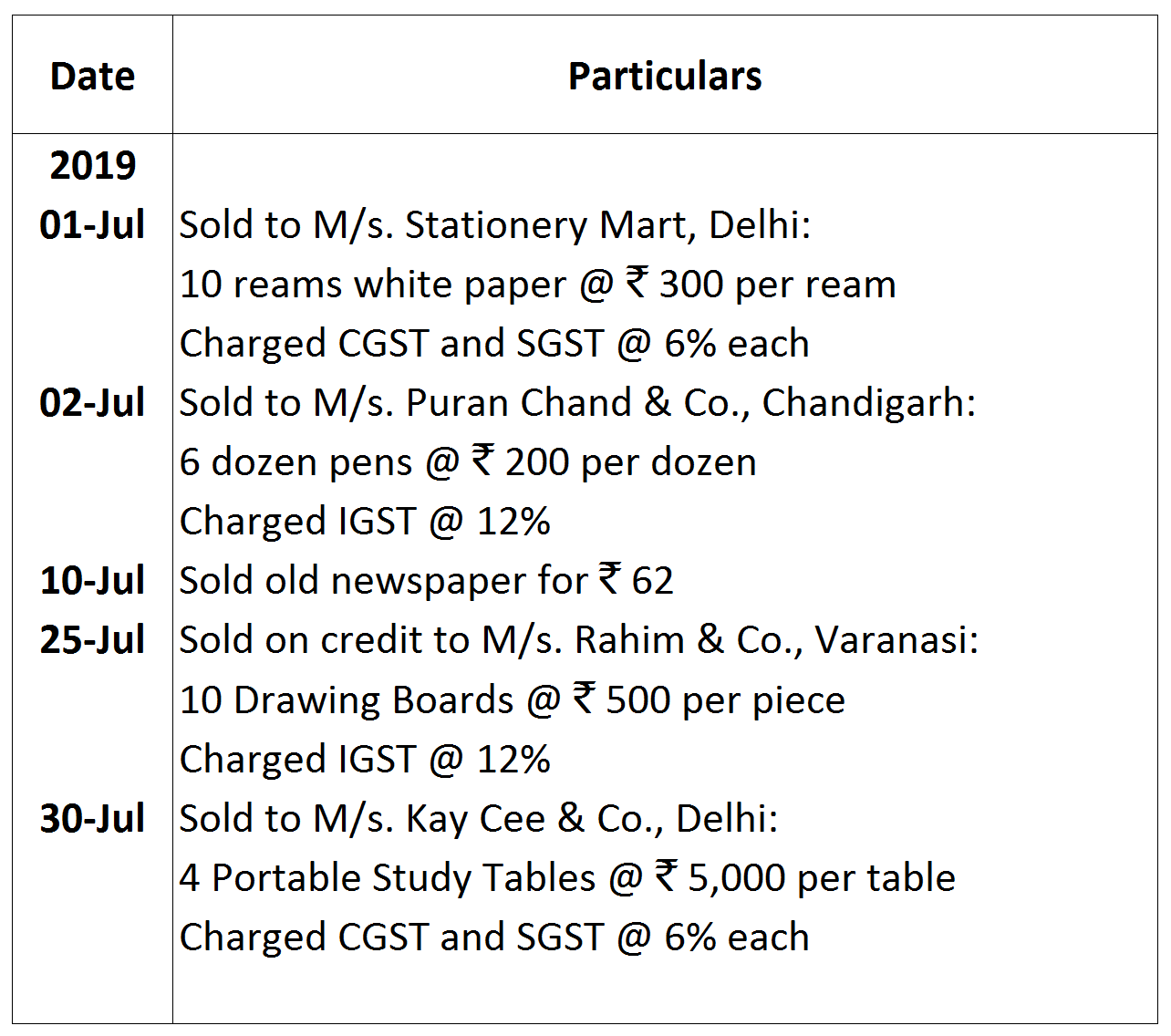
From the following particulars, prepare a Sales Book of M/s. Gyan Prasad & Bros., Delhi, dealers of stationery and post into Ledger Accounts:
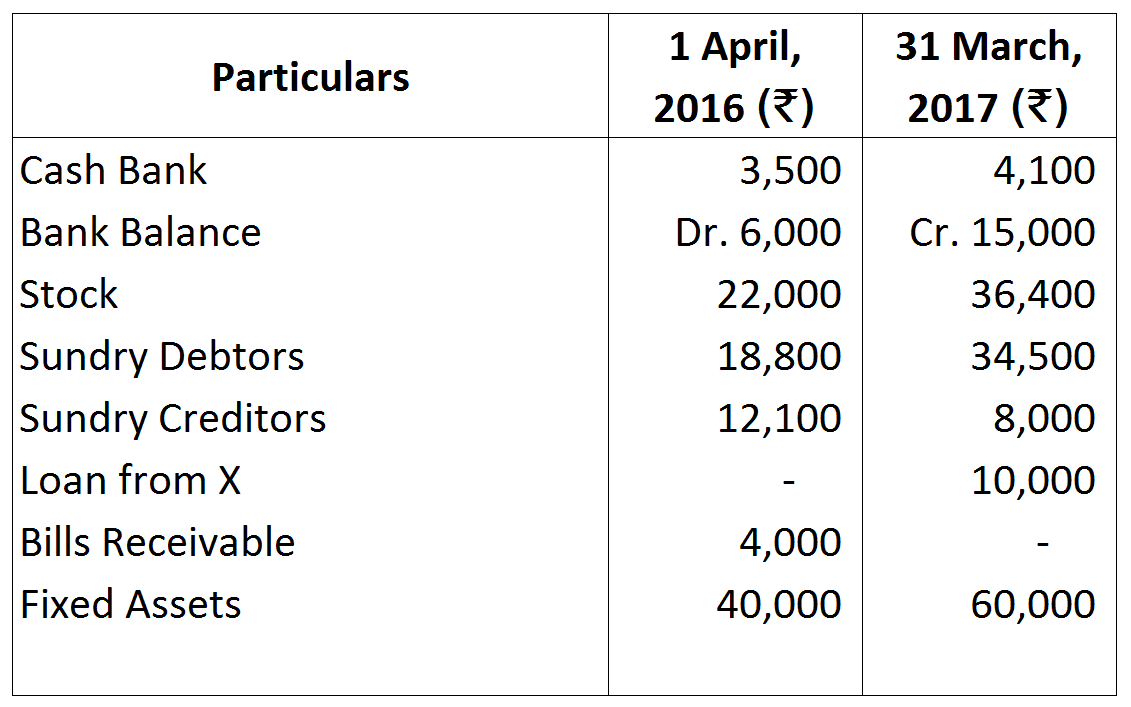
A retail Trader has not kept proper books of accounts. Ascertain his profit or loss for the year ending $31^{st}$ March, $2017,$ and prepare a final statement of affairs from the following information:
He withdrew from the business $₹ 1,500$ per month for his personal use and $₹ 8,000$ for giving a personal loan to his brother. He also used a house for his personal purposes, the rent of which at the rate of $₹ 900$ per month and electricity charges at an average rate of $₹ 250$ per month were paid from the business account. He had received a lottery prize of$ ₹ 25,000,$ out of which he invested half the amount in business. He has not paid two months' salary to his clerk $@ ₹ 1,200$ per month, but insurance premium $@ ₹ 600$ per annum was paid on $1^{st}$ October, $2016$ to run for one year. Loan from X was taken on 1^{st} July, 2016 on which interest was unpaid $@ 18\%$ p.a.
Fixed assets are to be depreciated $ @ 10\%$ p.a.