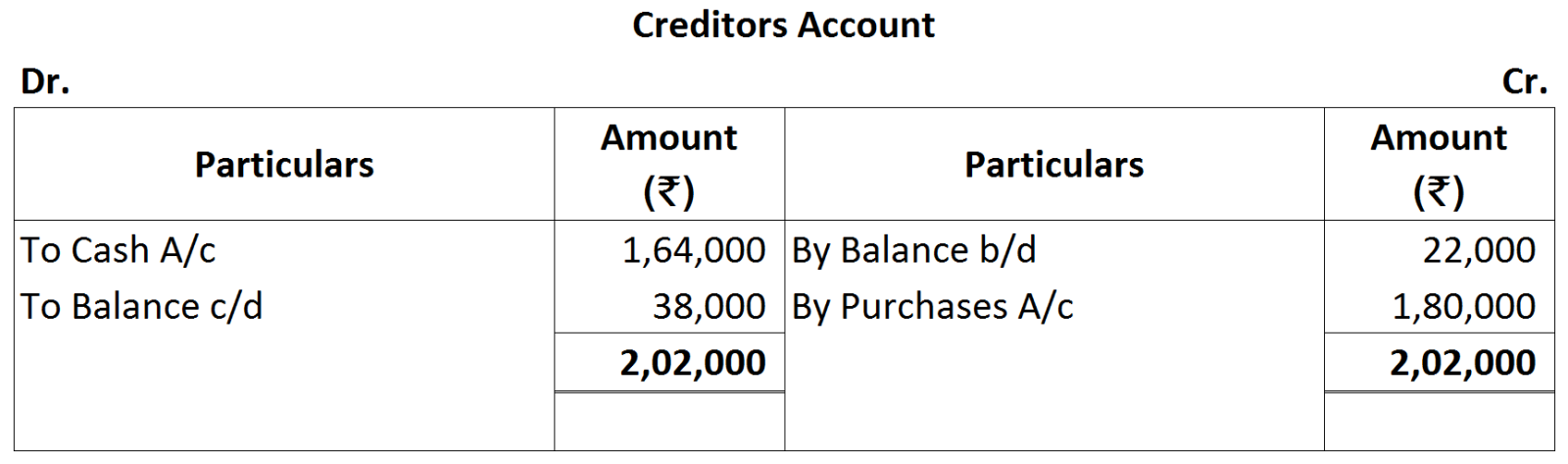
Questions

6 Marks Question

🎯

Test yourself on this topic

34 questions · timed · auto-graded

Question 16 Marks
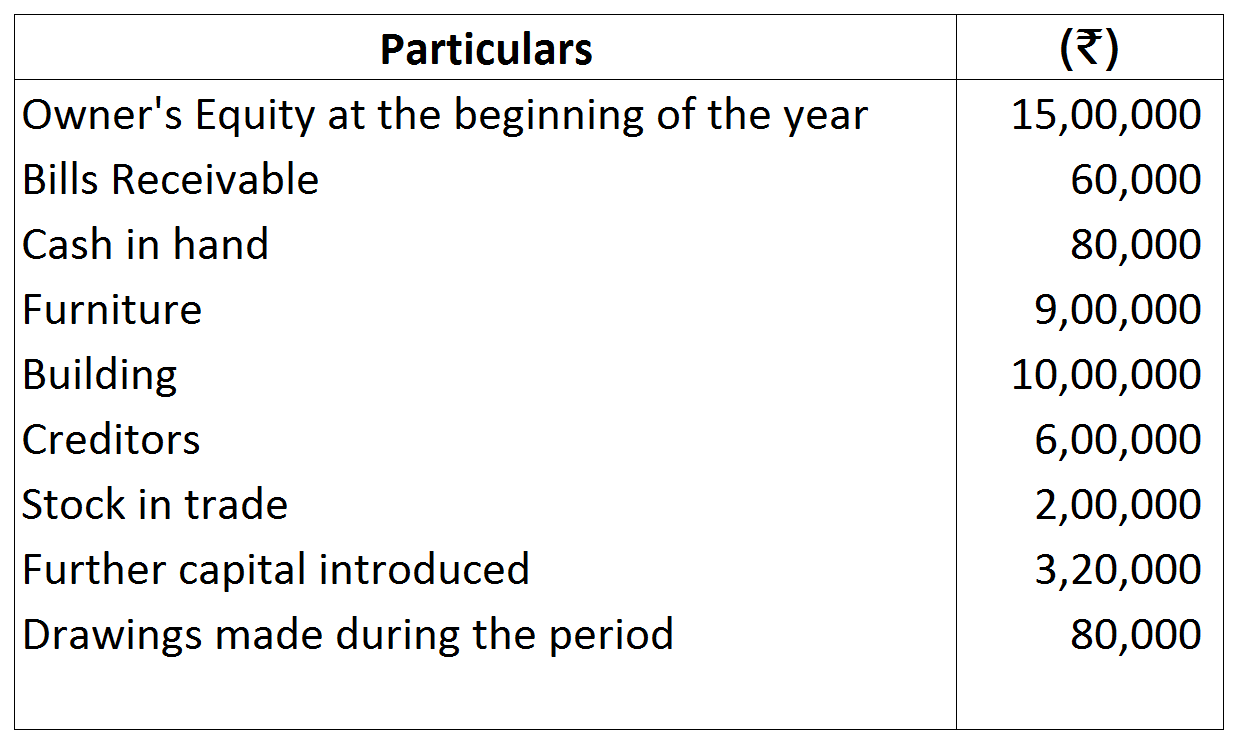
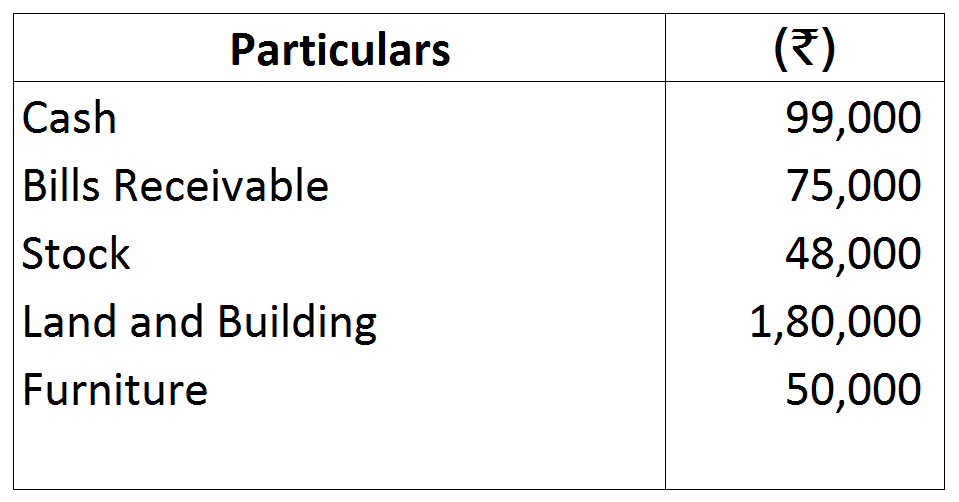
Mr. Joshi started a business with a capital of ₹ 5,00,000. At the end of the year his position was:
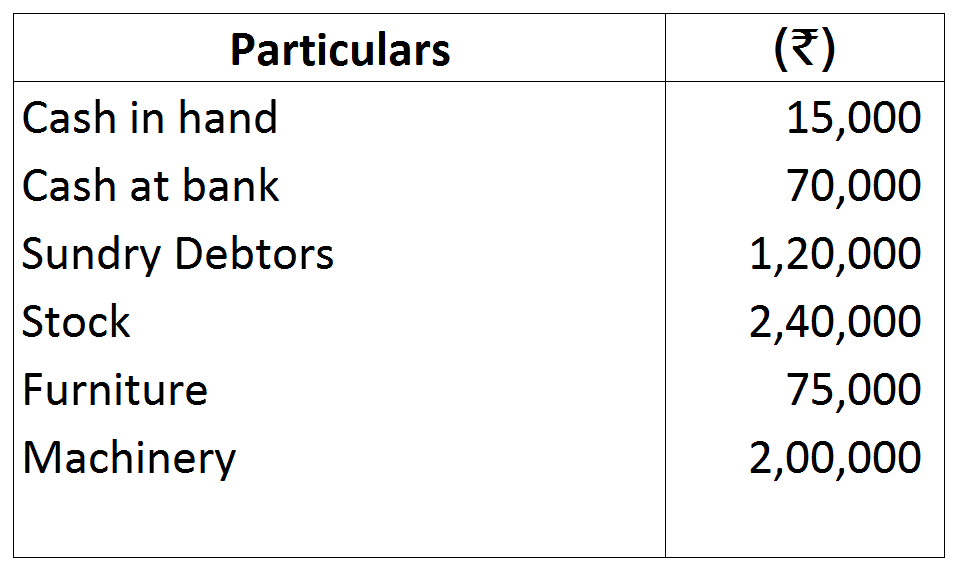
Sundry creditors at this date totalled ₹ 80,000. During the year he introduced a further capital of ₹ 1,50,000 and withdrew for household expenses ₹ 90,000.
You are required to calculate profit or loss during the year.
View full question & answer
Question 26 Marks
State three points of difference between Single Entry and Double Entry System. Difference between Double Entry System and Single Entry System?
Answer
Difference between Double Entry System and Single Entry System:
S.No.
Basis
Double Entry System
Single Entry System
1.
Aspect of a Transaction
Under this system, both aspect of a transaction are recorded.
Under this system, both aspect of transaction may not be recorded. In fact, for some transaction both the aspect, for some others one aspect and yet for others no aspect at all are recorded.
2.
Accounts Maintained
Under this system, personal, real and nominal etc.., all the accounts are maintained. Thus, it is a complete and scientificsystem of accounting.
Under this system, only personal accounts and Cash Book and maintained. Hence, it reamin an incomplete record of accounts.
3.
Trial Balance
Under this system, Trial Balance is prepared and thus, the arithmetical accuracy of all books of account is verified.
Under this system, Trial Balance cannot be prepared due to incomplete system of accounting. Therefore, arithmetical accuracy of the accounting cannot be verified.
4.
Profit or Loss
Under this system, after a certain period, net profit or net loss can be ascertained by preparing the Profit and Loss Account.
Under this system, Profit and Loss Account is not prepared to ascertain the net profit or loss. Method for ascertaining the profit or loss is not adequate.
View full question & answer
Question 36 Marks
Mr. White does not keep his books properly. Following information is available from his books.
During the year Mr. White sold his private car for ₹ $50,000$ and invested this amount into the business. He withdrew from the business ₹ $1,500$ per month upto $31^{st}$ October, $2015$ and thereafter ₹ $4,500$ per month as drawings. You are required to prepare a statement of profit or loss and a statement of affairs as at March $31, 2016$.
View full question & answer
Question 46 Marks
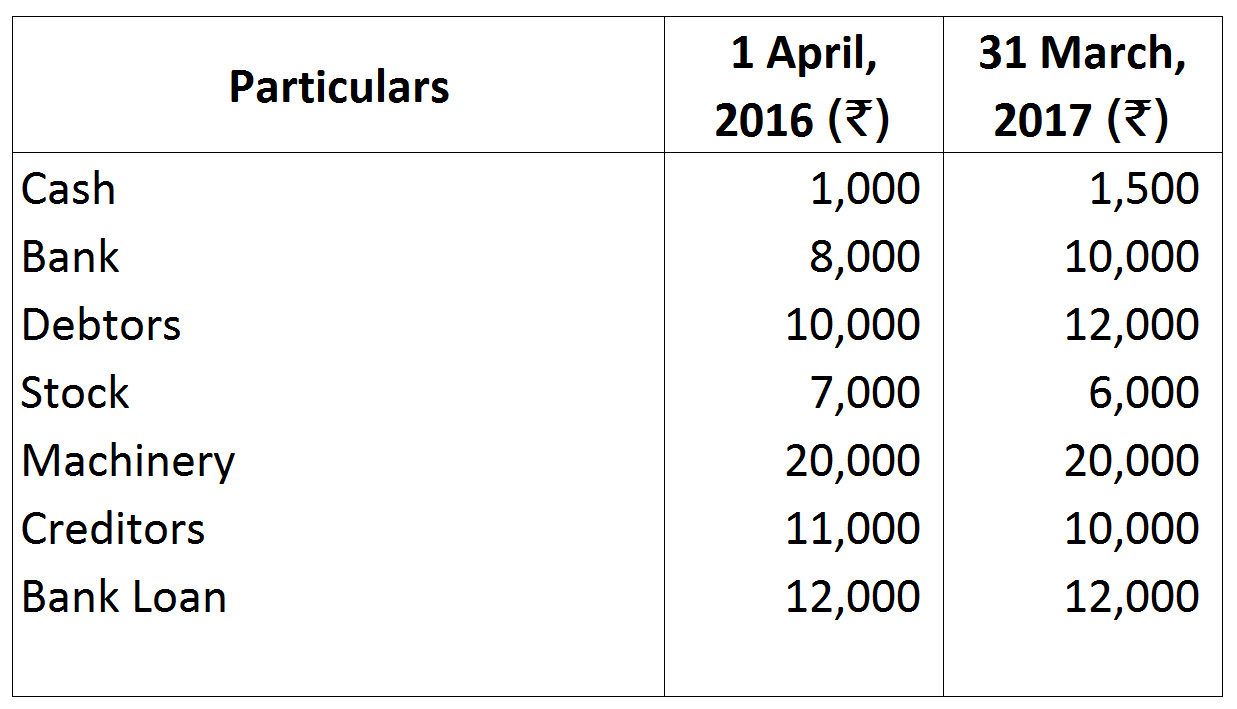
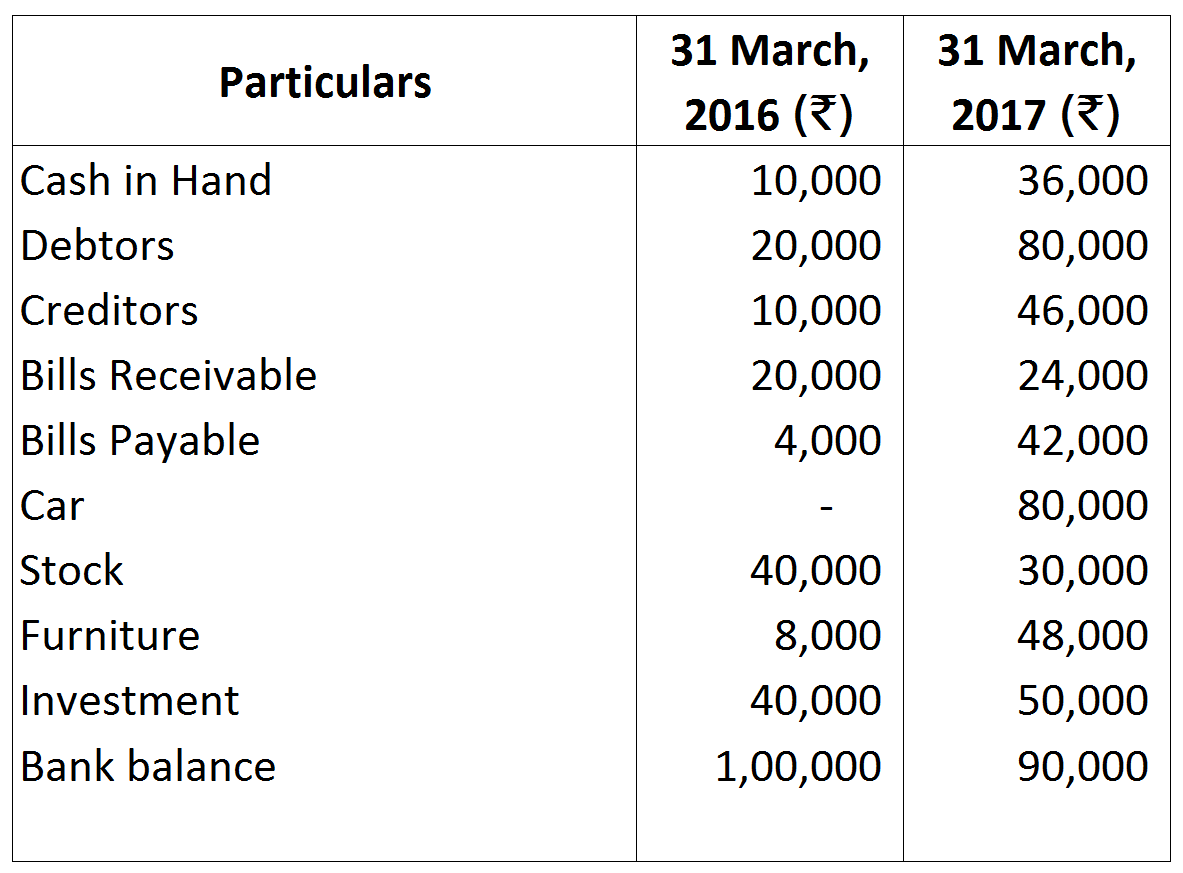
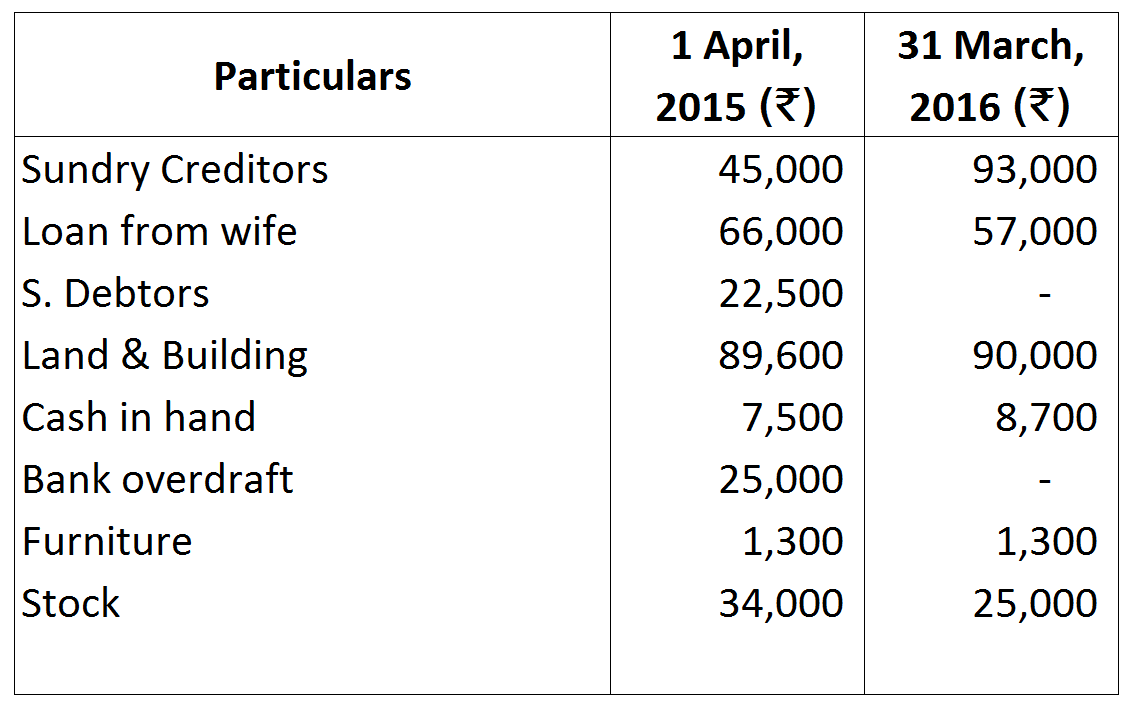
Mr. Vasudev does not keep proper records of his business. He provided following information. You are required to prepare a statement showing the profit or loss for the year.
View full question & answer
Question 56 Marks
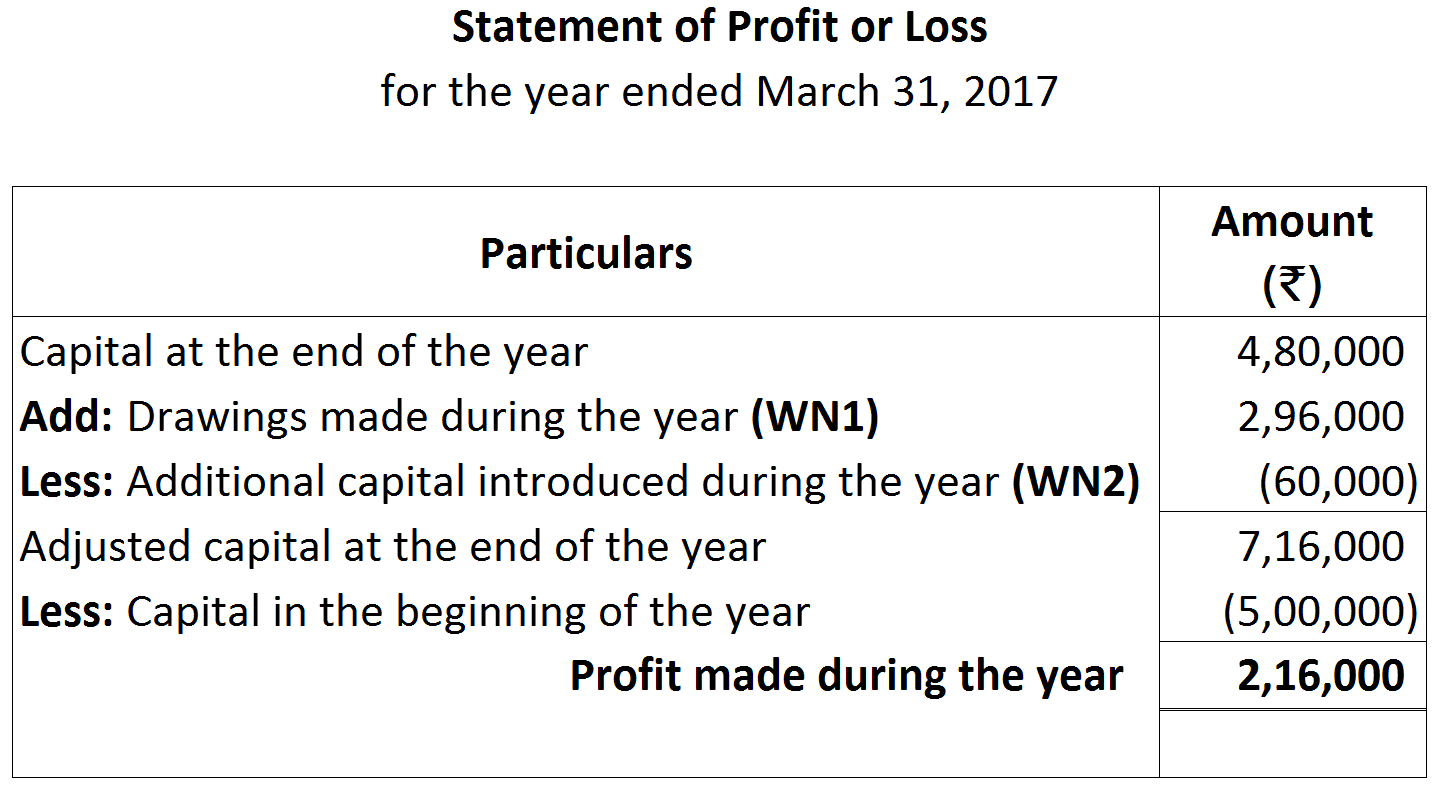
The Capital of Sh. Madhusudan on $1^{st}$ April, $2016$ was ₹ $5,00,000$ and on $31^{st}$ March, $2017$ was ₹ $4,80,000$. He has informed you that he withdrew from the business ₹ $8,000$ per month for his private use. He paid ₹ $20,000$ for his income-tax and the installment of the loan of his personal house at the rate of ₹ $15,000$ per month from the business. He had also sold his shares of Reliance Company costing ₹ $1,00,000$ at a profit of $20\%$ and invested half of this amount in the business. Calculate the profit or loss of the business.
Answer

Working Note:
  1. Calculation of Drawings
Cash Withdrawn = 96,000 (8,000 × 12)
Payment of Income tax = 20,000
Instalment of Personal Loan = 1,80,000 (15,000 × 12)
₹ 2,96,000
  1. Calculation of additional capita
Value of Shares = 1,00,000
Add: Profit = 20,000
Sale Value = ₹ 1,20,000
Aditional Capital $=₹ \ 60,000\Big(\frac{1,20,000}{2}\Big)$
View full question & answer
Question 66 Marks
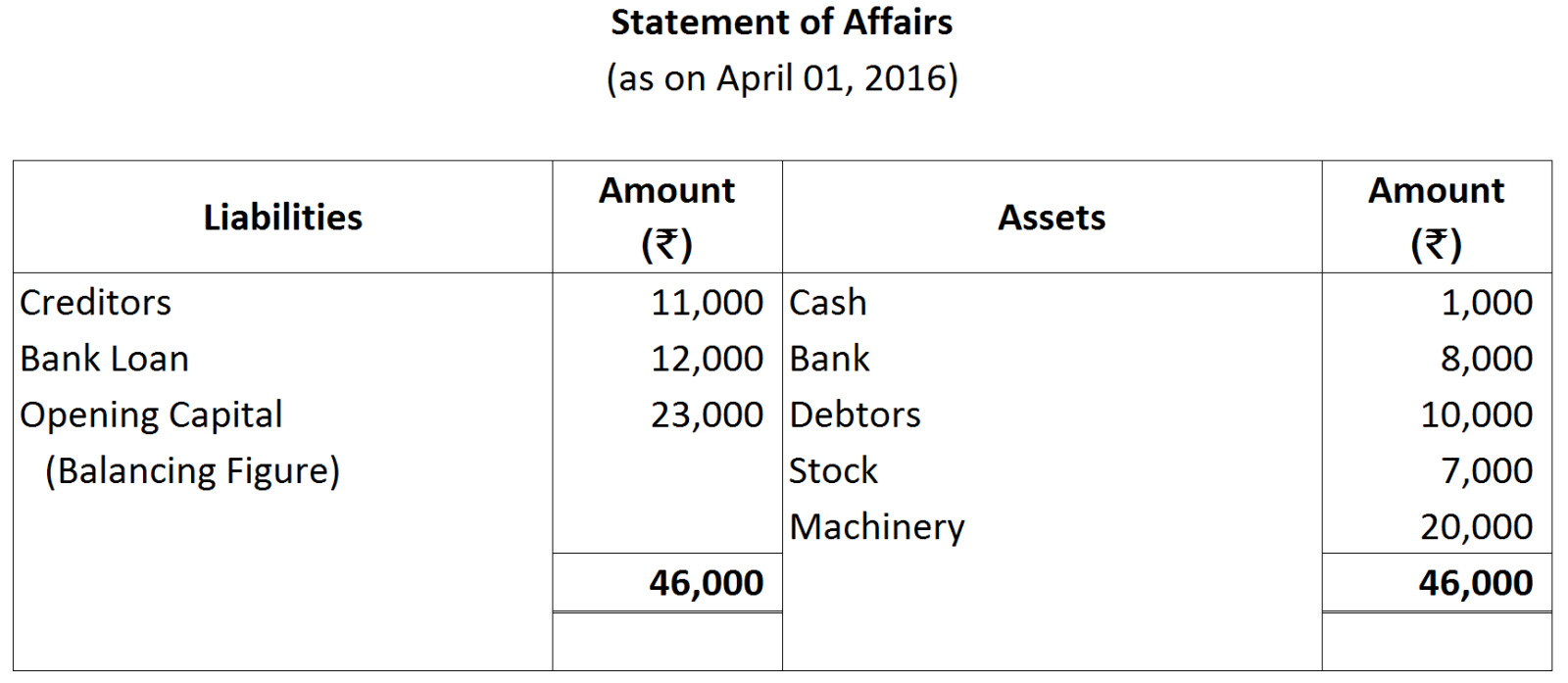
On $1^{st}$ April $2014$, Mr, Ghosh started business with a capital of ₹ $5,00,000$. He kept his books on single entry basis. Soon after he purchased furniture for ₹ $40,000$ and purchased goods for ₹ $3,00,000$. During the year he borrowed ₹ $1,00,000$ from his brother and introduced further capital of his own amounting to ₹ $80,000$.
On $31^{st}$ March, $2015$, there were sundry debtors amounting to ₹ $2,20,000$ and creditors amounted to ₹ $1,40,000$. Stock was valued at ₹ $4,50,000$. Cash in hand ₹ $15,400$ and Bank Overdraft ₹ $40,000$.
During the year Mr. Ghosh withdrew ₹ $2,000$ per week for his family expenses. You are informed that included in sundry debtors is an irrecoverable amount of ₹ $5,000$. He also took goods from the business for his personal use amounting to ₹ $4,000$.
You are required to calculate his profit or loss during the year.
View full question & answer
Question 76 Marks
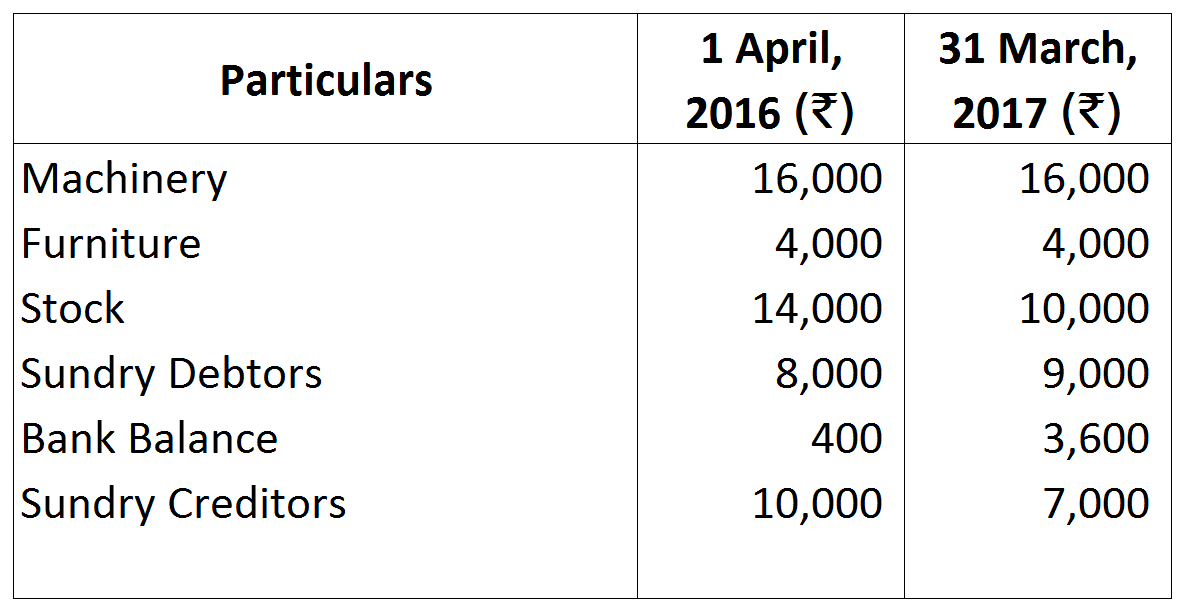
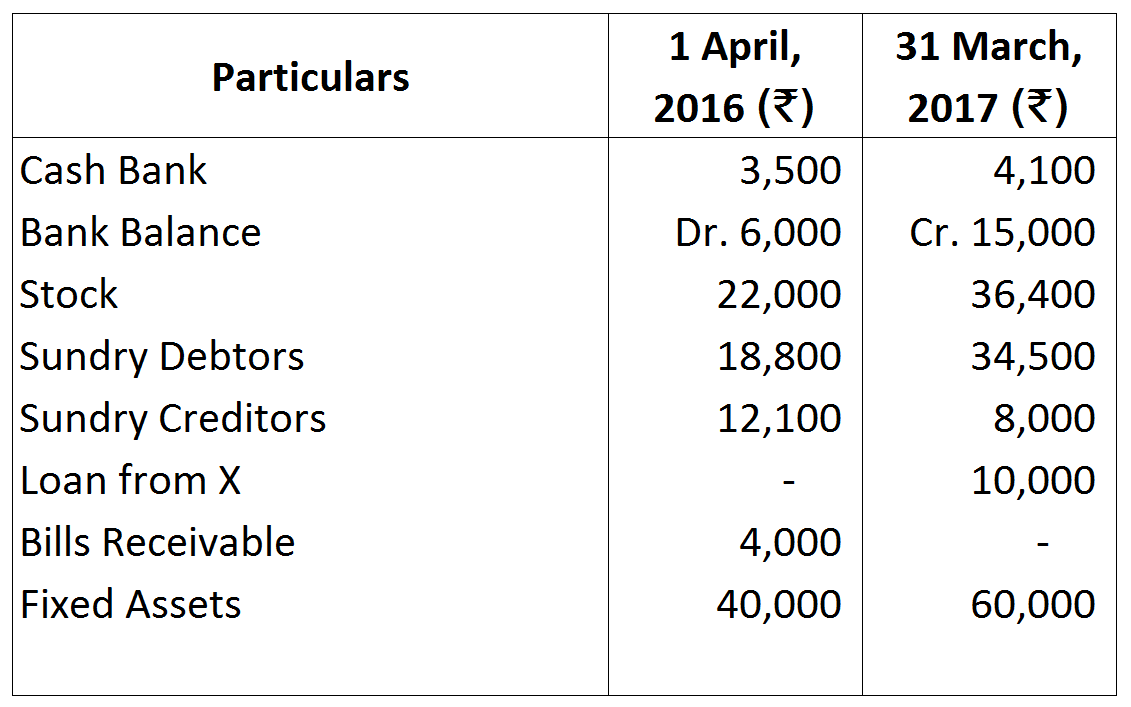
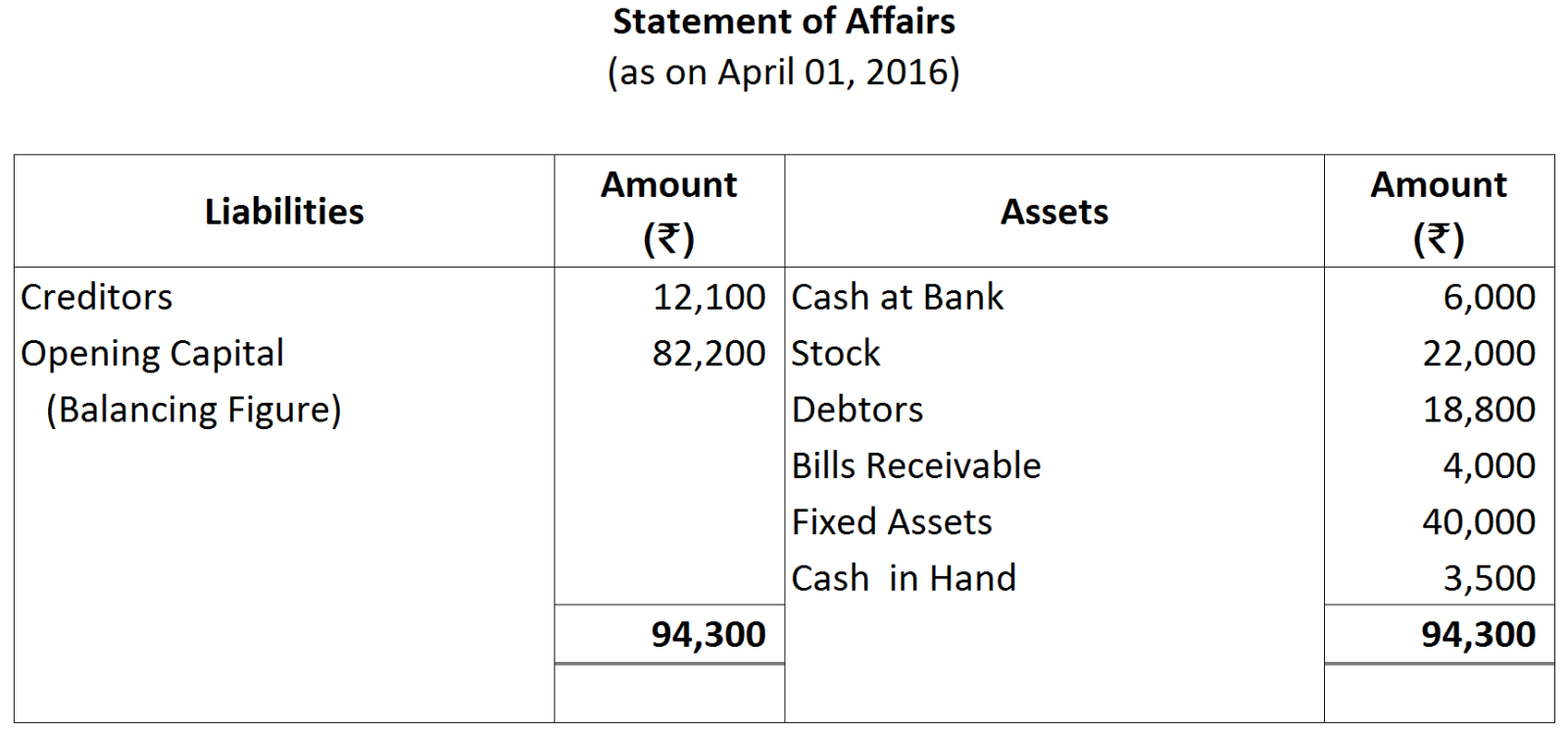
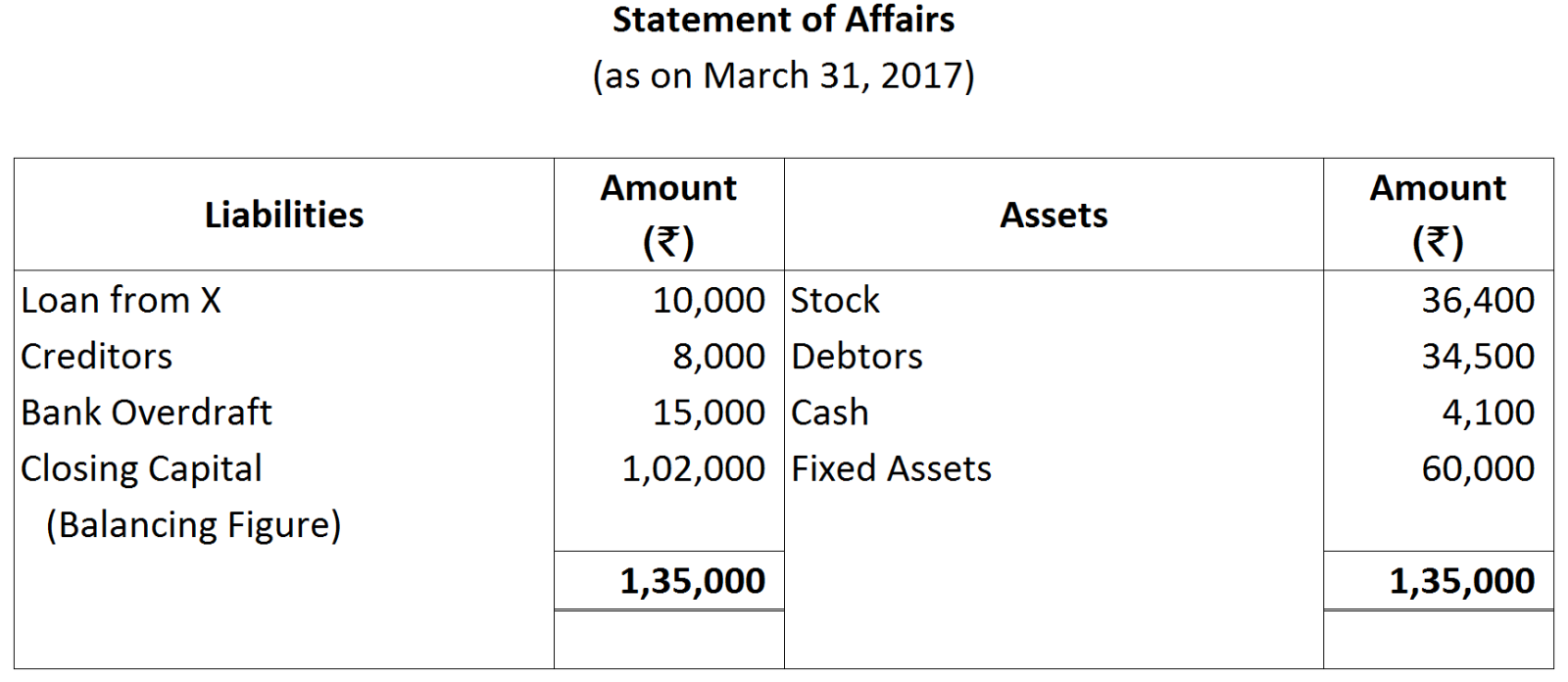
From the following information relating to the business of Mr. X who keeps books by single entry ascertain the profit or loss for the year ended $31^{st}$​​​​​​​ March,$ 2017:$
Mr. X withdrew ₹ 4,100 during the year to meet his household expenses. He introduced ₹ 600 as fresh capital. Machinery and furniture to be depreciated by 10% and 5% per annum respectively.
View full question & answer
Question 86 Marks
Mr. A does not keep proper records of his business. Following information is available from records kept by him:
Mr. A withdrew from the business ₹ 3,000 per month upto 30th September 2016 and thereafter ₹ 4,000 per month as drawings. ₹ 50,000 realised by the proprietor as maturity value of National Saving Certificates was invested in the business. Prepare a statement showing net profit (or net loss) for the year.
View full question & answer
Question 96 Marks
Tulsi started business on $1^{st}$April, $2016$ with a capital of ₹ $4,50,000.$ On $31^{st}$ March, $2017 $her position was as under:

She owed ₹ $45,000$ to her friend Parvati on that date. She withdrew ₹ $8,000$ per month for household purposes. Ascertain her profit or loss for the year ended $31^{st}$​​​​​​​ March,$ 2017:$
View full question & answer
Question 106 Marks
State three points of difference between Statement of Affairs and Balance Sheet.
Answer
Difference between Balance Sheet and Statement of Affairs Basis Balance Sheet:
S.No.
Basic
Balance Sheet
Statement of Affairs
1.
Objective
The main objective of preparing Balance Sheet is to know about the financial poistion of the business.
The main objective of preparing Statement of Affairs is to know about capital at a point of time.
2.
Accounting System
Balance sheet is prepared when accounts are maintained under Double Entry System.
Statement of Affairs is prepared when account are maintained under Single Entry System.
3.
Accounts and Information
This is prepared exclusively on the basis of ledger accounts.
In view of income accounts, its preparation is based on limited accounts, calculation, estimates and other information.
4.
Reliability
Being based on actual figures, Balance Sheet is regarded as a reliable statement.
Since it is based on the accounts and partly on other information and one's memory, hence, it is not regarded as areliable statement.
5.
Trial Balance
Trial Balance is prepared before Balance Sheet is prepared.
In the case of statement of Affairs, Trial Balance is not prepared.
View full question & answer
Question 116 Marks
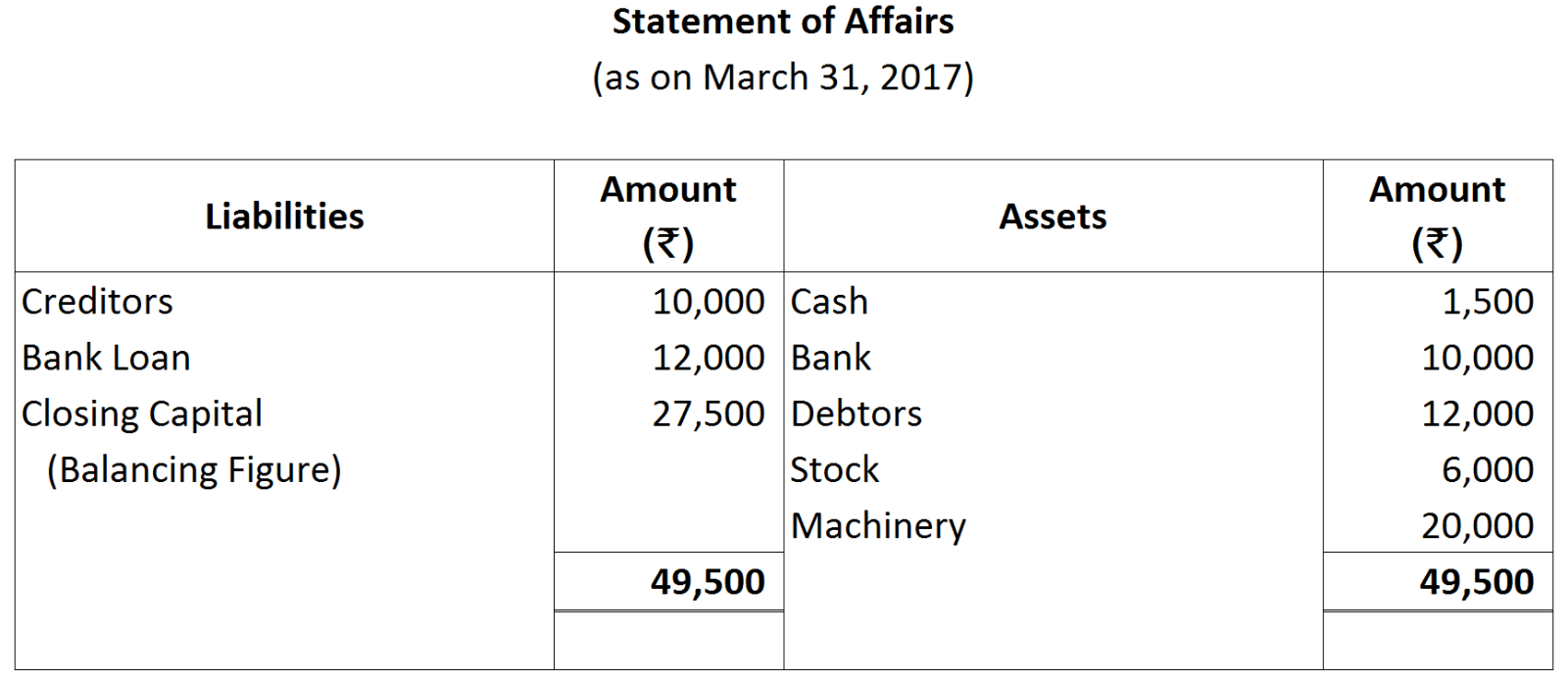
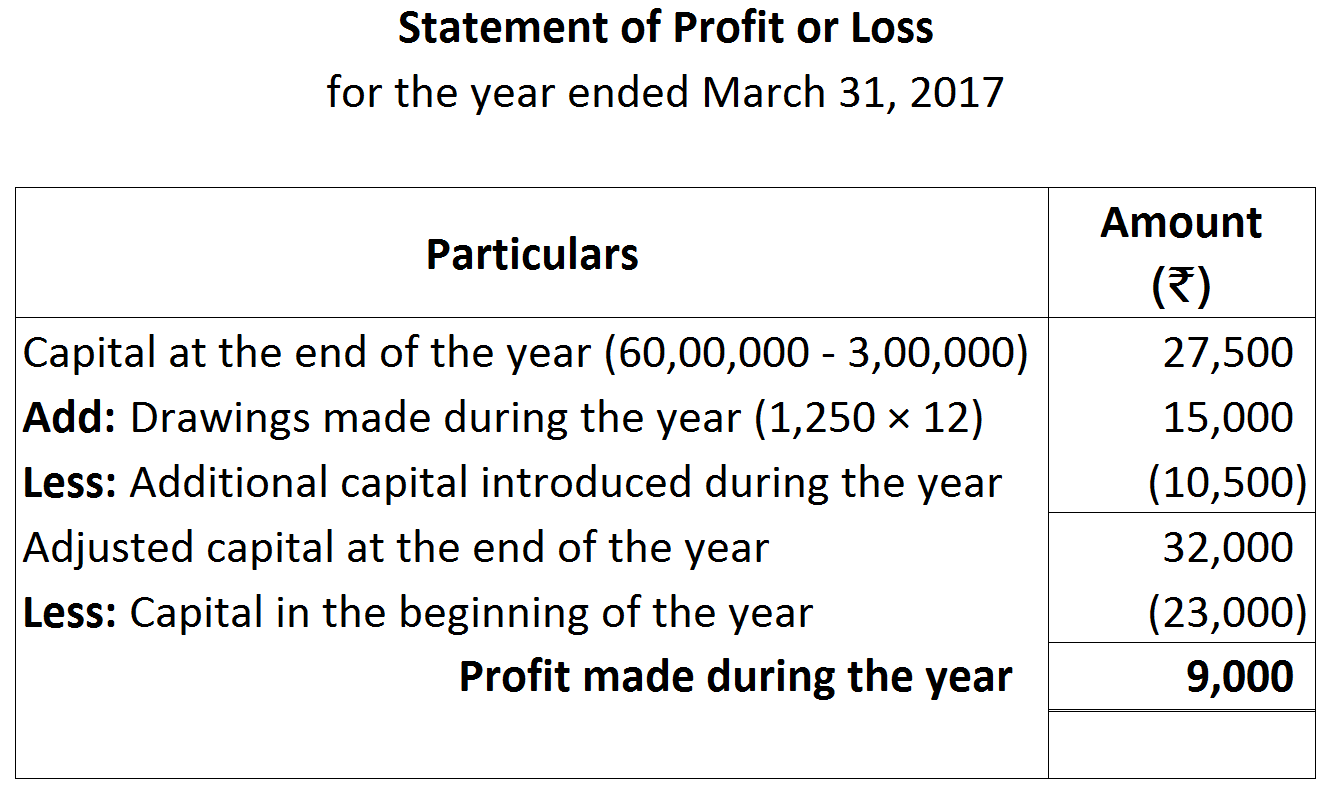
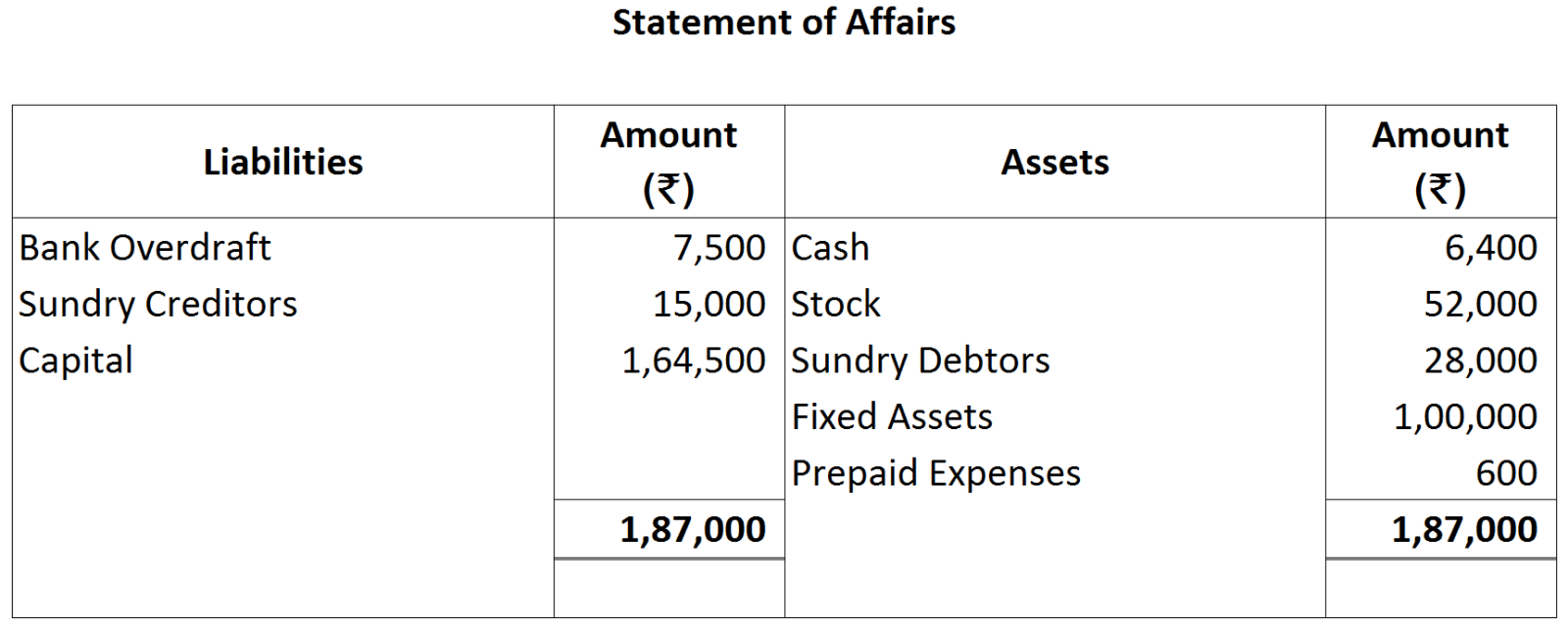
Following incomplete information is available from records maintained by Mr. X:

During the year Mr. X introduced in the business the amount realised on sale of ₹ 10,000 investments at the premium of 5%. Personal expenses of Mr. X paid from business account amounted to ₹ 1,250 per month. Prepare a statement to calculate Profit (or Loss) during the year.
Answer


Working Note:
Calculation of additional capital introduced during the year.
Value of Investments = 10,000
Premium = 500 (10,000 × 5%)
Sale Value of Investments = ₹ 10,500(Aditional Capital)
View full question & answer
Question 126 Marks
Why is Statement of Affairs not called a Balance Sheet?
Answer
The assets and liabilities are recorded in a statement of affairs just like a Balance Sheet, it should not be described as a Balance Sheet because of the following differences:
S.No.
Basis of Difference
Balance Sheet
Statement of Affairs
1.
Double Entry
It is prepared with the list of ledger balances drawn from the books of accounts kept on the basis of double entry.
It is not prepared with the list of ledger balances but with such information as is available from the accounting records kept on the basis of single entry.
2.
Arithmetical Accuracy
The tallying of balance sheet proves arithmetical accuracy of accounting books because it is prepared on the basis of a trial balance.
A statement of affairs does not prove the arithmetical accuracy of accounting books because it is not prepared on the basis of a trial balance.
3.
Value of Assets and Liabilities
The values of assets and liabilities shown in a Balance Sheet are the actual value based on ledger accounts.
The values of assets and lliabilities shown in the statement of affairs are merely the estimates based on physical inspection.
4.
Object
It is prepared for ascertaining the financial position of a business.
It is prepared for ascertaining the capital of a business.
5.
Omission of an Assets or a Liability
If an asset or liability is omitted while preparing a Balance Sheet, it will be easily detected because the Balance Sheet will not tally.
If an asset or liability is omitted while preparing statement of affairs, it cannot be easily detected.
6.
Reliability
A Balance Sheet is treated as more reliable because it is based on double entry principles.
It is treated as less reliable because it is based on oncomplete records and estimates.
View full question & answer
Question 136 Marks
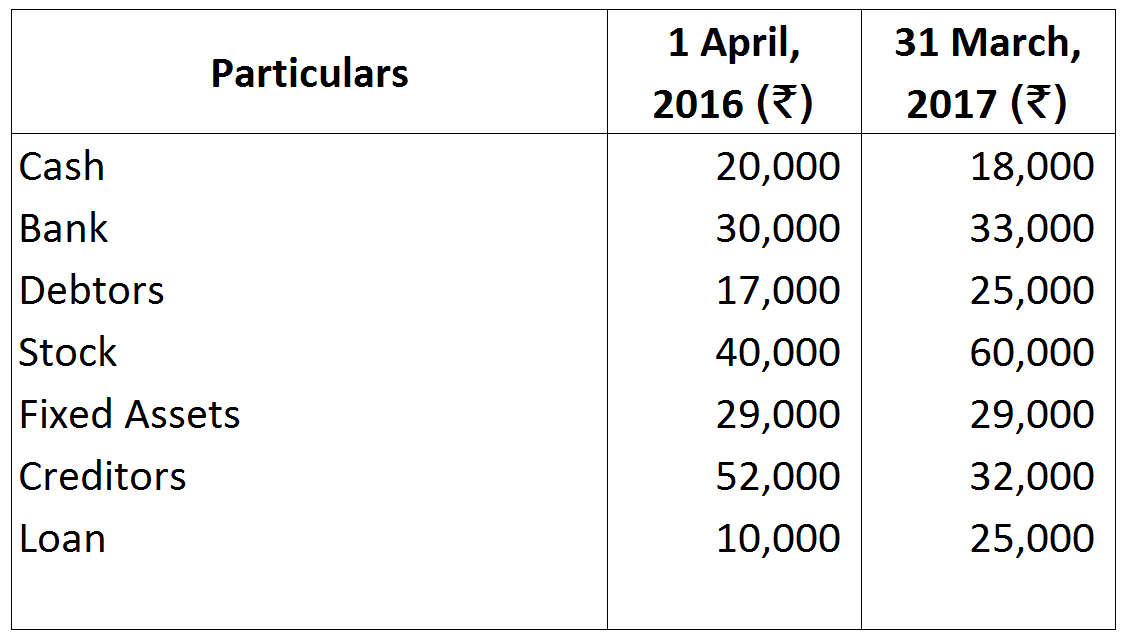
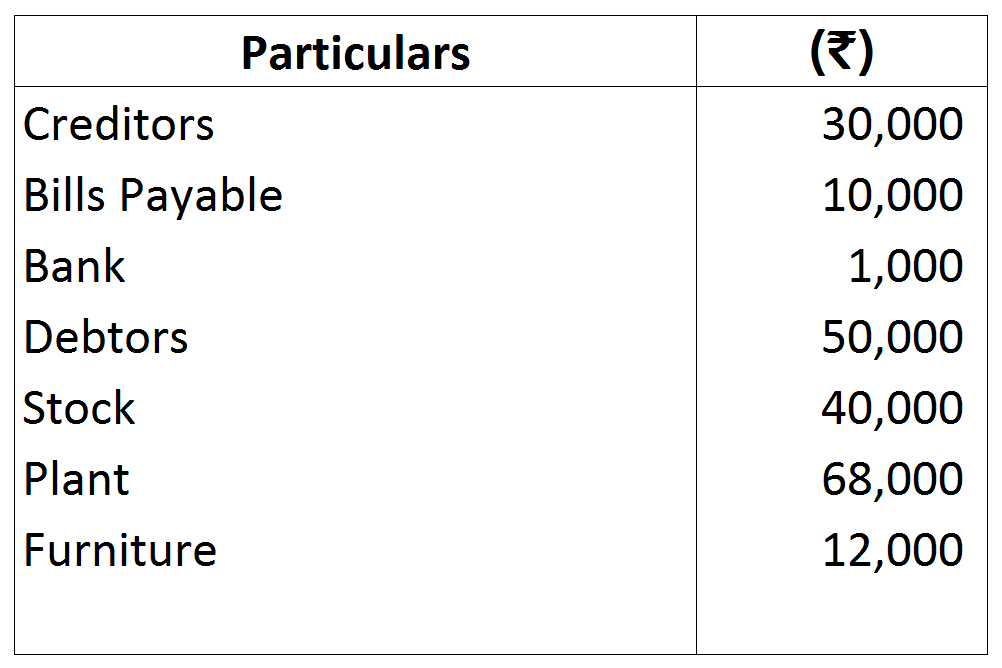
On April $1^{st}, 2016$, X started a business with ₹ $40,000$ as his capital. On March $31^{st}, 2017$, his position was as follows:

During the year $2016-17$ X drew ₹ $24,000$. On $1^{st}$ October $2016$, he introduced further capital amounting to ₹ $30,000$. You are required to ascertain profit or loss made by him during the year 2016-17.
Adjustments:
  1. Plant is to be depreciated at $10\%$.
  2. A Provision of $5\%$ is to be made against debtors.
Also prepare the Statement of Affairs as on March $31^{st} 2017$.
View full question & answer
Question 146 Marks
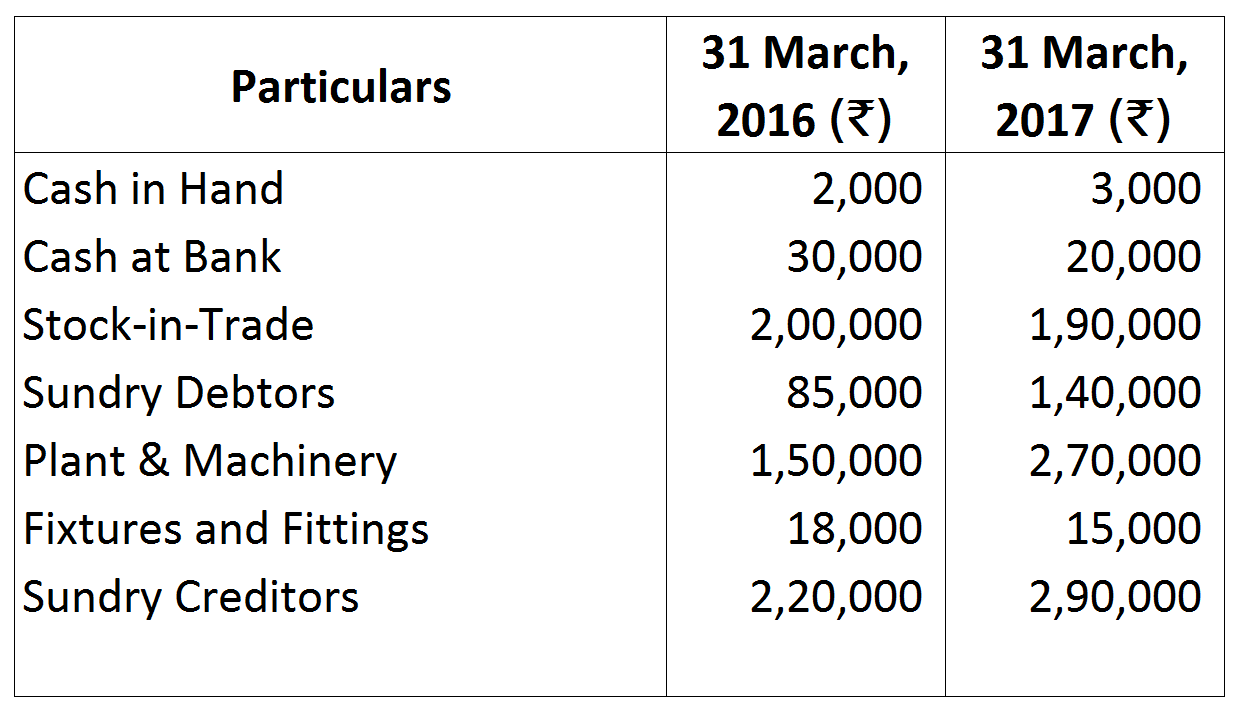
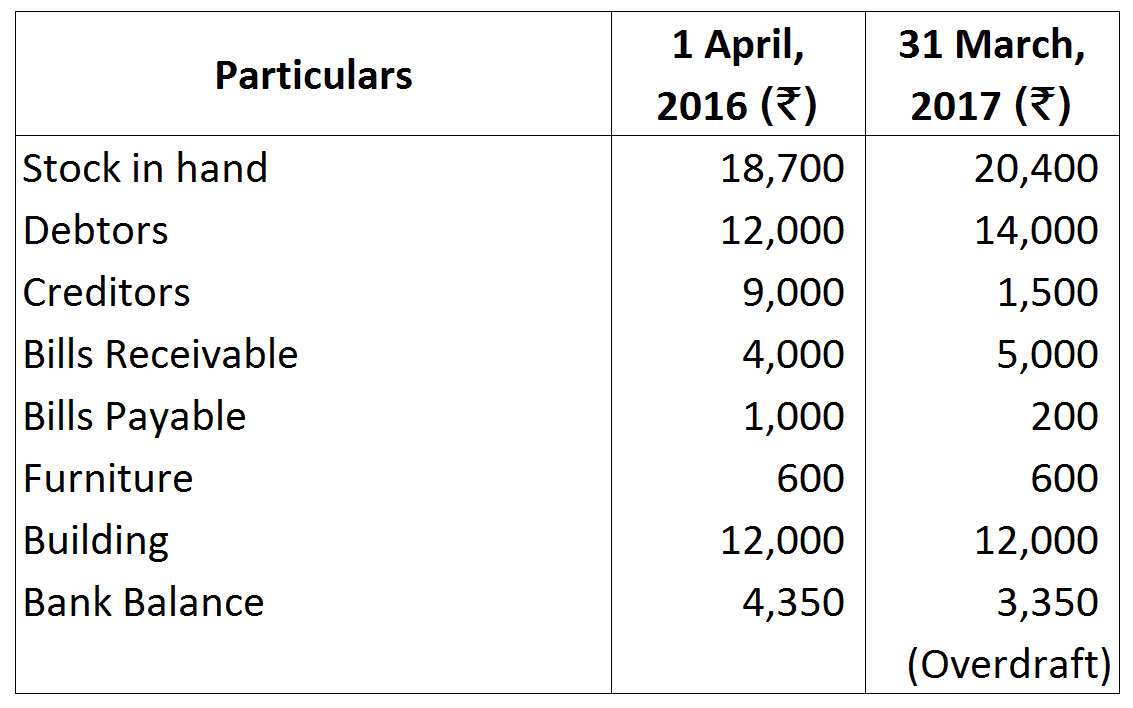
Raghuveer keeps incomplete records. His position was as follows:

During the year, Raghuveer introduced ₹ $50,000$ as further capital in the business and withdrew ₹ $7,500$ per month. From the above information, show Profit or Loss for the year ended $31^{st}$​​​​​​​ March,$ 2017:$
View full question & answer
Question 156 Marks
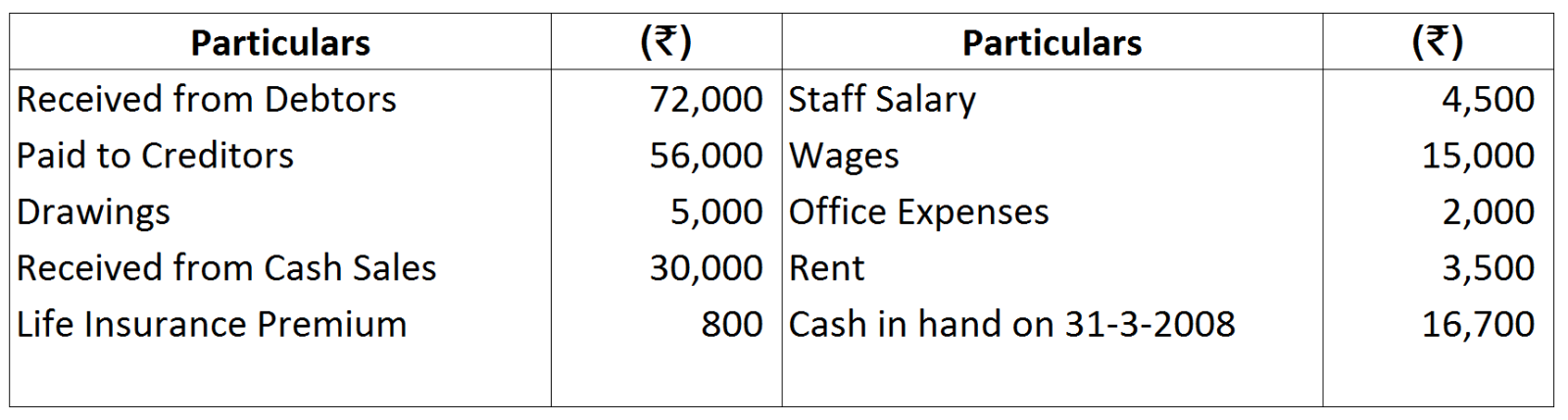
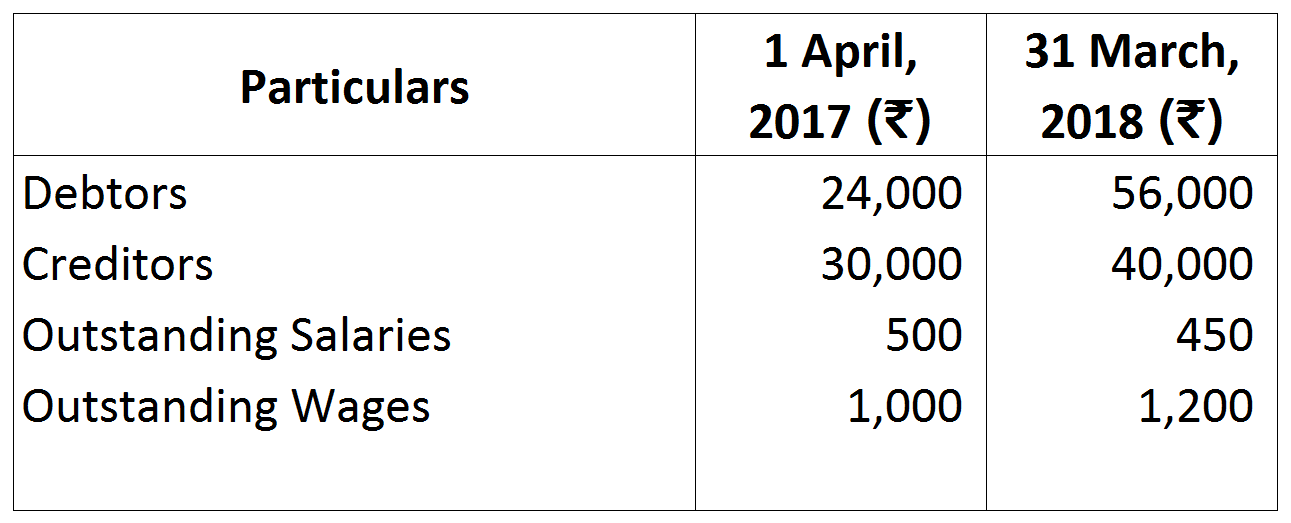
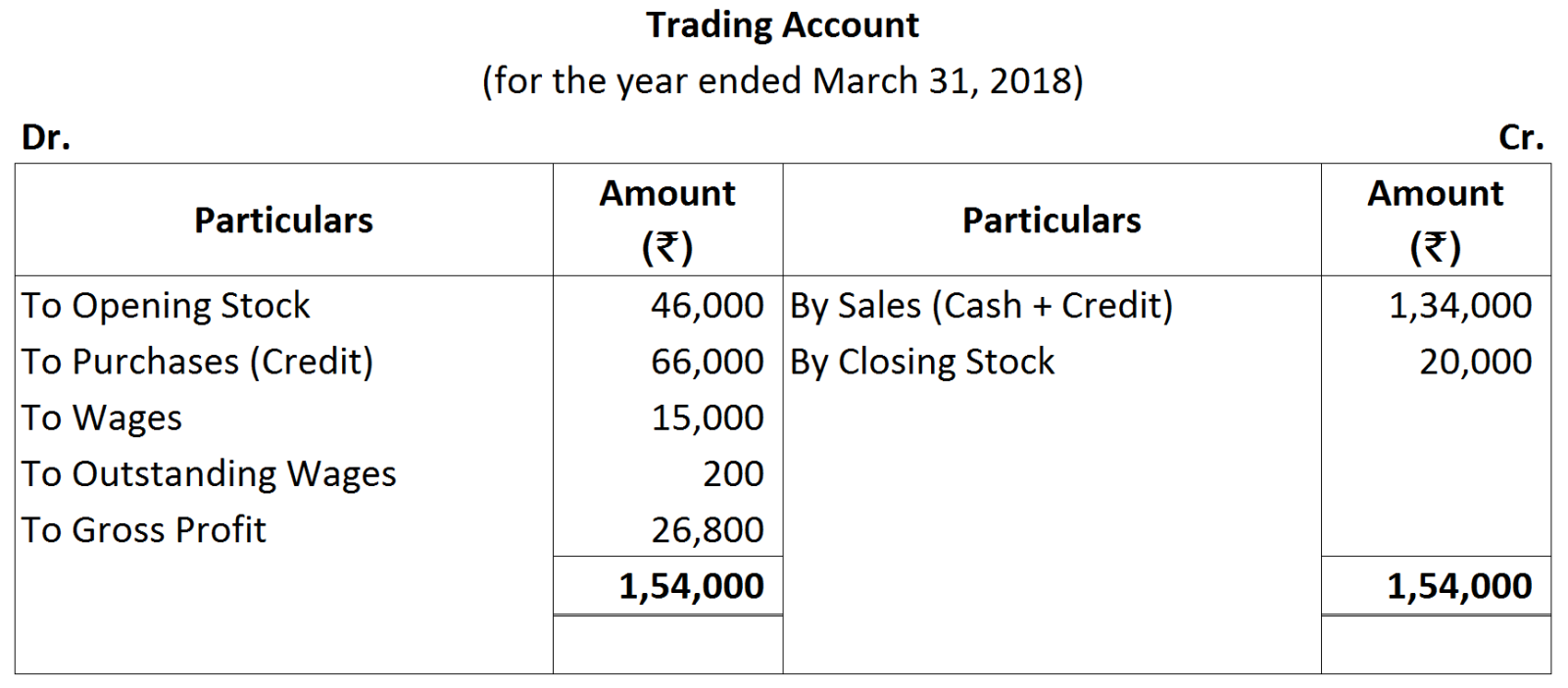
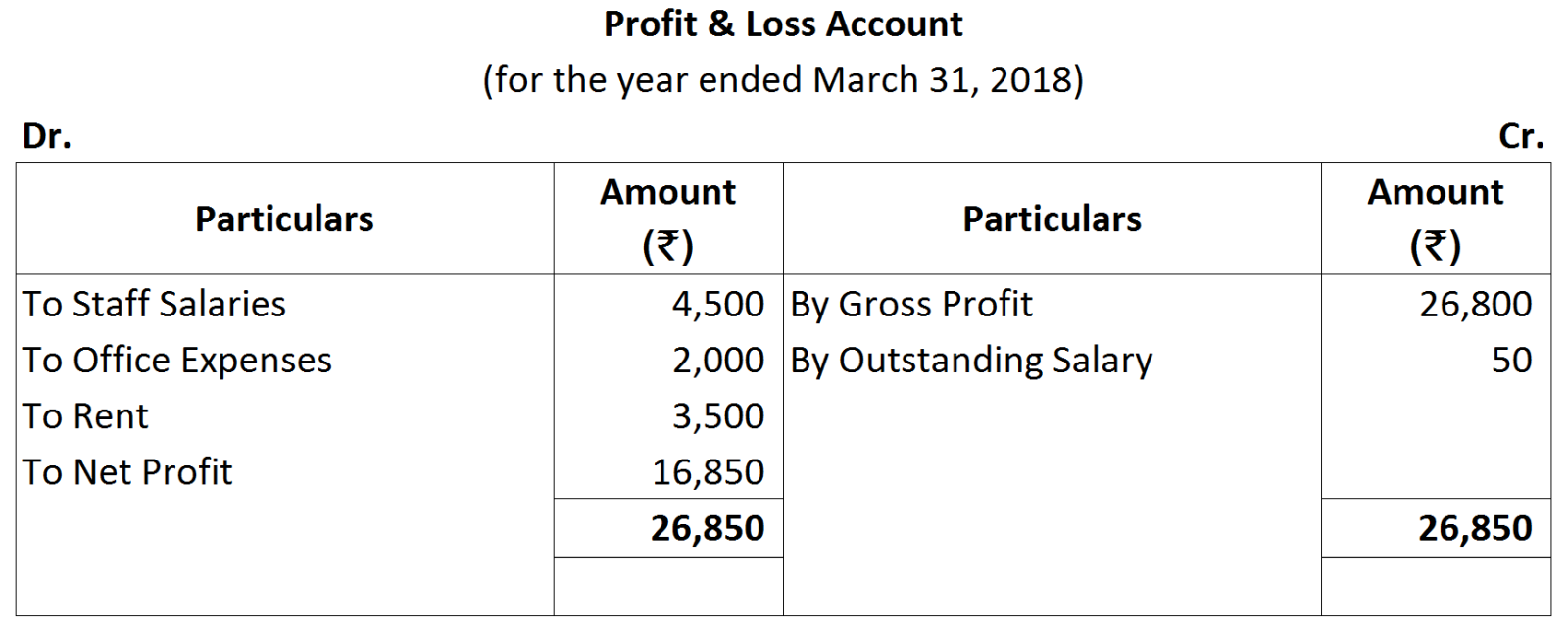
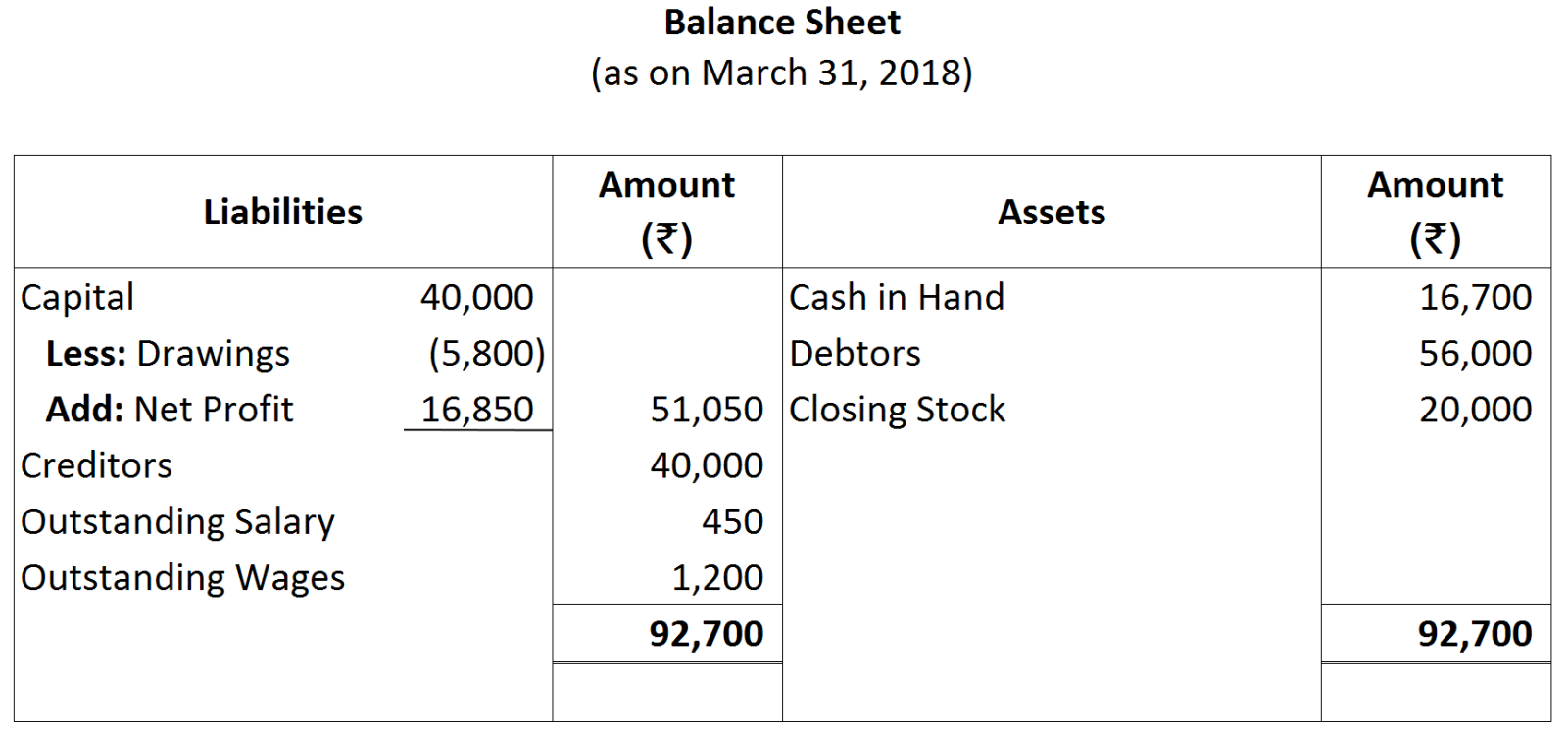
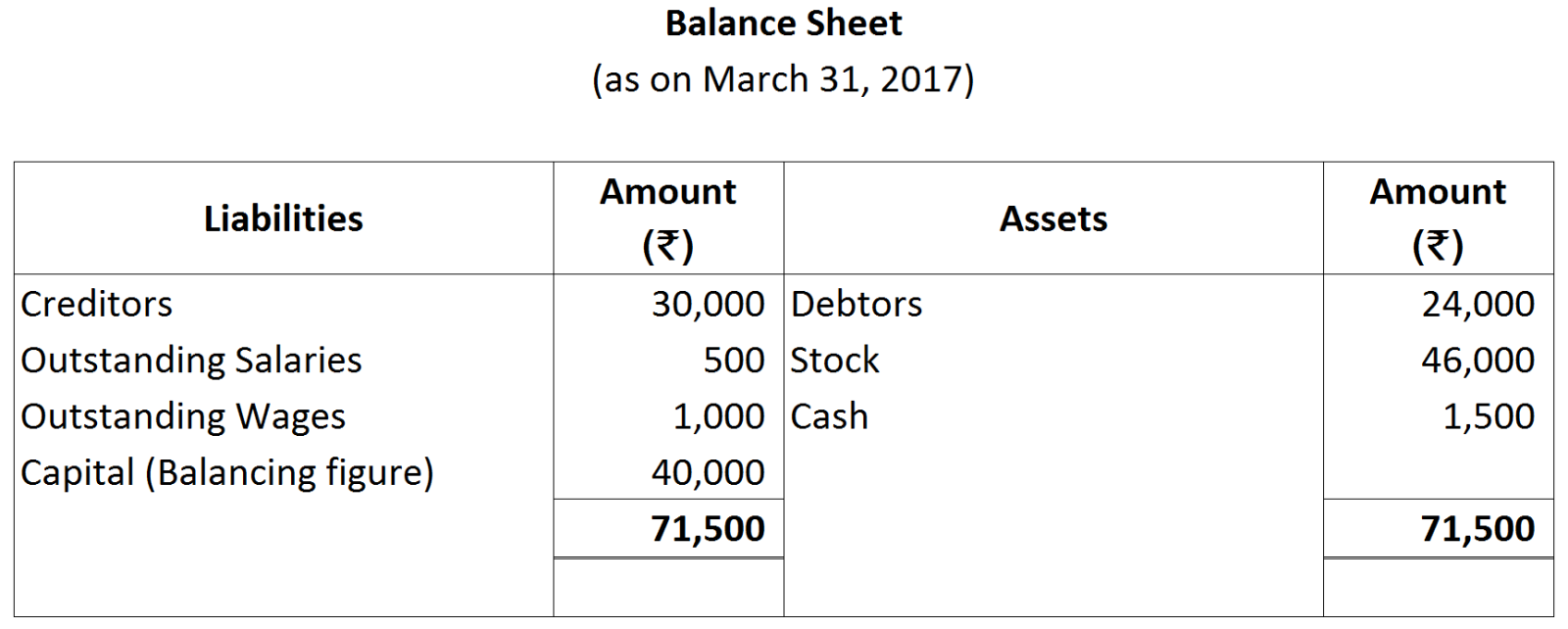
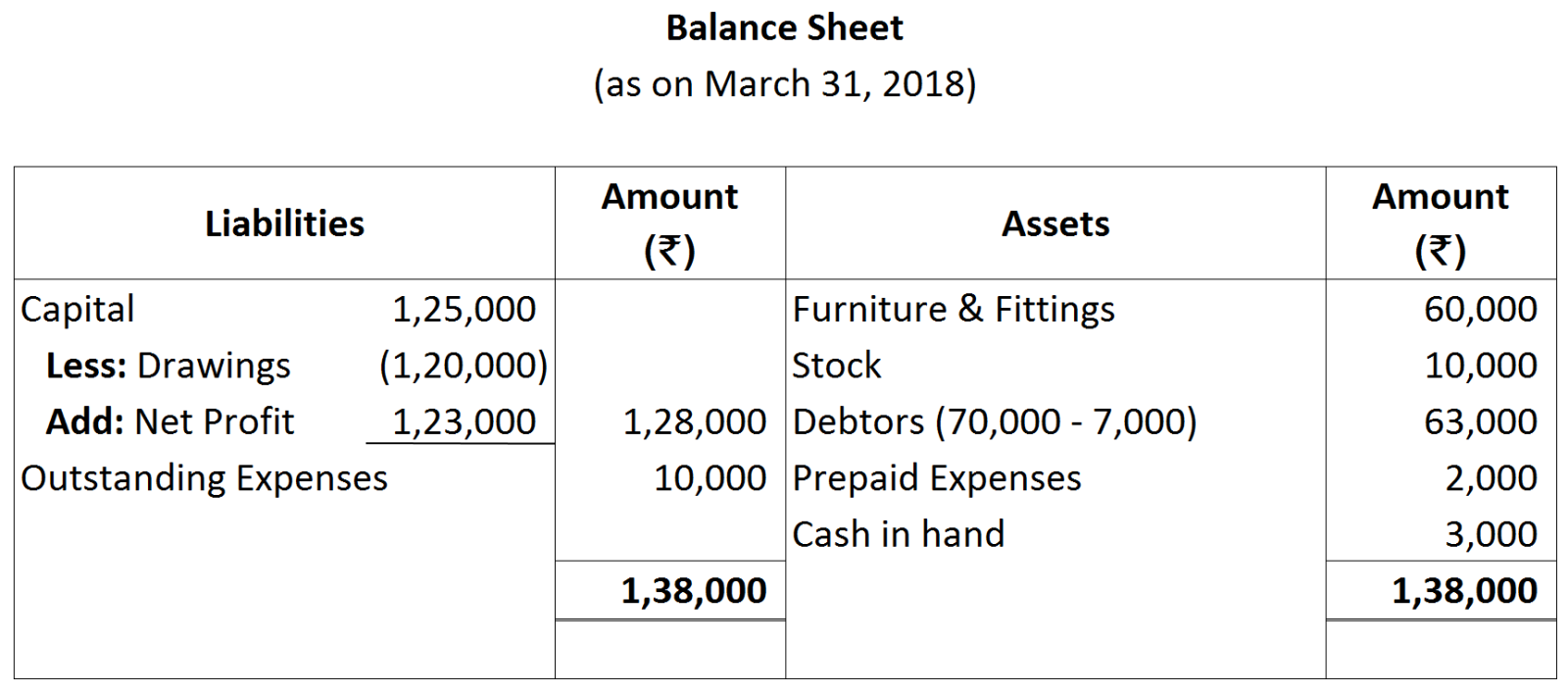
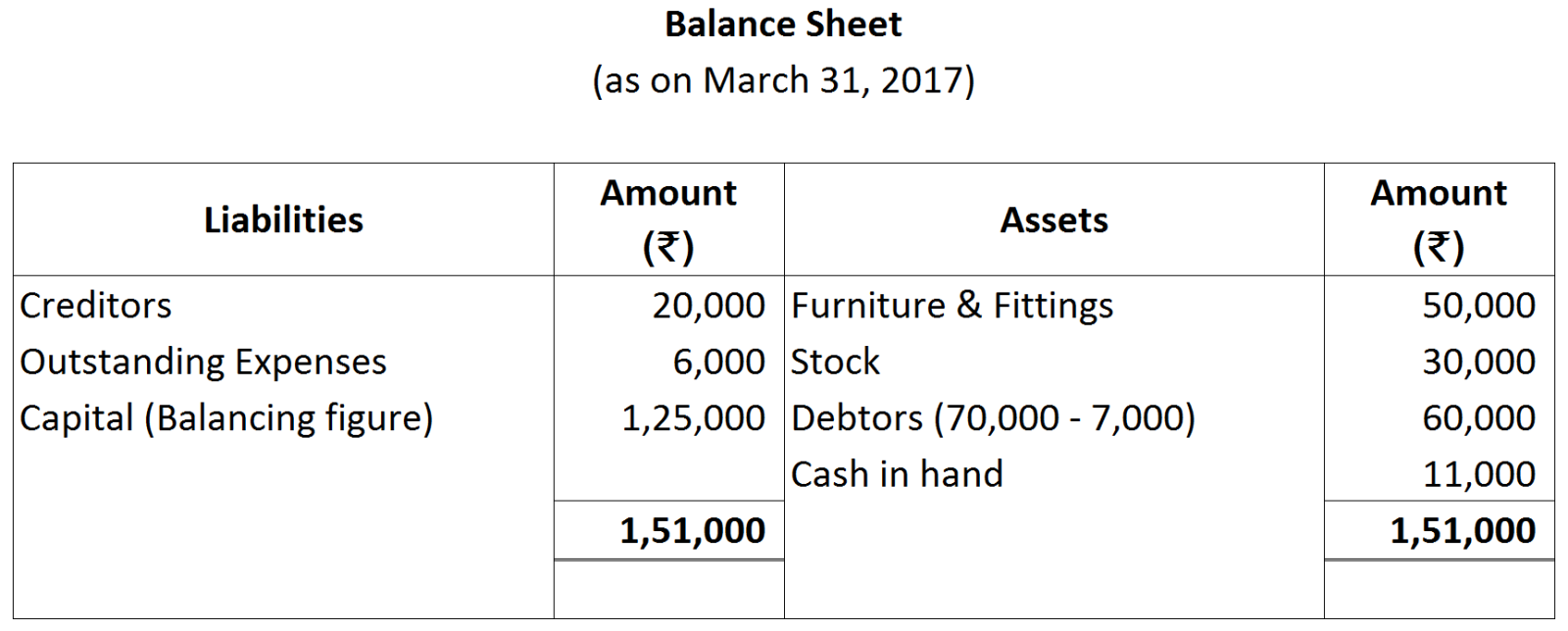
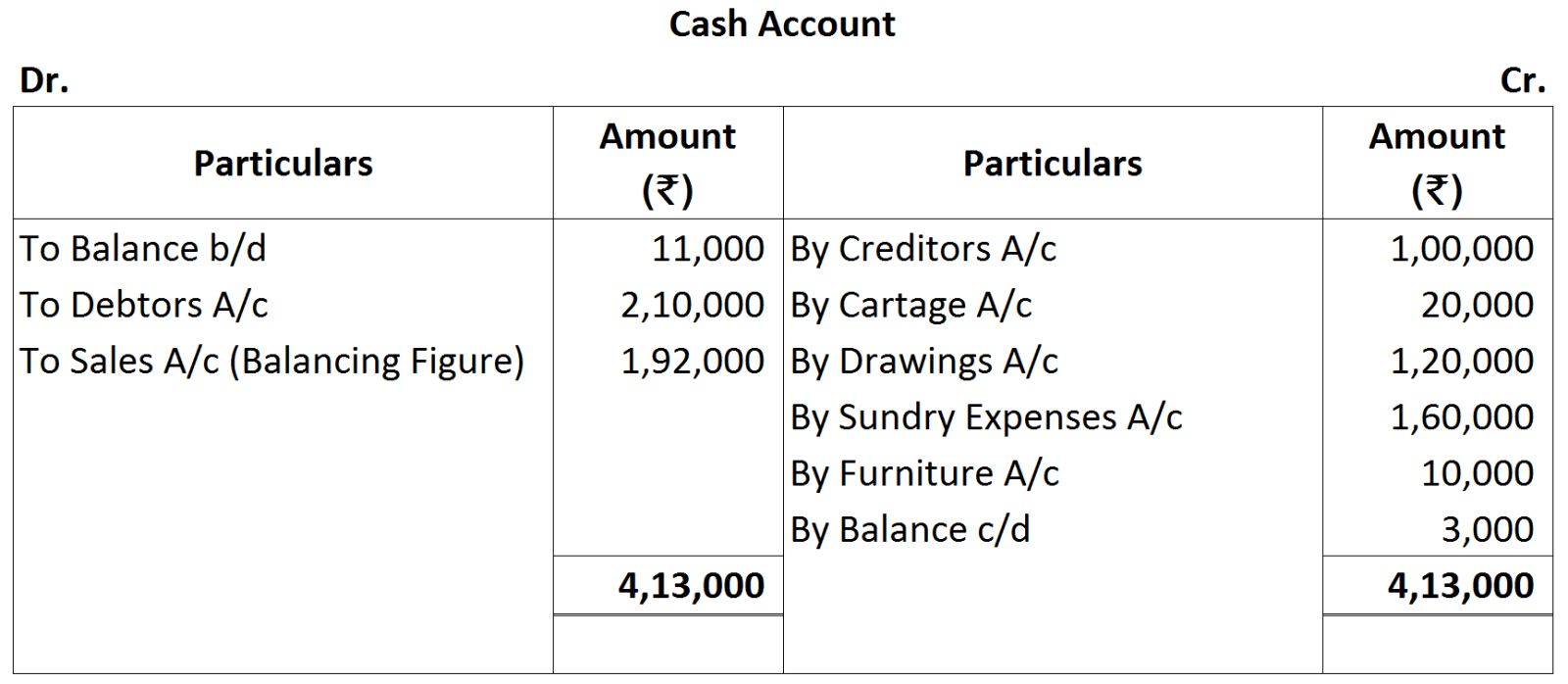
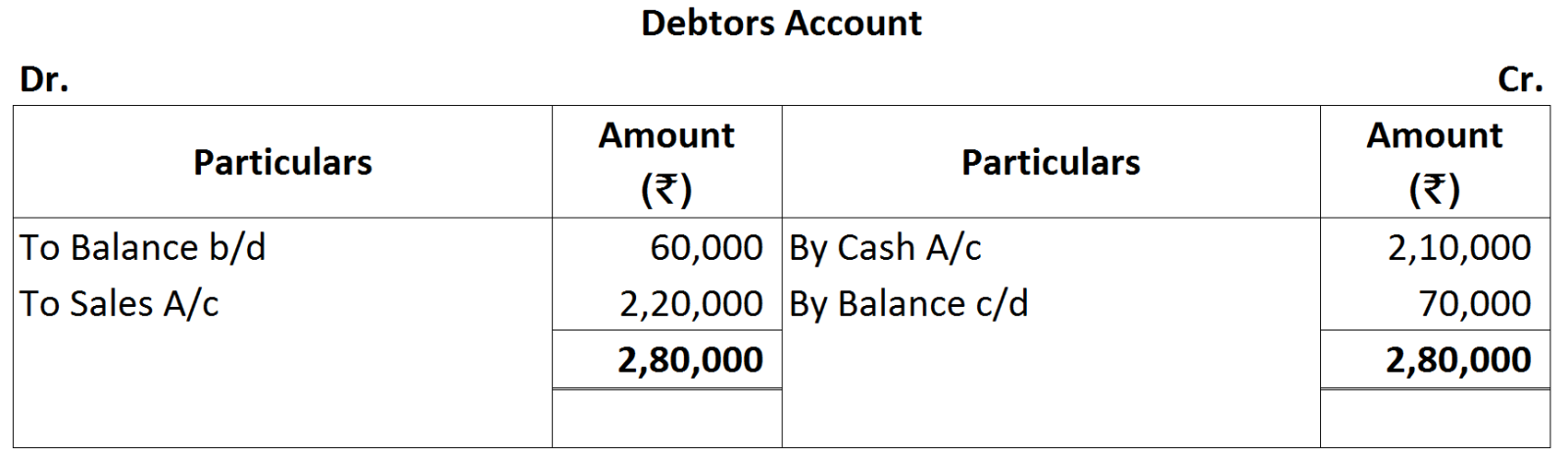
Chakravarti does not maintain proper books of accounts. Following information is obtained from his books for the year ended $31^{st}$​​​​​​​ March,$ 2018:$

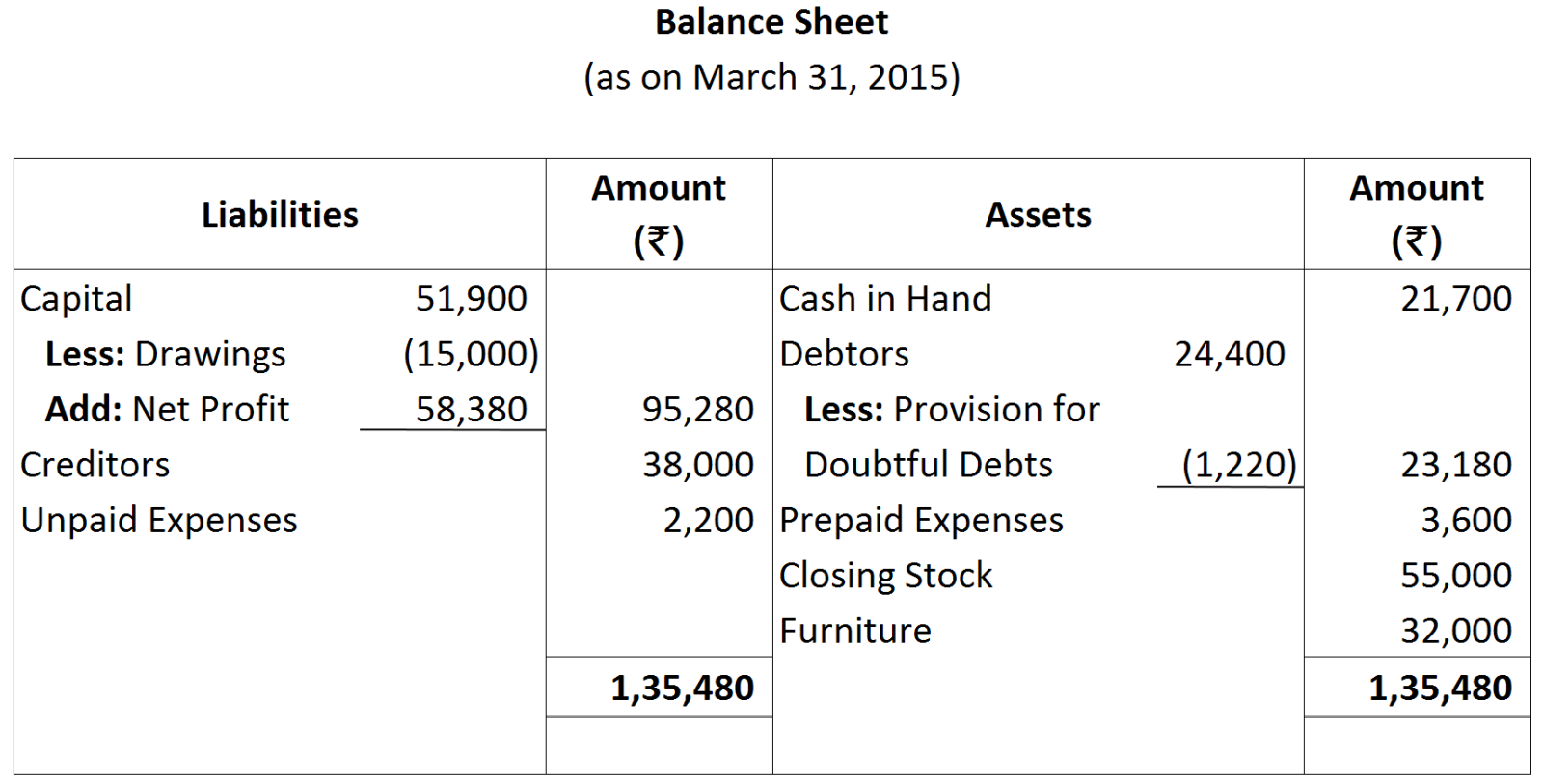
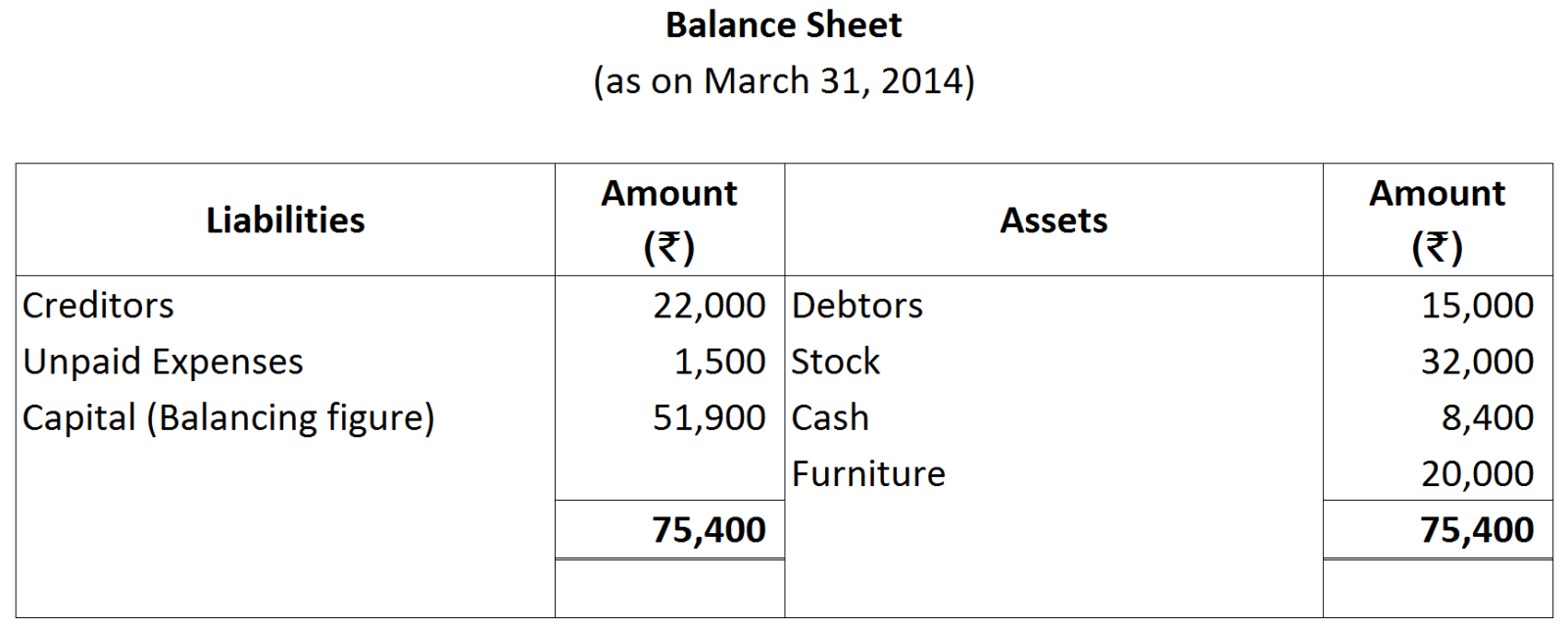
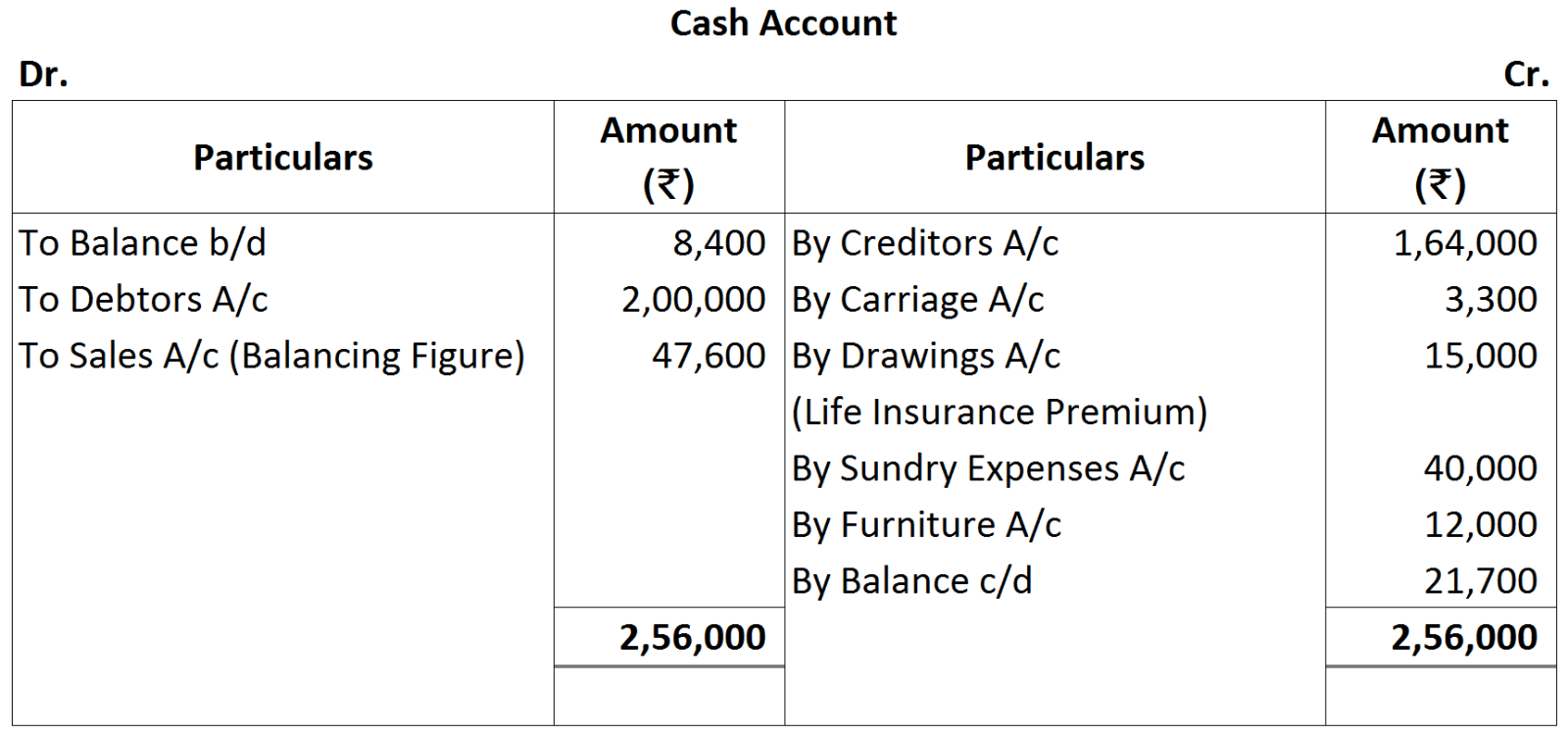
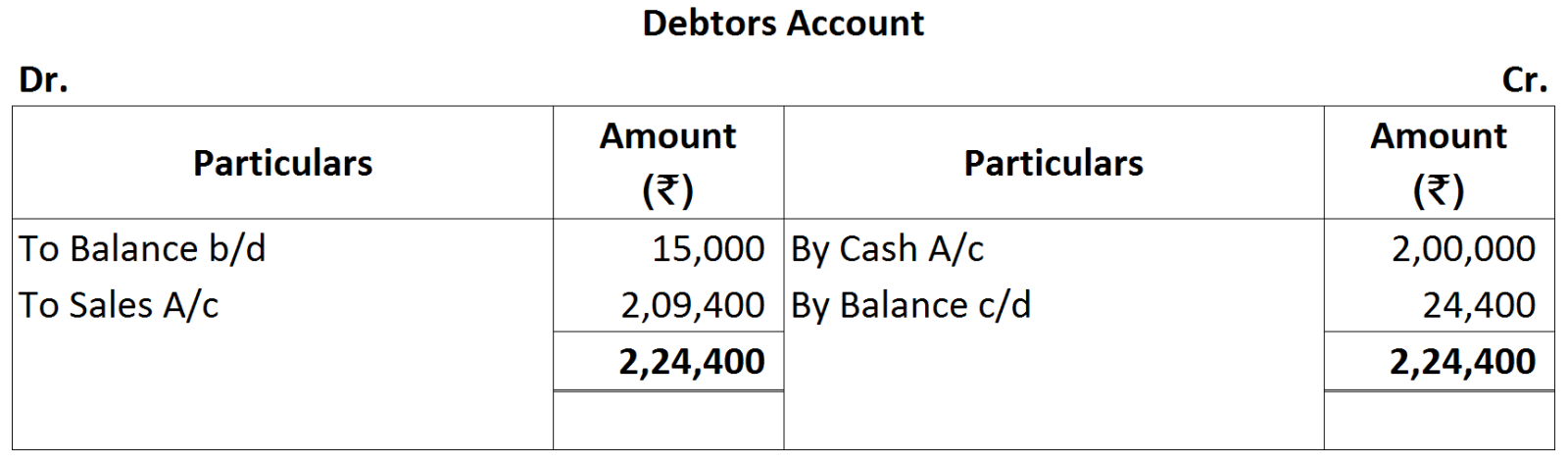
The Stock on $31^{st}​​​​​​​$​​​​​​​ March,$ 2018:$ was valued at ₹ $20,000 $but Chakravarti has no record of the Stock on$ 1^{st} $April, $2017.$ However, he informs you that he sells his goods at cost plus $25%.$
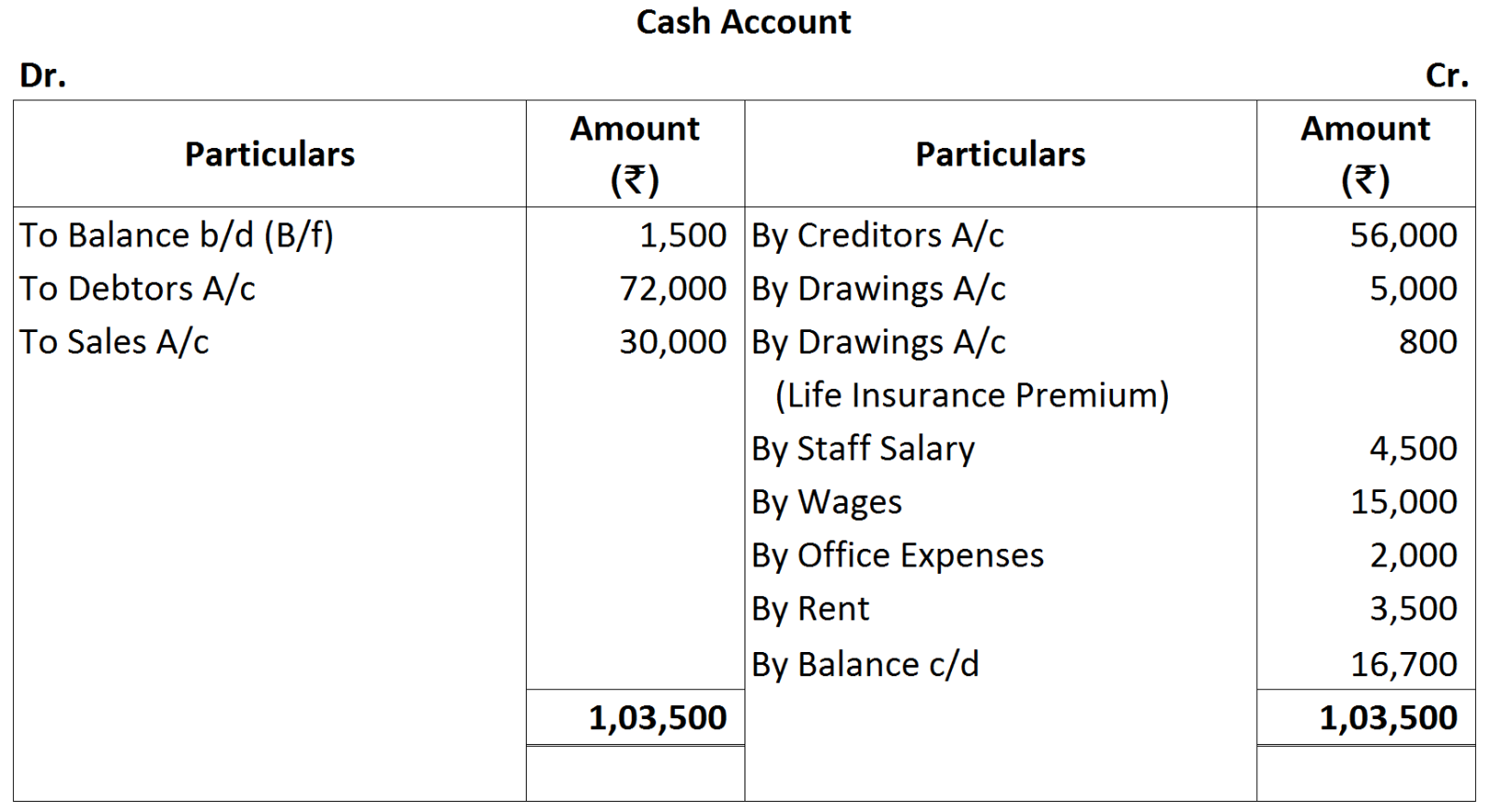
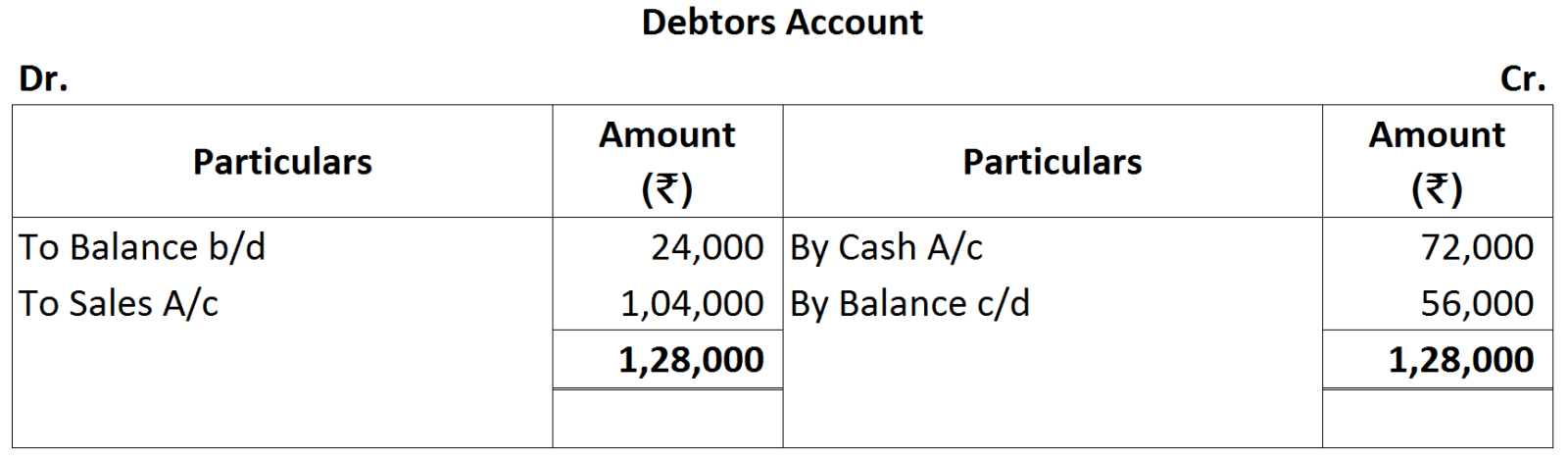
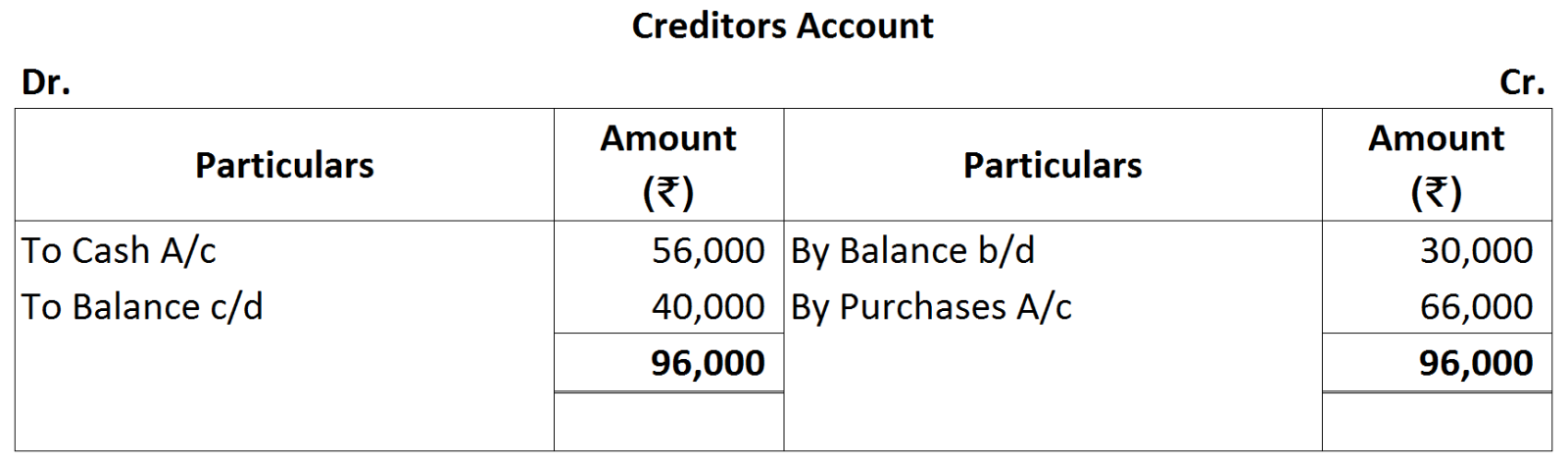
Prepare his Cash Book, Trading and P & L A/c for the year ended $31^{st} $March, $2018$ and a Balance Sheet as at that date.
Answer


Working Notes:


Rate of Gross Profit (on cost) = 25%
Rate of Gross Profit (on sales) = 20%
Gross Profit = 20% of (30,000 + 1,04,000) = 26,800
Gross Profit = Net Sales - Cost of Goods Sold
26,800 = 1,34,000 - Cost of Goods Sold
Cost of Goods Sold = 1,34,000 - 26,800 = ₹ 1,07,200
Cost of Goods Sold = Opening Stock + Purchases + Direct Expenses - Closing Stock
1,07,200 = Opening Stock + 66,000 + (15,000 + 200) - 20,000
Opening Stock = 1,07,200 - 66,000 - 15,200 + 20,000 = ₹ 46,000
View full question & answer
Question 166 Marks
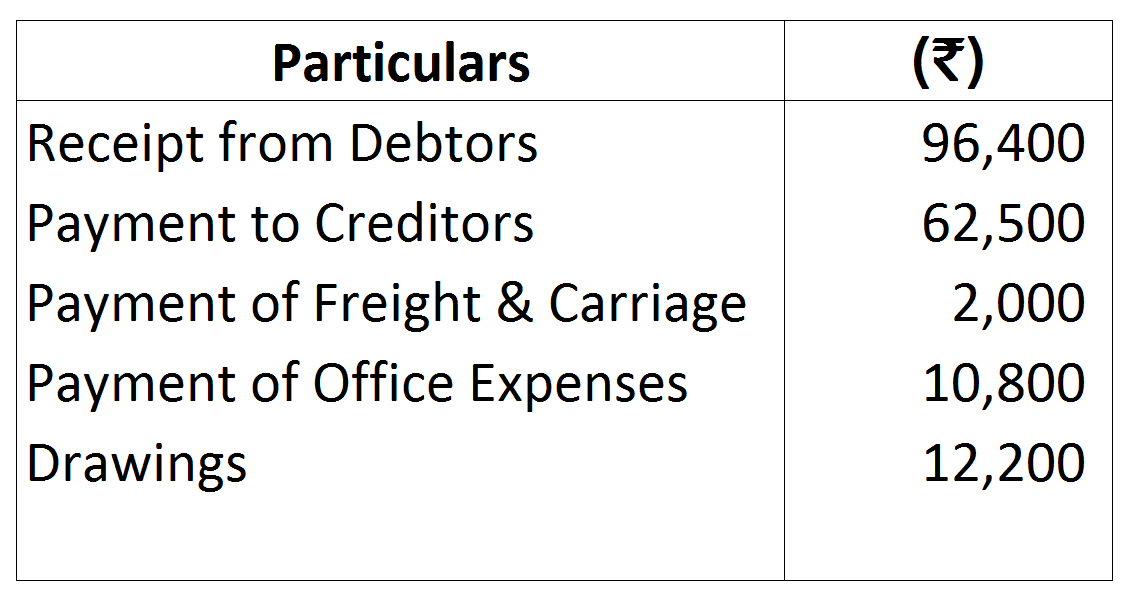
Mr. Bhardwaj has kept incomplete records. He submits to you the following information:
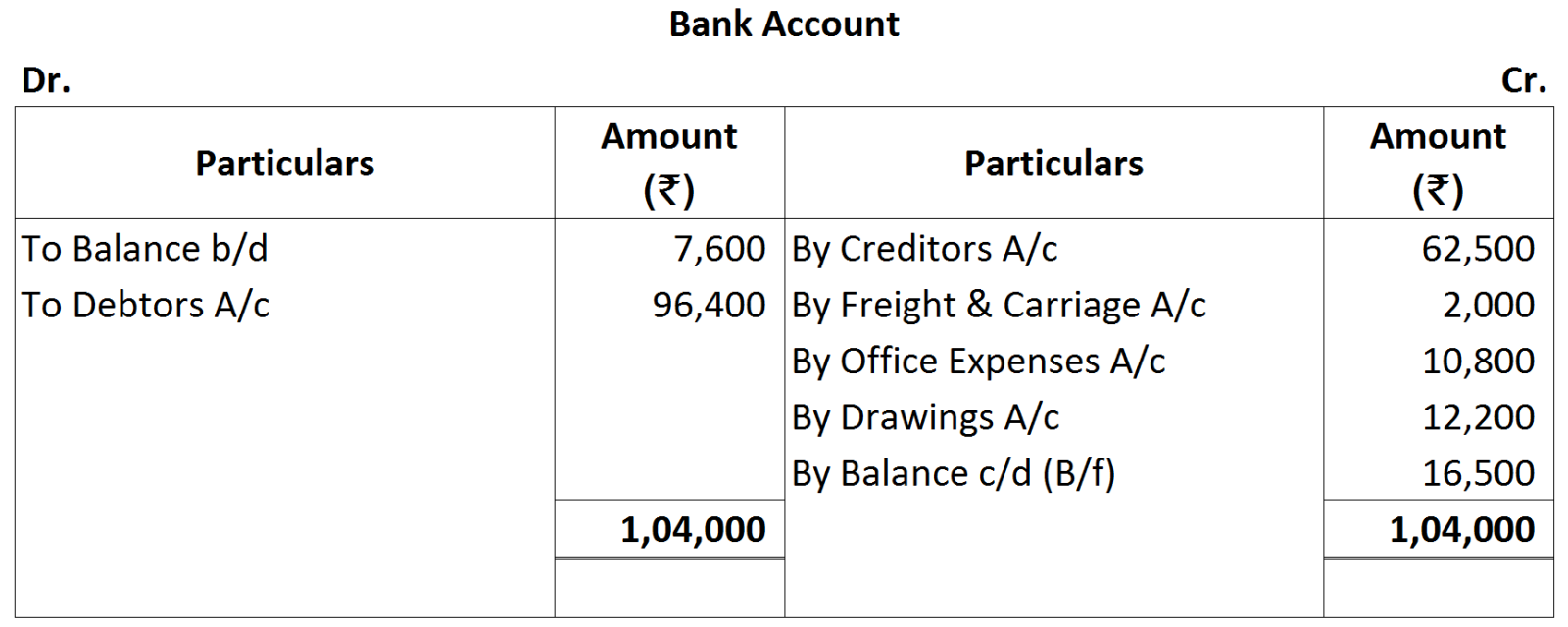
Bhardwaj banks all receipts and makes all payments only by means of cheques. Following is the analysis of his bank transactions:

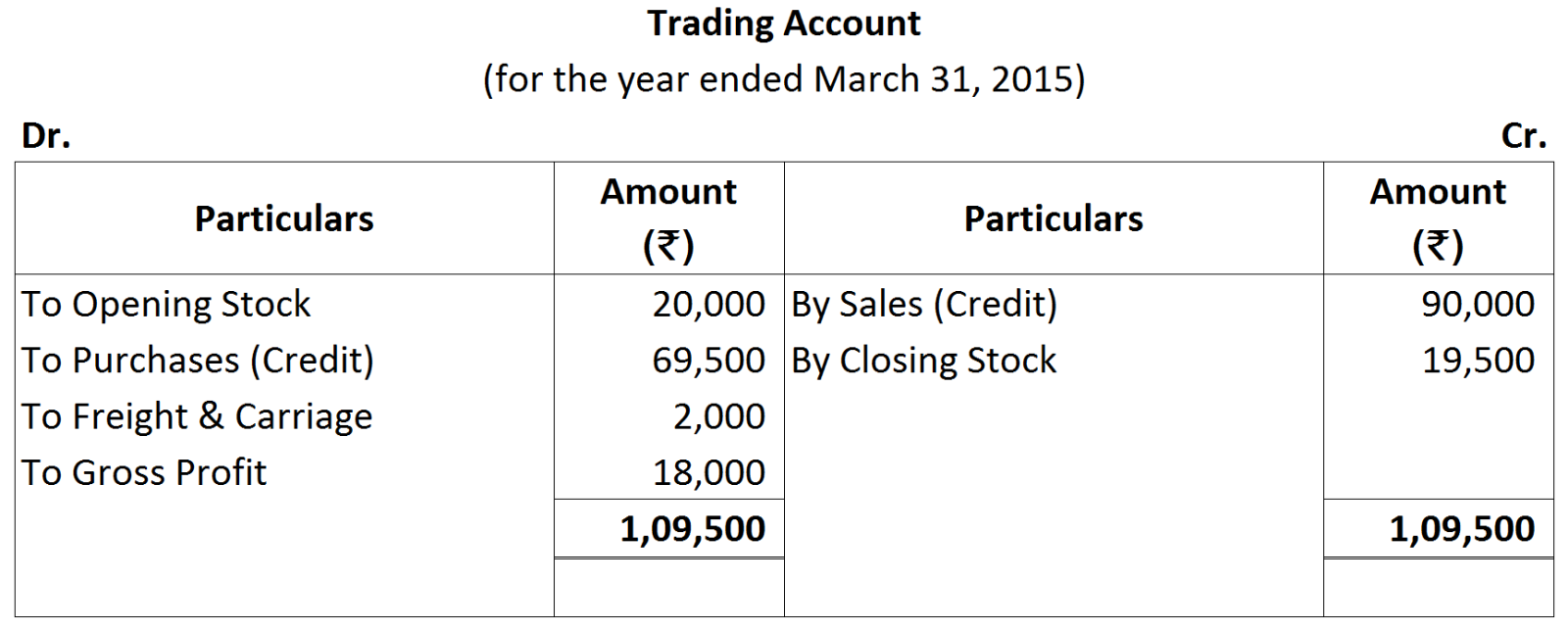
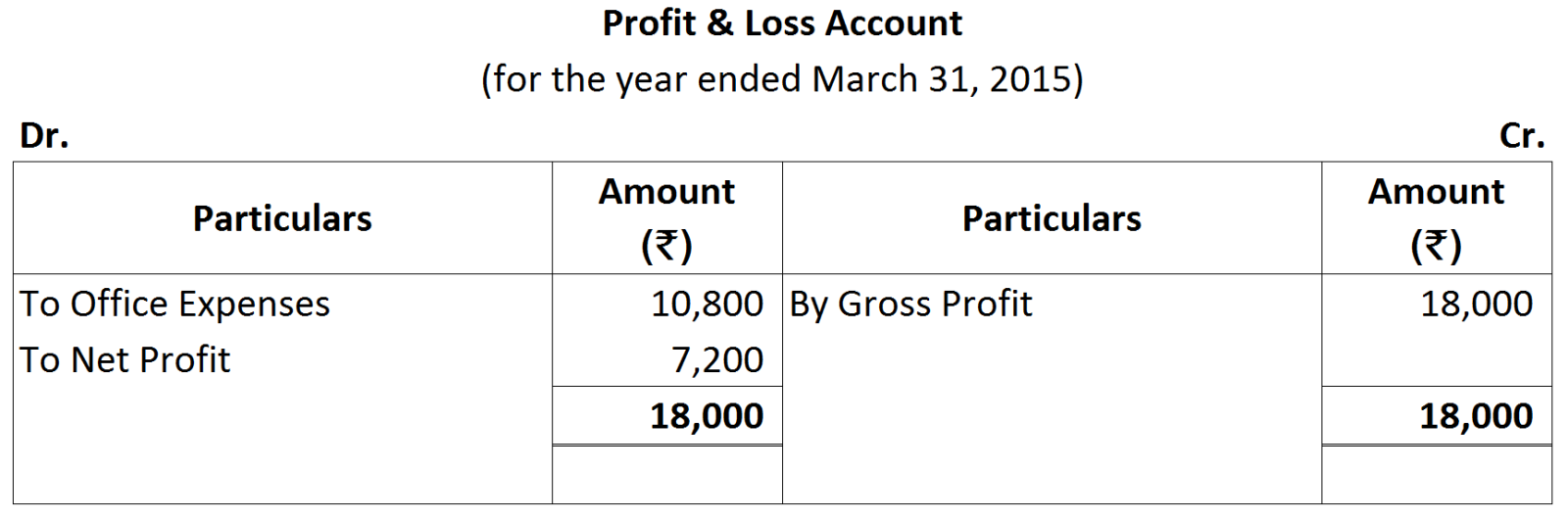
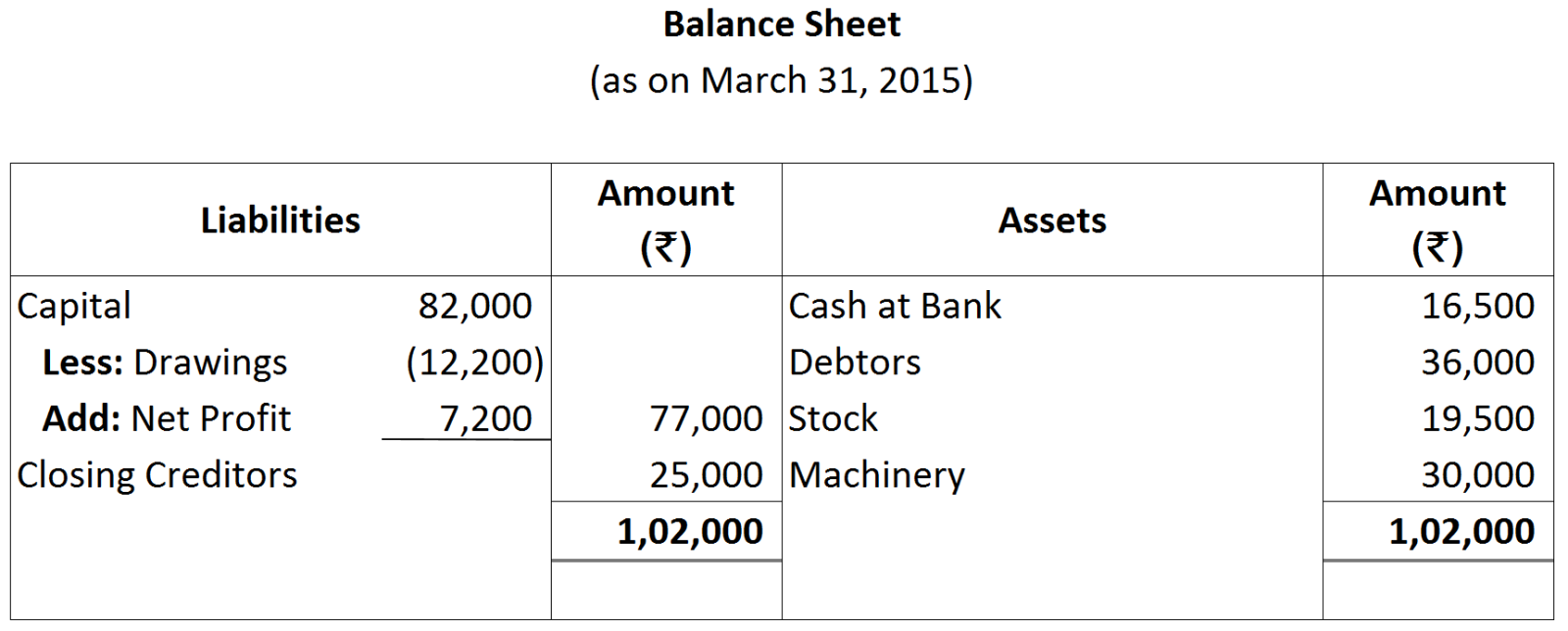
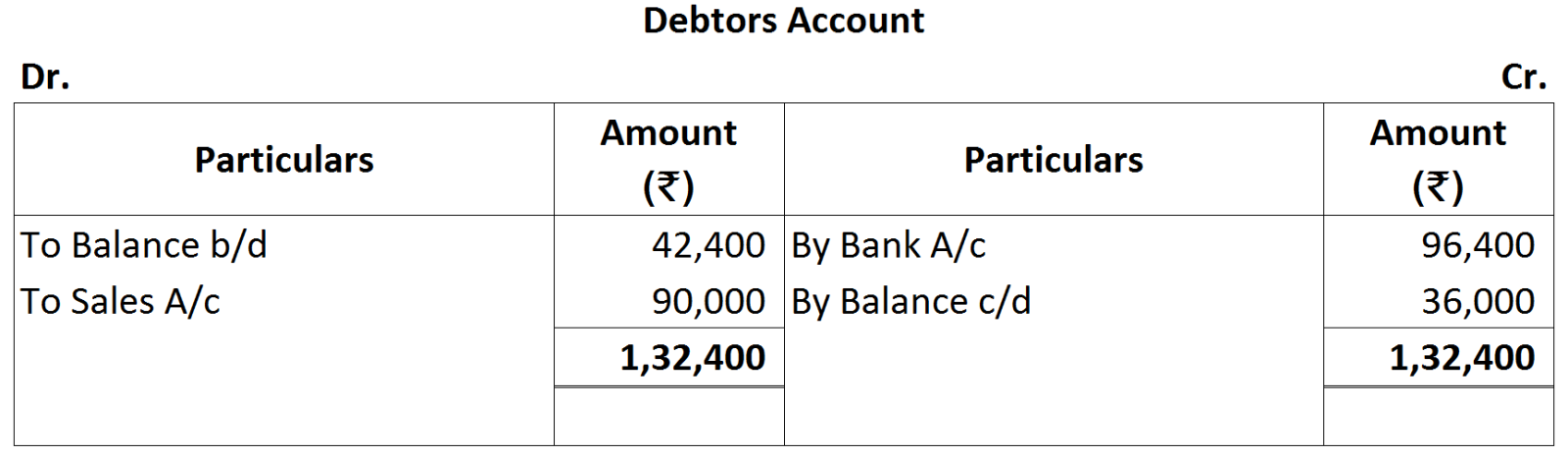
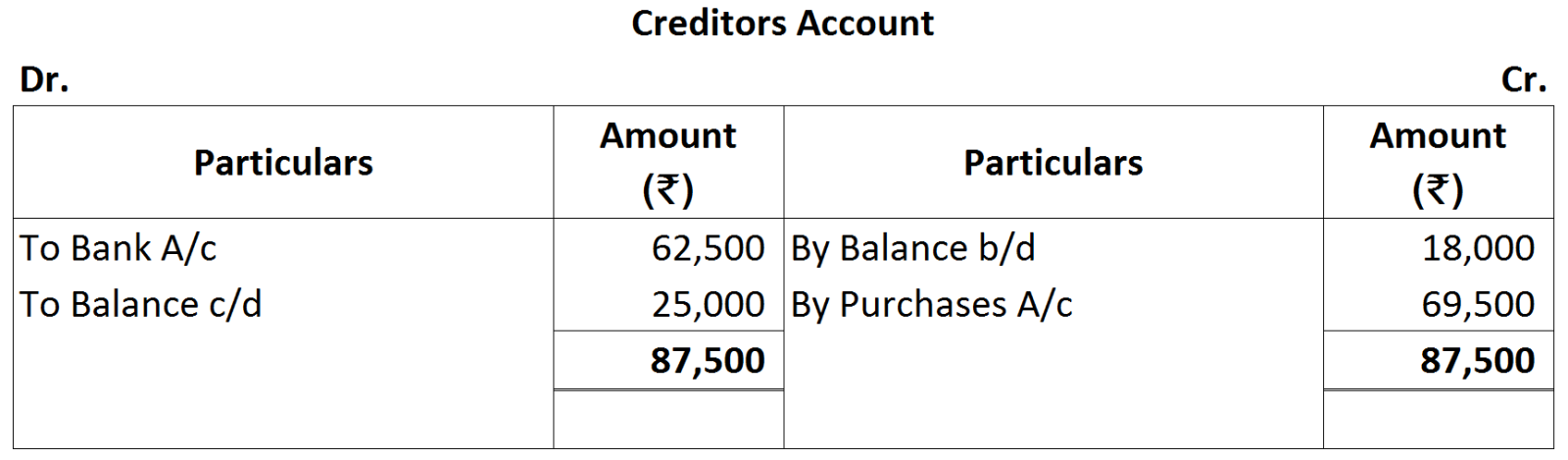
Sundry Debtors on $31^{st}$ March, $2015$ were $₹\ 36,000$ and Sundry Creditors were $₹\ 25,000.$ No information is available regarding stock-in-trade on $31^{st}$ March, $2015$, but it is ascertained that Mr. Bhardwaj takes $20\%$ profit on Sales. Prepare Bhardwaj's Bank A/c, Trading and Profit & Loss A/c and a Balance Sheet as at $31^{st}$ March, $2015.$
Answer


Working Notes:


Rate of Gross Profit (on sales)$ = 20\%$
Gross Profit $= 20\%$ of $90,000 = 18,000$
Gross Profit $= $Net Sales – Cost of Goods Sold
18,000 $=$ 90,000 $–$ Cost of Goods Sold
Cost of Goods Sold $=  90,000  –  18,000  = ₹ 72,000$
Cost of Goods Sold $=$ Opening Stock $+$ Purchases $+$ Direct Expenses$ -$ Closing Stock
$72,000 = 20,000 + 69,500 + 2,000 -$ Closing Stock
Closing Stock $= 20,000 + 69,500 + 2,000 - 72,000 = ₹ 19,500$
View full question & answer
Question 176 Marks
$X$ who keeps incomplete records, gives you the following information:
You are also given the following information:
  1. A provision of $₹\ 1,450$ is required for bad and doubtful debts.
  2. Depreciation $@ 5\%$ is to be written off on Building and furniture.
  3. Wages outstanding $₹\ 3,000$; salaries outstanding $₹\ 1,200.$
  4. Insurance has been prepaid to the extent of $₹\ 250.$
  5. Legal Expenses outstanding $₹\ 700.$
  6. Drawings of Mr. $X$ during the year were $₹\ 7,520.$
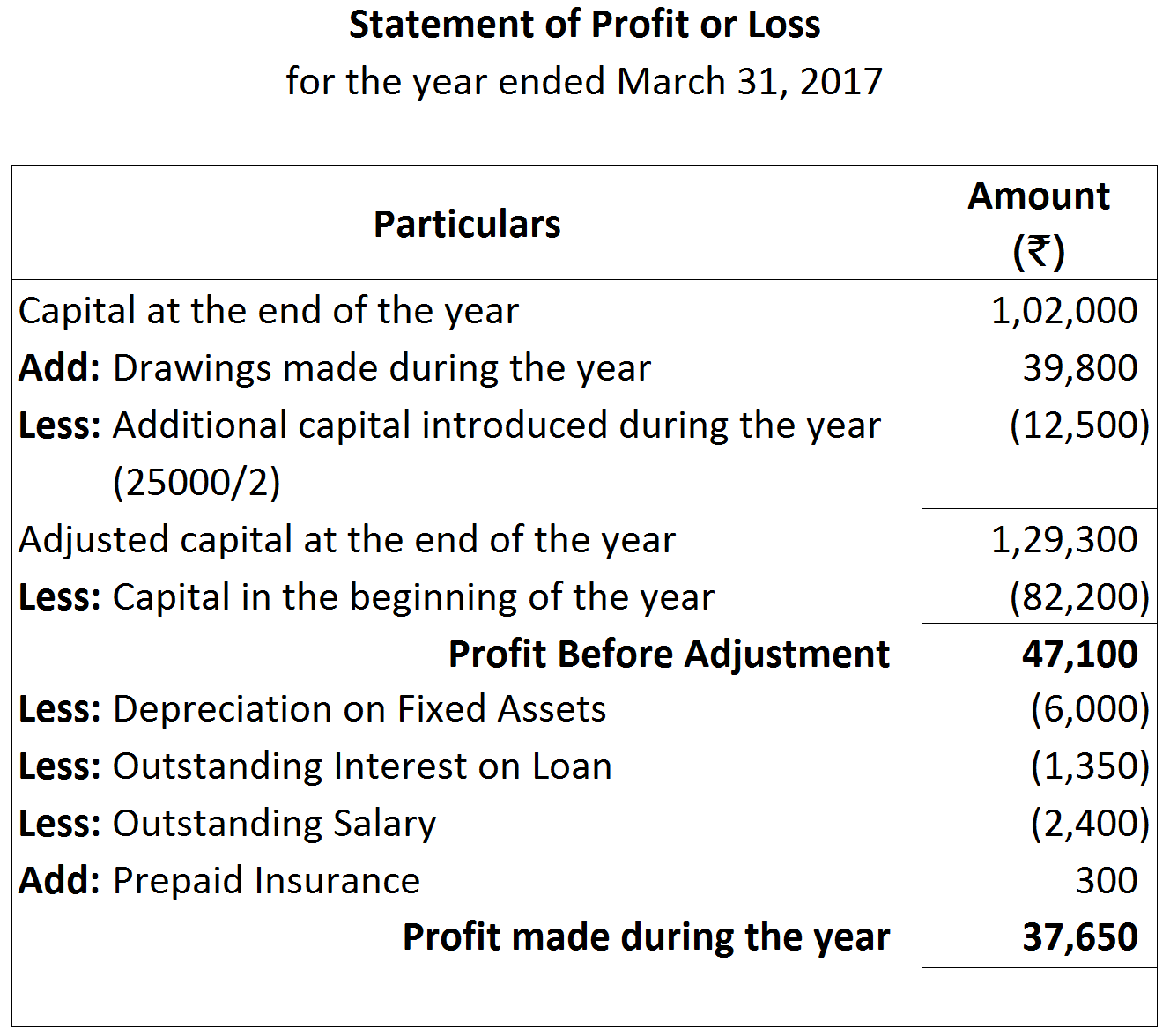
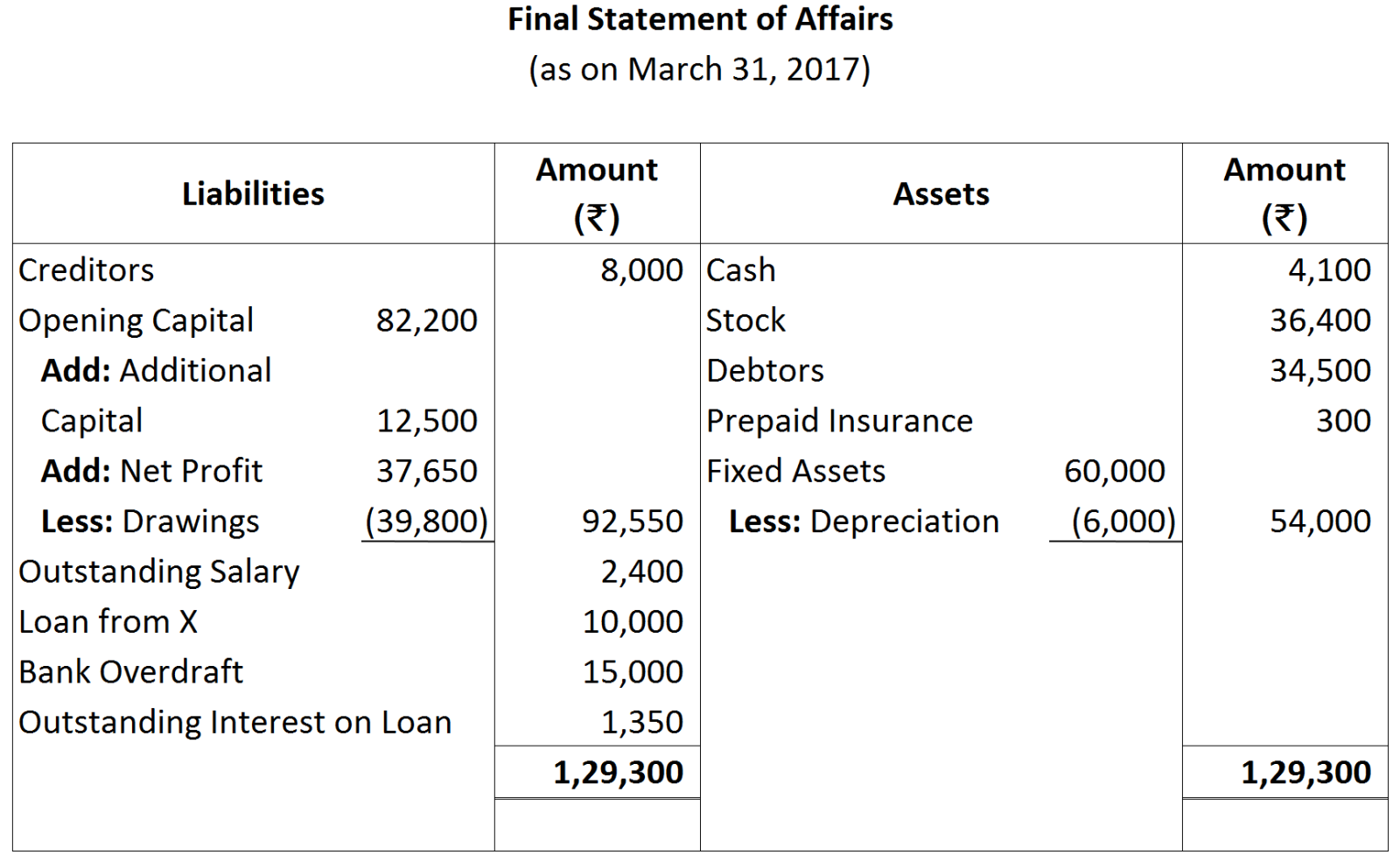
Prepare a statement of Profit as on $31^{st}$ March, $2017,$ and a final statement of affairs as at that date.
View full question & answer
Question 186 Marks
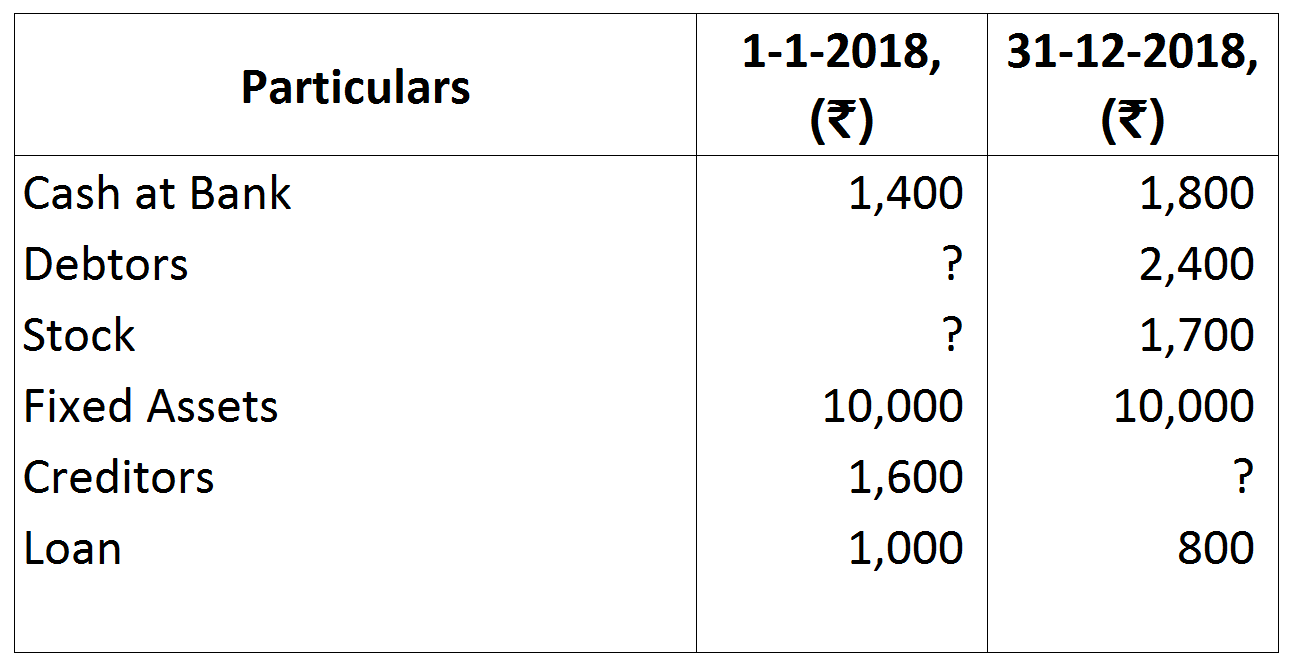
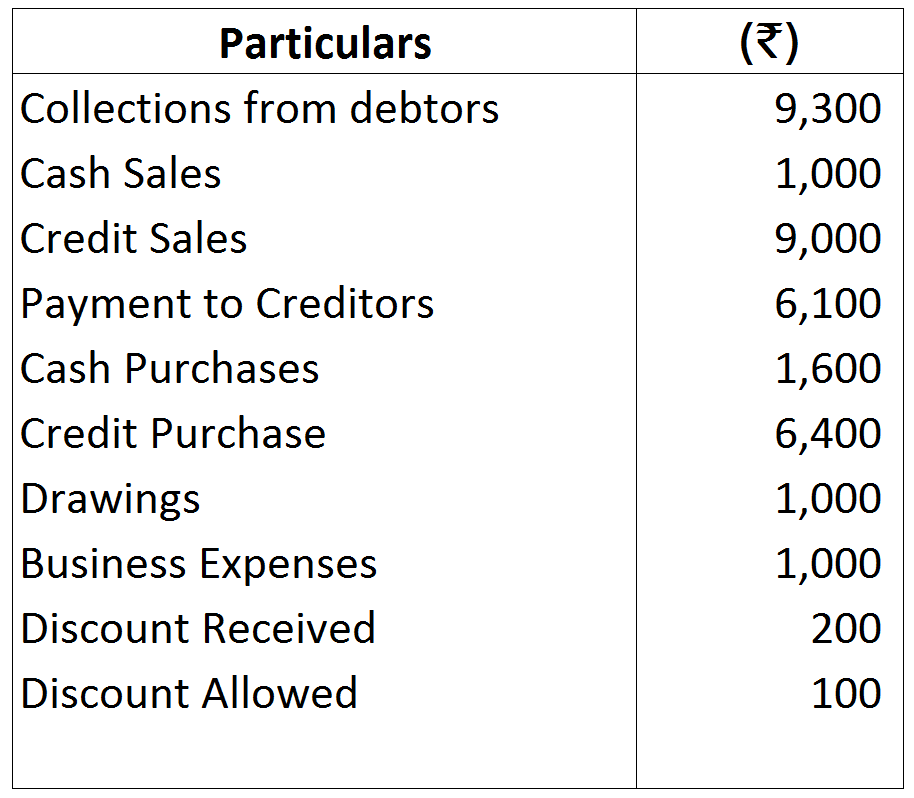
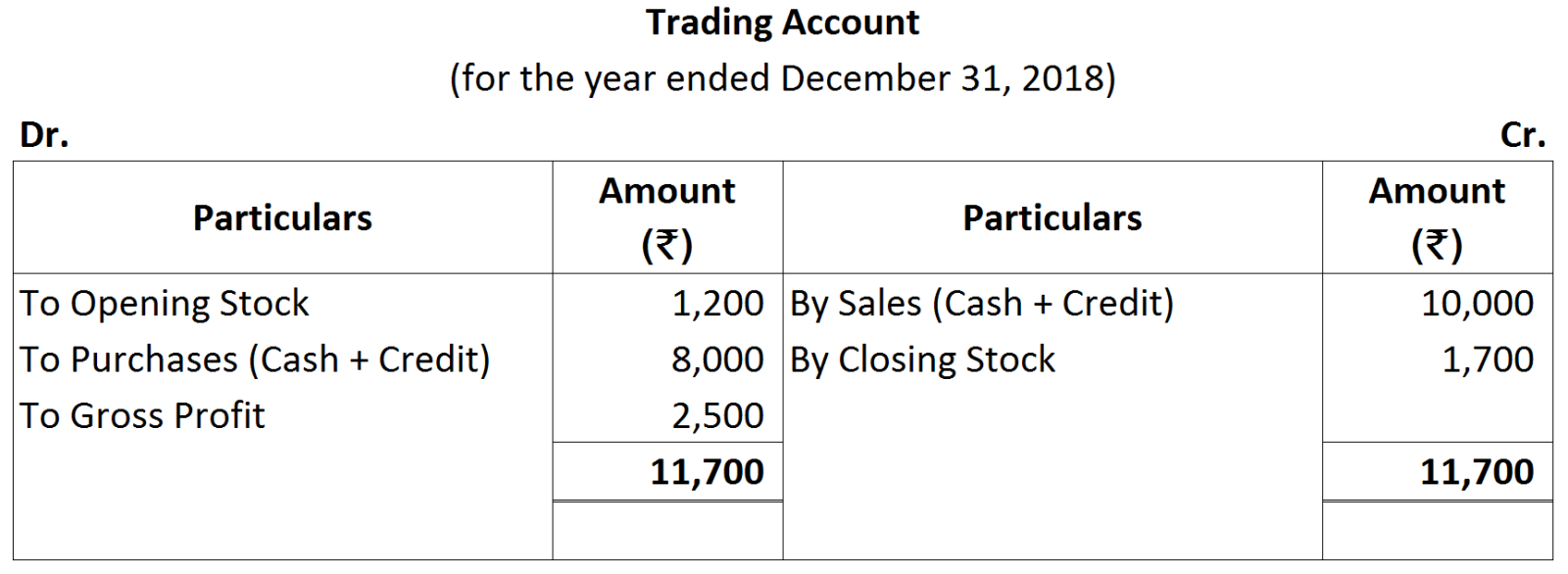
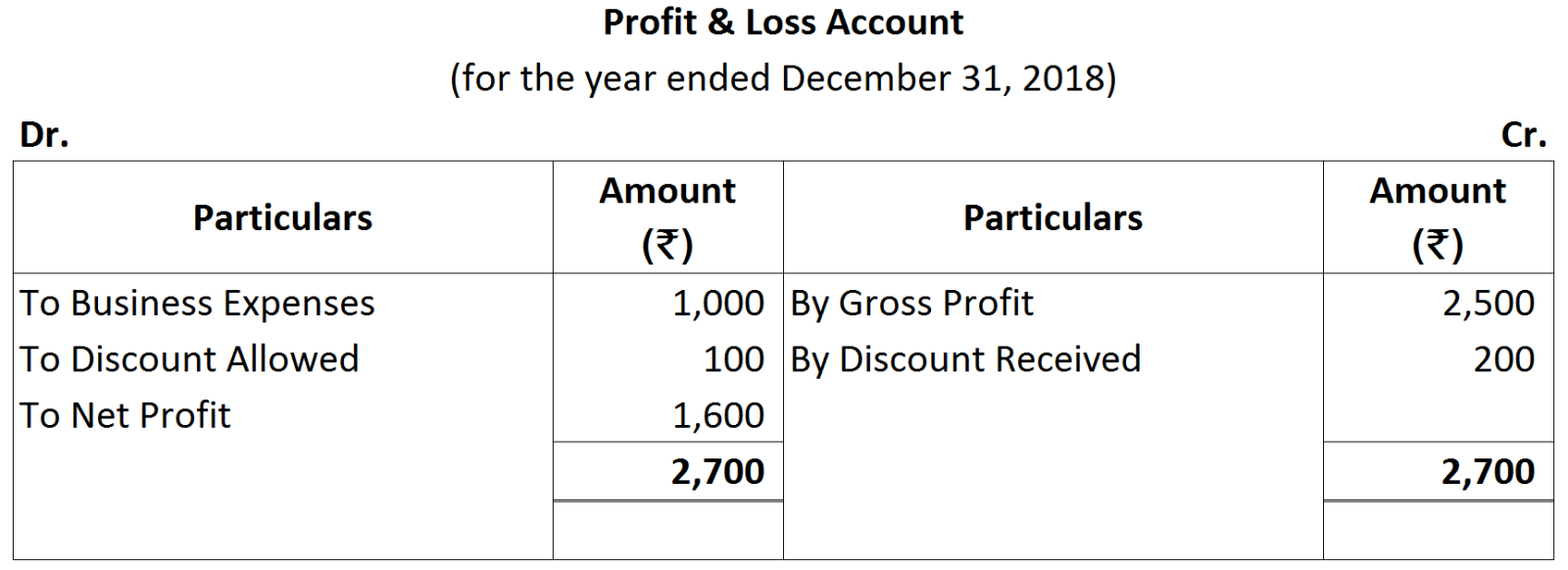
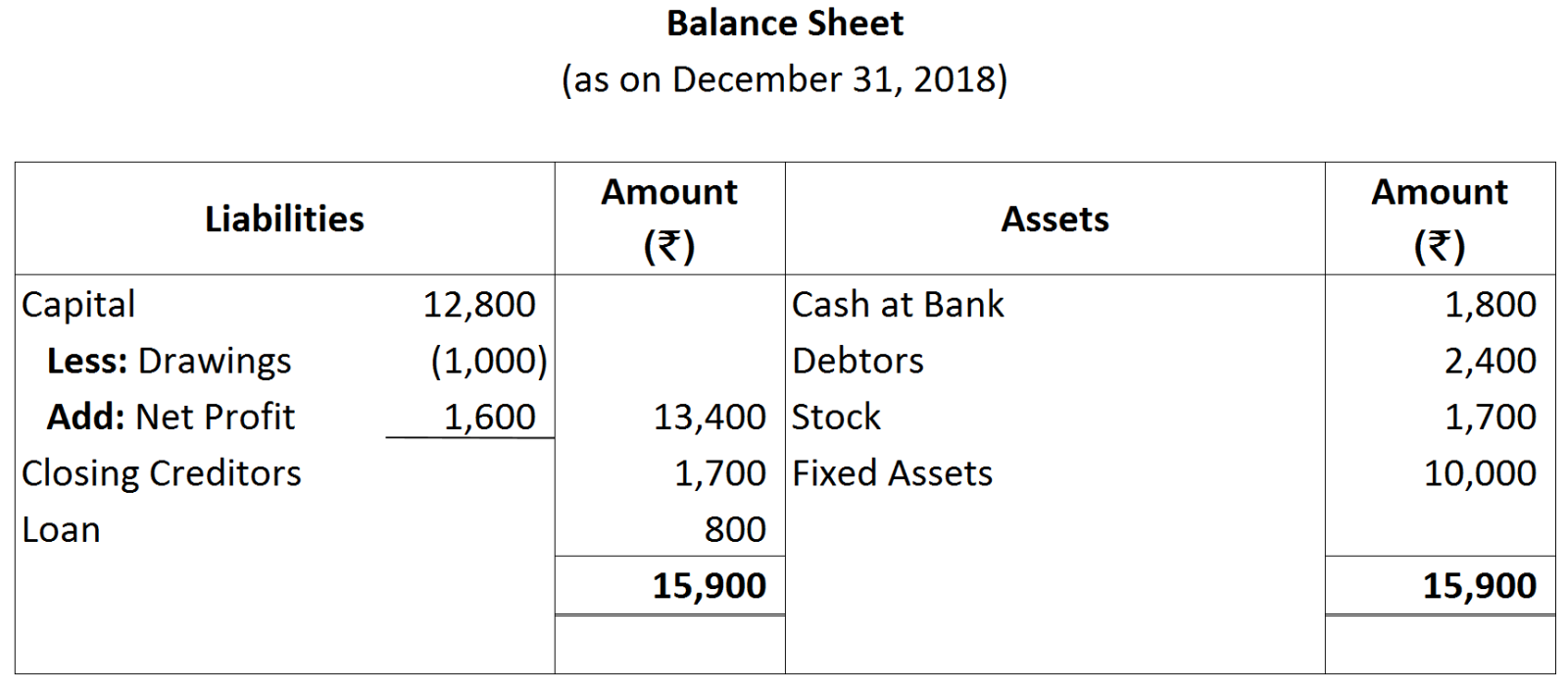
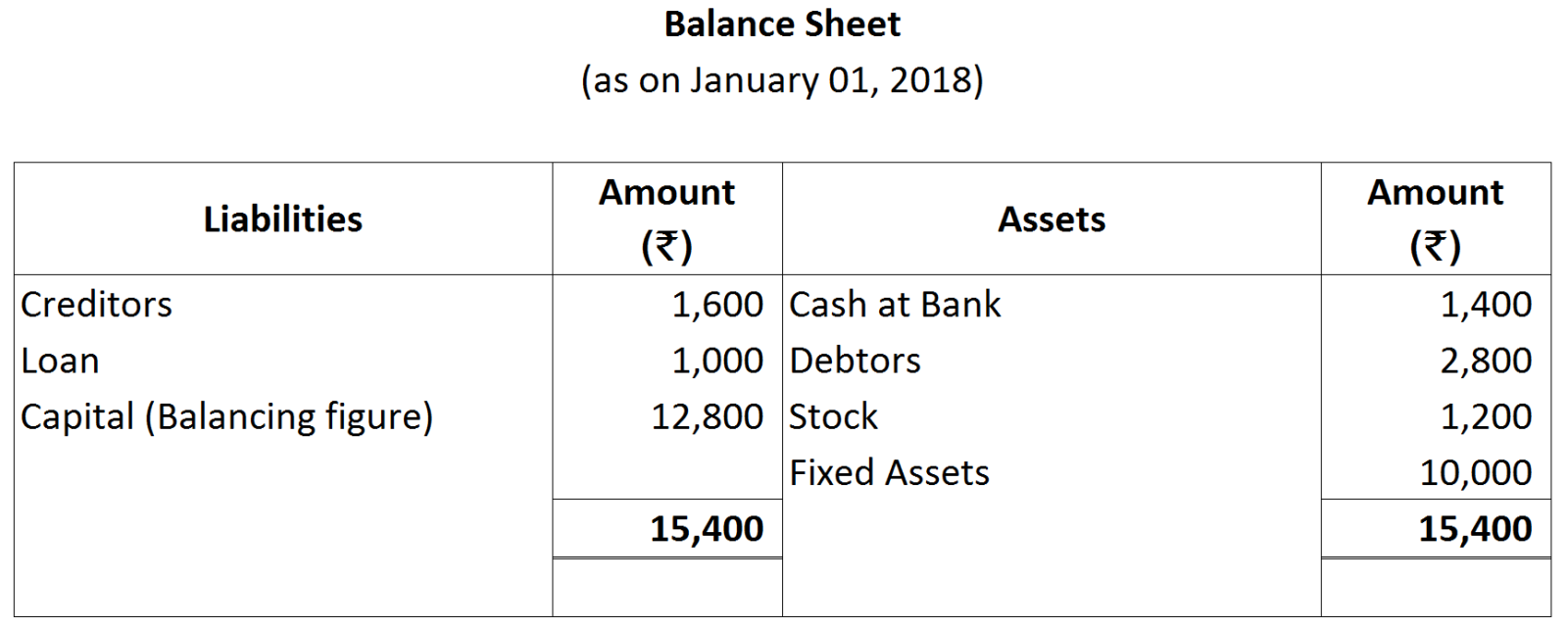
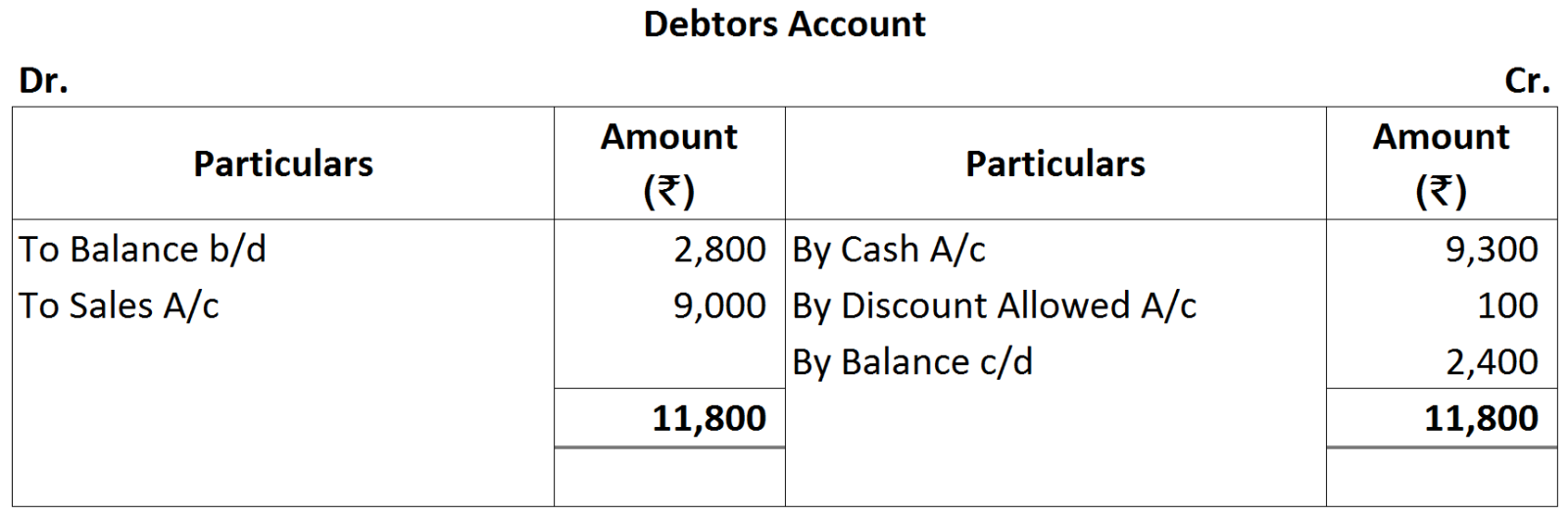
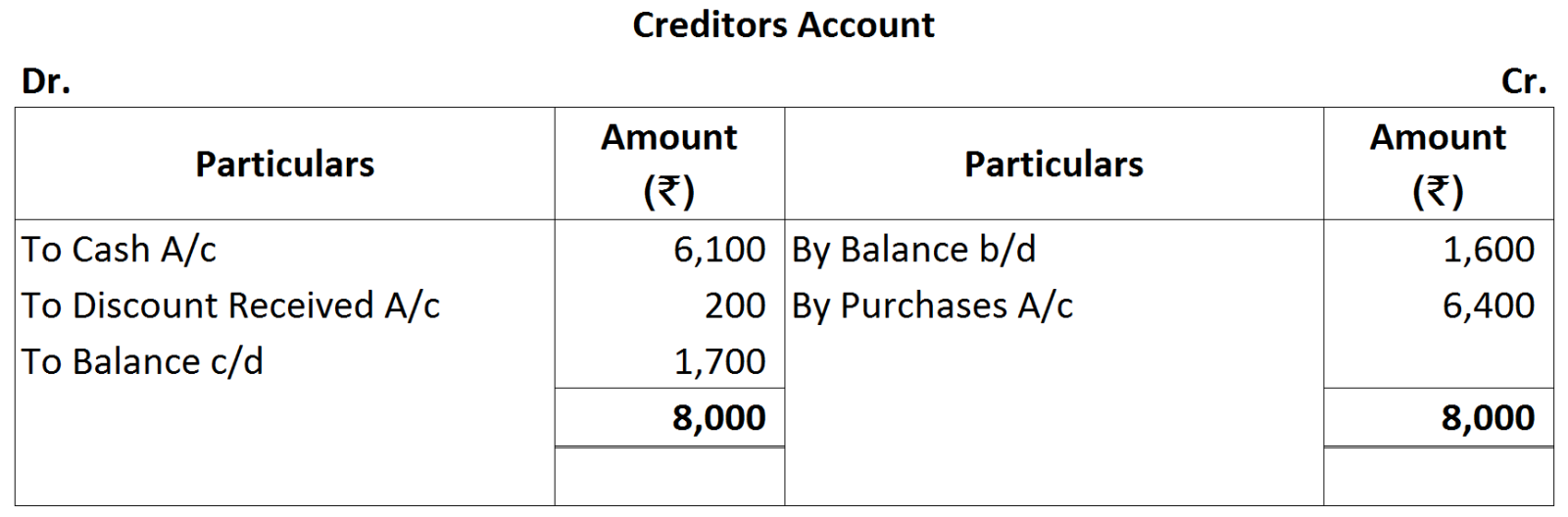
From the following records kept on single entry basis, prepare final accounts assuming that ratio of gross profit to sales is 25%: Transactions during the year 2018:
Answer


Working Notes:


Rate of Gross Profit (on sales) = 25% Gross Profit = 25% of (1,000 + 9,000) = 2,500 Gross Profit = Net Sales - Cost of Goods Sold 2,500 = 10,000 - Cost of Goods Sold Cost of Goods Sold = 10,000 - 2,500 = ₹ 7,500 Cost of Goods Sold = Opening Stock + Purchases + Direct Expenses – Closing Stock 7,500 = Opening Stock + (1,600 +6,400) + 0 - 1,700 Opening Stock = 7,500 - 8,000 + 1,700 = ₹ 1,200
View full question & answer
Question 196 Marks
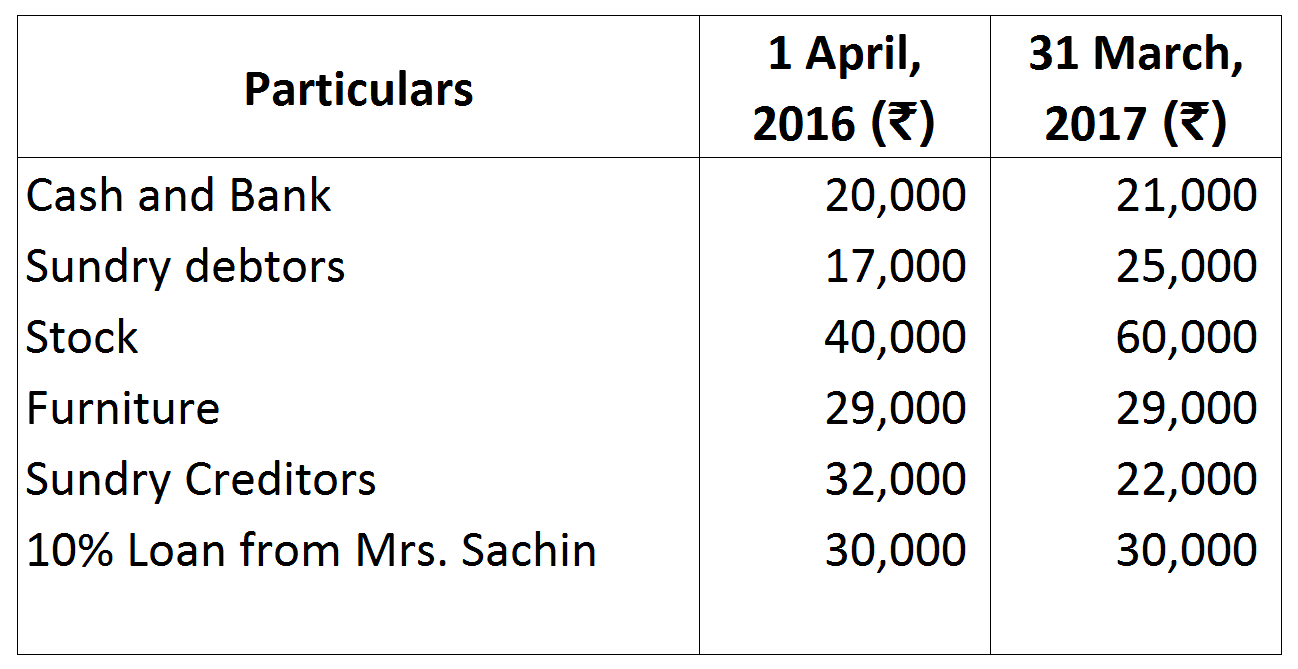
The following information is available from Sachin, who maintains books of accounts on single entry system:
Sachin withdrew $₹\ 5,000$ from the business every month for meeting his household expenses. During the year, he sold investments held by him privately for $₹\ 35,000$ and invested the amount in his business. At the end of the year $2016-17$, it was found that full year's interest on loan from Mrs. Sachin had not been paid. Depreciation $@ 10\%$ per annum was to be provided on furniture for the full year. Shop assistant was to be given a share of $5\%$ on the profits ascertained before charging such share. Calculate profit earned during the year ended $31^{st}$ March, $2017$ by Sachin.
View full question & answer
Question 206 Marks
Gopal keeps incomplete records. On $1^{st}$ April, $2016, $ his position was as follows:
His position on $31^{st}$ March, $2017$ was as follows: Cash in hand $₹\ 3,000;$ Cash at Bank $₹\ 5,000;$ Stock $ ₹\ 44,000;$ Debtors $₹\ 21,000$; Fixed Assets $₹\ 80,000$; Creditors $₹\ 22,000$. You are informed that Gopal has taken stocks worth $₹\ 4,500$ for his private use and that he has been regularly transferring $₹\ 2,000$ per month from his business banking account by way of drawings. Out of his drawings he spent $₹\ 15,000$ for purchasing a Scooter for the business on $1$st October, $2016.$

You are requested to find out his profit or loss and to prepare the Statement of Affairs after considering the following:
  1. Depreciate Fixed Assets and Scooter by $10\%$ p.a.
  2. Write off Bad-Debts $₹\ 1,000$ and provide $5\%$ for doubtful debts on Sundry Debtors.
  3. Commission earned but not received by him was $₹\ 2,500.$
View full question & answer
Question 216 Marks
A retail Trader has not kept proper books of accounts. Ascertain his profit or loss for the year ending $31^{st}$ March, $2017,$ and prepare a final statement of affairs from the following information:
He withdrew from the business $₹\ 1,500$ per month for his personal use and $₹\ 8,000$ for giving a personal loan to his brother. He also used a house for his personal purposes, the rent of which at the rate of $₹\ 900$ per month and electricity charges at an average rate of $₹\ 250$ per month were paid from the business account. He had received a lottery prize of $₹\ 25,000,$ out of which he invested half the amount in business. He has not paid two months' salary to his clerk $@ ₹\ 1,200$ per month, but insurance premium $@ ₹\ 600$ per annum was paid on $1^{st}$ October, $2016$ to run for one year. Loan from $X$ was taken on $1^{st}$ July, 2016 on which interest was unpaid $@ 18\%$ p.a.
Fixed assets are to be depreciated $@ 10\%$ p.a.
Answer
Working Note:
Calculation of Amount of Drawings Cash Withdrawn $= ₹\ 18,000$ Loan to Brother $= ₹\ 8,000$ Rent $= ₹\ 10,800$ Electricity Charges $= ₹\ 3,000 = ₹\ 39,800$
View full question & answer
Question 226 Marks
Charu do not keep proper books of accounts. Prepare the statement of profit or loss for the year ending 31-3-2017 from the following information:
The following adjustments are to be made:
  1. Proprietor withdrew cash ₹ 5,000 per month for private use.
  2. Depreciation @ 5% on Car and @ 10% on furniture.
  3. Outstanding Rent ₹ 6,000.
  4. Fresh Capital introduced during the year ₹ 30,000.
View full question & answer
Question 236 Marks
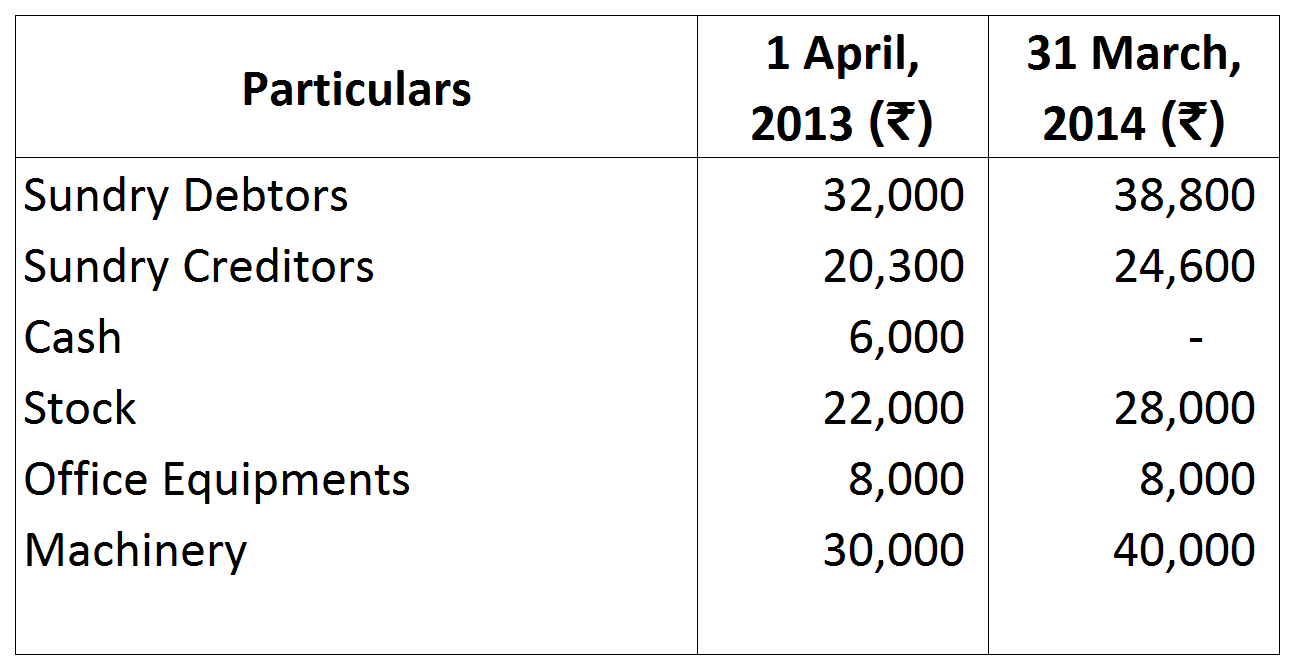
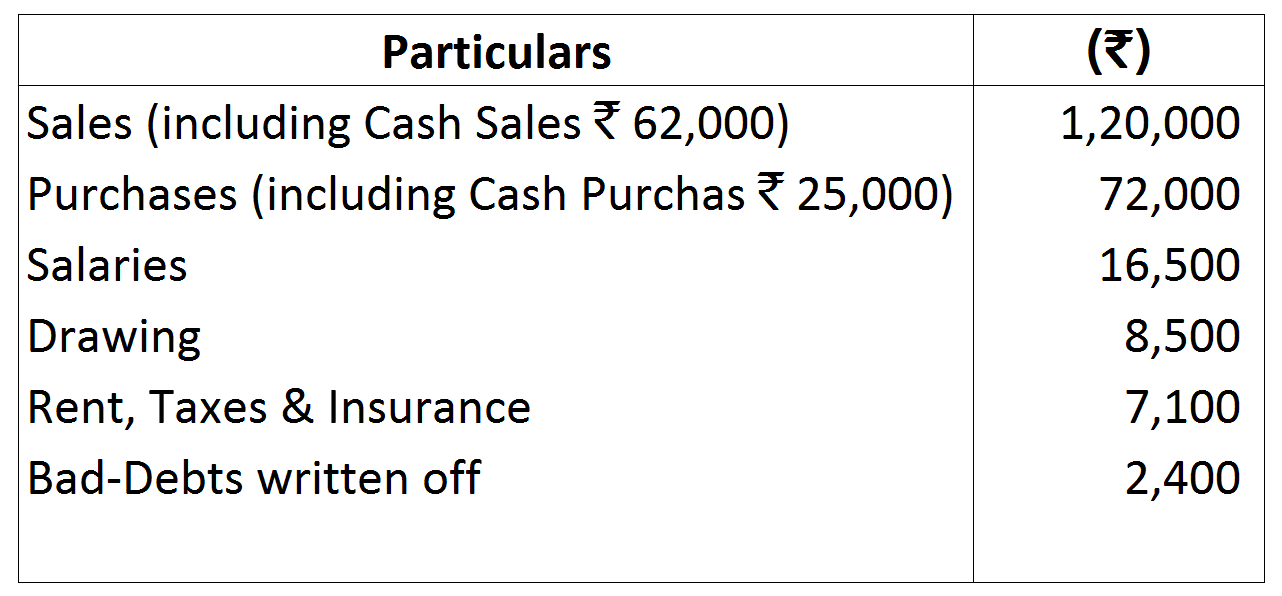
A retail trader did not keep his books on the double entry system. Following balances were obtained from his books:
Following further details of the transactions for the year ended $31^{st}$ March, $2014$ are available from his incomplete records:

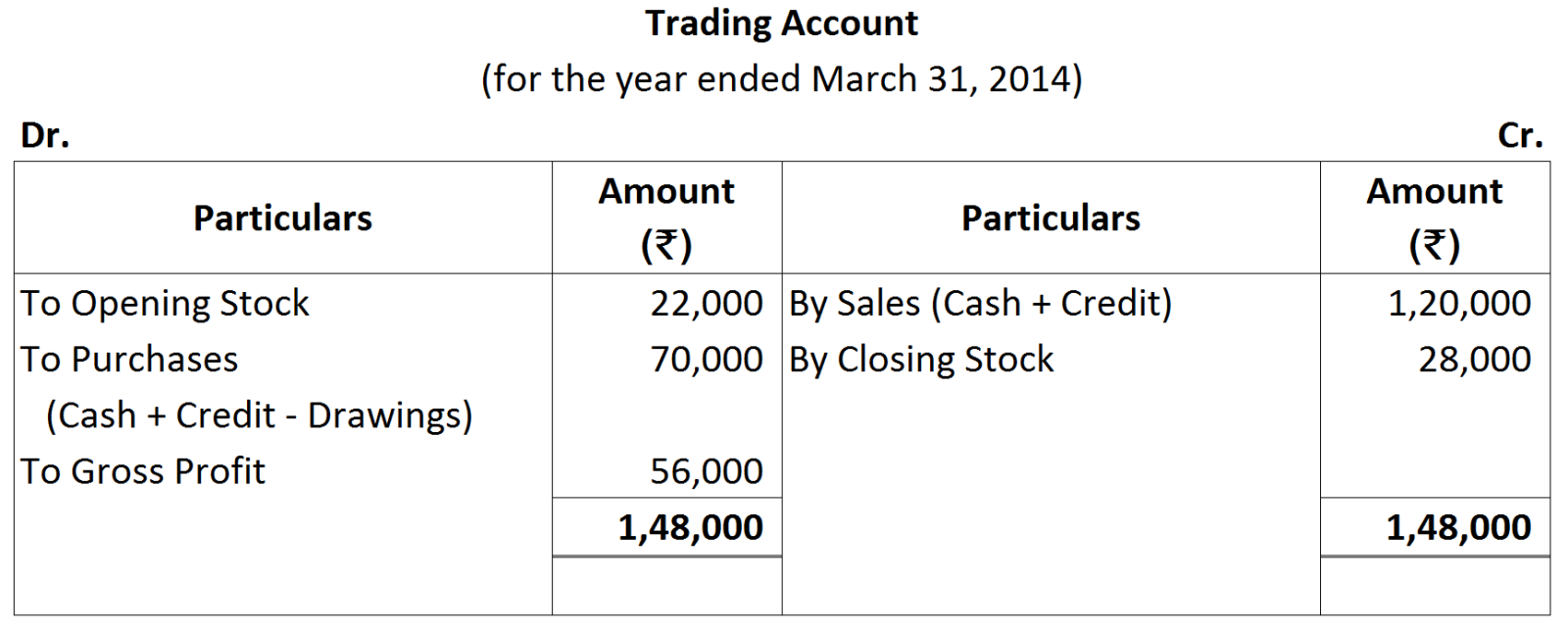
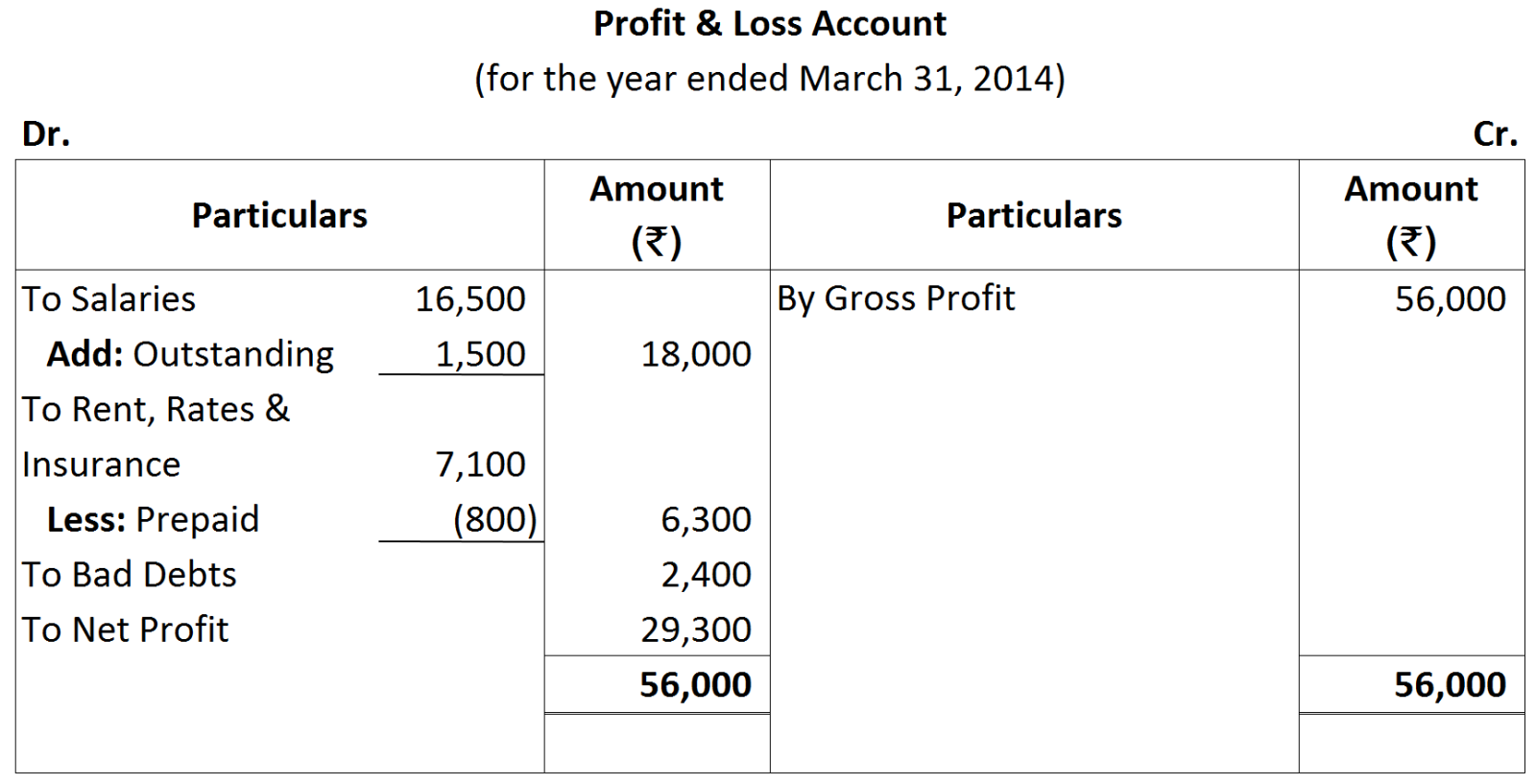
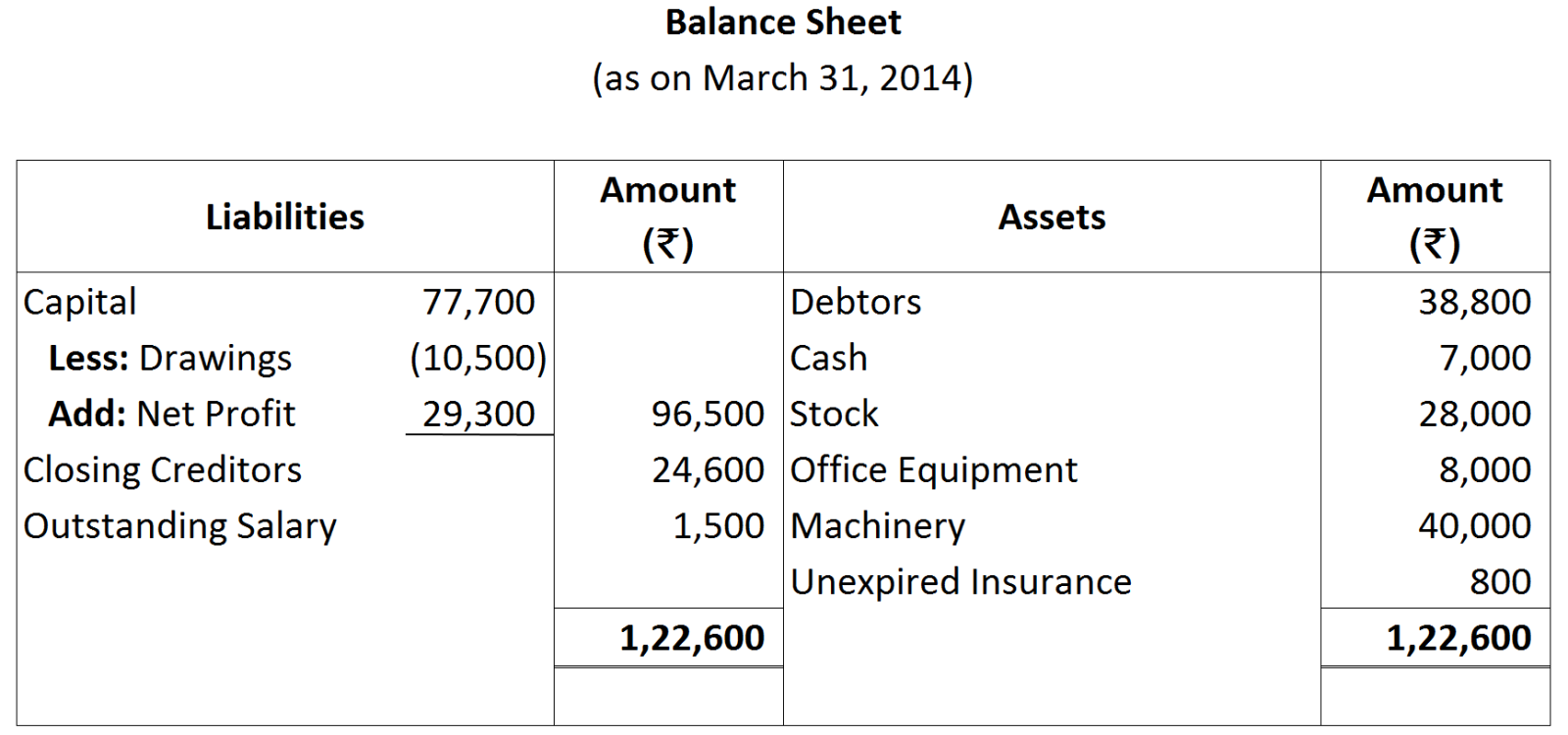
You are required to prepare his Trading, P & L A/c and Balance Sheet after considering the following:
  1. ₹ $1,500$ are outstanding for salaries.
  2. Insurance was unexpired to the extent of ₹ $800$.
  3. Goods worth ₹ $2,000$ were used by the proprietor for personal use.
Answer


Working Notes:


View full question & answer
Question 246 Marks
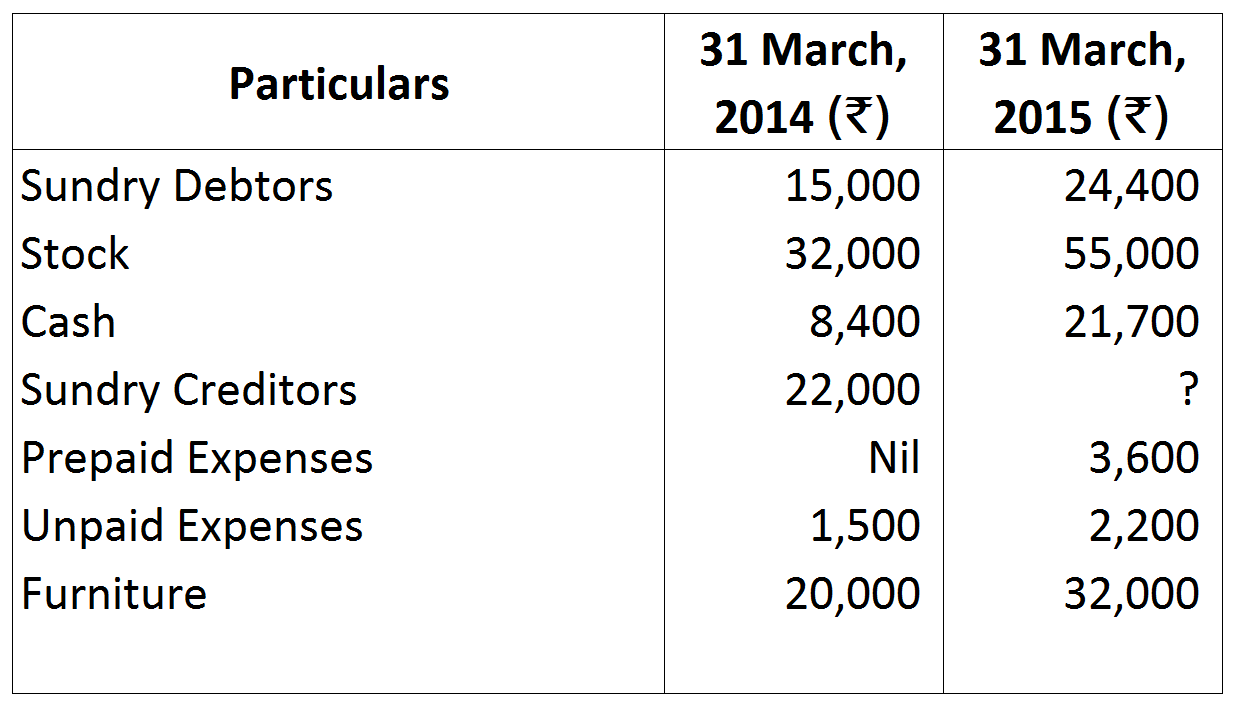
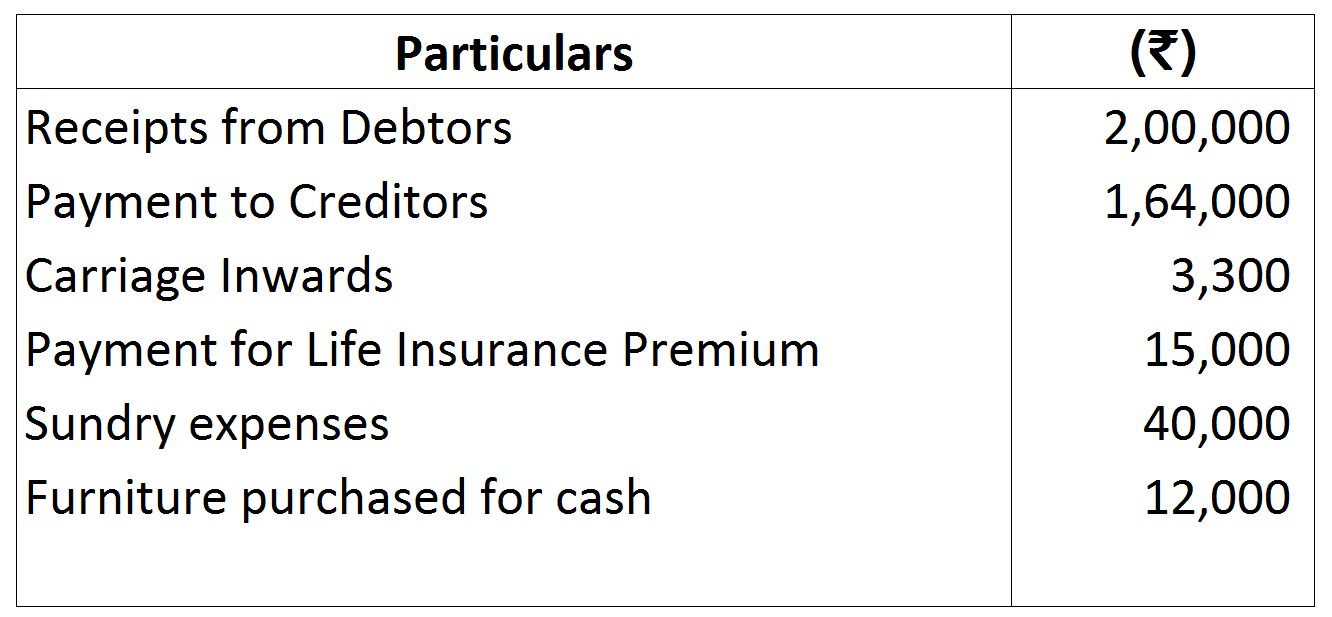
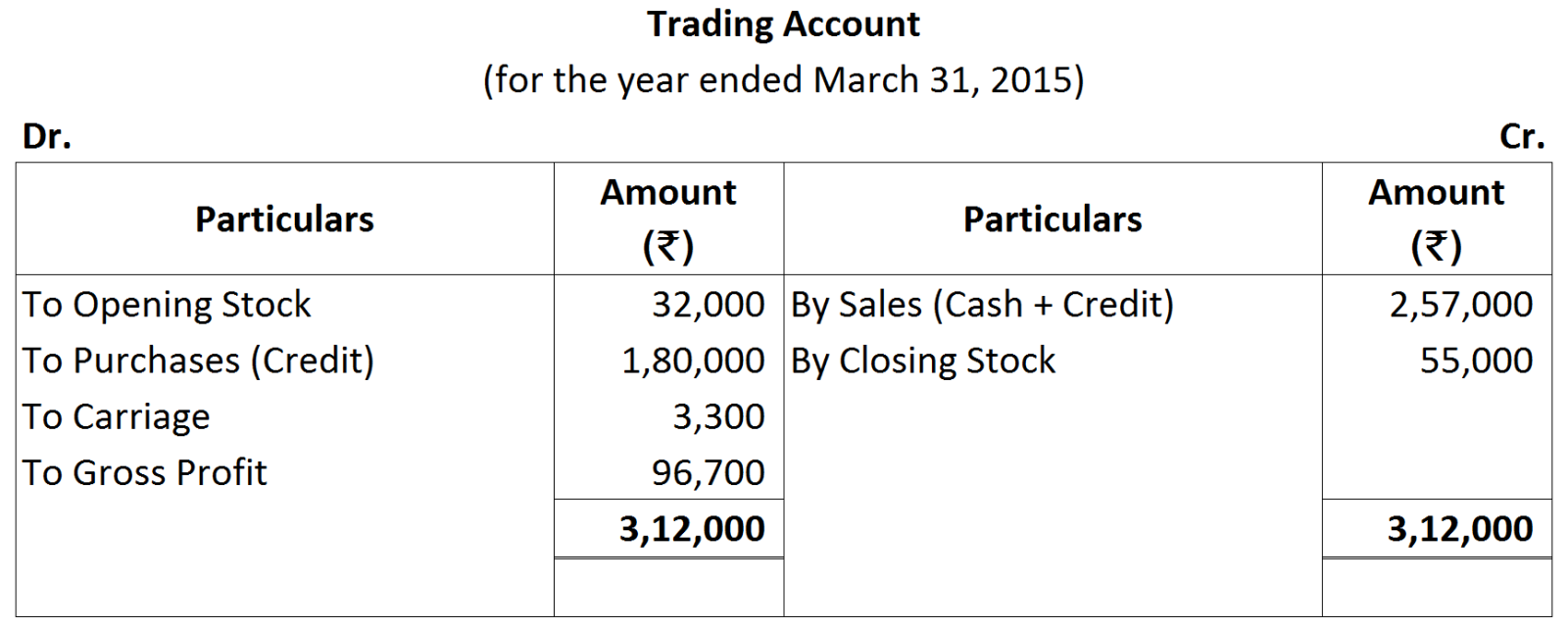
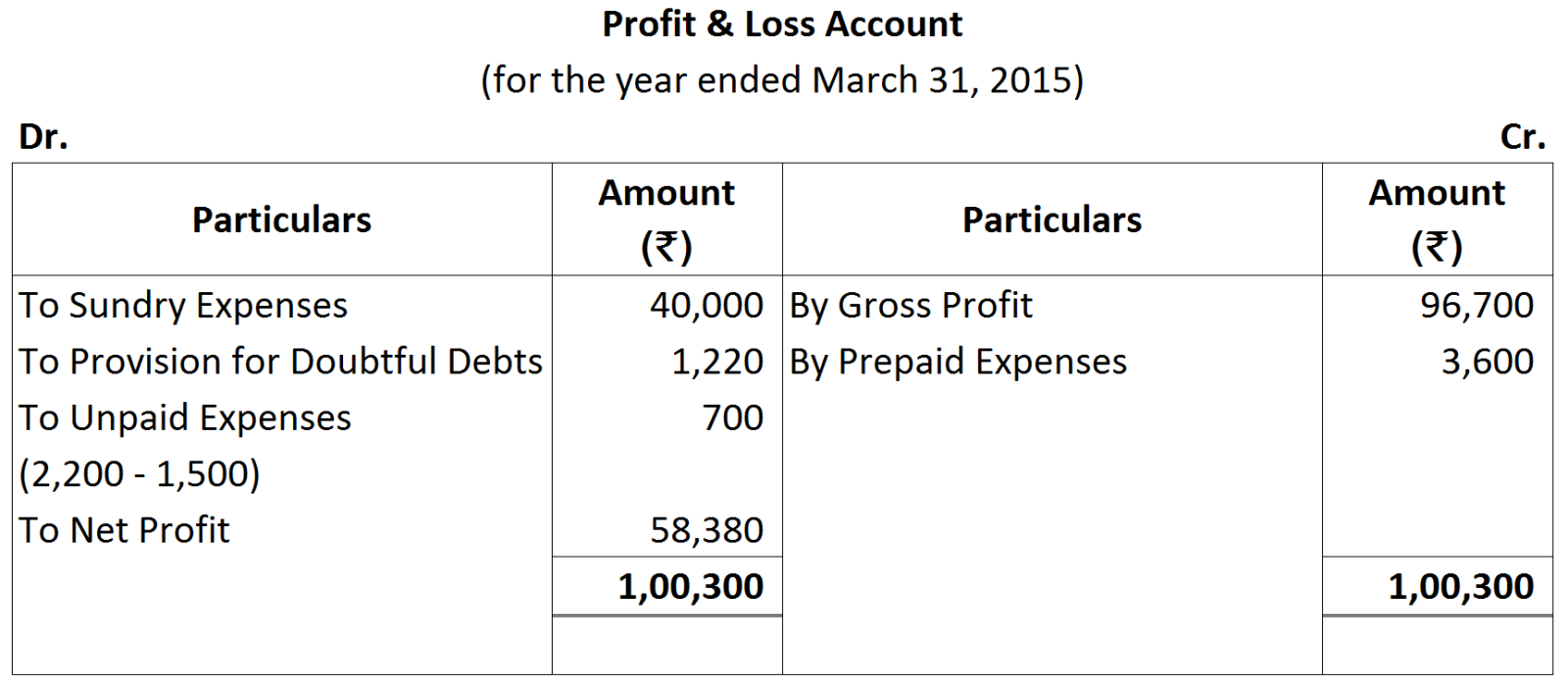
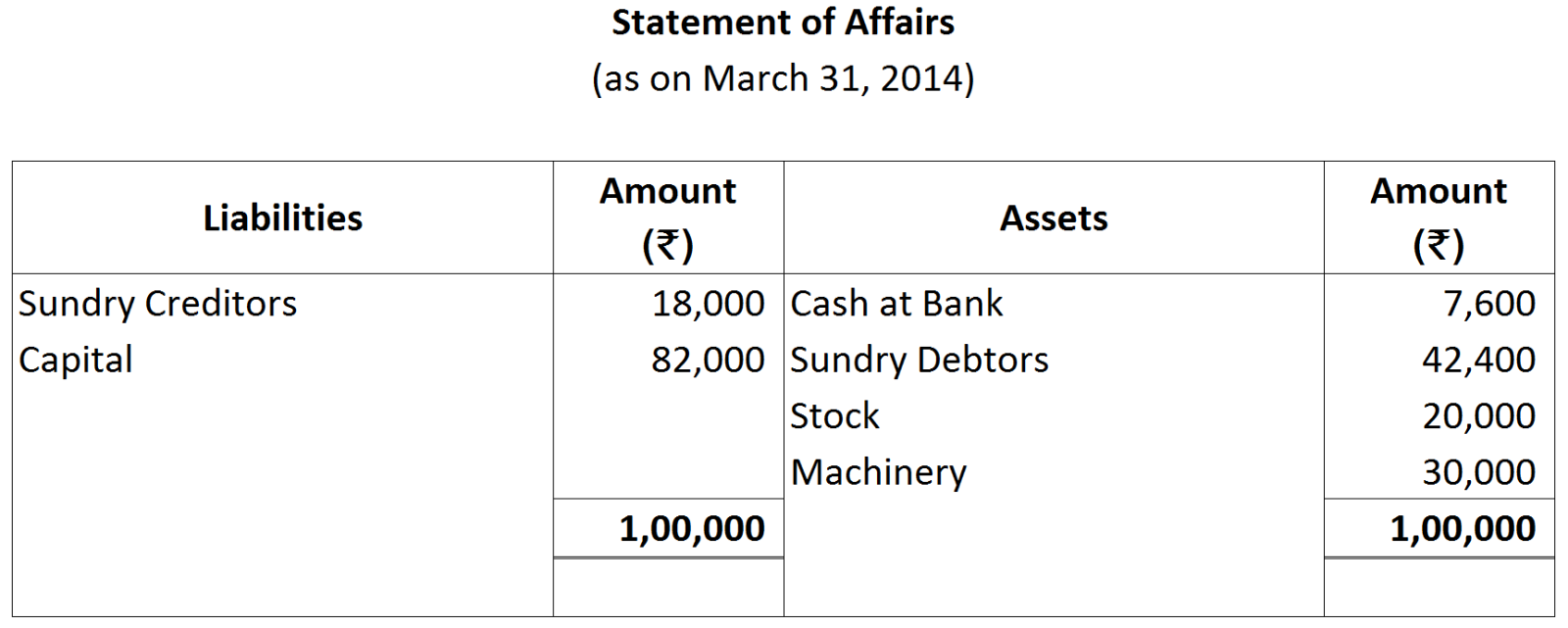
Lalit Mohan keeps incomplete records. From the following information provided by him, prepare a Trading and Profit & Loss Account for the year ended $31^{st}$ March, $2015$ and a Balance Sheet as at that date:
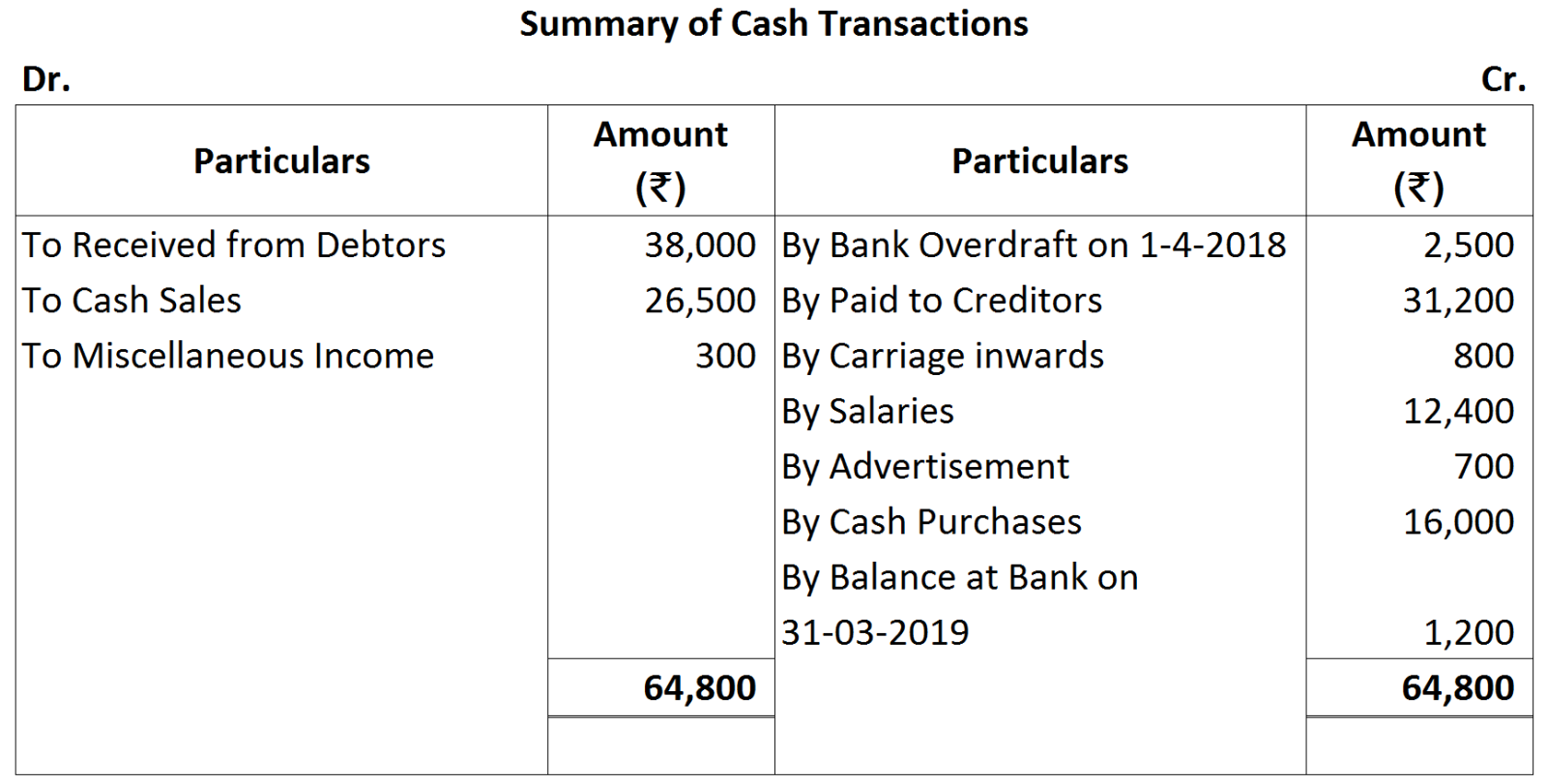
Summary of cash transactions during the year:
You are informed that there were considerable amount of cash sales during the year. Credit purchases during the year amounted to ₹ $1,80,000$. Provide $5\%$ for doubtful debts on debtors.
Answer


Working Notes:


View full question & answer
Question 256 Marks
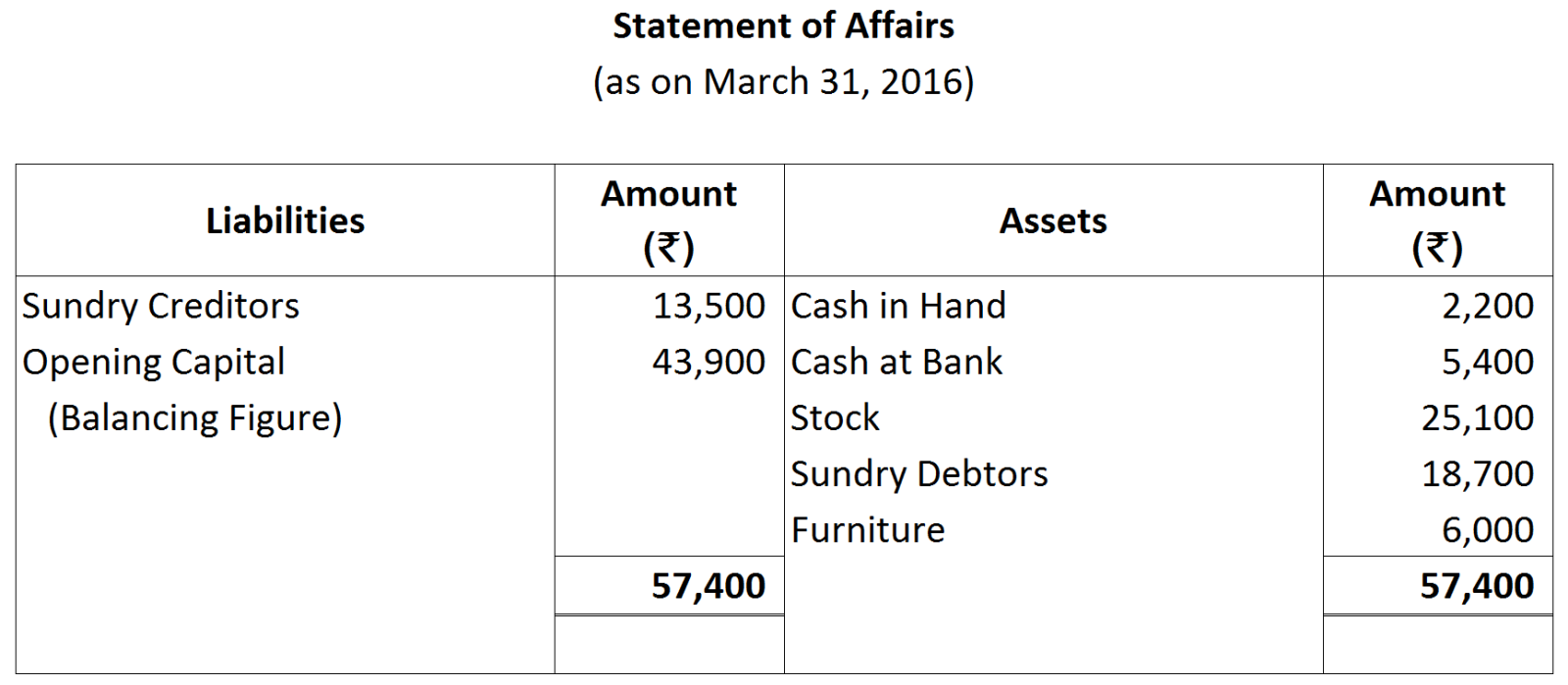
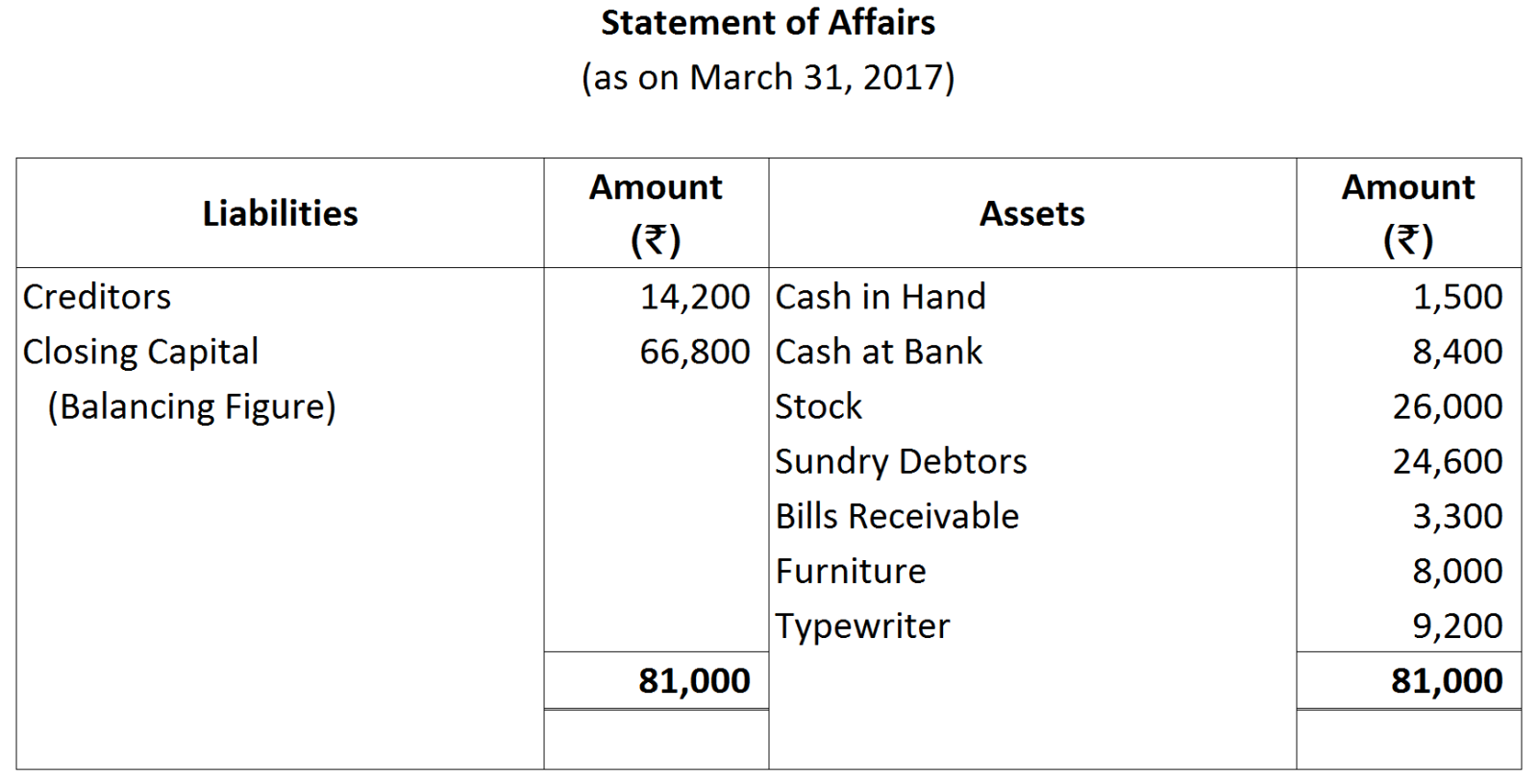
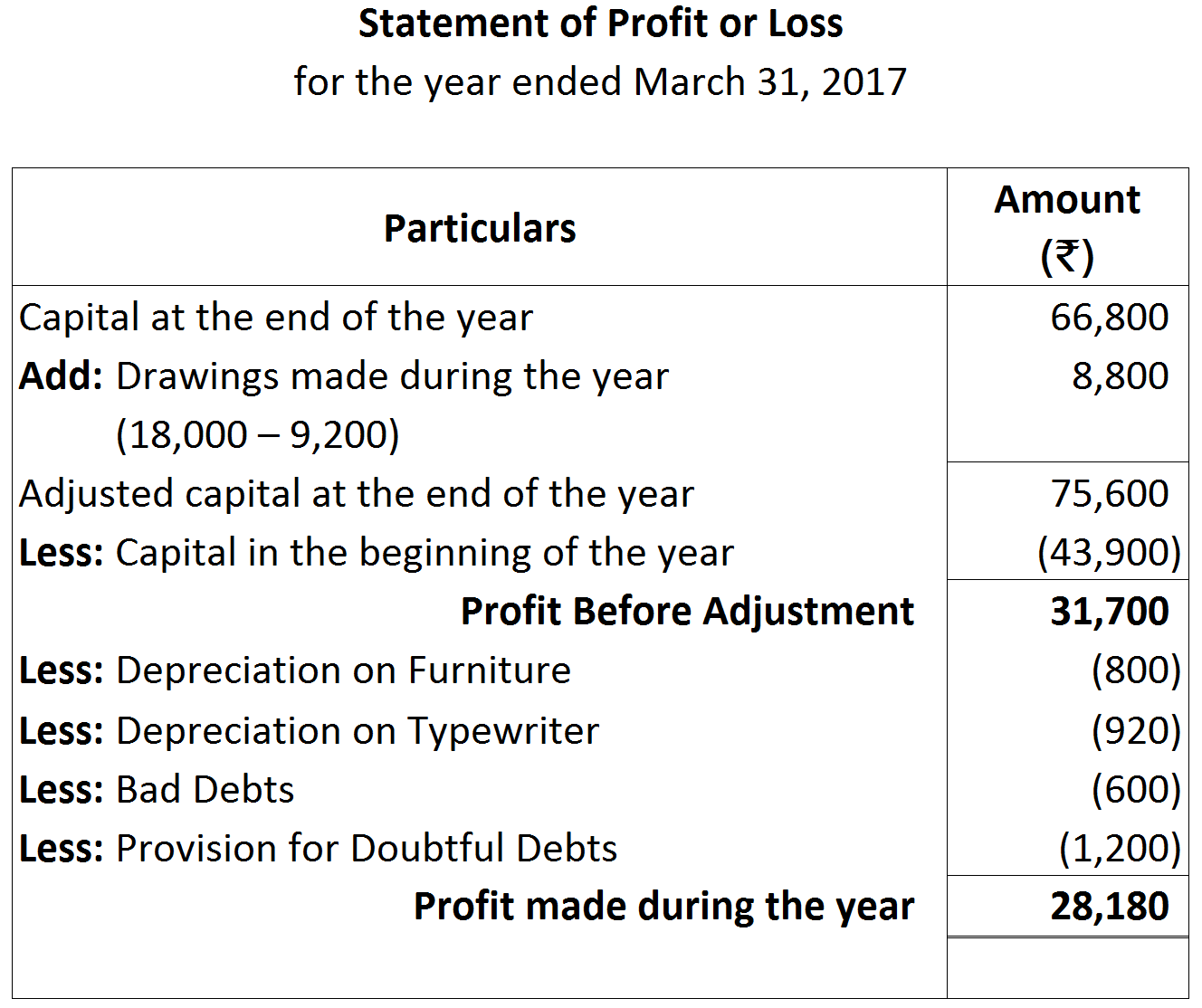
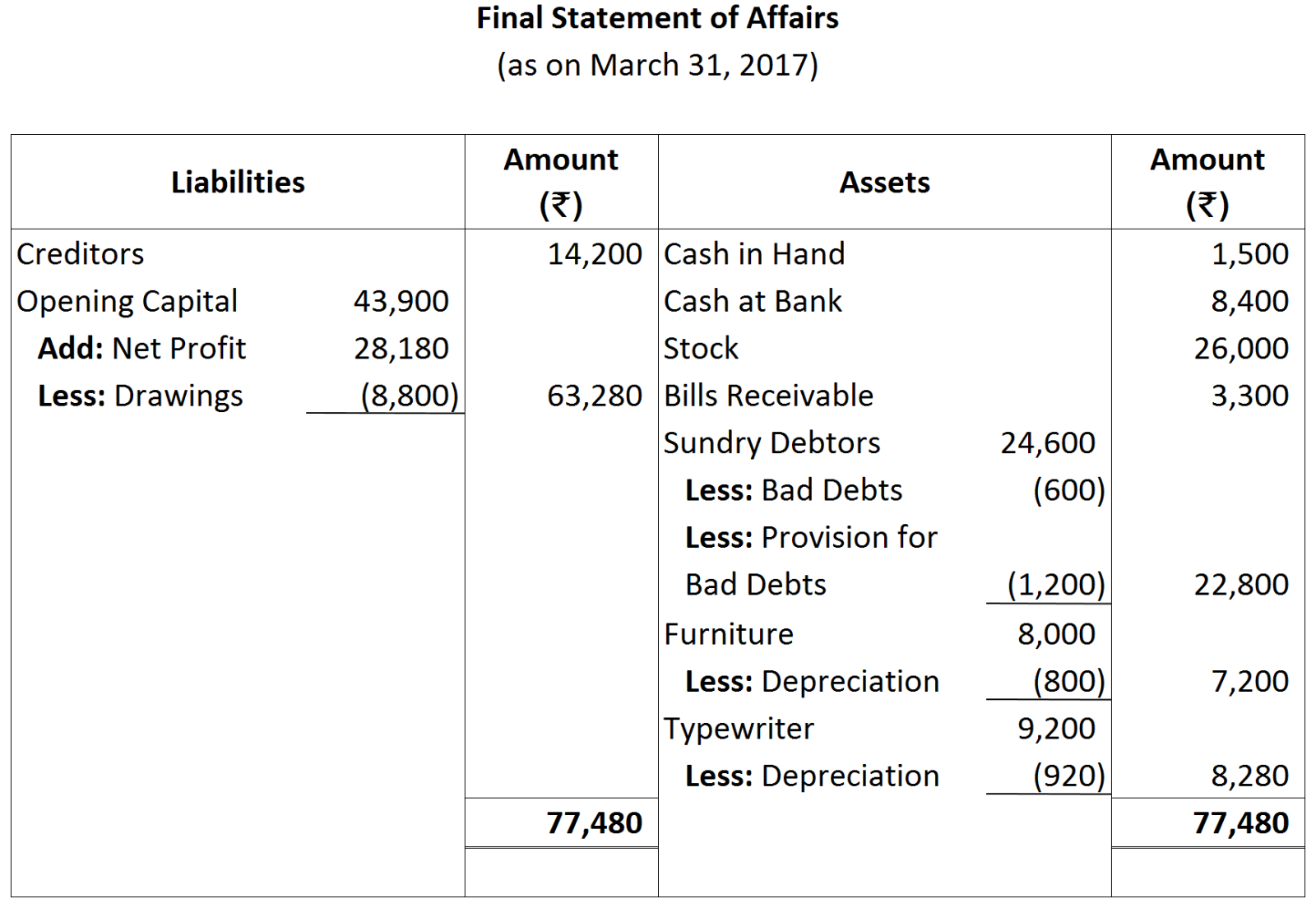
Ashok keeps incomplete records. The position of his business on $1^{st}$ April, $2016$ was as follows: Cash in Hand ₹ $2,200$; Cash at Bank ₹ $5,400$; Stock ₹ $25,100$; Sundry Debtors ₹ $18,700$; Furniture ₹ $6,000$; Sundry Creditors ₹ $13,500$. His position on $31^{st}$ March, $2017$ was as follows: Cash in Hand ₹ 1,500; Cash at Bank ₹ $8,400$; B/R ₹ $3,300$; Stock ₹ $26,000$; Sundry Debtors ₹ $24,600$; Furniture ₹ $8,000$; Sundry Creditors ₹ $14,200$. During the year he had withdrawn from the business ₹ $18,000$, of which ₹ $9,200$ were spent in purchasing a Typewriter for the business.
  1. Depreciate furniture and typewriter by $10\%$.
  2. Write off ₹ $600$ as Bad-Debts.
  3. Make a provision of $5\%$ on Debtors for doubtful debts.
Calculate the profit or loss of his business for the year ended $31^{st}$ March, $2017$ and prepare a final statement of affairs, after the above adjustments.
Answer
Solution is as follows:


View full question & answer
Question 266 Marks
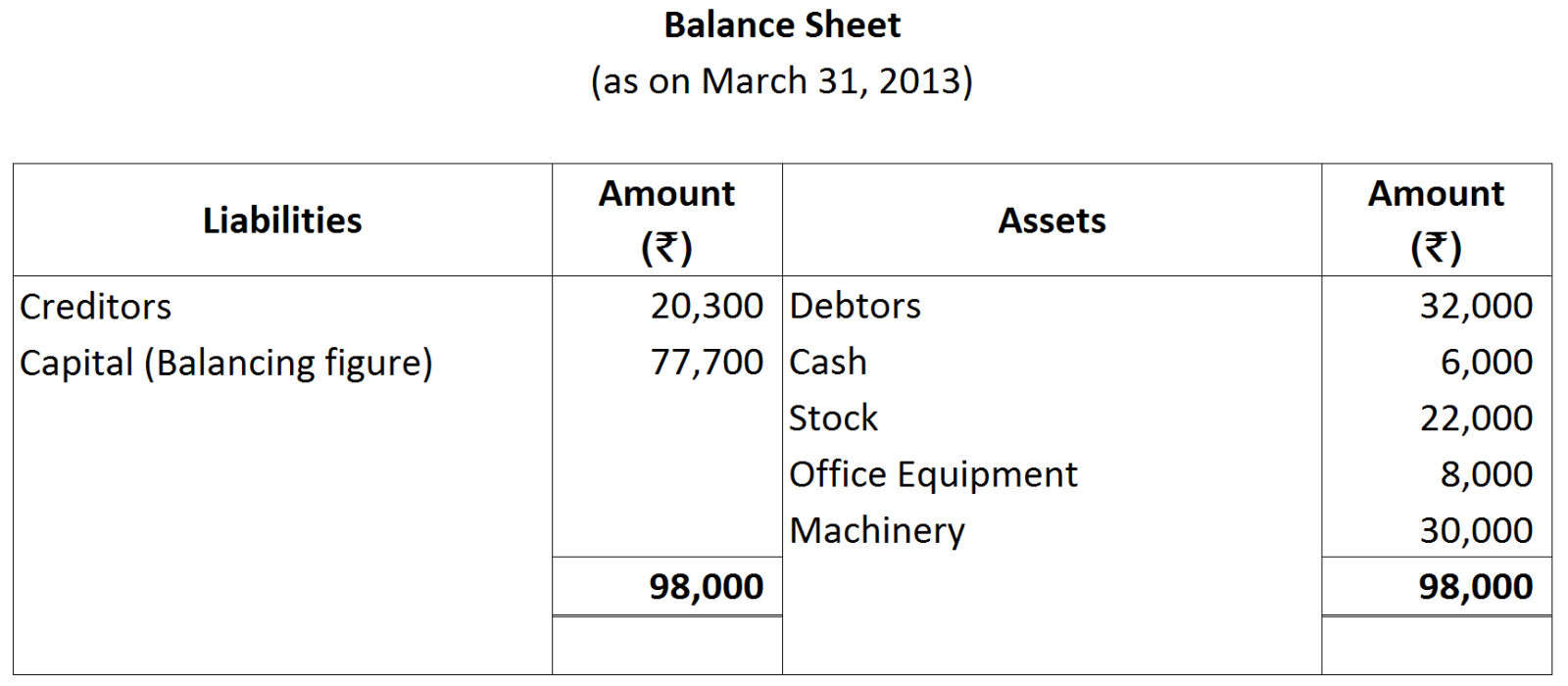
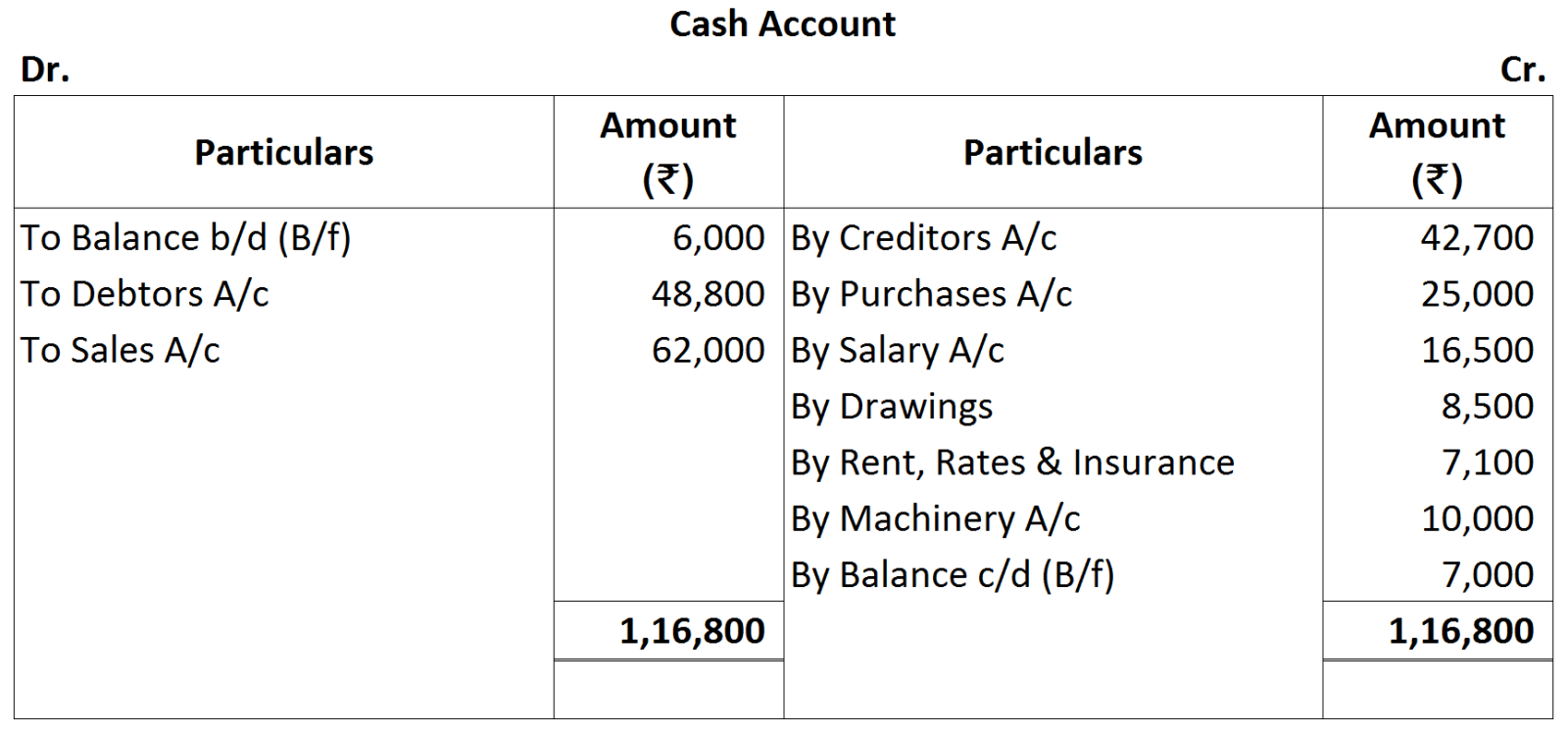
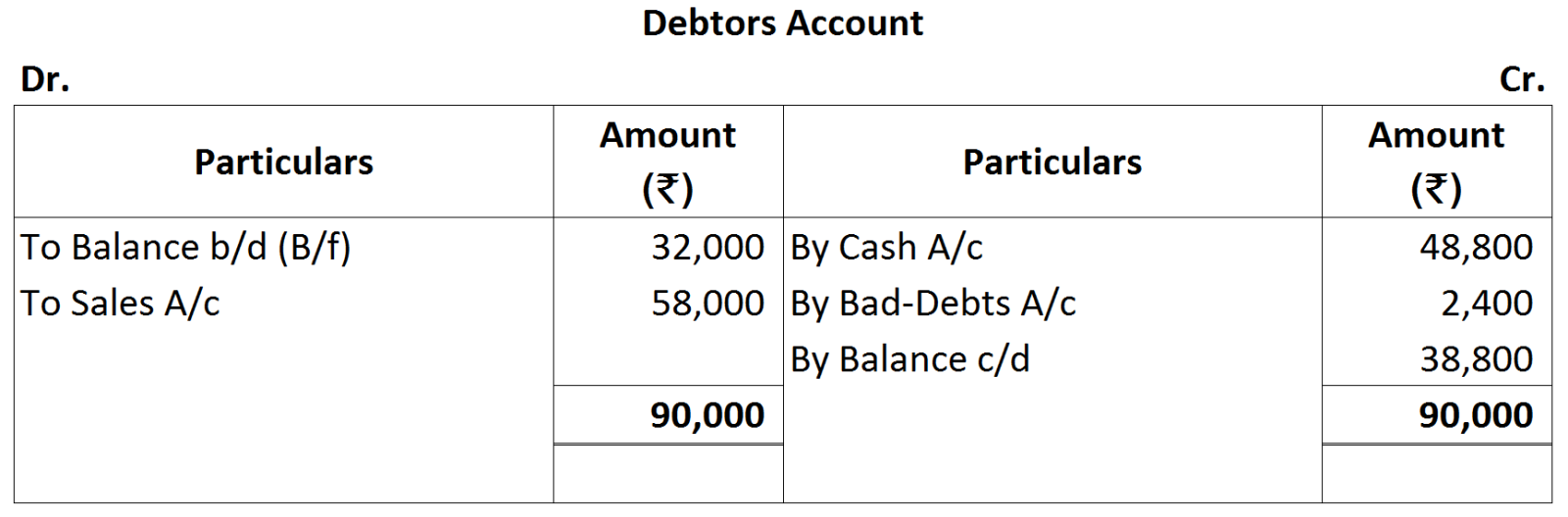
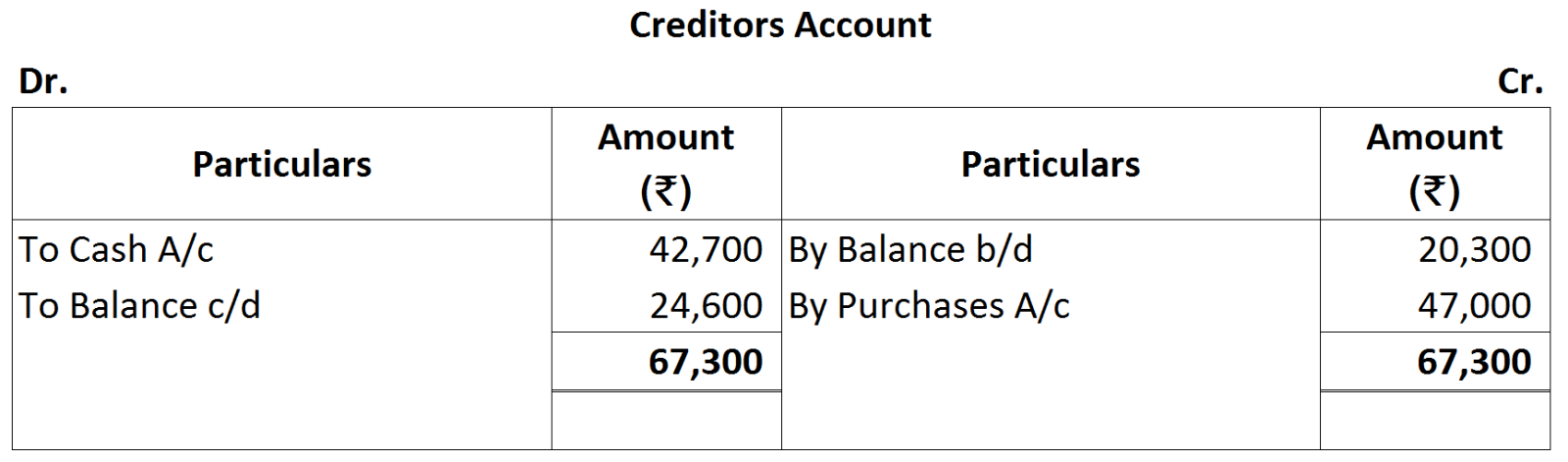
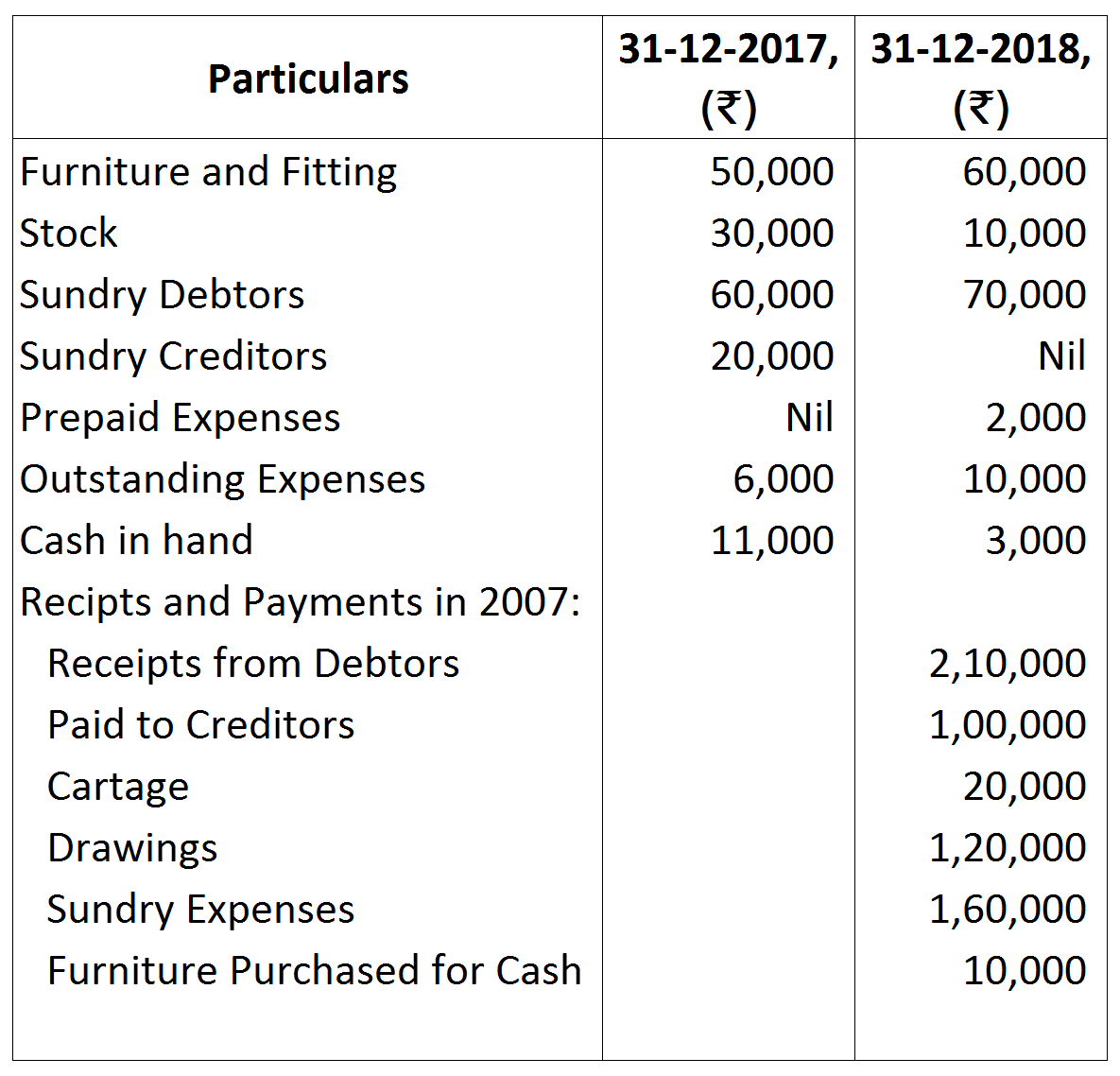
Sonam keeps his books on single entry and provides you with the following information:
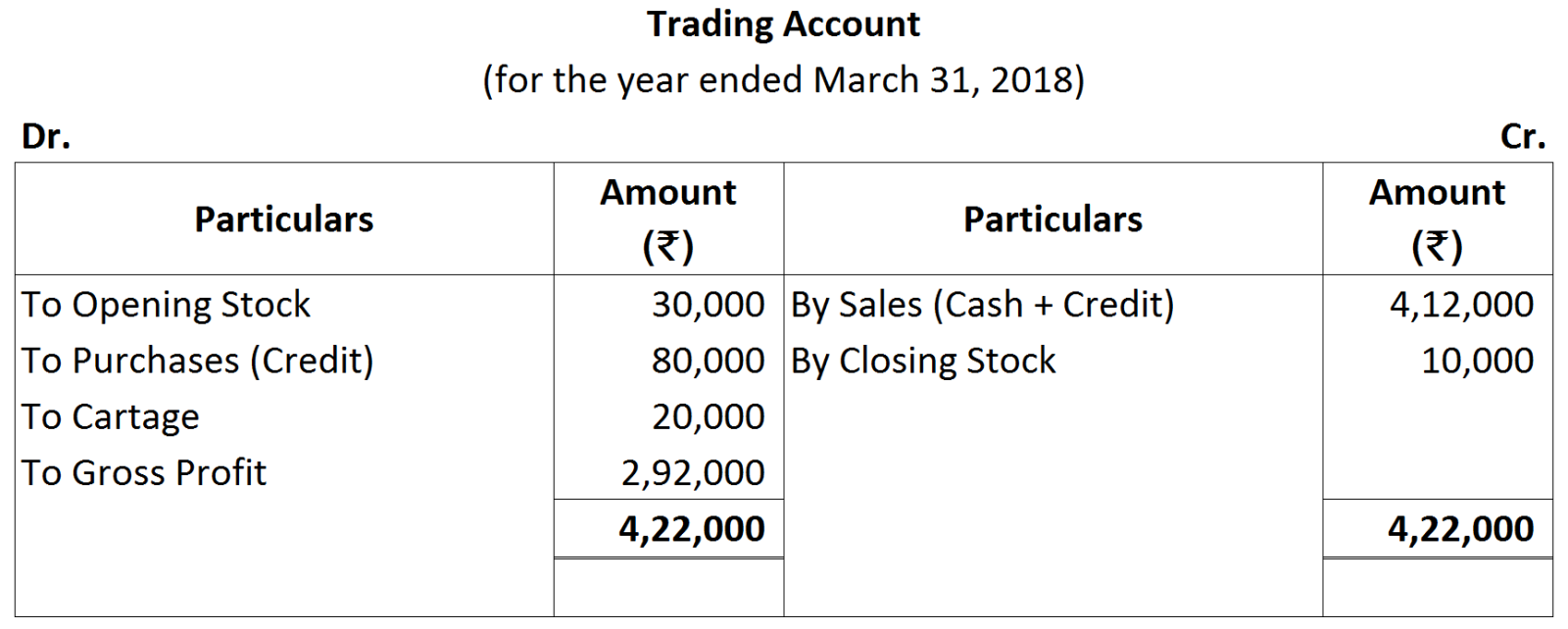
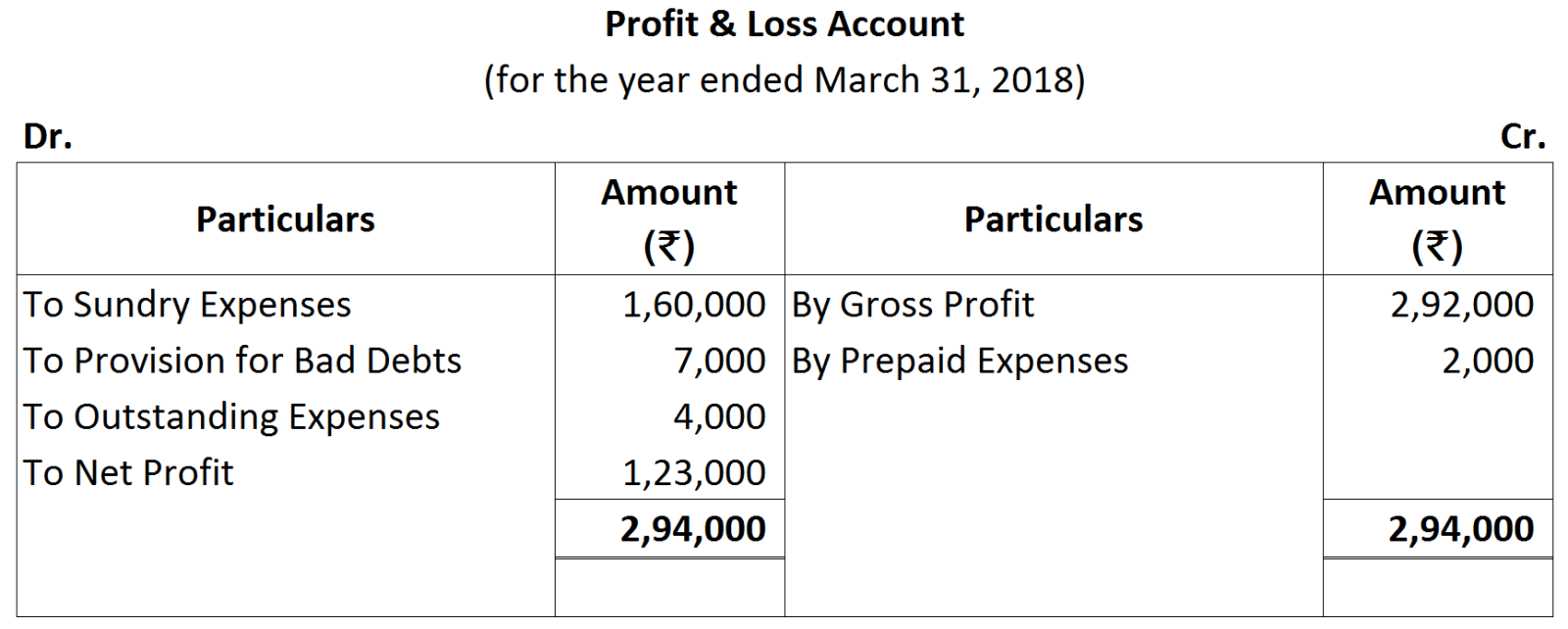
Prepare Trading and Profit & Loss Account for the year ended 31 December, 2018 after providing for bad debts at 10%.
There was a considerable amount of Cash Sales.
Answer


Working Notes:


View full question & answer
Question 276 Marks
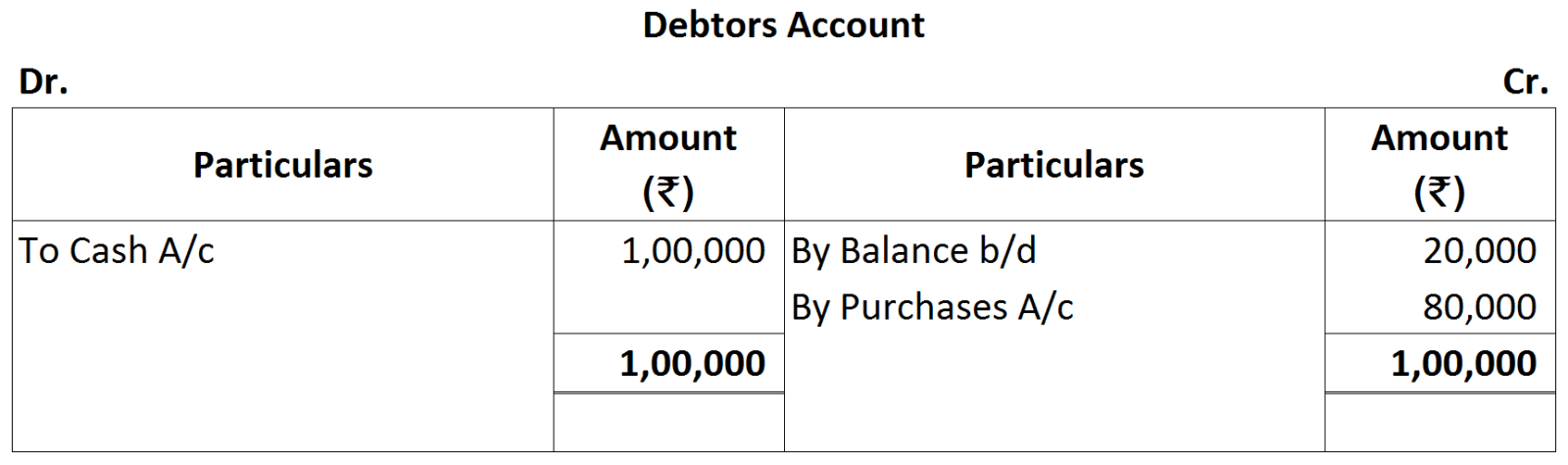
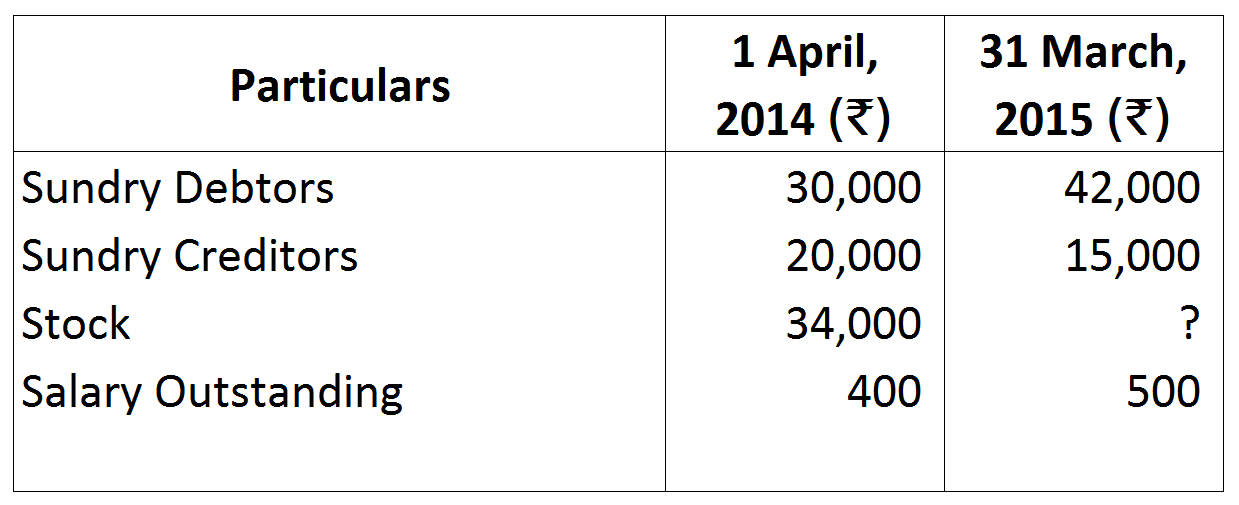
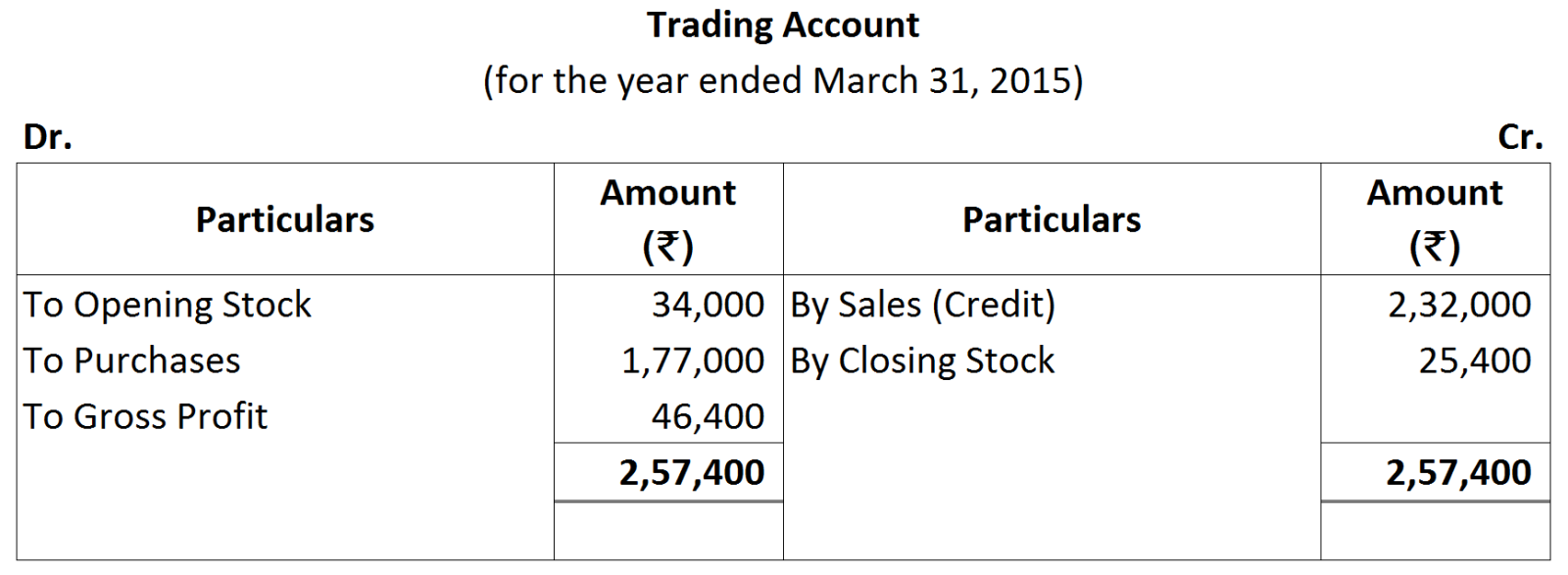
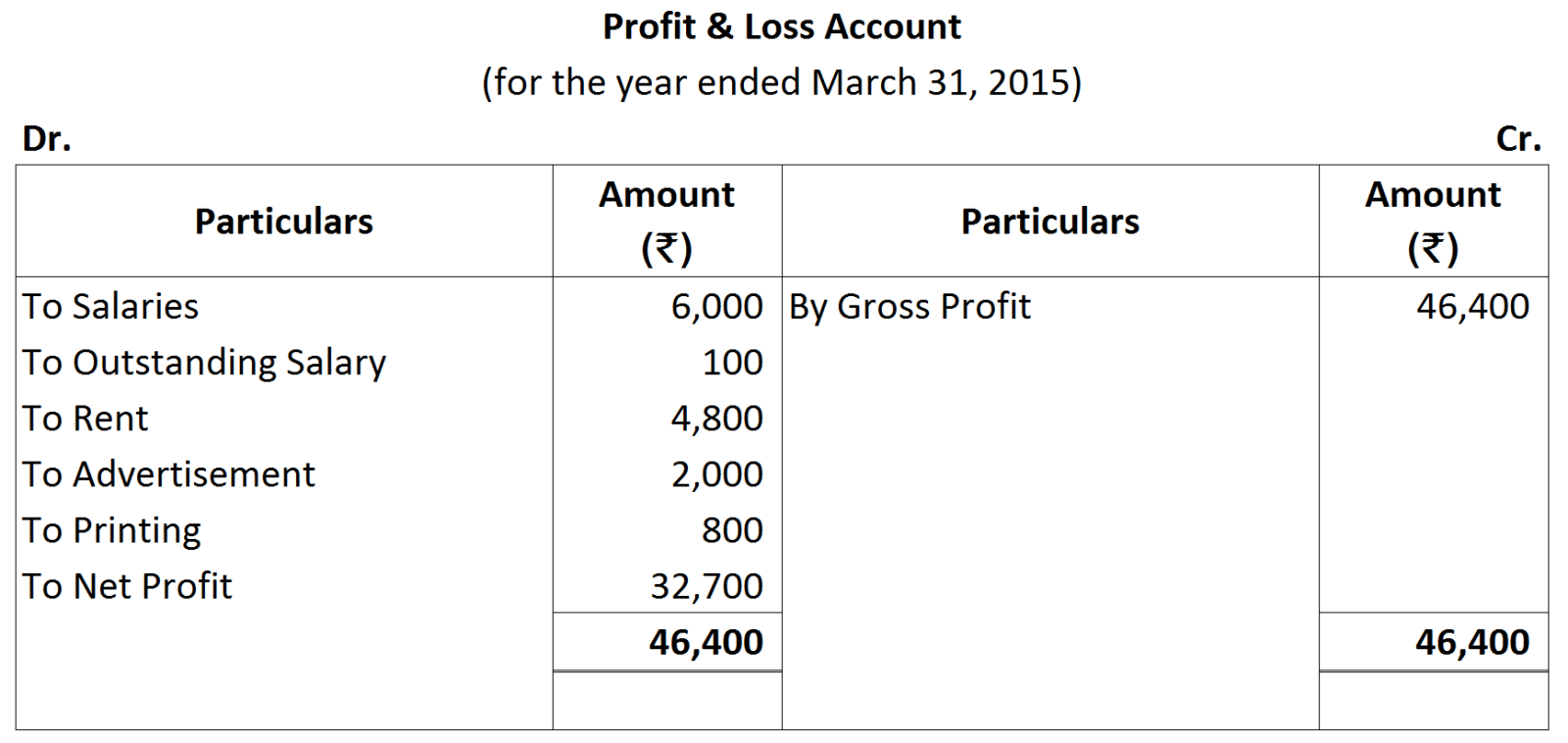
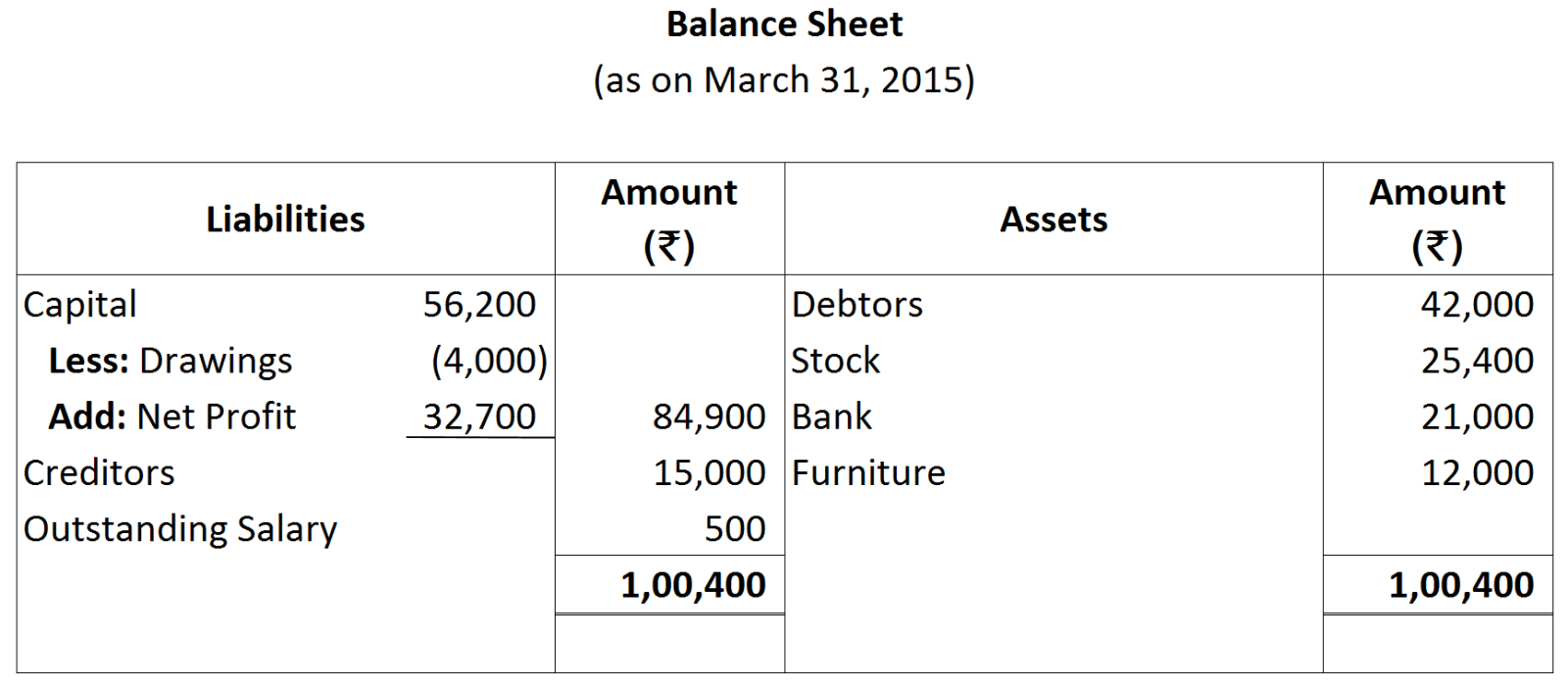
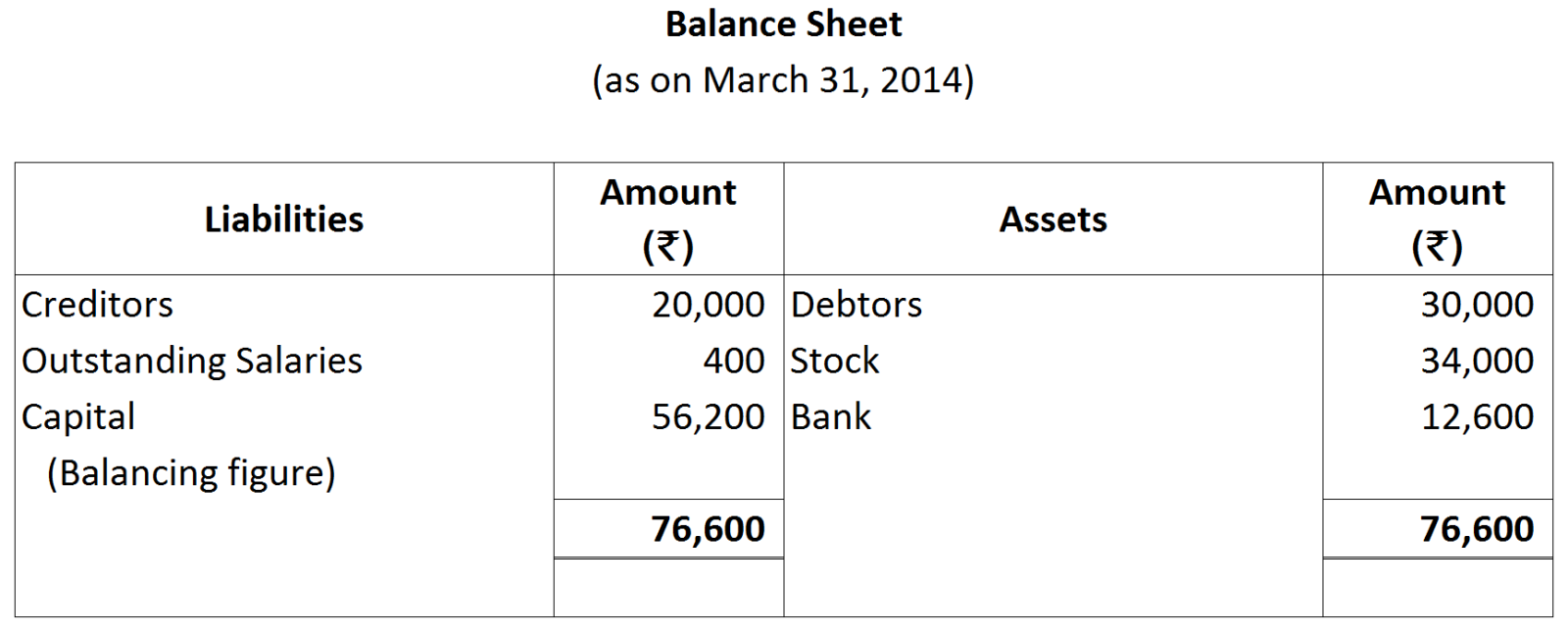
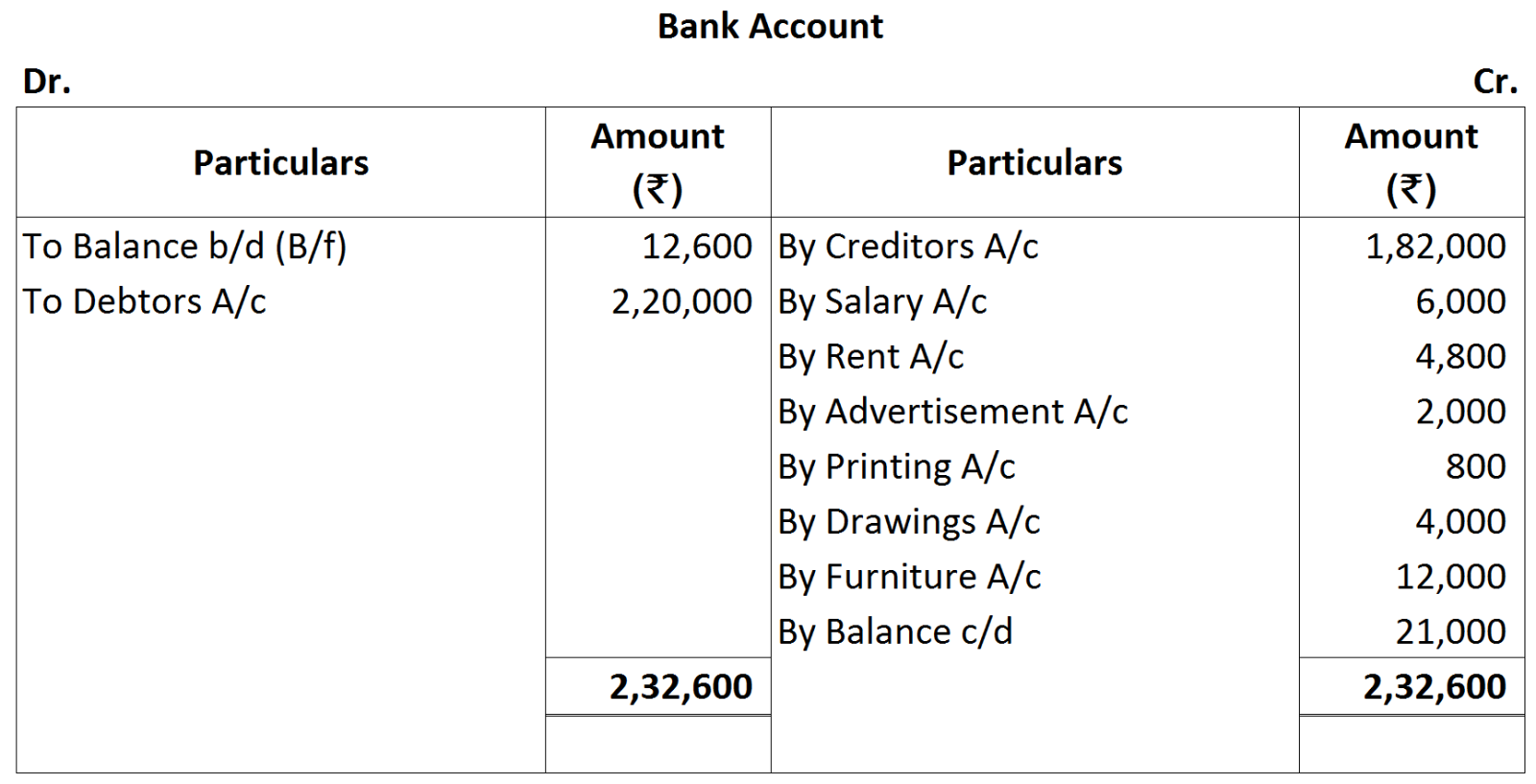
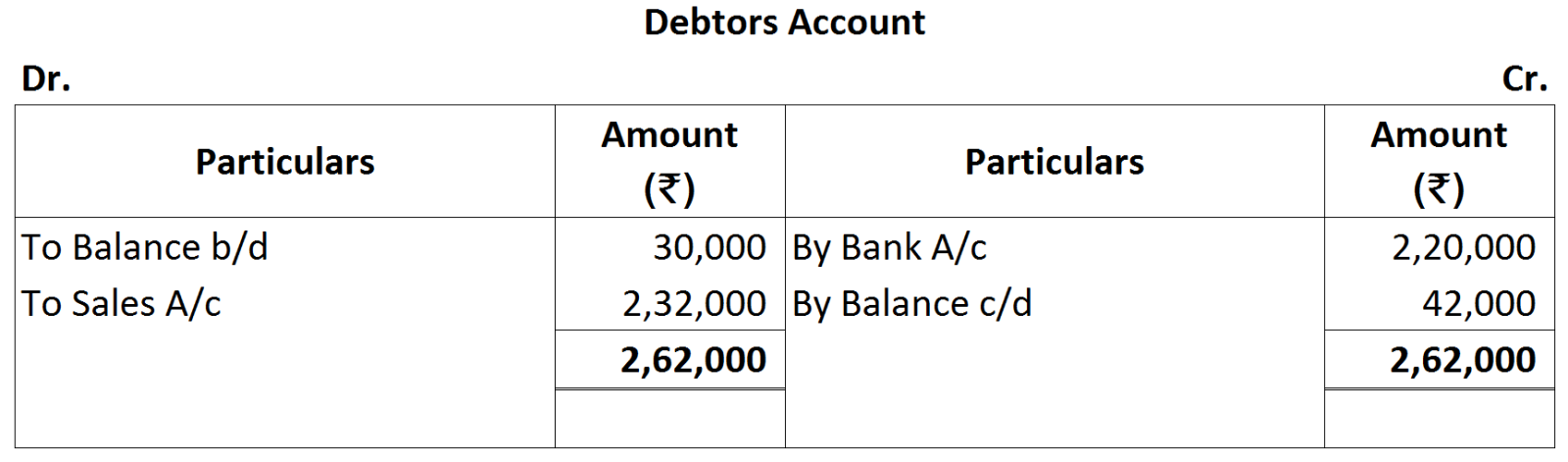
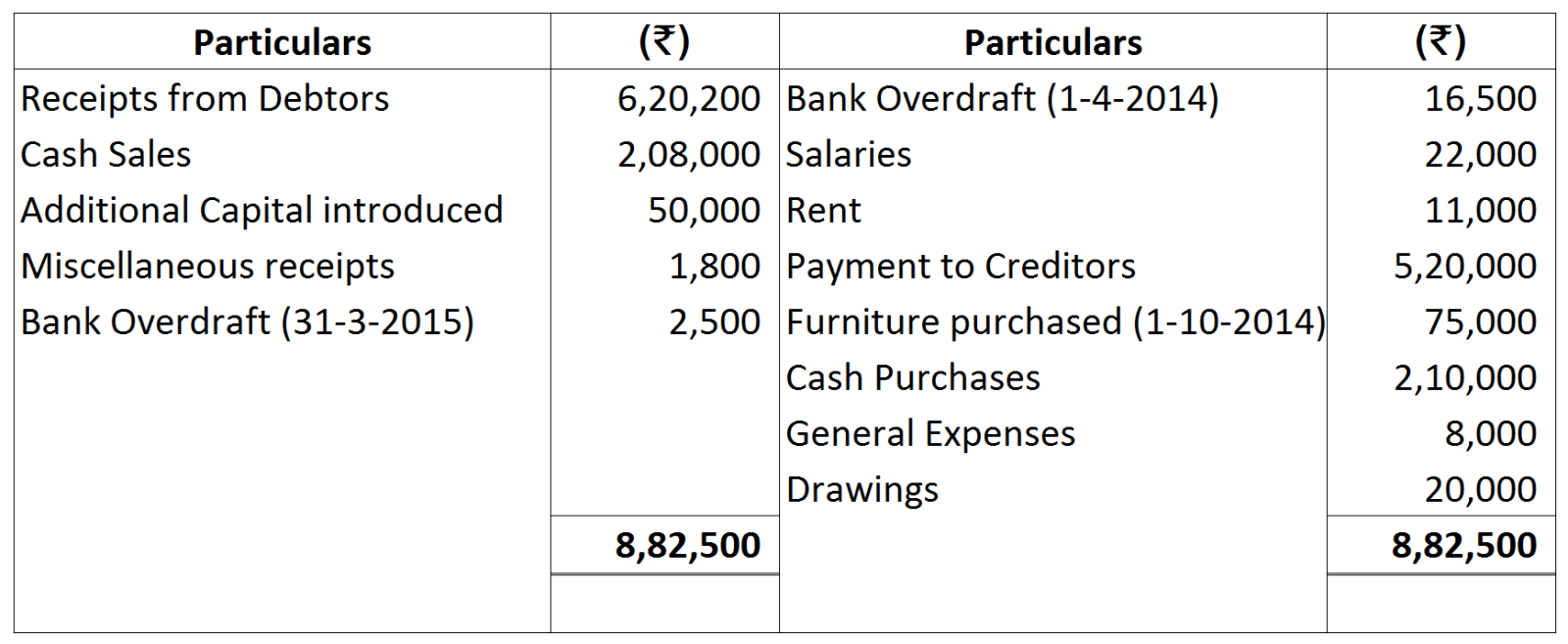
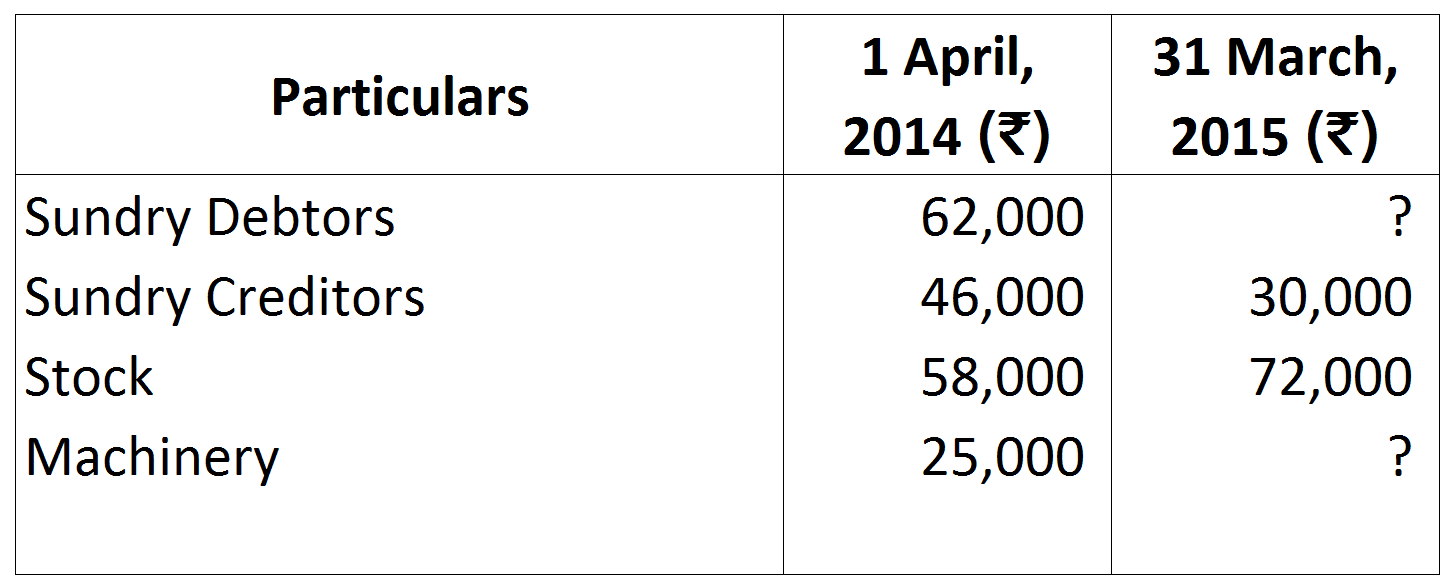
Mr. Gopal Das has only a Bank Pass Book and does not keep any other books of accounts. From the following information prepare his Final Accounts for the year ended $31^{st} $ March, $2015.$ An analysis of the Pass Book shows: Total amount received from Debtors and deposited with the Bank $₹\ 2,20,000;$ Payment to Creditors $₹\ 1,82,000$; Salaries $₹\ 6,000;$ Rent paid $₹\ 4,800;$ Advertisement $₹\ 2,000;$ Printing $₹\ 800;$ Personal Expenses $₹\ 4,000;$ Payment for Furniture $₹\ 12,000;$ Balance at Bank on $31^{st}$ March, $2015, ₹\ 21,000.$ Other Assets and Liabilities were as follows:
Mr. Gopal Das takes $20\%$ profit on sales.
Answer


Working Notes:


Rate of Gross Profit $($on sales$) = 20\%$
Gross Profit $= 20\%$ of $2,32,000 = 46,400$$$
Gross Profit $=$ Net Sales $-$ Cost of Goods Sold
$46,400 = 2,32,000 -$ Cost of Goods Sold
Cost of Goods Sold $= 2,32,000 - 46,400 = ₹\ 1,85,600$
Cost of Goods Sold $=$ Opening Stock $+$ Purchases $+$ Direct Expenses $-$ Closing Stock
$1,85,600 = 34,000 + 1,77,000 -$ Closing Stock
Closing Stock $= 34,000 + 1,77,000 - 1,85,600 = ₹\ 25,400$
View full question & answer
Question 286 Marks
Mohan commenced business on $1^{st}$ April, $2012$ with a capital of $₹\ 50,000.$ On $1^{st}$ January, $2013,$ he introduced $₹\ 25,000$ into business of which $₹\ 10,000$ was borrowed from Ram. His position on $31^{st$} March, $2013$ was as under:
Assets: Cash in hand $₹\ 4,000;$ Bank (Cr.) $₹\ 6,500;$ Debtors $₹\ 24,000;$ B/R $₹\ 18,600.$
Stock $₹\ 25,400$; Furniture $₹\ 15,000;$ Prepaid expenses $₹\ 1,000.$
Liabilities : Creditors $₹\ 13,500;$ B/P $₹\ 4,800;$ Ram's Loan $₹\ 10,000;$ Outstanding expenses $₹\ 700.$
Actual drawings were not known but his living expenses are $₹\ 1,000$ p.m. Depreciate furniture by $10\%.$ Interest on loan is due $@ 12\%$ p.a.
Ascertain his profit or loss for the year $2012-13$ & prepare final statement of affairs.
View full question & answer
Question 296 Marks
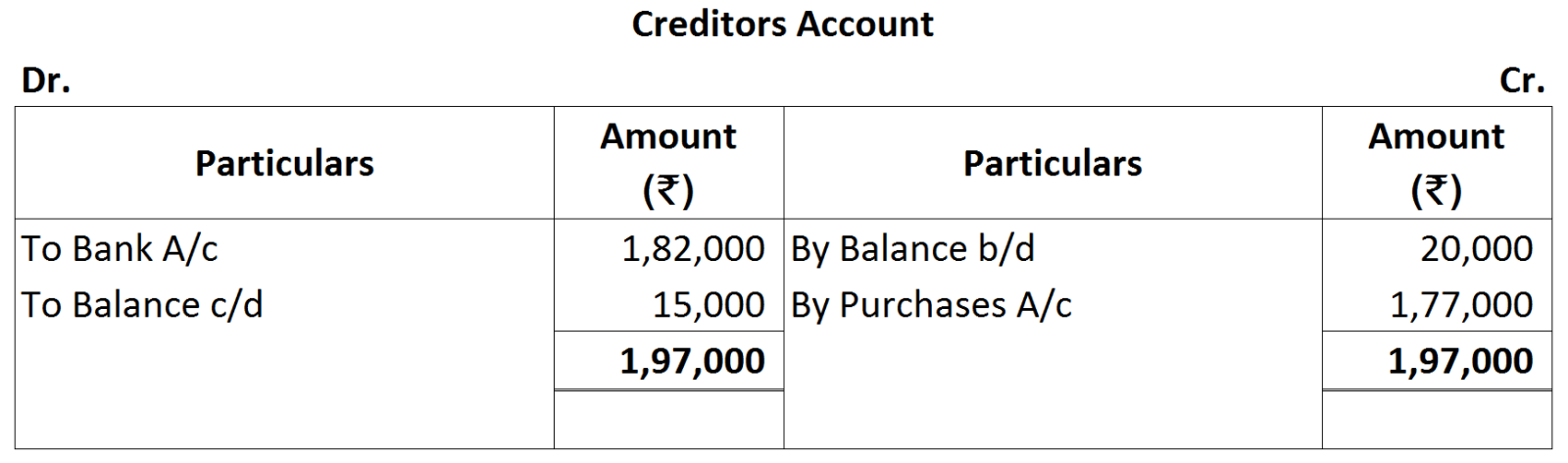
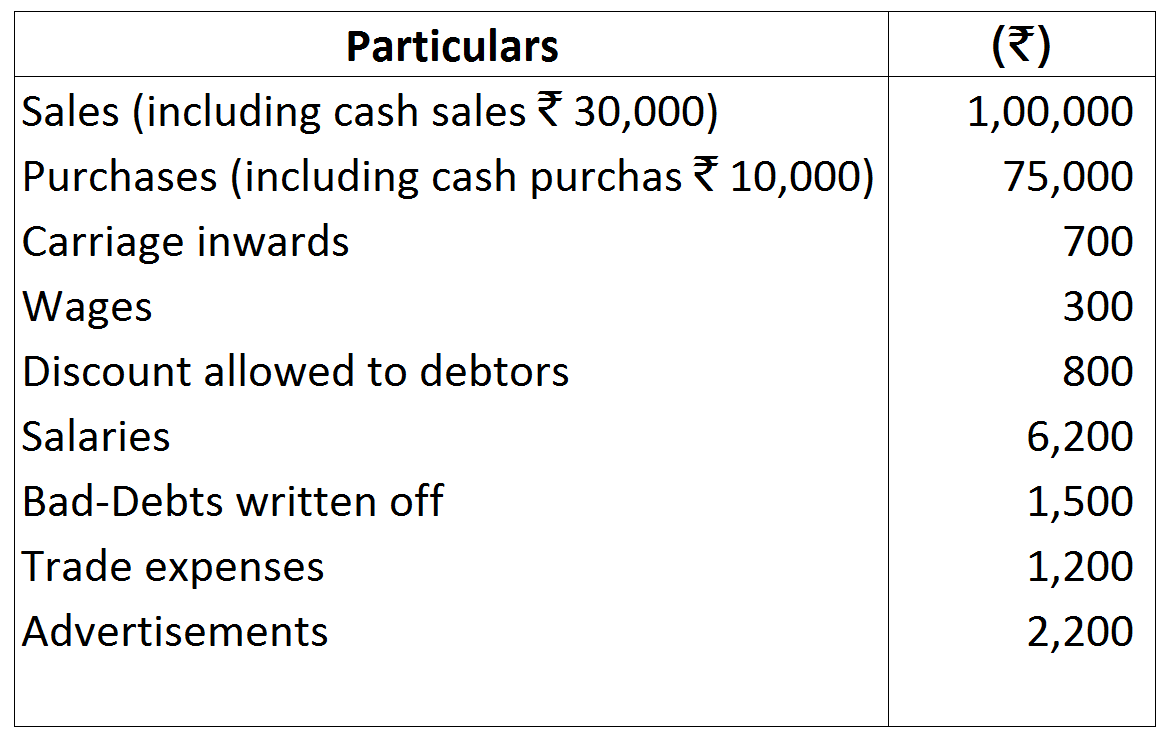
Mr. Manoj keeps incomplete records. During the year $2014-15$ the analysis of his cash book was as under:

Other Informations:
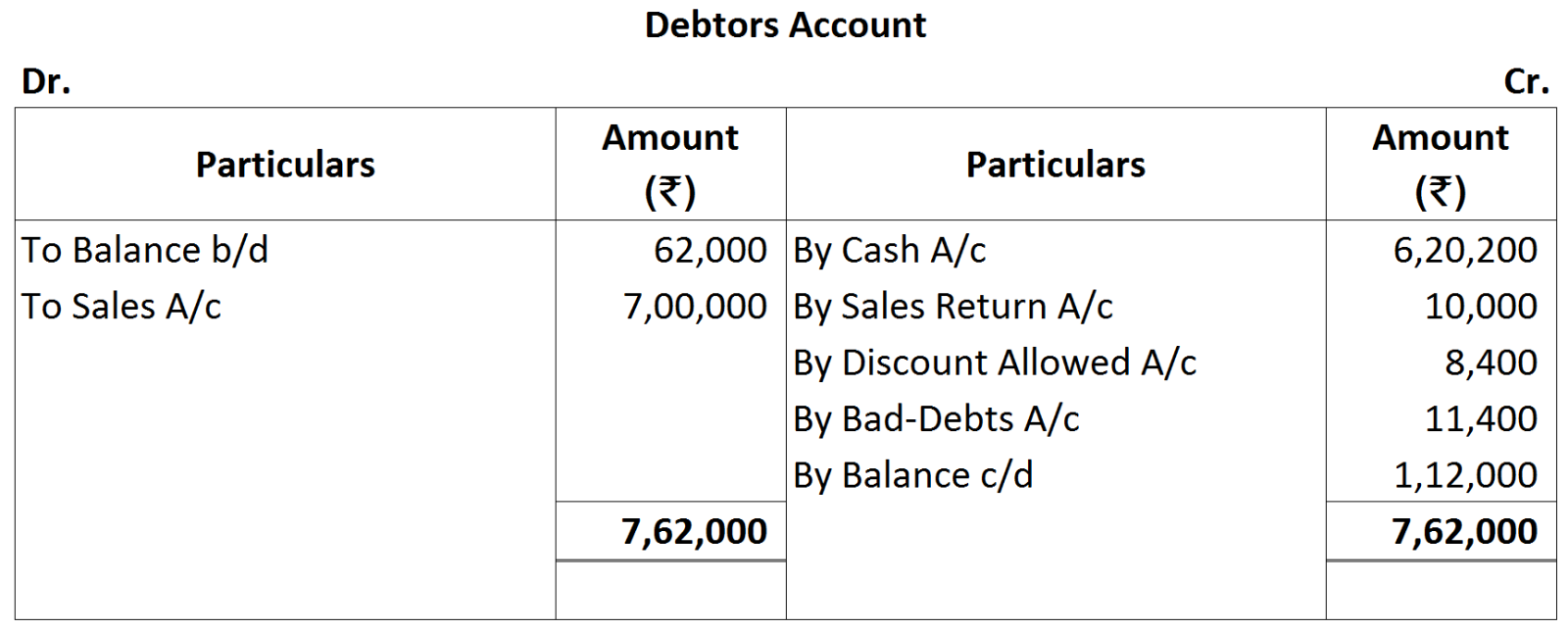
  1. Credit sales during the year were $₹\ 7,00,000$
  2. Sales Returns were $₹\ 10,000$
  3. Discount allowed to debtors $₹\ 8,400$
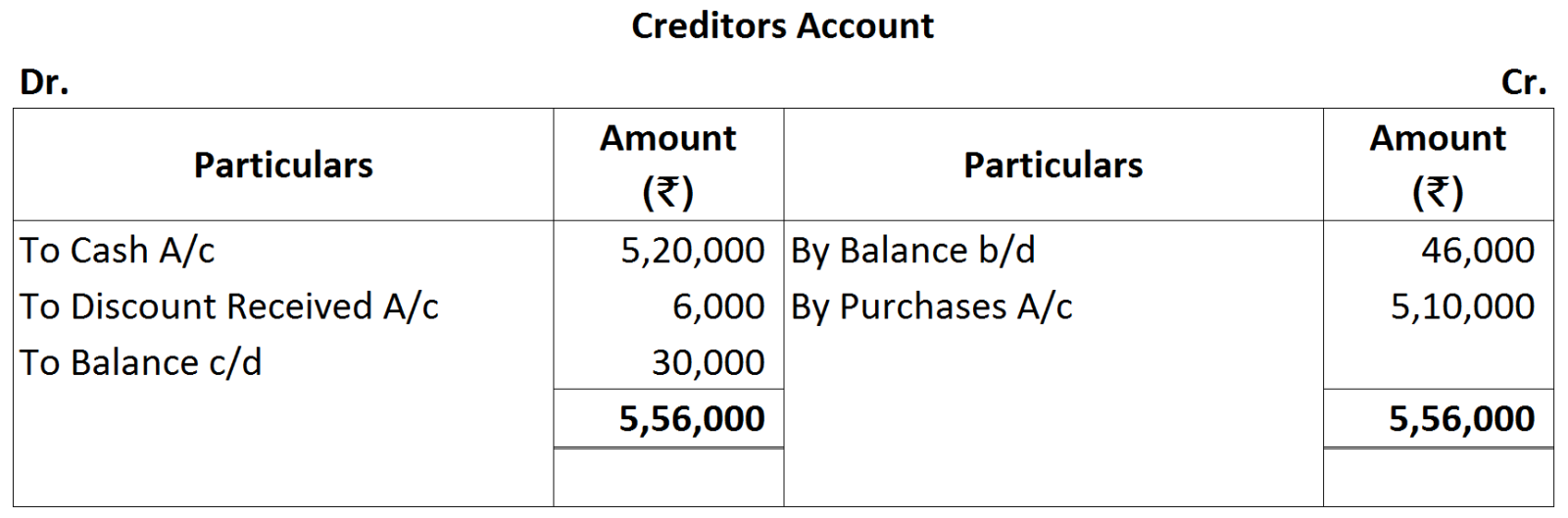
  4. Discount received from creditors $₹\ 6,000$
  5. Bad-debts written off during the year $₹\ 11,400$
Adjustments:
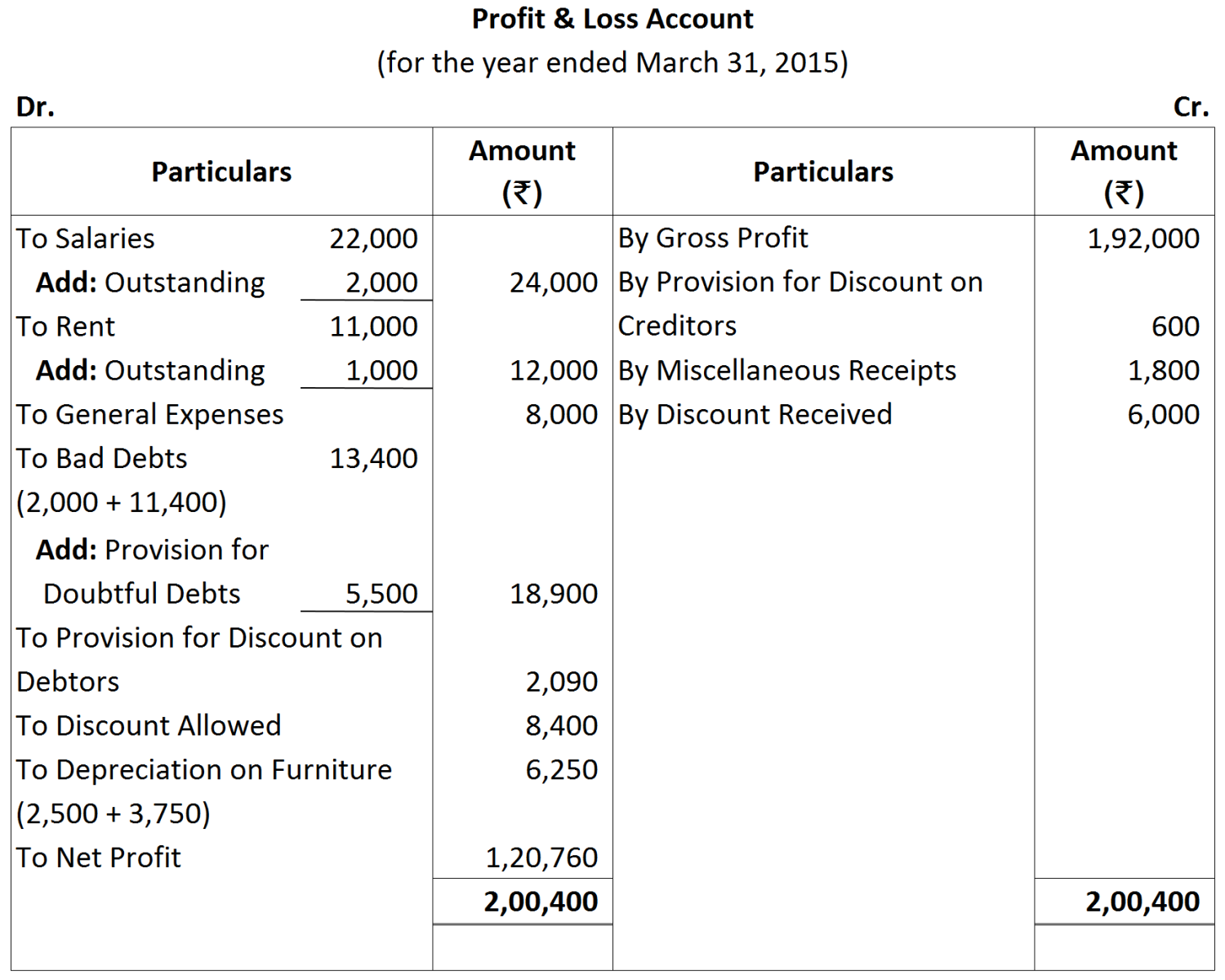
  1. Write off further bad-debts $₹\ 2,000.$
  2. Provide $5\%$ for doubtful debts and $2\%$ for discount on debtors and creditors.
  3. Charge $10\%$ p.a. depreciation on furniture.
  4. One month salaries and one month rent was outstanding.
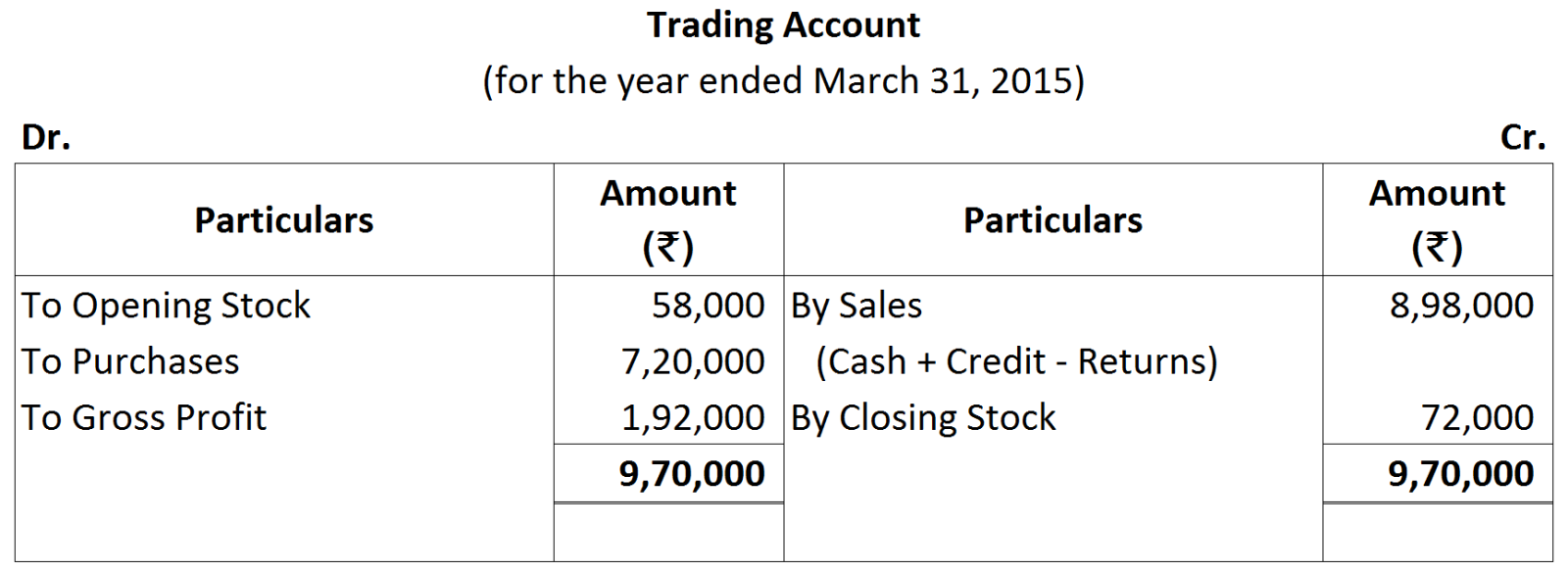
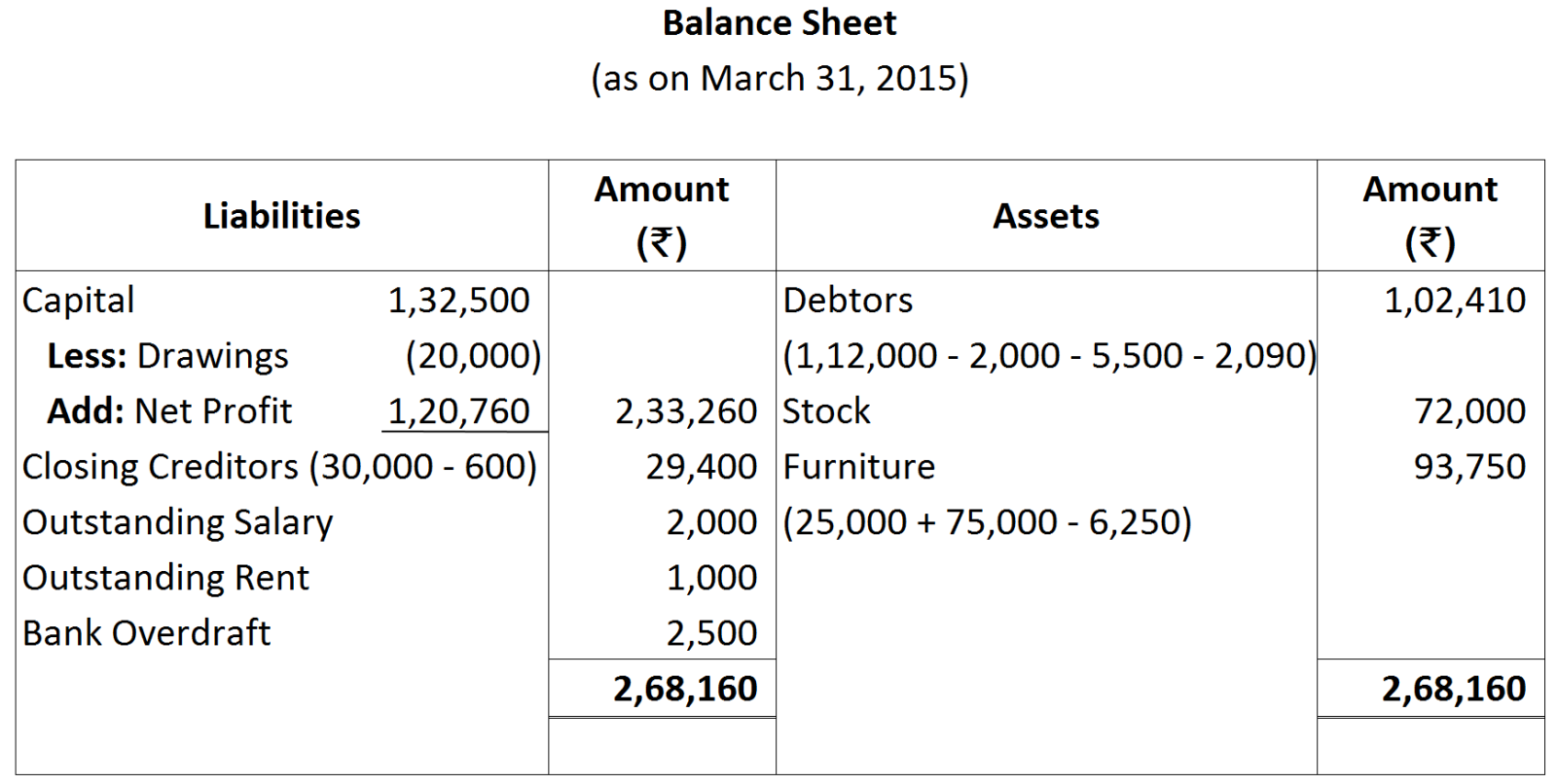
Prepare Trading and Profit & Loss Account for the year ended $31^{st}$ March, $2015$ and a Balance Sheet as at that date.
Answer


Working Notes:


View full question & answer
Question 306 Marks
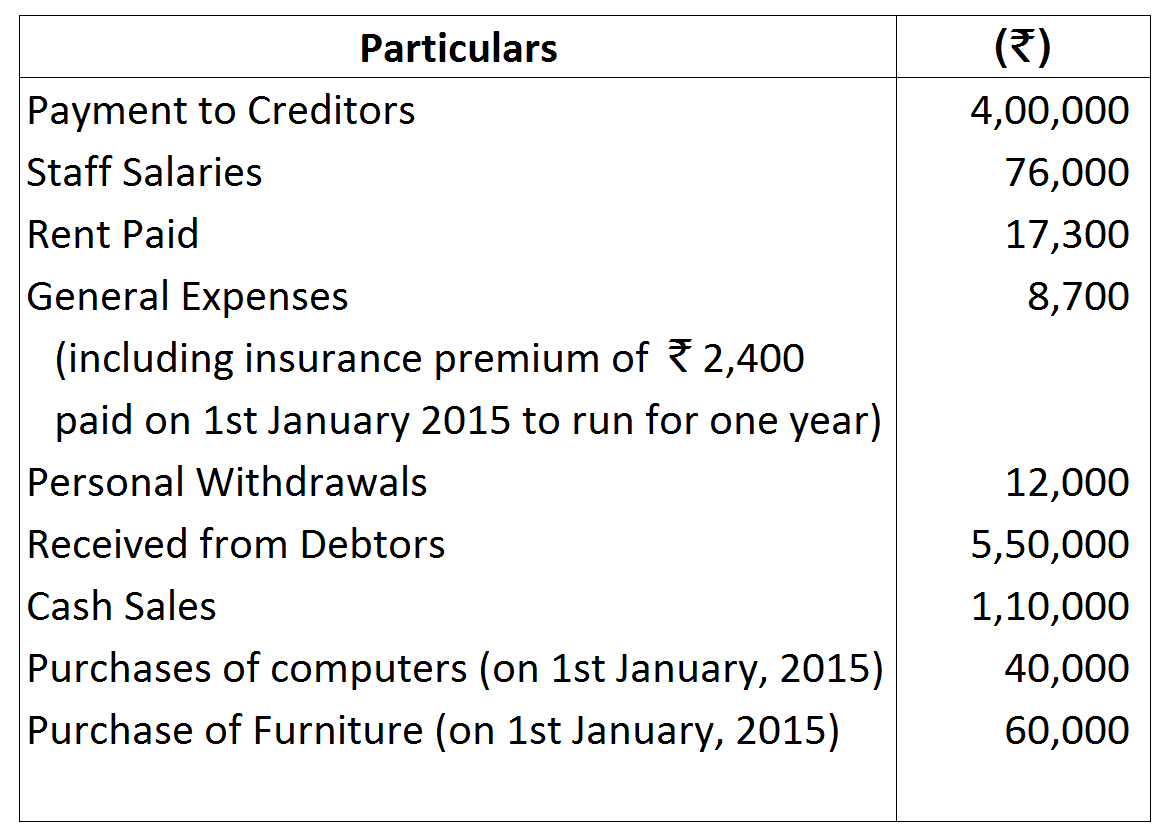
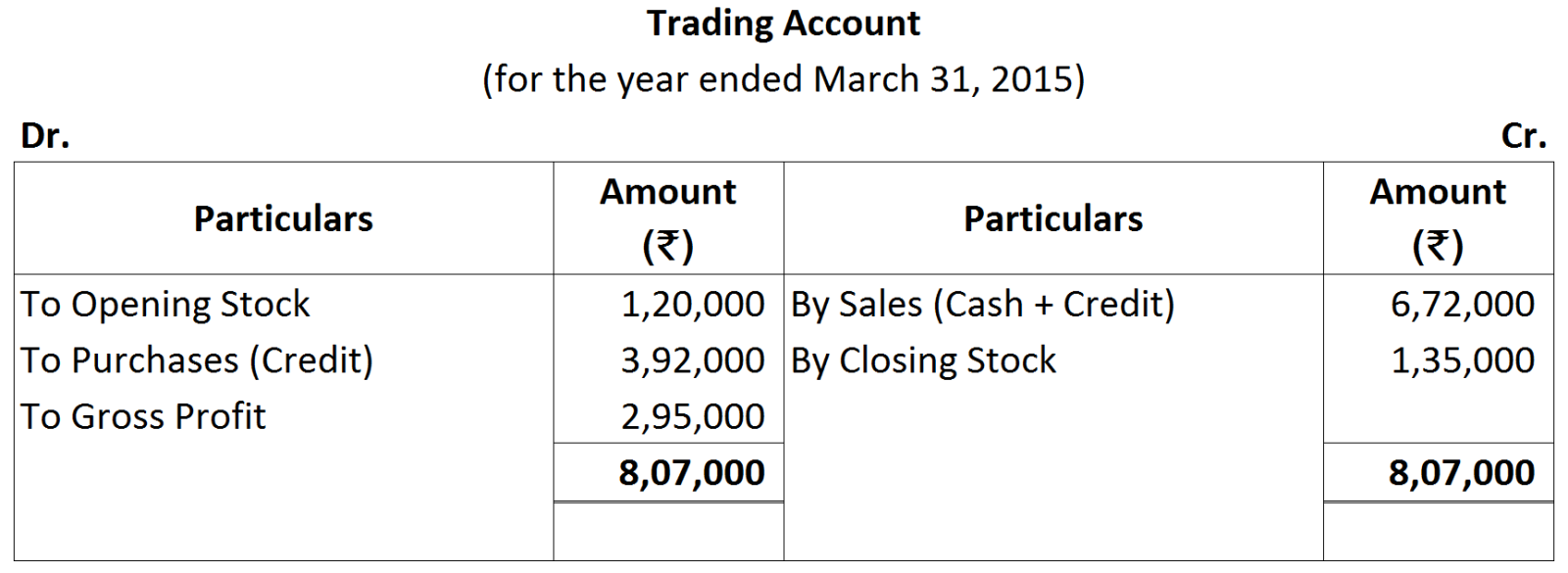
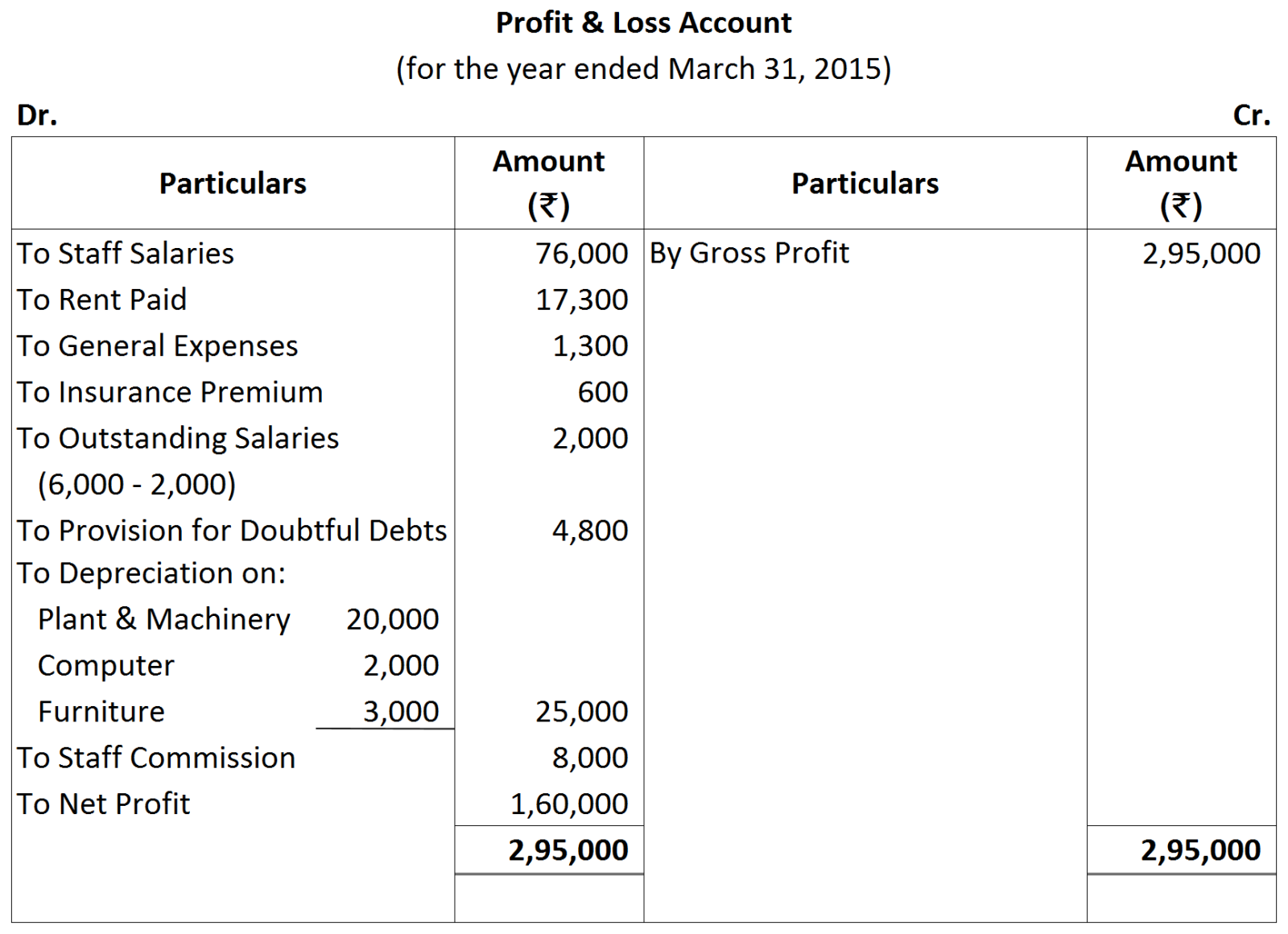
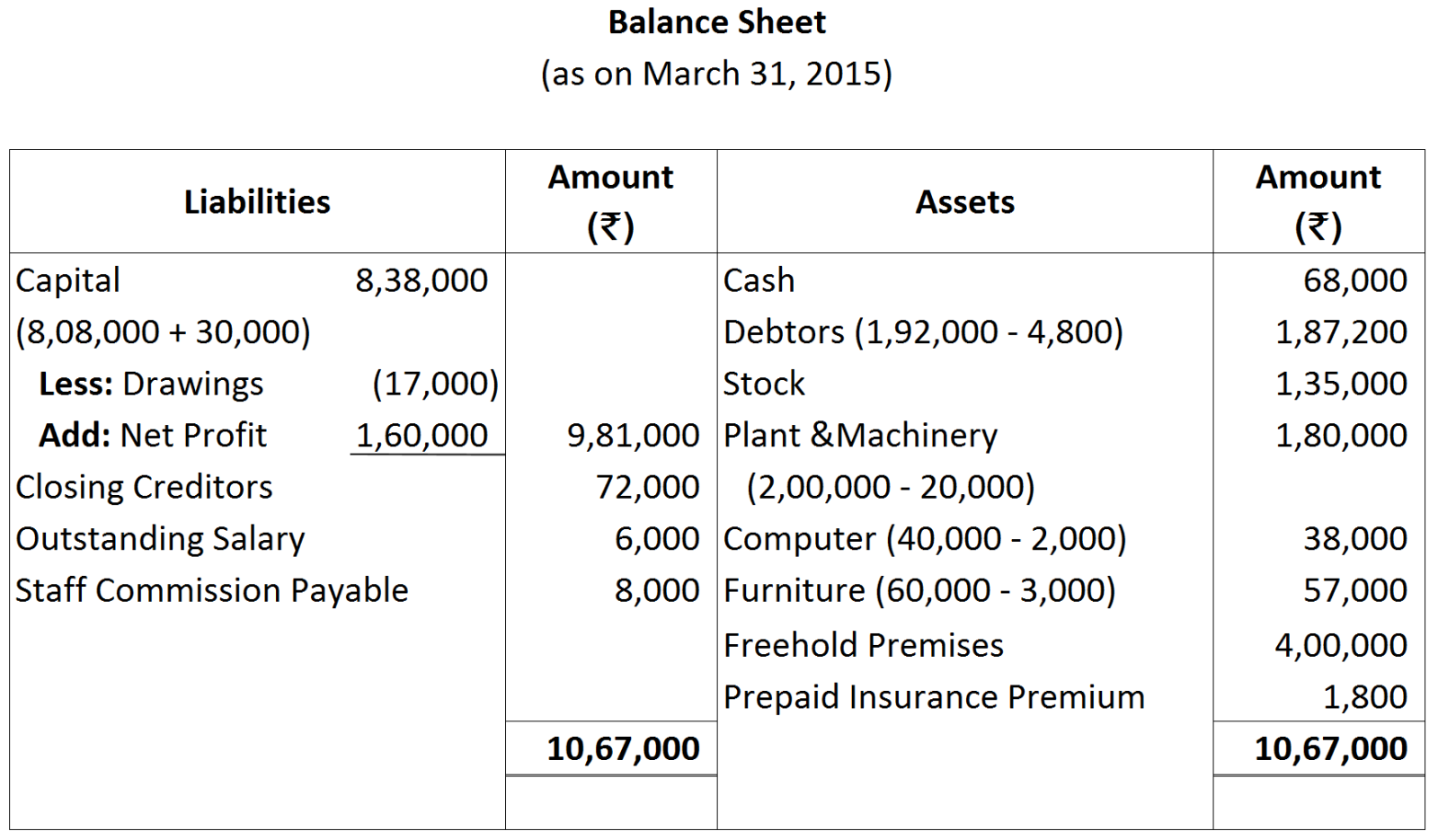
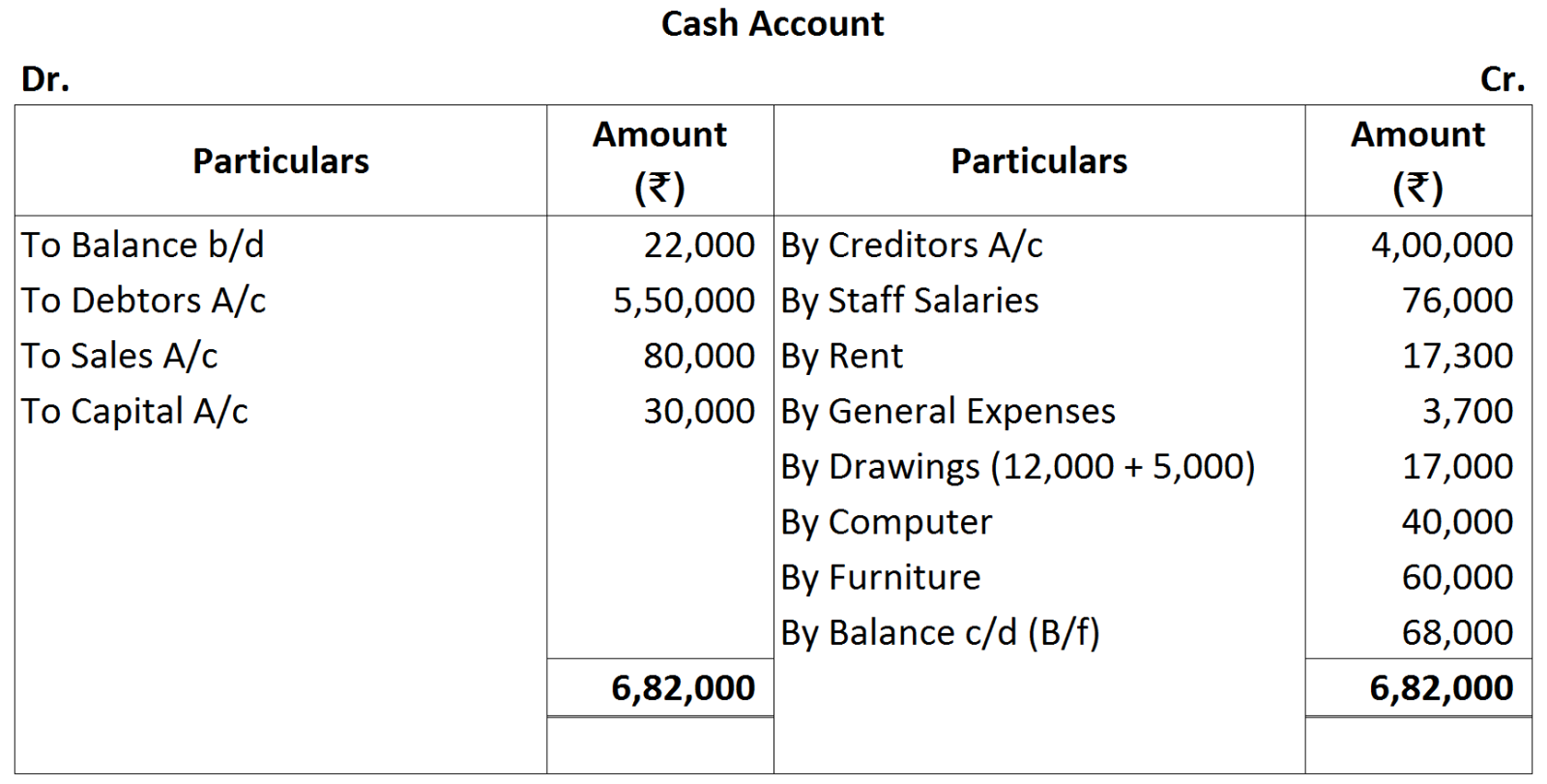
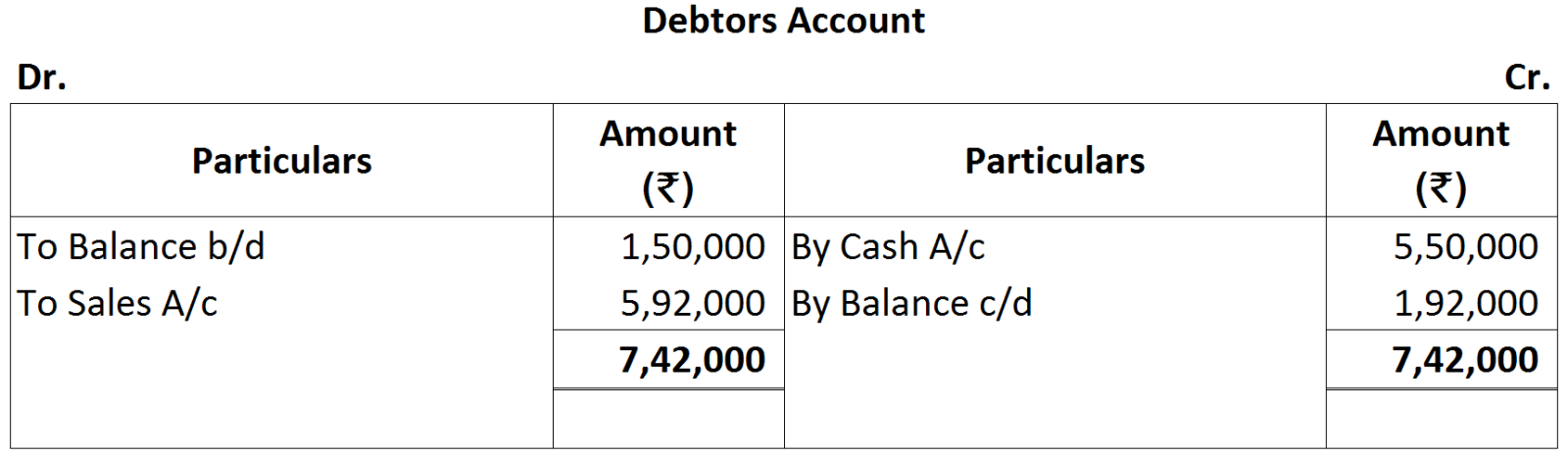
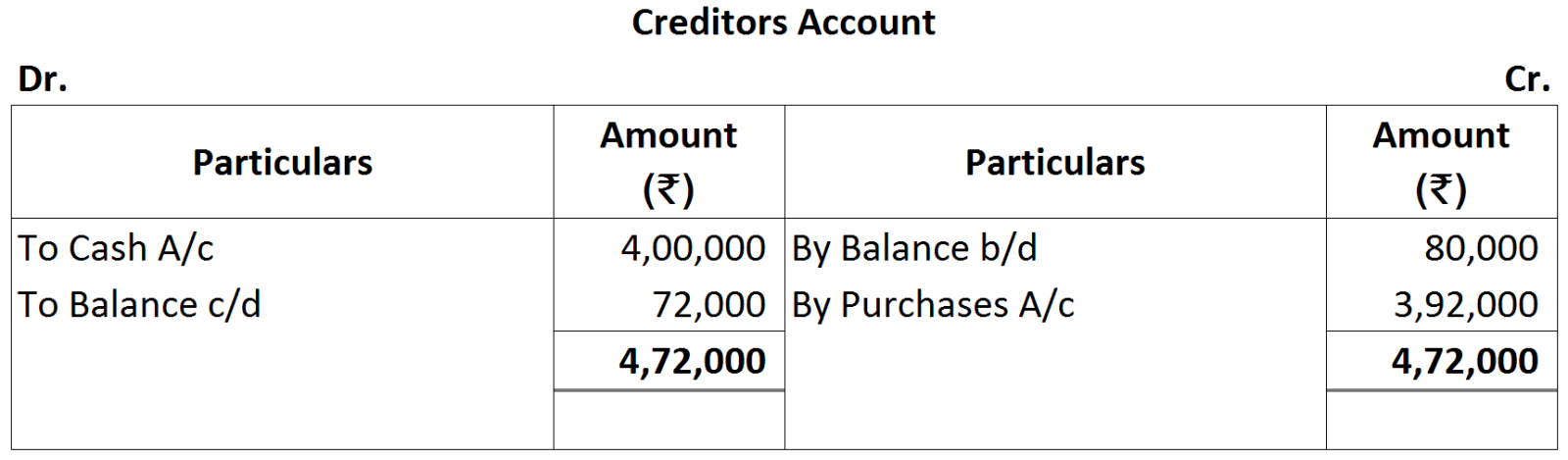
Sh. Param Bhushan does not maintain proper books of accounts. From the following, prepare his trading and profit & loss account for the year ended $31^{st}$ March, $2015$, together with balance sheet as at that date:
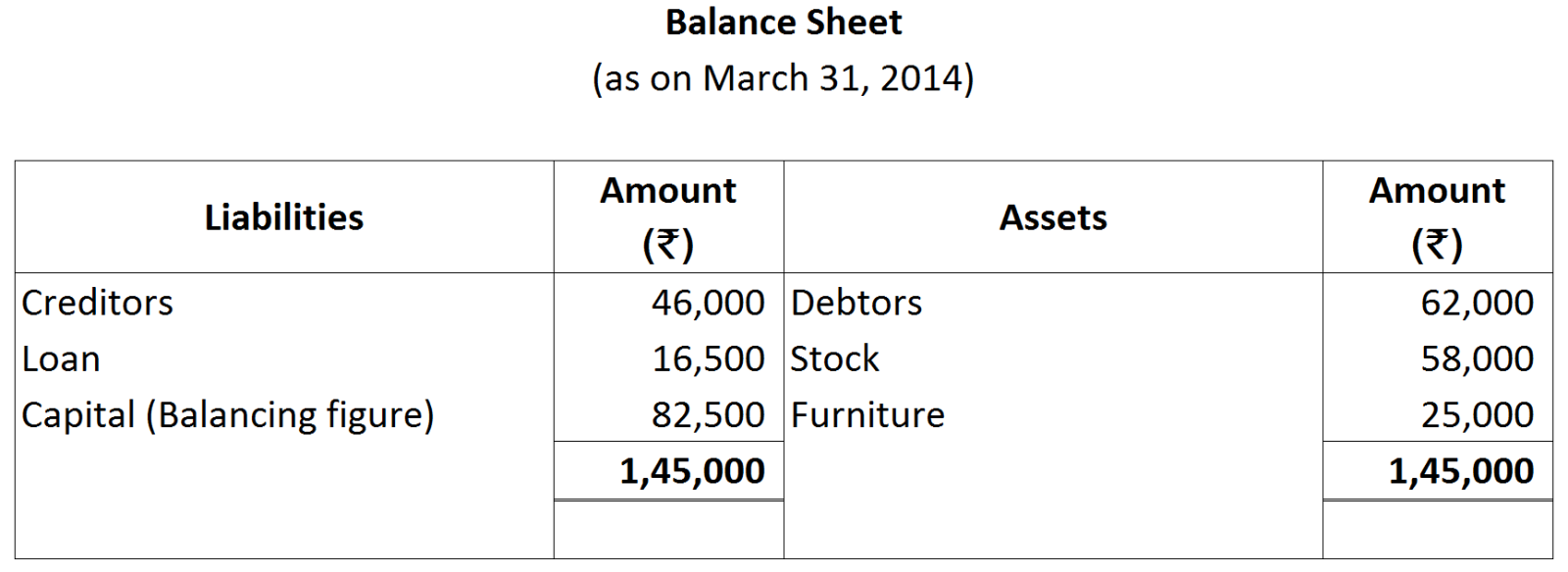
BALANCE SHEET
as at $31^{st}$ March, $2014$

Cash book analysis shows the following:
The following further information is available: Closing Stock ₹ $1,35,000$; Closing Debtors ₹ $1,92,000$; Closing Creditors ₹ $72,000$; Outstanding Salaries at the end ₹ $6,000$; General Expenses include ₹ $5,000$ for house rent of Sh. Param Bhushan and Cash Sale include ₹ $30,000$ for sale of his personal jewellery. Create a provision of $2\frac{1}{2}\%$ for doubtful debts and depreciate plant and machinery by $10\%$ p.a. and computers and furniture by $20\%$ p.a. Also provide $5\%$ for group incentive commission to staff on net profit after charging such commission.
Answer


Working Notes:


View full question & answer
Question 316 Marks
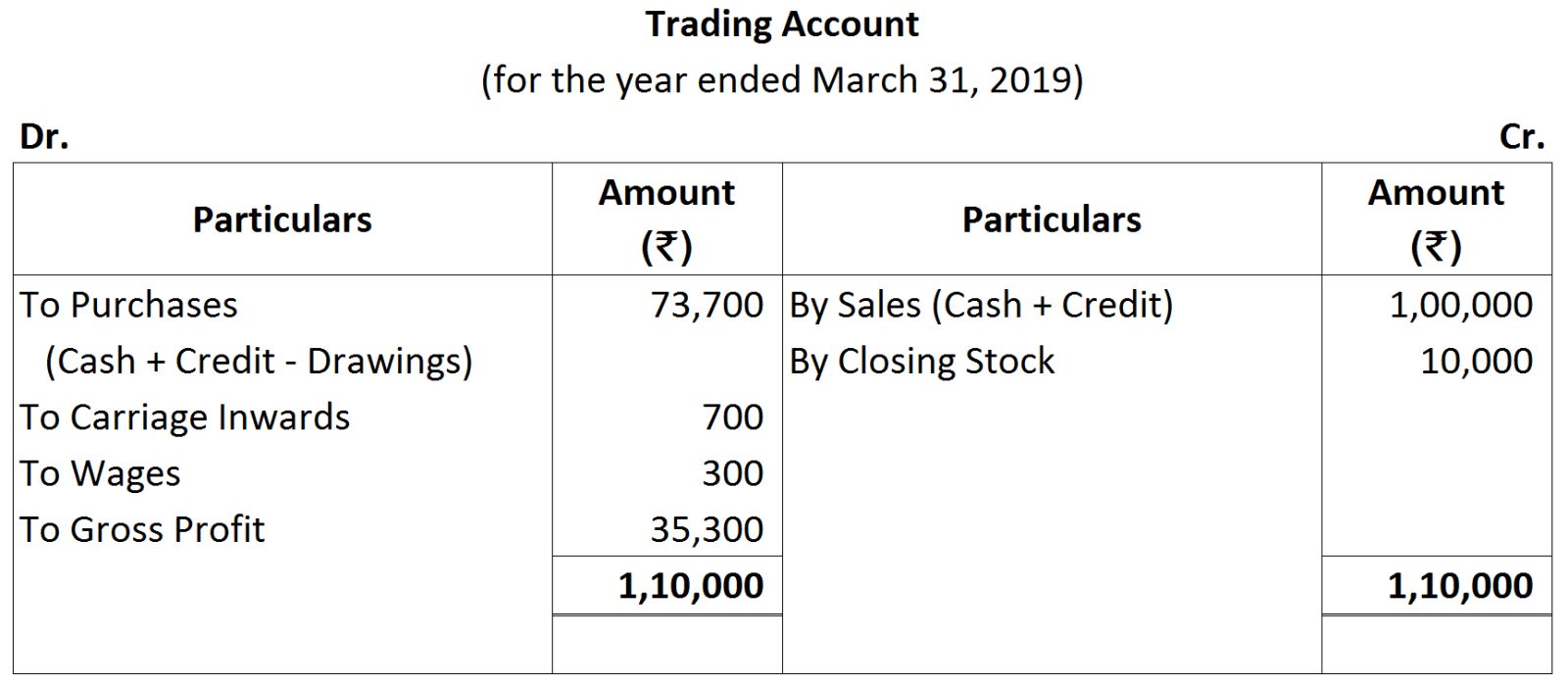
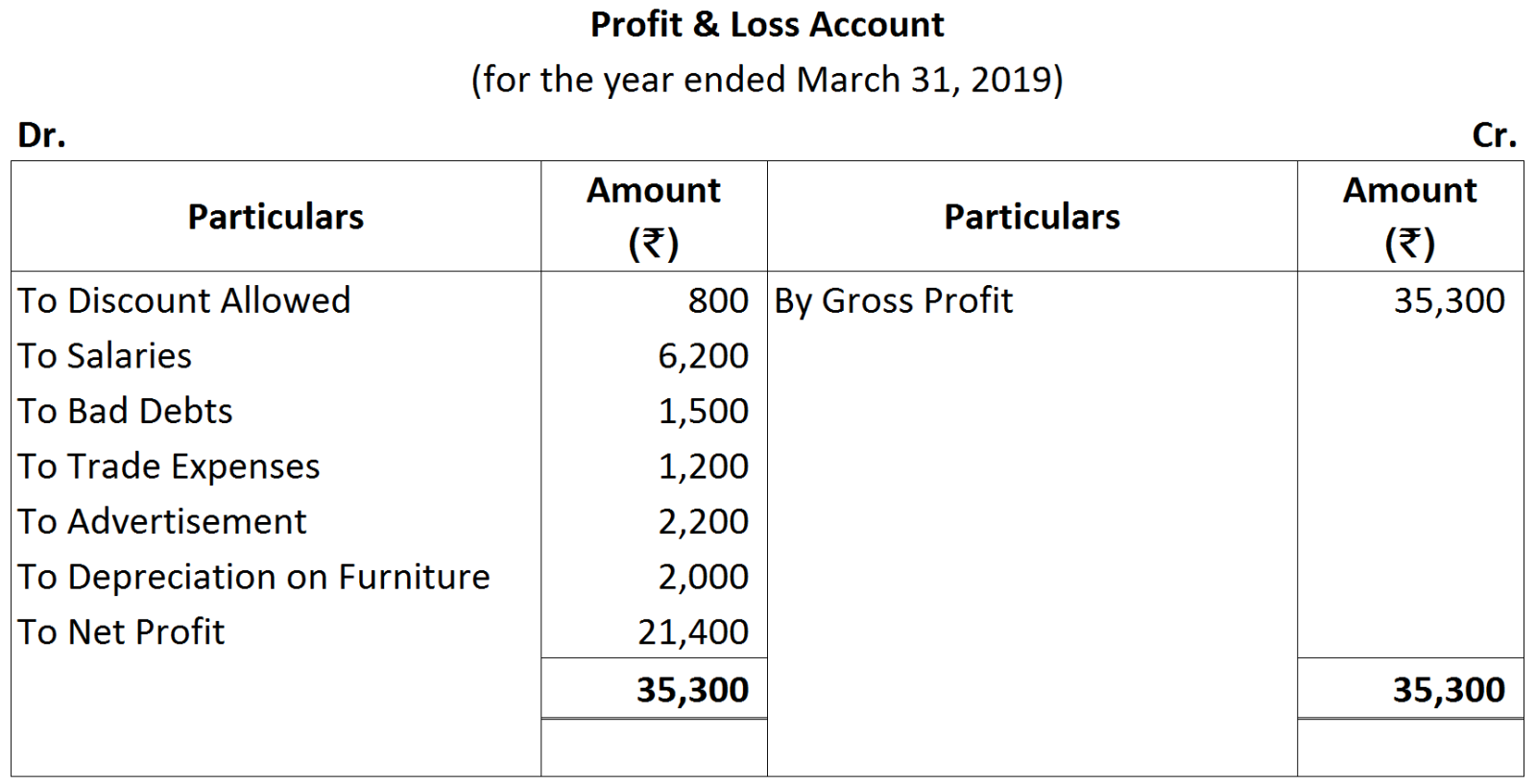
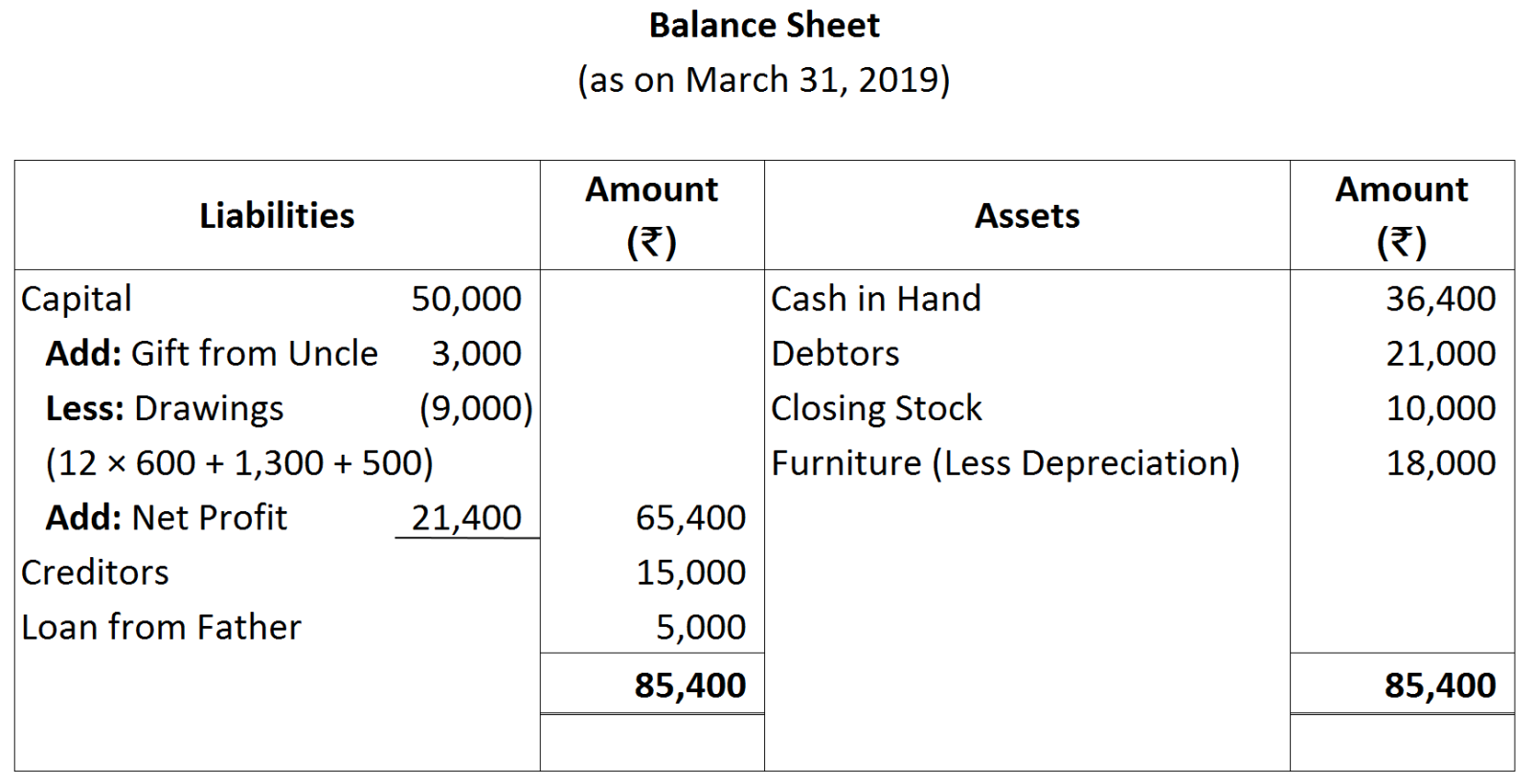
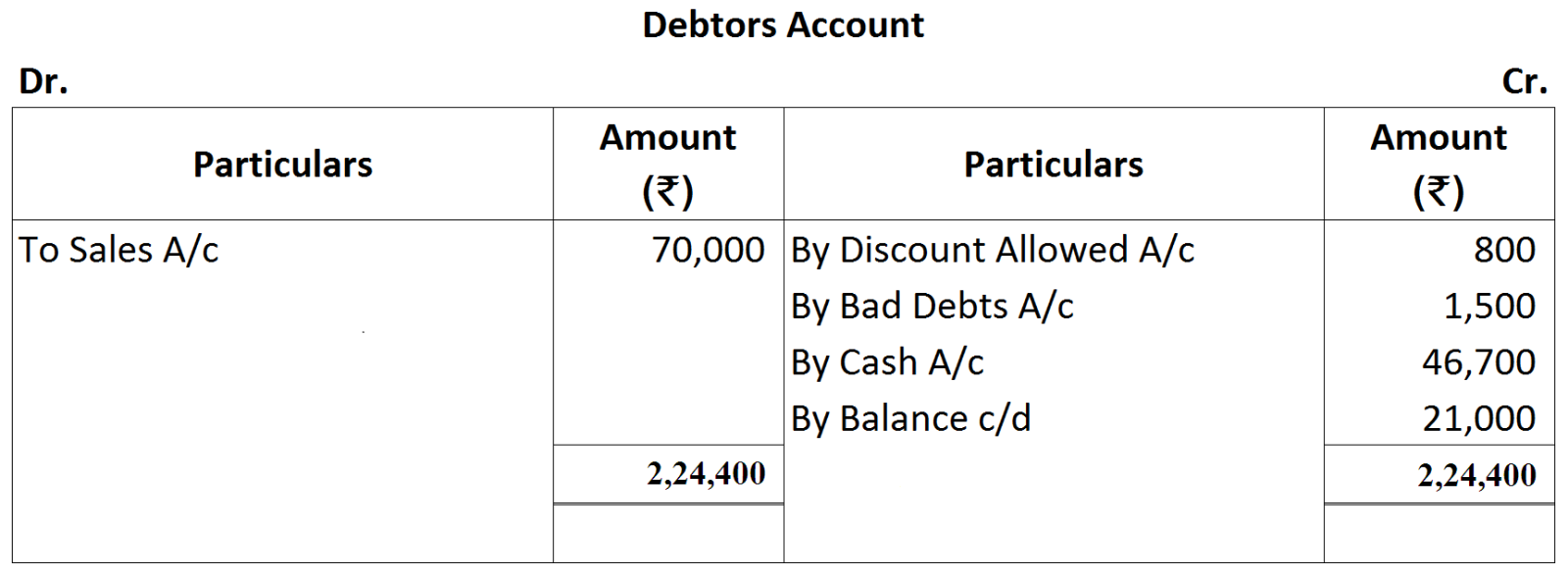
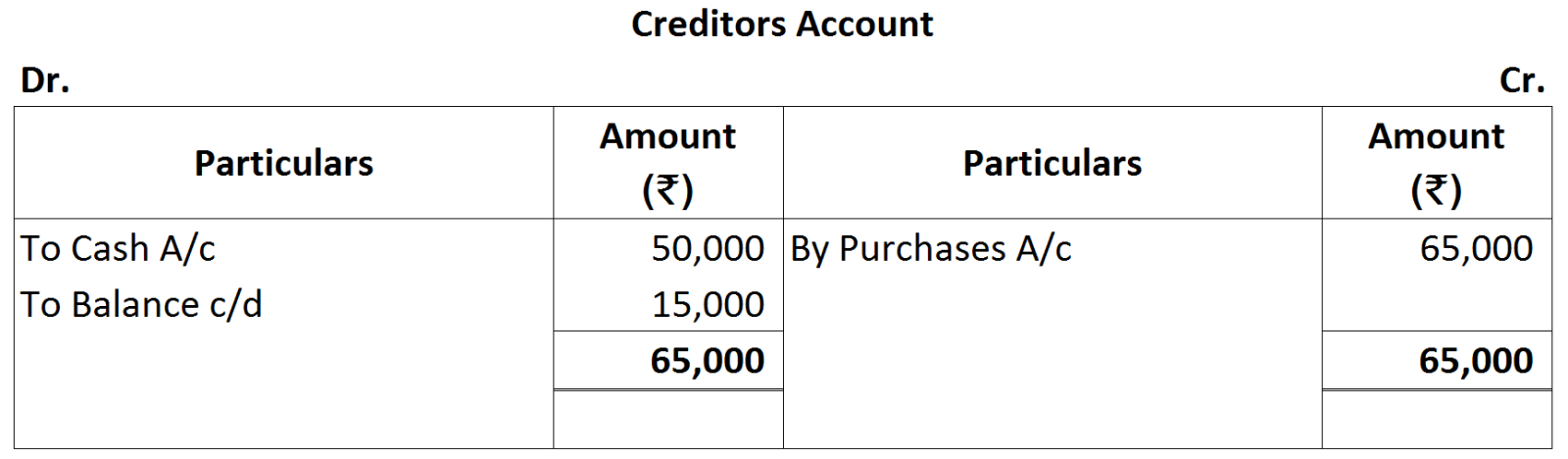
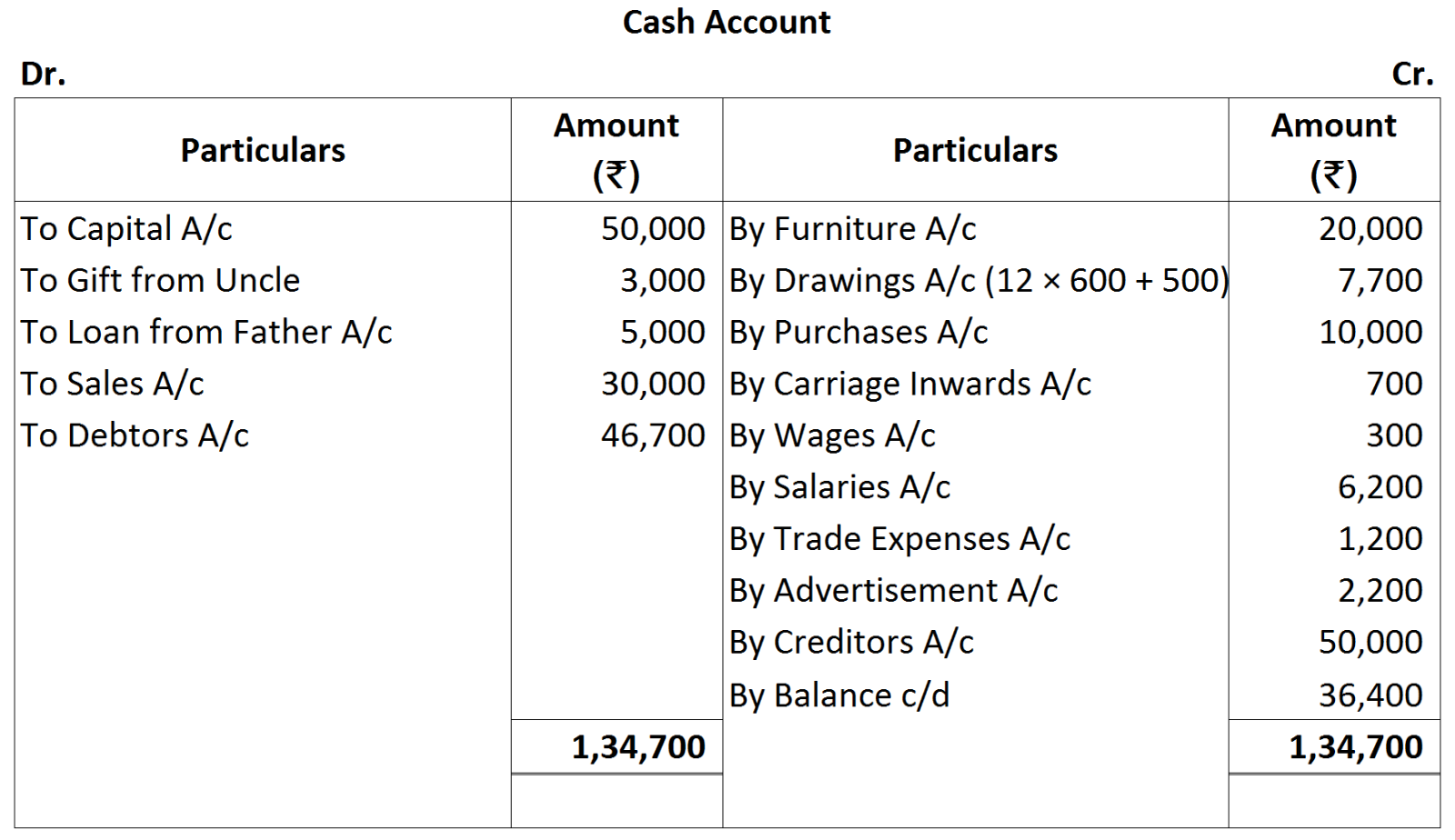
Vardhman commenced business on $1^{st} $ April, $2018$, with a capital of $₹\ 50,000.$ He immediately purchased furniture of $₹\ 20,000.$ During the year he received from his uncle a gift of $₹\ 3,000$ and he borrowed from his father a sum of $₹\ 5,000.$ He had withdrawn $₹\ 600$ per month for his household expenses. He had no Bank account and all dealings were in cash. He did not maintain any books but following information is given :
He used goods worth $₹\ 1,300$ for personal purposes and paid $₹\ 500 $ to his son for examination and college fees. On $31^{st}$ March, $2019$, his Debtors were worth $₹\ 21,000$ and Creditors $₹\ 15,000. $ Stock in trade was valued at $₹\ 10,000.$ Furniture to be depreciated by $10%$ p.a. Prepare Trading and Profit and Loss Account for the year ended on $31^{st}$ March, $2019$, and Balance Sheet as at $31^{st}$ March, $2019.$
Answer


Working Notes:


View full question & answer
Question 326 Marks
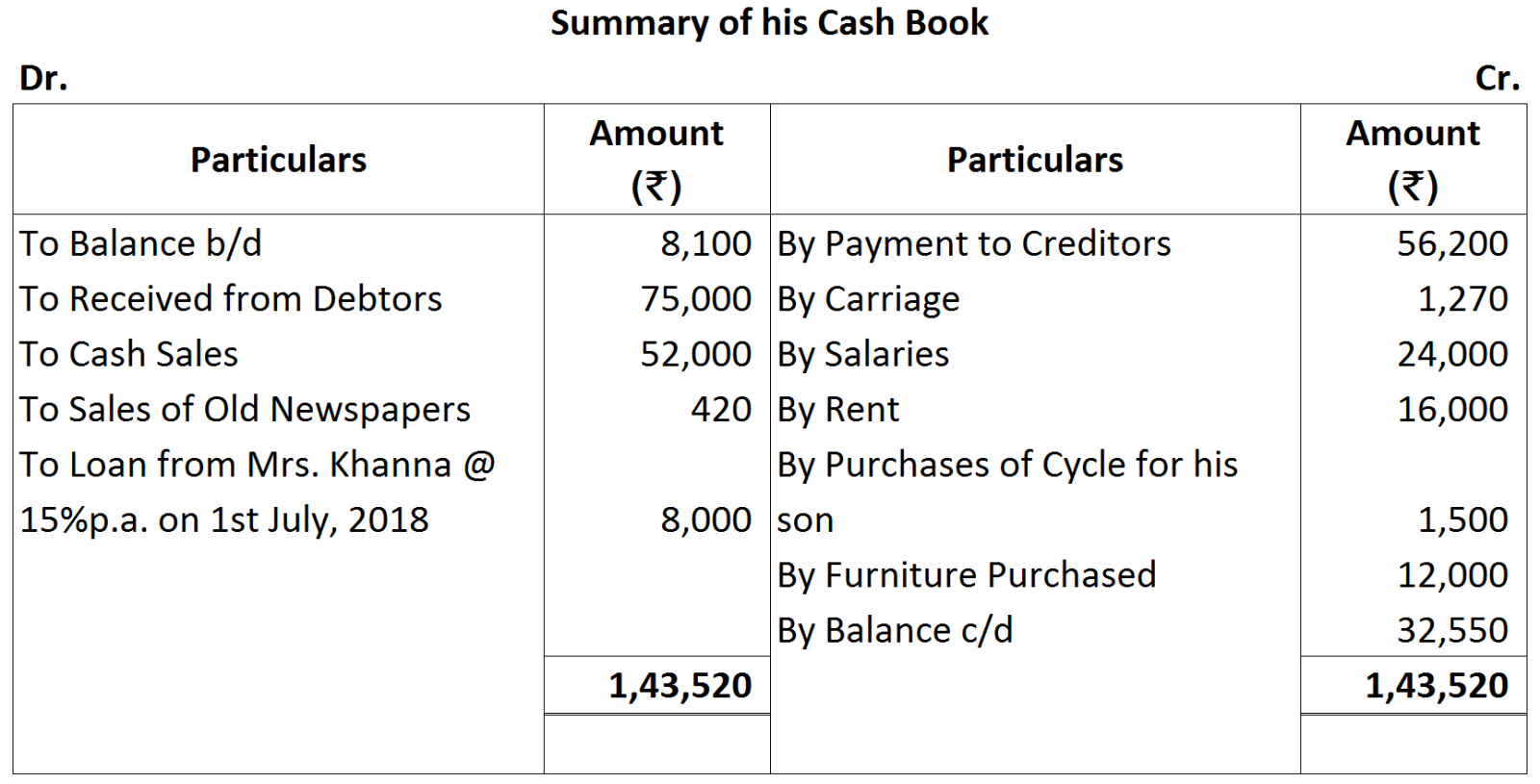
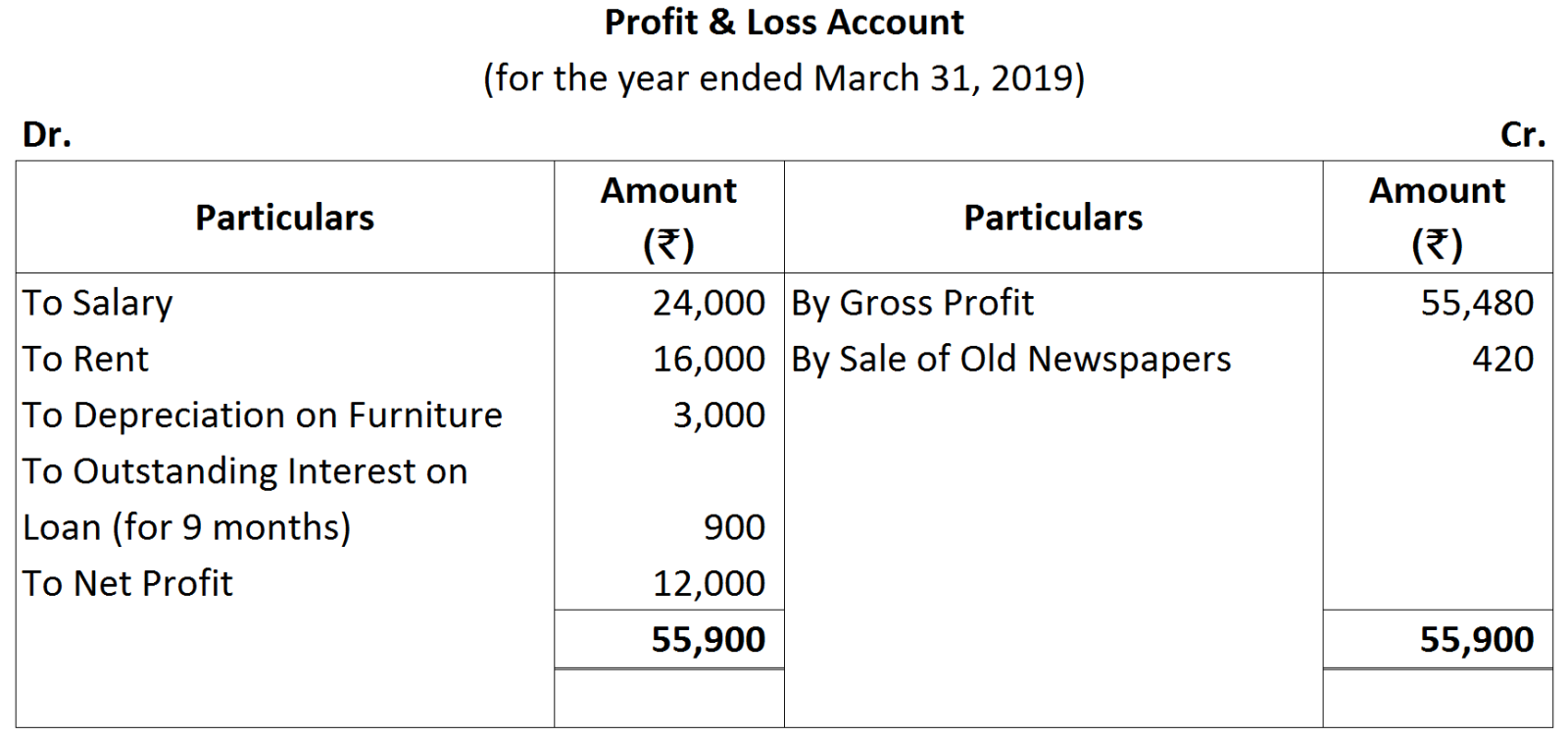
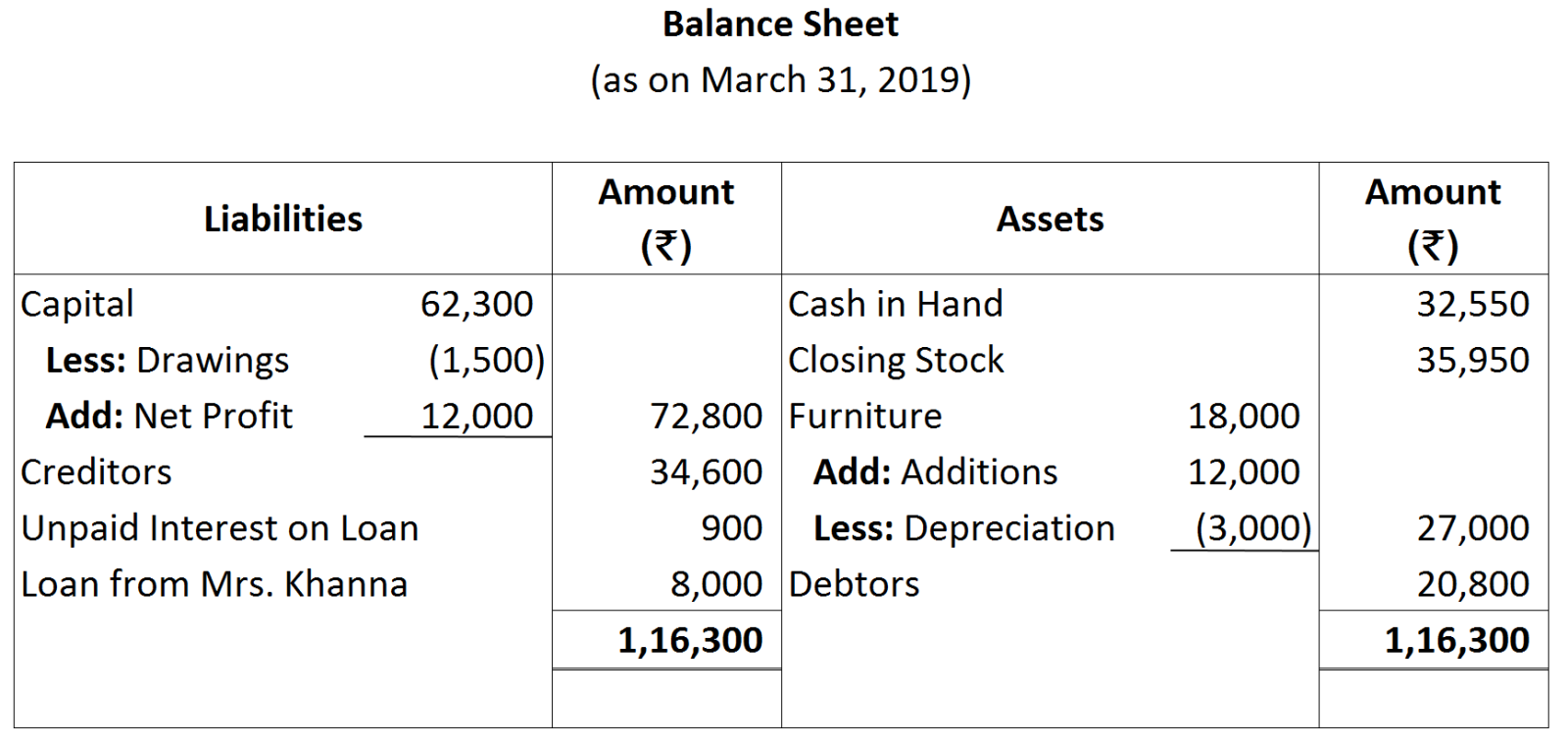
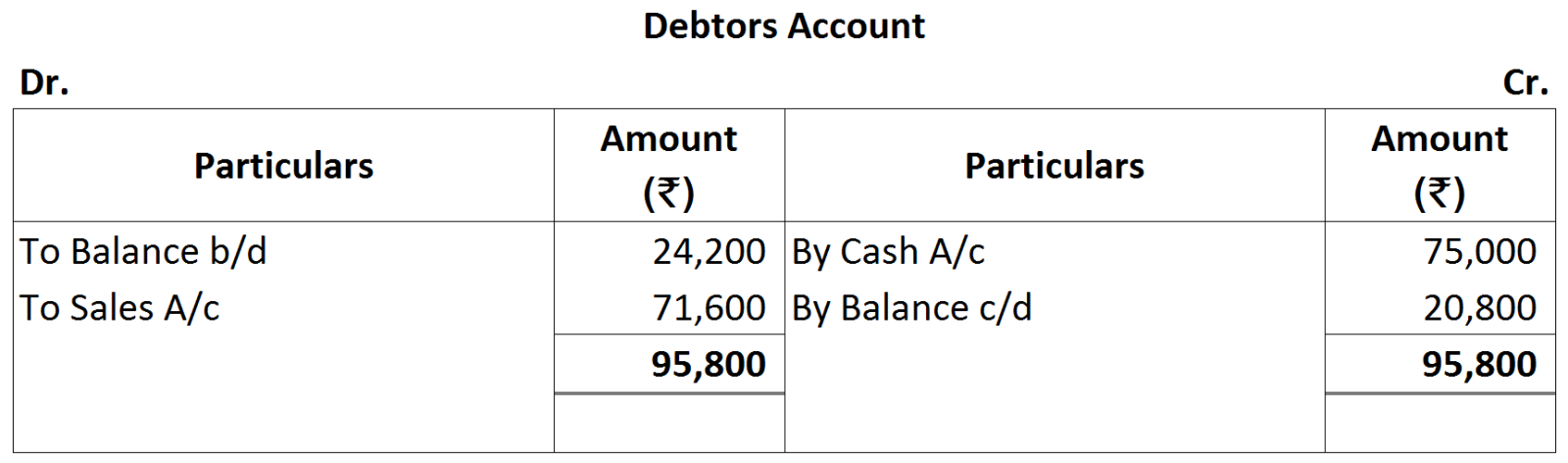
Mukesh Khanna has not kept proper books. However, he gives you the following information relating to the year $2018-19:$
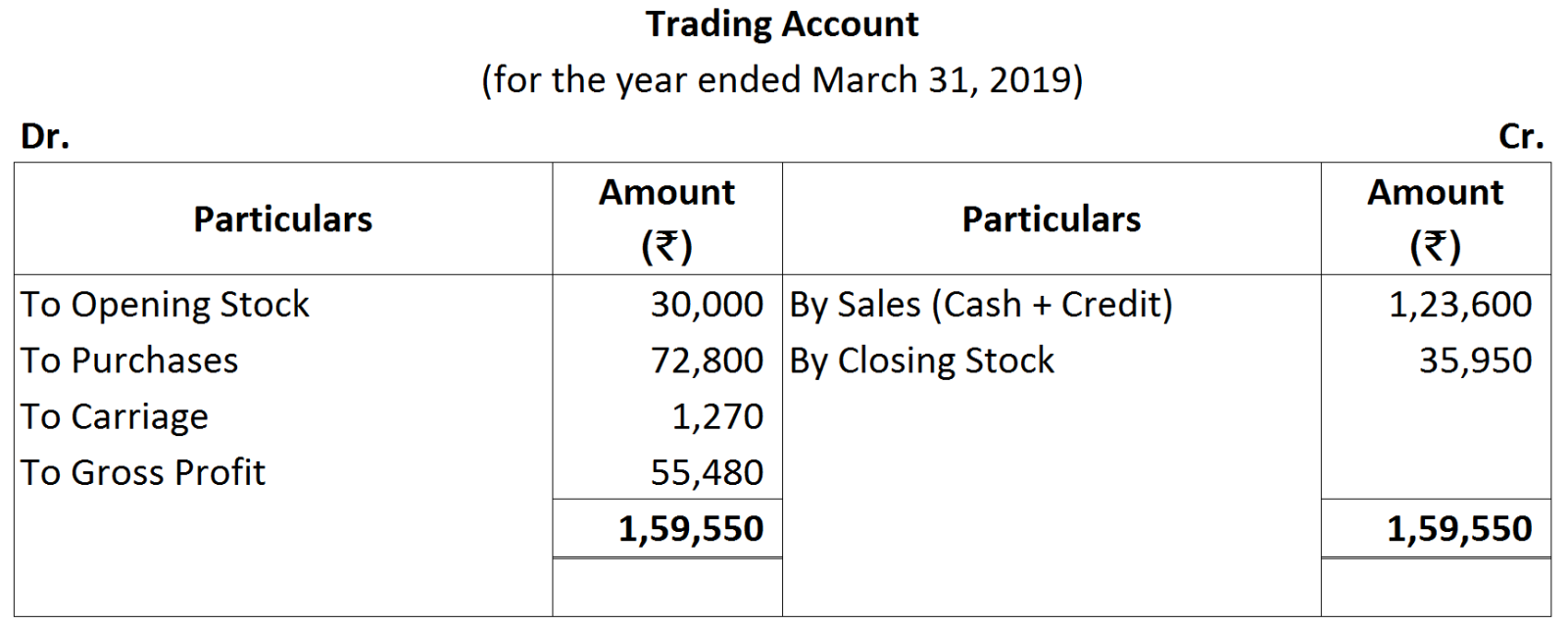
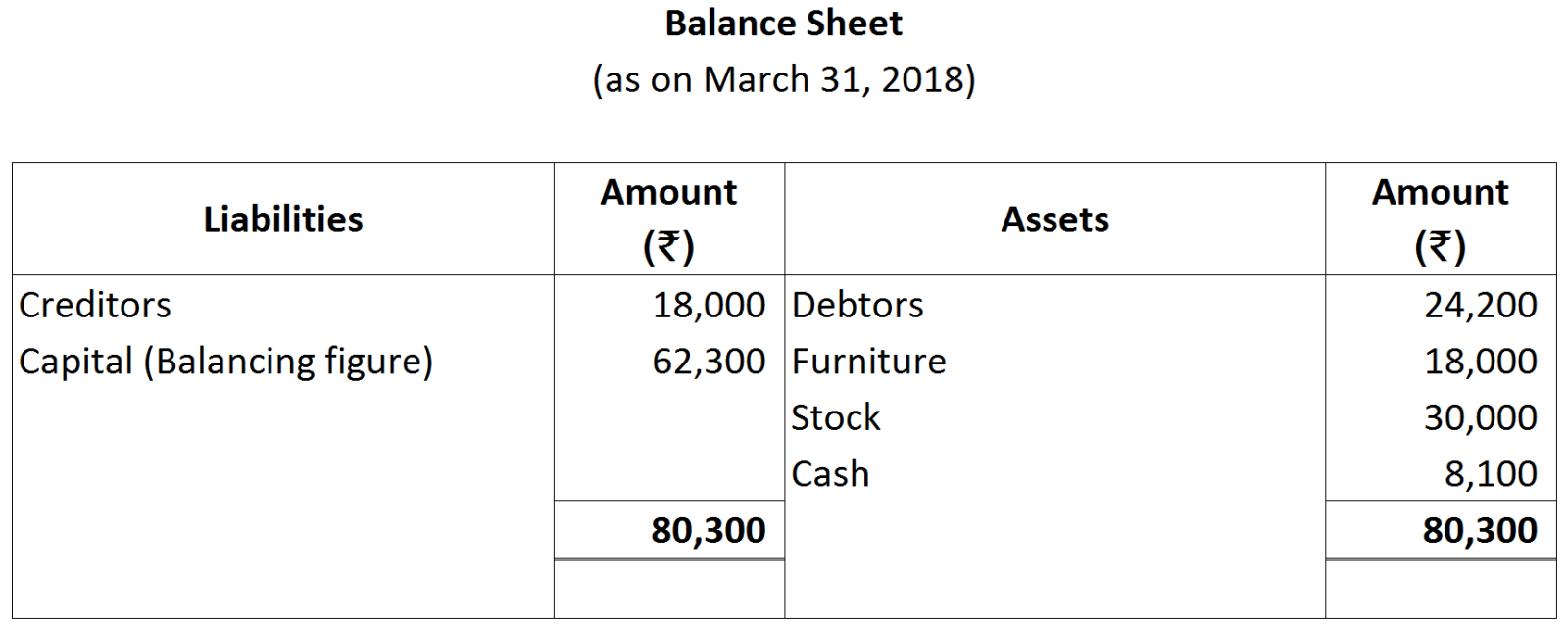
The following balances existed on $1^{st}$ April, $2018 -$ Debtors $₹\ 24,200;$ Furniture $₹\ 18,000$; Stock $₹\ 30,000;$ Creditors $₹\ 18,000.$ The following balances existed on $31st$ March, $2019 -$ Debtors $₹\ 20,800;$ Furniture $₹\ 30,000;$ Stock $₹\ 35,950;$ Creditors $₹\ 34,600$. Adjustments:
  1. Depreciate Furniture by $10\%.$
  2. Provide upto-date interest on Mrs. Khanna's Loan.
Prepare Trading and Profit and Loss A/c for the year ending $31^{st}$ March, $2019$ and a Balance Sheet as at that date.
Answer


Working Notes:


View full question & answer
Question 336 Marks
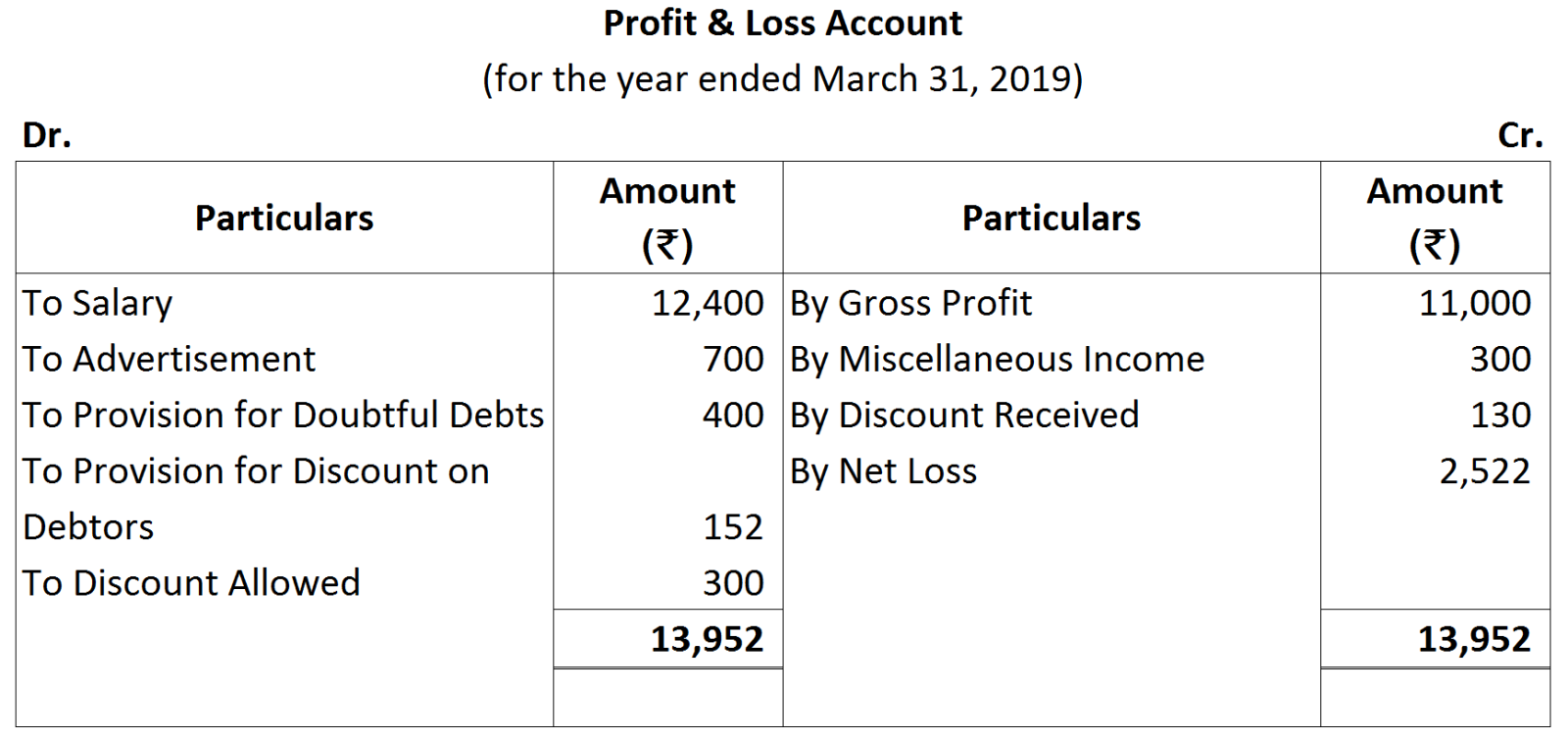
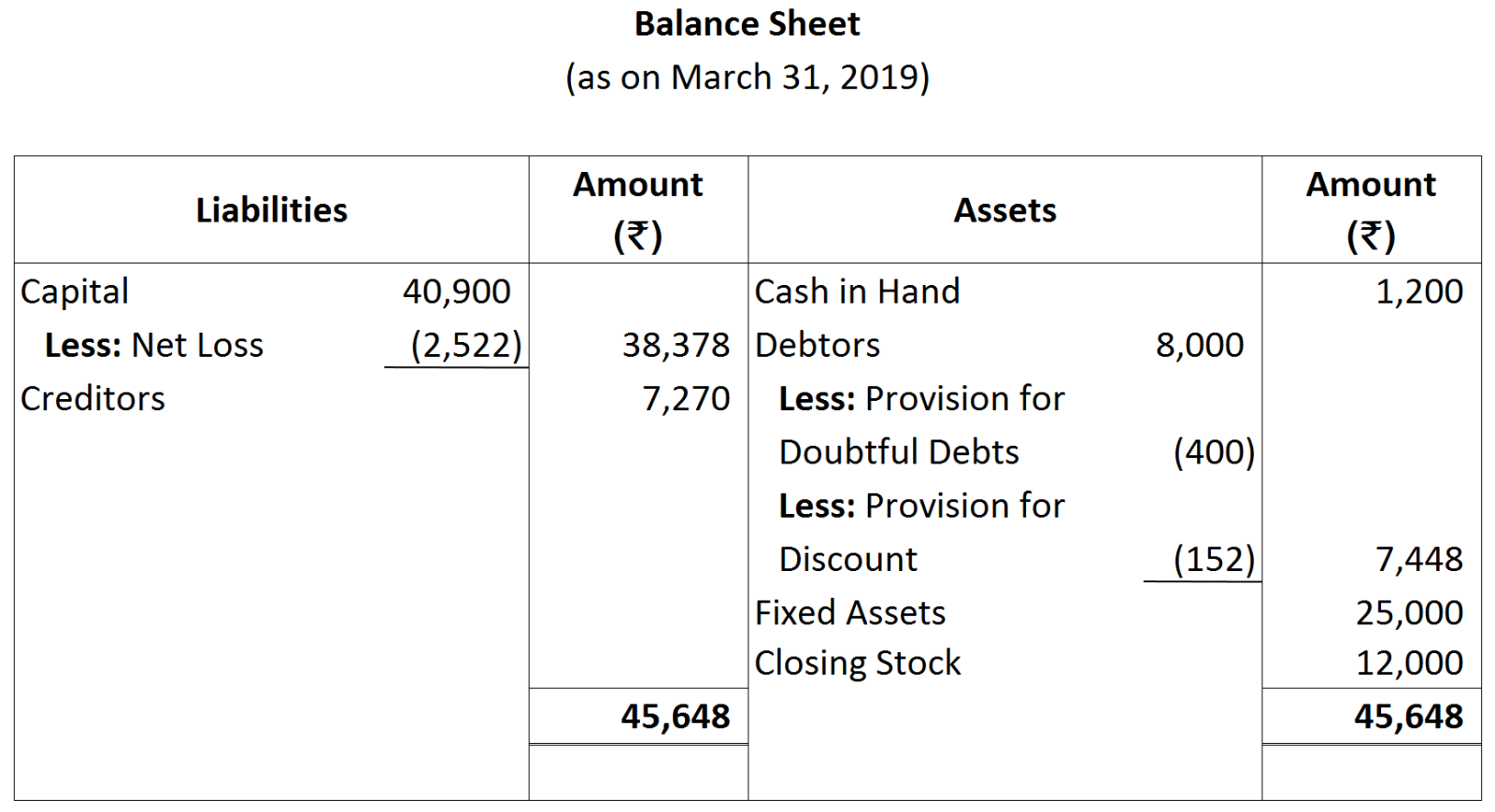
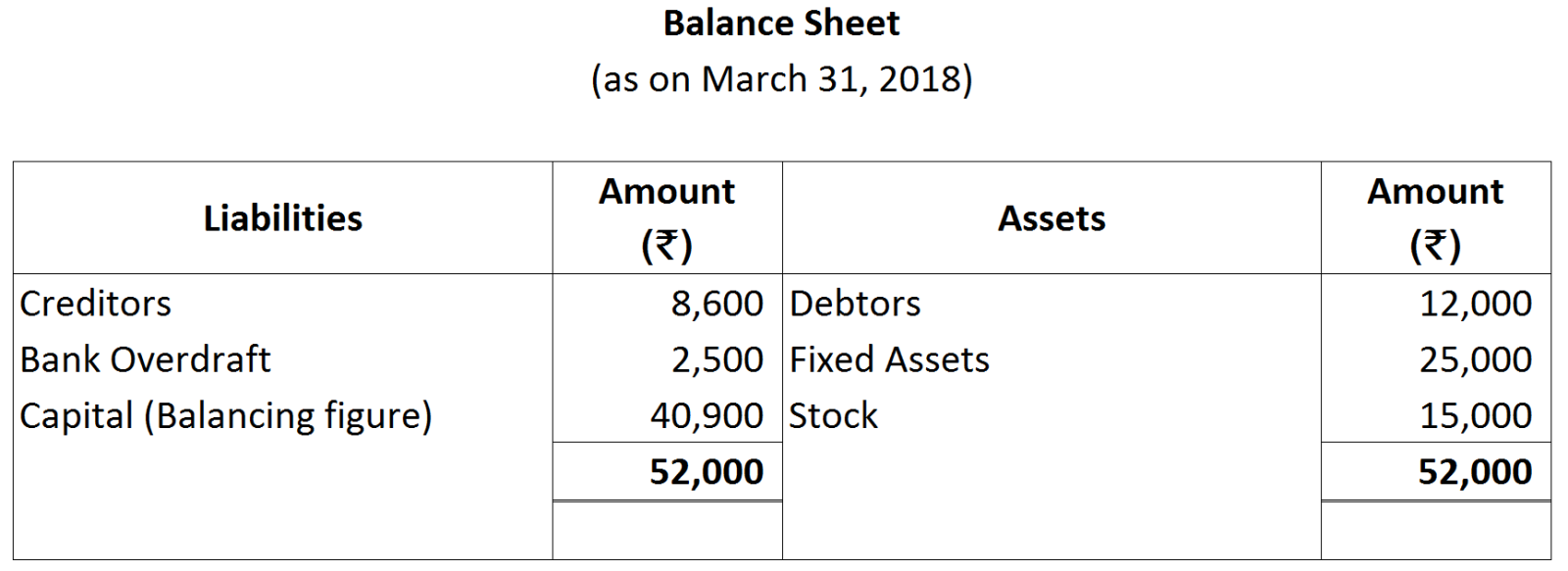
Mr. Asif Ali, a retail trader, who keeps Incomplete Records gives you the following information for the year $2018-19:$
The Assets and Liabilities were as follows:
Other Informations:
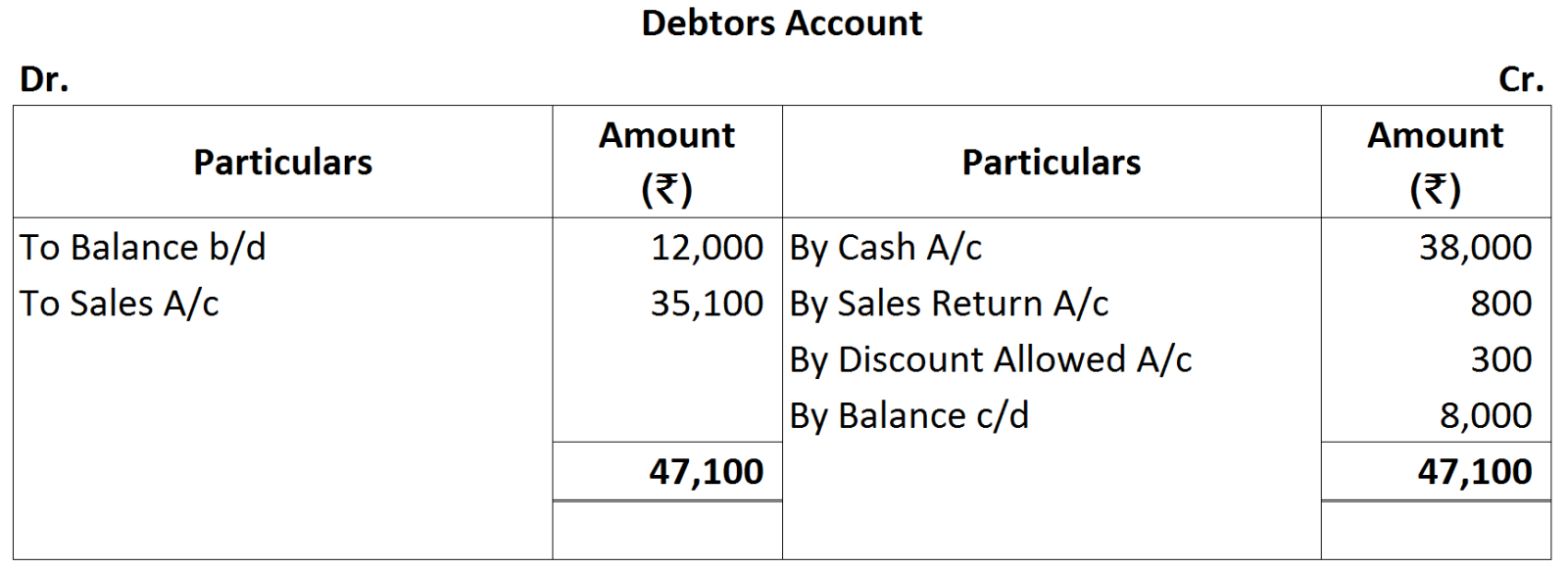
  1. Credit Sales during the year were $₹\ 35,100.$
  2. Sales returns $₹\ 800.$
  3. Credit Purchases during the year were $₹\ 30,000.$
  4. Discount allowed to Debtors $₹\ 300.$
  5. Discount received from Creditors $₹\ 130.$
Adjustments:
  1. Make a provision for doubtful debts $@\ 5\%$ on Debtors.
  2. Also make a provision for discount $@\ 2\%$ on Debtors.
Prepare his Trading, P & L A/c and a Balance Sheet as at $31^{st}$ March, $2019.$
Answer


Working Notes:

View full question & answer
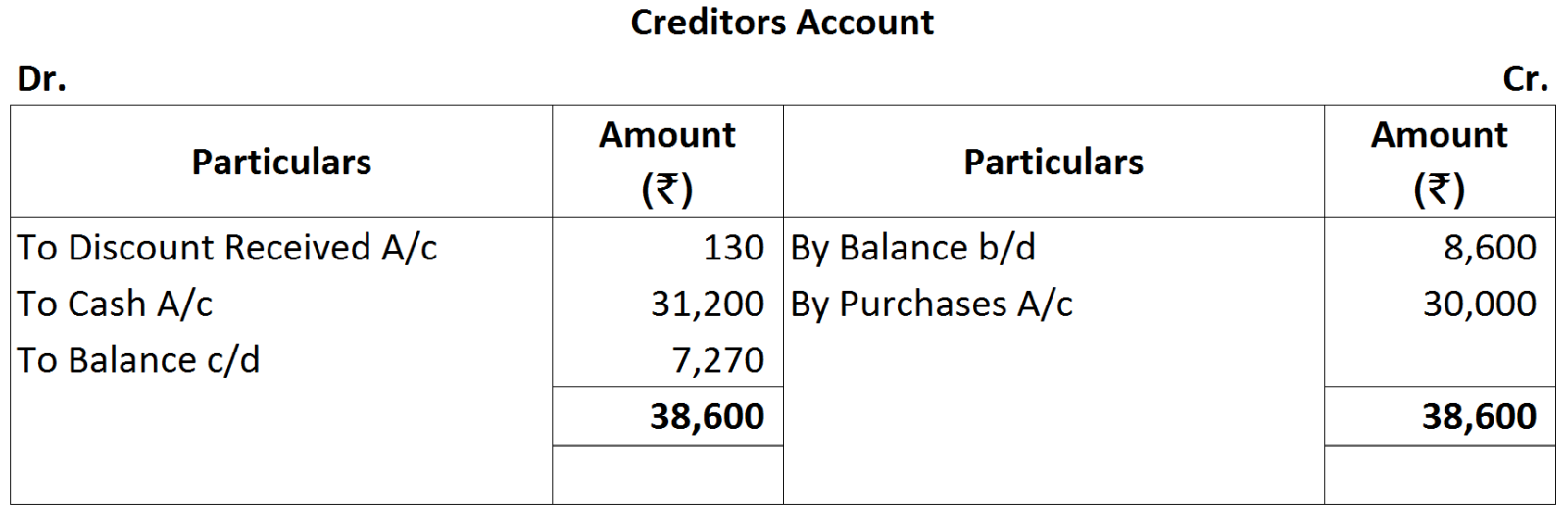
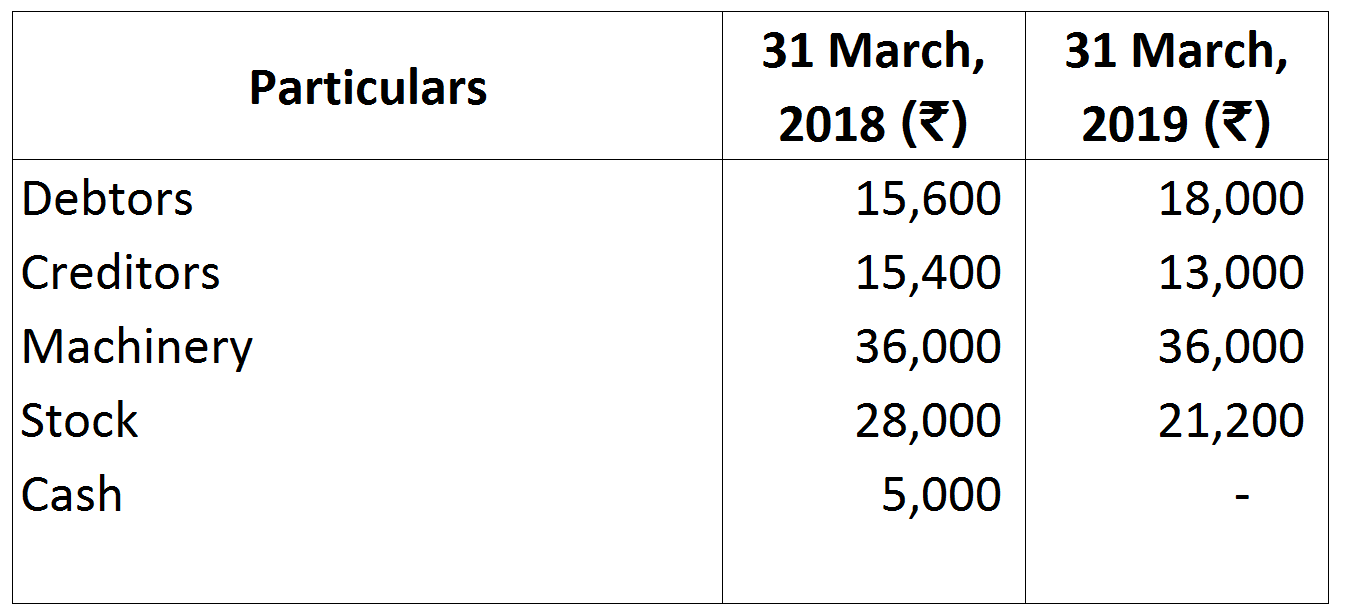
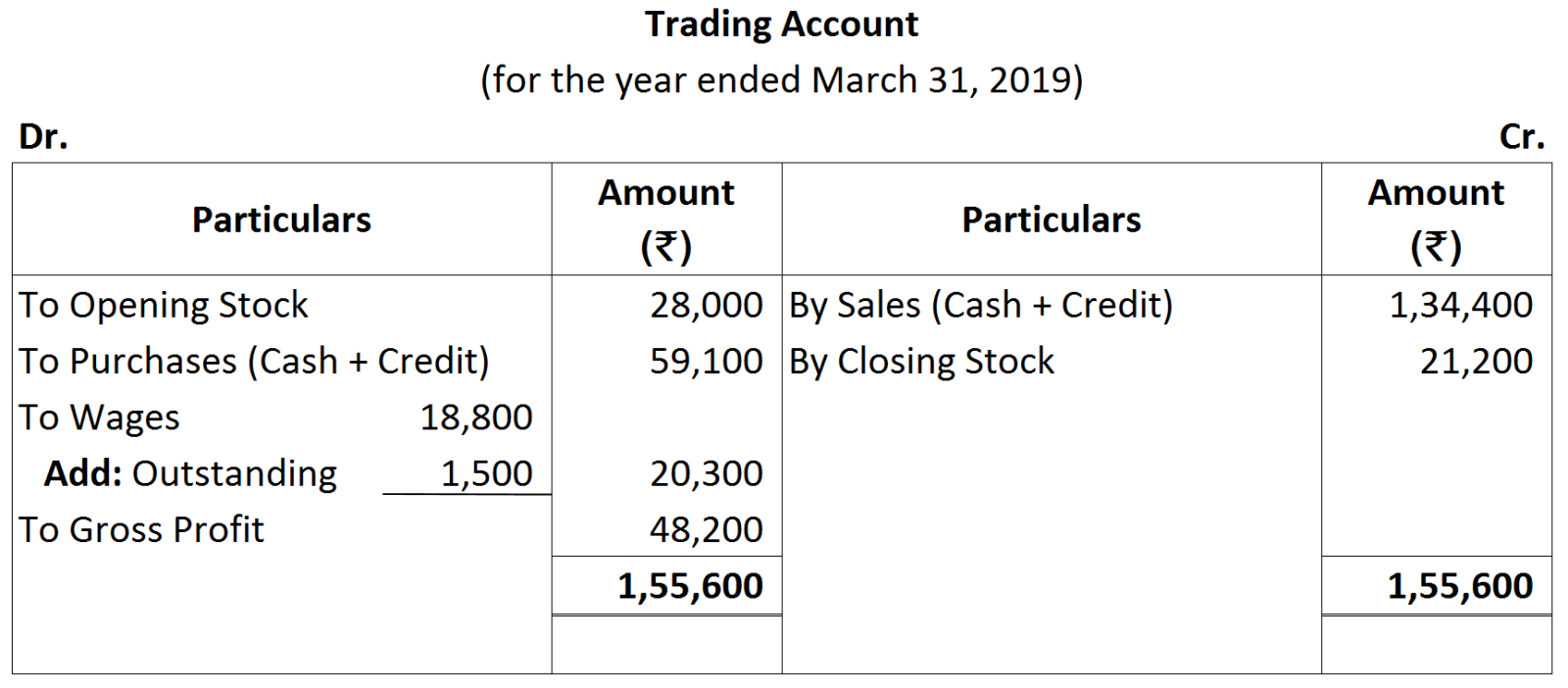
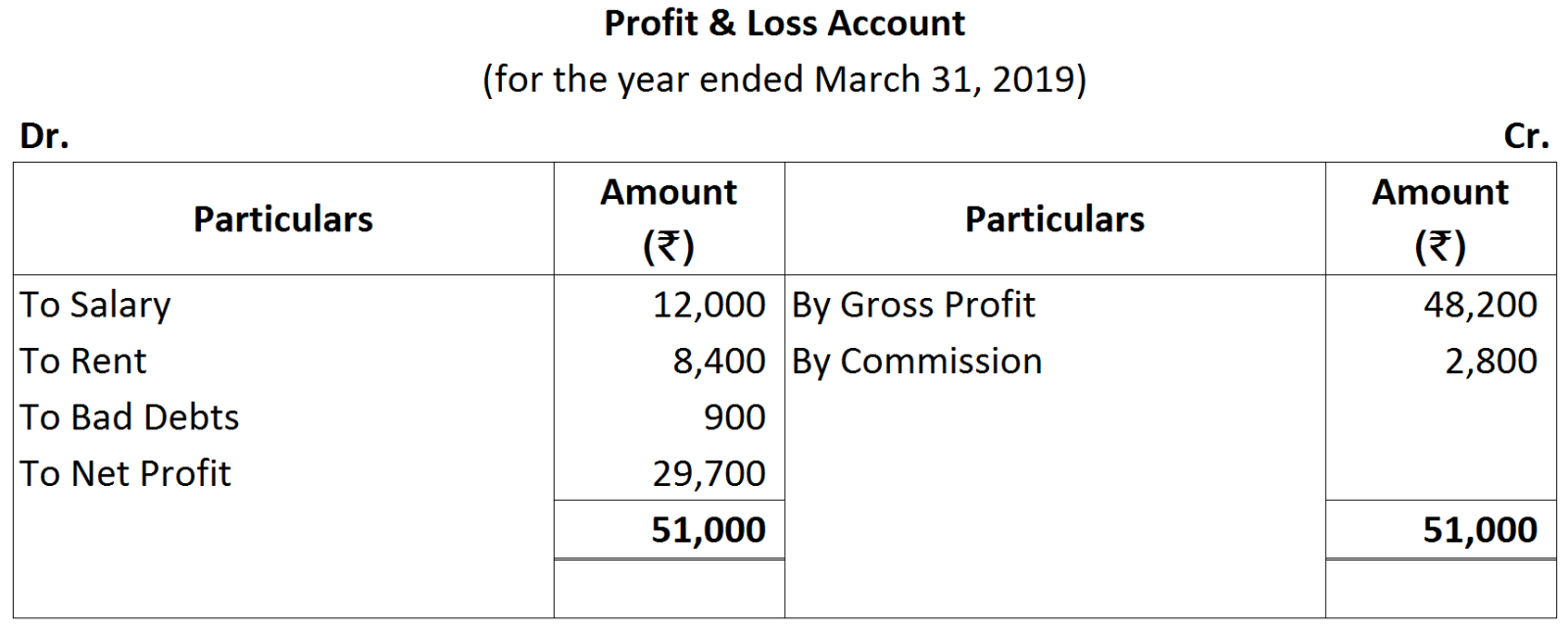
Question 346 Marks
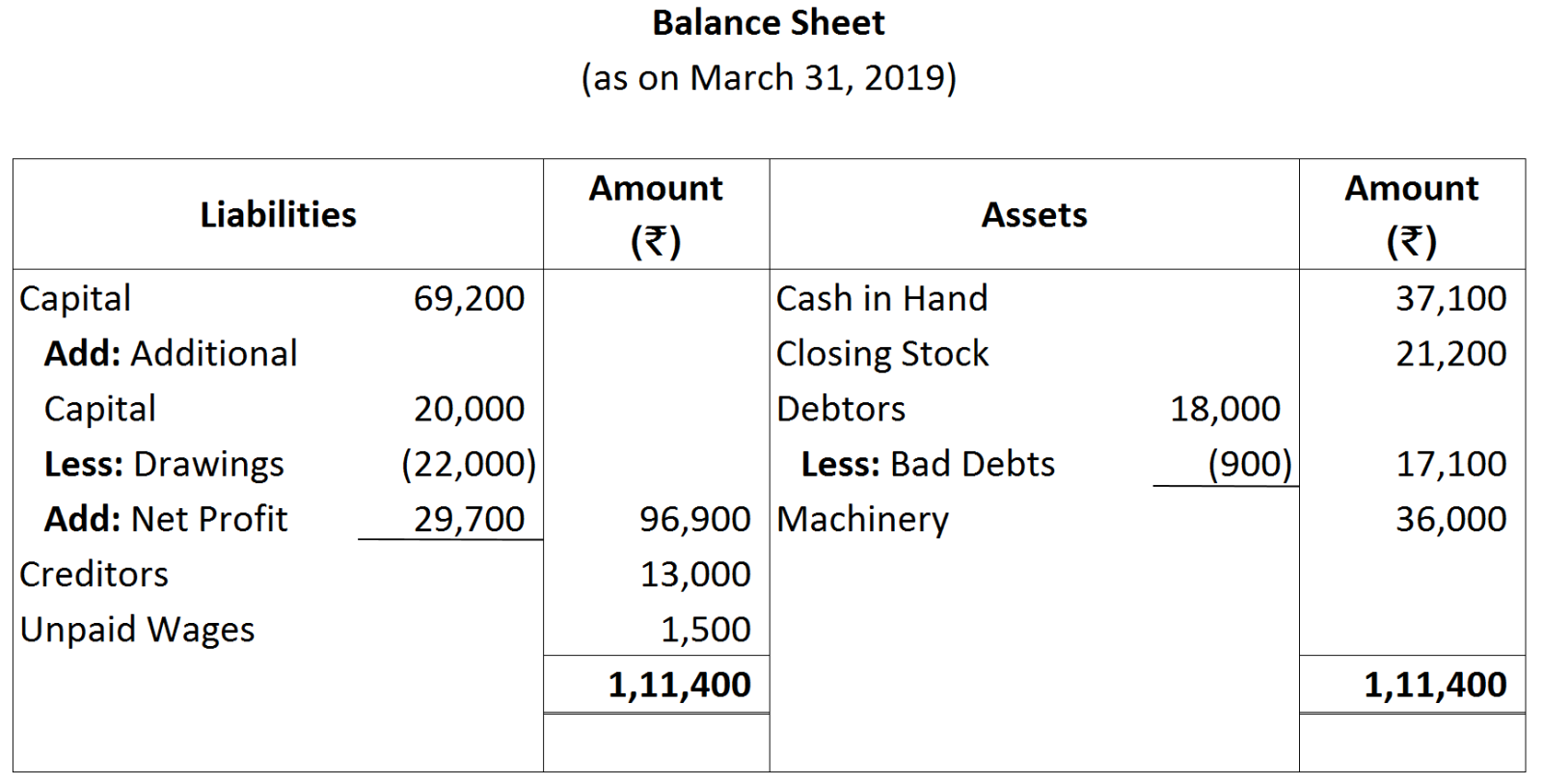
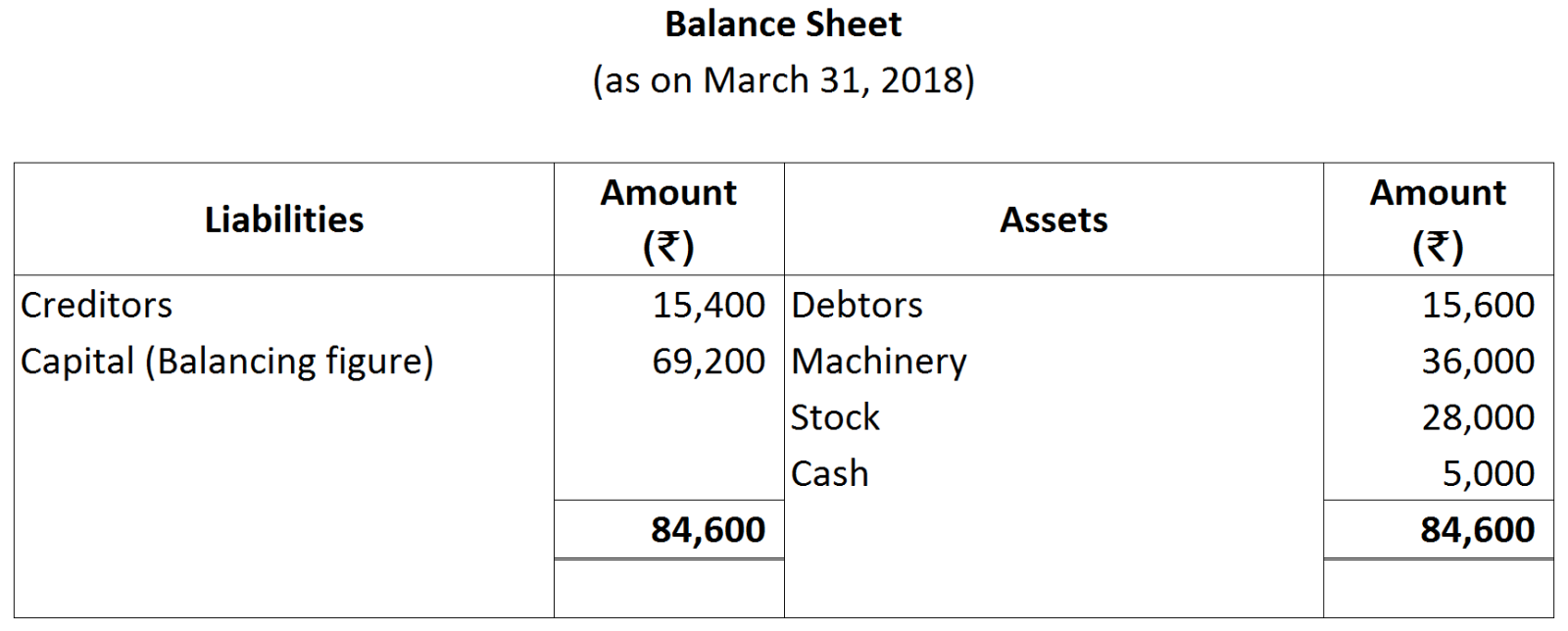
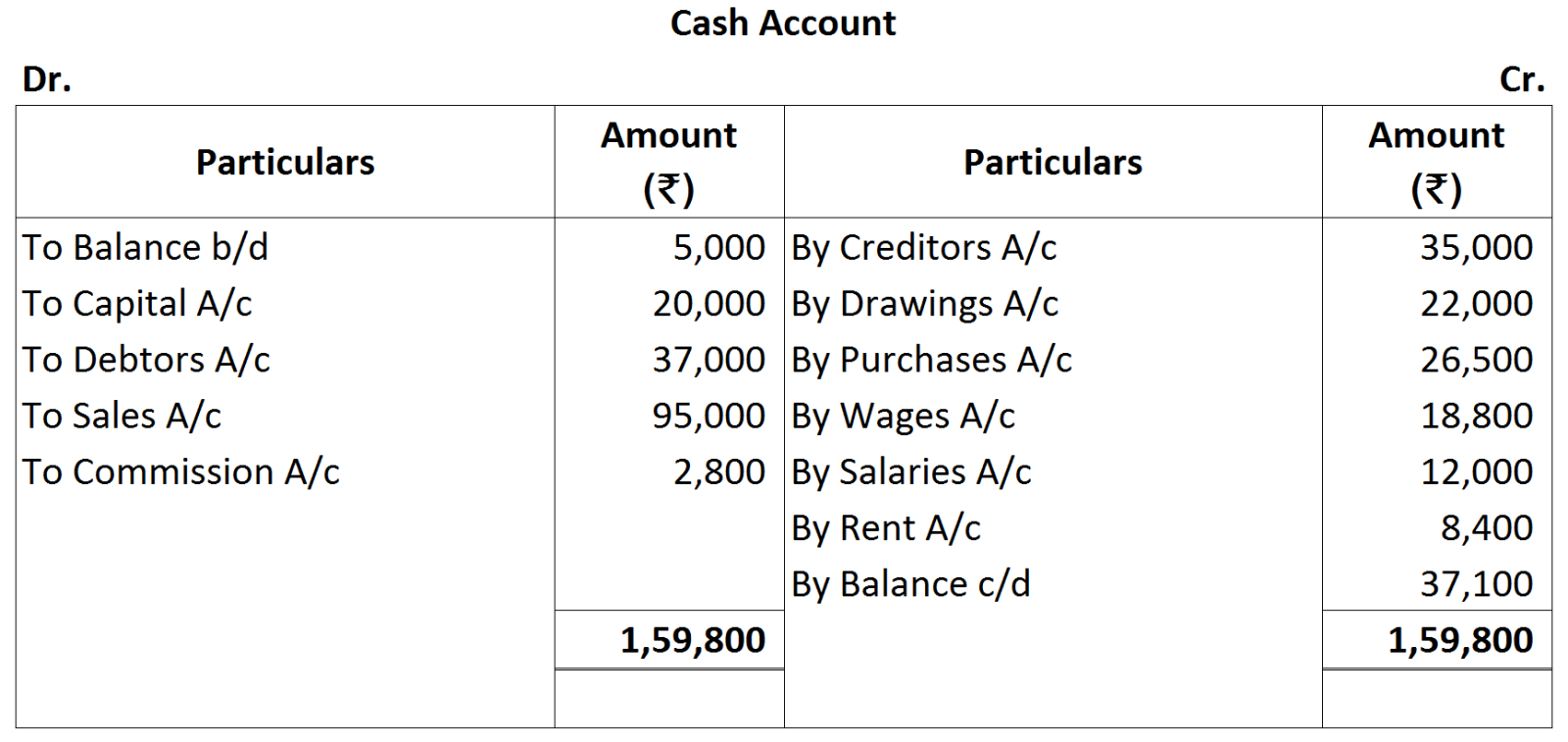
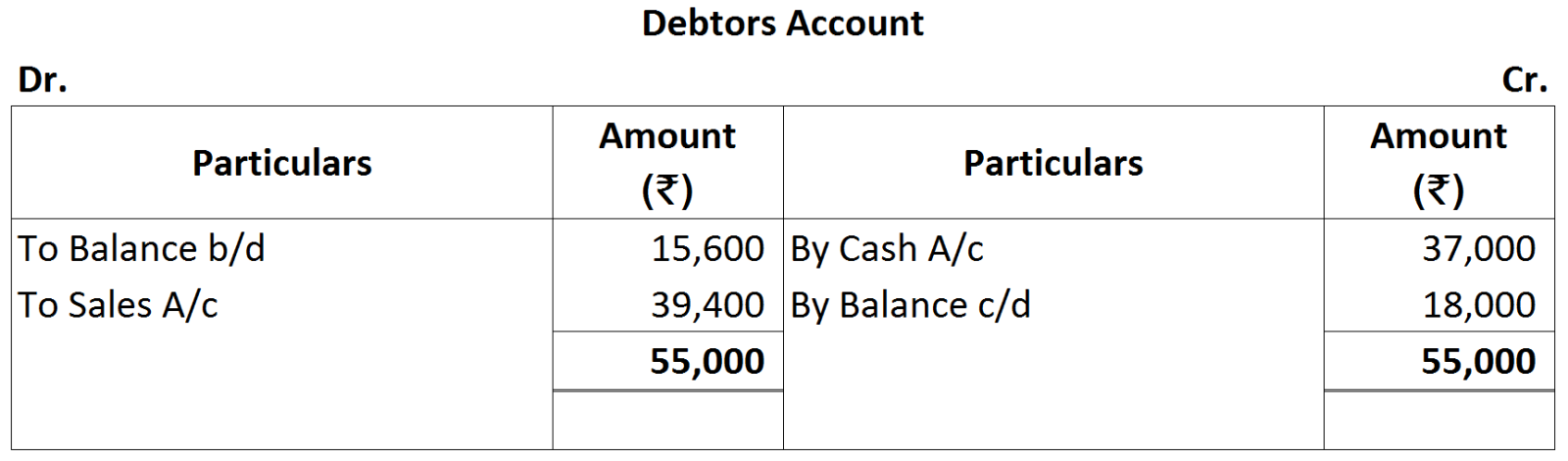
Anand Mohan has kept incomplete books. From the following particulars, prepare his Final Accounts for the year ending $31^{st}$ March, $2019:$ Received from Debtors $₹\ 37,000;$ Fresh Capital brought in cash $₹\ 20,000;$ Commission Received $₹\ 2,800;$ Cash Sales$ ₹\ 95,000.$ Paid to Creditors $₹\ 35,000;$ Cash Purchases $₹\ 26,500;$ Ornaments for his wife $₹\ 22,000;$ Wages $₹\ 18,800;$ Rent $₹\ 8,400;$ Salary $₹\ 12,000$. His Other Assets and Liabilities:
  1. Unpaid wages $₹\ 1,500.$
  2. Provide for Doubtful Debts at $5\%$ on Debtors.
Answer


Working Notes:


View full question & answer
6 Marks Question - Account STD 11 Commerce Questions - Vidyadip