Question
State two characteristic properties distinguishing the behaviour of paramagnetic and diamagnetic materials ?

Answer

Diamagnetic SubstancesParamagnetic Substances
1. They are feebly repeated by magnets.1. They are feebly by attracted magnets.
2. On placing in an external field these substances acquire feeble magnetisation in opposite direction of the magnetising field.2. On placing in an external field these substances acquire feeble magnetisation in direction of the magnetising field.

Need a full question paper?

Generate a complete, print-ready paper with questions like this in minutes — across 16+ boards, with answer keys.
Start Generating Free

Similar questions

At what temperature the mean speed of the molecules of hydrogen gas equals the escape epeed from the earth?
Three point charges +Q, -2Q and -3Q are placed at the vertices of an equilateral triangle ABC of side l.
If these charges are displaced to the mid points A1, B1 and C1 respectively, calculate the amount of work done in shifting the charges to the new locations.
A circular loop of radius 20cm carries a current of 10A. An electron crosses the plane of the loop with a speed of 2.0 × 10⁶m/s. The direction of motion makes an angle of 30° with the axis of the circle and passes through its centre. Find the magnitude of the magnetic force on the electron at the instant it crosses the plane.
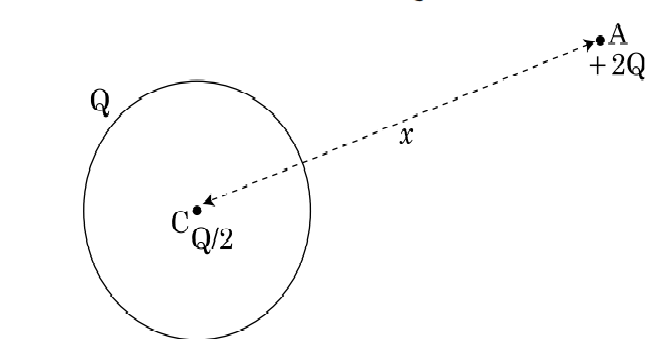
A thin metallic spherical shell of radius R carries a charge Q on its surface. A point charge Q/2 is placed at the centre C, and another charge + 2Q is placed outside the shell at A at a distance x from the centre as shown in the figure.
  1. Find the electric flux through the shell.
  2. State the law used.
  3. Find the force on the charges at the centre C of the shell and at the point A.

Calculate the Q-value of the fusion reaction
4He + 4He = 8Be.
Is such a fusion energetically favourable? Atomic mass of 8Be is 8.0053u and that of 4He is 4.0026u.
The photon emitted during the de-excitation from the first excited level to the ground state of hydrogen atom is used to irradiate a photocathode of a photocell, in which stopping potential of 5 V is used. Calculate the work function of the cathode used.
The work function of caesium is $2.14 eV$. Find (a) the threshold frequency for caesium, and (b) the wavelength of the incident light if the photocurrent is brought to zero by a stopping potential of $0.60 V$.
A coil of inductance 5.0mH and negligible resistance is connected to the oscillator of the previous problem. Find the peak currents in the circuit for $\omega=100\text{s}^{-1},500\text{s}^{-1},1000\text{s}^{-1}.$
How are em waves produced by oscillating charges? Draw a sketch of linearly polarised em waves propagating in the Z-direction. Indicate the directions of the oscillating electric and magnetic fields.
Explain that Kirchhoff's second law is law of conservation of energy.