Question
State two differences between the e.m.f and terminal voltage of a cell.

Answer

e.m.f. of cell Terminal voltage of cell
1 It is measured by the amount of work done in moving a unit positive charge in the complete circuit inside and outside the cell. 1 It is measured by the amount of work done in moving a unit positive charge in the circuit outside the cell.
2 It is the characteristic of the cell i.e., it does not depend on the amount of current drawn from the cell 2 It depends on the amount of current drawn from the cell. More the current is drawn from the cell, less is the terminal voltage.
3 It is equal to the terminal voltage when cell is not in use, while greater than the terminal voltage when cell is in use. 3 It is equal to the emf of cell when cell is not in use, while less than the emf when cell is in use.

Need a full question paper?

Generate a complete, print-ready paper with questions like this in minutes — across 16+ boards, with answer keys.
Start Generating Free

Similar questions

Two bodies, A and B of equal mass are kept at heights 20 m and 30 m respectively. Calculate the ratio of their potential energies.
Illustrate-combination of cells e.g., three cells, in series, explaining the combination briefly. Obtain an expression for current ‘i’ in the combination.
What is meant by the ‘loudness’ of a sound? How is it related to the intensity?
Find the final temperature when a mass of 80g of water at 100°C is mixed with a mass of 40g of water at 25°C.
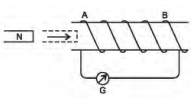
(i) The diagram shows an insulated copper coil wound over a thin cardboard tube and connected to centre zero galvanometer G. It is noticed that the galvanometer needle shows deflection towards the right when the powerful magnet is moved towards the coil as shown in the diagram.
Image
Now, answer the following questions:
(a) Explain why there is a deflection in the galyanometer.
(b) When viewed from end A , what is the direction of current in the coil (clockwise/anticlockwise)?
(c) What is your observation when the magnet is suddenly pulled away from the coil?
(d) What is your observation in the galvanometer when both the magnet and the coil are mounted on trolley and then moved towards the right with the same speed?
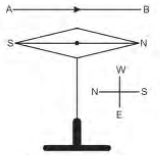
(ii) Diagram given shows a freely suspended magnetic needle.
(a) Why does the needle move in the above situations?
(b) Name and state the law which will determine the direction of motion of magnetic needle.
Image
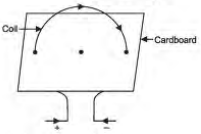
(iii) (a) Copy the diagram given and draw the lines of the magnetic field produced due to the flow of current.
(b) State one way of increasing the magnetic strength of the coil.
(c) Give three characteristics of magnetic lines of force in (a).
Image
How does the resistance of a metallic wire depend on its temperature? Explain with reason.
Illustrate-combination of cells e.g., three cells, in parallel, explaining the combination briefly. Obtain an expression for current ‘i’ in the combination.
Copy the given diagram of a transformer and complete it. Name the parts A and B. Name the part you have drawn to complete the diagram. What is the material of this part? Is this transformer a step-up or step-down? Give reason.
Distinguish between $\alpha , \beta$ and $γ$ rays.
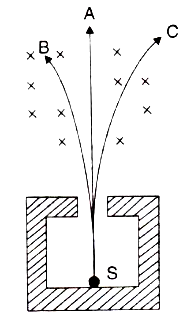
The diagram in figure shows a radioactive source S placed in a thick lead walled container. The radiations given off are allowed to pass through a magnetic field. The magnetic field (shown as x) acts perpendicular to the plane of paper inwards. Arrows shows the paths of the radiation A, B and C.


(a) Name the radiations labelled A, B and C.
(b) Explain clearly how you used the diagram to arrive at the answer in part(a).