Questions

[5 Mark Question Answer]

🎯

Test yourself on this topic

42 questions · timed · auto-graded

Question 15 Marks
An electrical appliance having a resistance of 200 Ω is operated at 220 V. calculate the energy consumed by the appliance in 5 minutes in kWh.
Answer
Given, Resistance , $R=200 \Omega$
Voltage , V $=200 V$
time,$t=5 min =5 \times 60 sec =300 sec$
As, Energy , $E =\frac{ V ^2 t }{ R }$
In kWh
As $1 kWh =3.6 \times 10^6 J$
$
\begin{aligned}
& 1 J =\frac{1}{3.6 \times 10^6} kWh \\
& 60000 J =\frac{60000}{3.6 \times 10^6}=0.0167 kWh
\end{aligned}
$
View full question & answer
Question 25 Marks
A geyser is rated 1500 W, 250 V. This geyser is connected to 250 V mains. Calculate:

(i) The current drawn,

(ii) The energy consumed in 50 hours, and

(iii) The cost of energy consumed at Rs 4.20 per kWh.

Answer
Given,|
Power of geyser, $P=1500 W$
Voltage, $V=250 V$
(i) Current, $I =\frac{ P }{ V }$
$I =\frac{1500}{250}=6 A$
(ii) Time, $t=50 h$
Energy,$E=P \times t$
$
=1500 \times 50=75000 Wh =75 kWh
$
(iii) Cost per unit of energy $=$ Rs 4.20
Cost for $75 kWh$ of energy $=4.20 \times 75=$ Rs 315
View full question & answer
Question 35 Marks
A battery of e.m.f. 15 V and internal resistance 2 Ω is connected to two resistors of resistances 4 ohm and 6 ohm joined (a) in series. Find in each case the electrical energy spent per minute in 6 Ω resistor.
Answer
Given, E.m.f of battery , V $=15 V$
Internal resistance of battery , $R_B=2 \Omega$
Resistance given in circuit, $R_1=4 \Omega$
$R _2=6 \Omega$
(i) When resistors are connected in series,
Equivalent resistance, $R=R_B+R_1+R_2=12 \Omega$
Current in the circuit, $I =\frac{15}{12}=1.25 A$
Now voltage across resistor $R_2, V_2=I R=1.25 \times 6$
$
V_2=7.50 V
$
Time,$t=1 min =60 sec$
Energy across $R_2, E=\frac{V^2 t}{R}=\frac{(7.5)^2 \times 60}{6}$
$
E=562.5 J
$
View full question & answer
Question 45 Marks
Two resistors A and B of 4 Ω and 6 Ω respectively are connected in parallel. The combination is connected across a 6 volt battery of negligible resistance. Calculate :

the power dissipated in each resistor.

Answer
Given,
Resistance, $RA =4 \Omega$
Resistance, $RB =6 \Omega$
Voltage, $V=6 V$
(a) Power dissipation across each resistor , $P = VI$
Current across resistor $R _{ A }, I _{ A }=\frac{ V }{ R _{ A }}$
$I_A=\frac{6}{4}=1.5 A$
Power dissipation across resistor $R _{ A }$
$
P=V I_A=6 \times 1.5=9 W
$
(b) Current across resistor $R_B, I_B=\frac{V}{R_B}$
$I _{ B }=\frac{6}{6}=1 A$
Power dissipation across resistor $R_B$,
$
P = VI _{ B }=6 \times 1=6 W
$
View full question & answer
Question 55 Marks
Two resistors A and B of 4 Ω and 6 Ω respectively are connected in parallel. The combination is connected across a 6 volt battery of negligible resistance. Calculate: the power supplied by the battery .
Answer
Given,
Resistance, $R _{ A }=4 \Omega$
Resistance, $R _{ B }=6 \Omega$
Voltage, $V=6 V$
$\Omega$ As resistances are connected in parallel
Equivalent Resistance $=\frac{1}{R}=\frac{1}{R_A}+\frac{1}{R_B}$
$
\frac{1}{ R }=\frac{1}{4}+\frac{1}{6}=\frac{10}{24}
$
$
R=2.4 \Omega
$
As power, $P =\frac{ V ^2}{ R }=\frac{(6)^2}{2.4}=15 W$
View full question & answer
Question 65 Marks
An electric bulb is rated 250 W, 230 V.

(i) the energy consumed in one hour, and

(ii) the time in which the bulb will consume 1.0 kWh energy when connected to 230 V mains.

Answer
Given,
Power, $P=250 W$
Voltage, $V=230 V$
(i) Energy, $E = P \times t$
Time, $t=\frac{1000}{250}=4$ hours
If it comes $1 kWh$ of energy then it requires 4 hours.
View full question & answer
Question 75 Marks
Two bulbs are rated 60 W, 220 V and 60 W, 110 V respectively. Calculate the ratio of their resistances.
Answer
Given,
Voltage,$V_1=220 V$
$
V_2=110 V
$
Power, $P_1=P_2=P=60 W$
As $R =\frac{ V ^2}{ P }$
$
R _1=\frac{ V _1^2}{ P }=\frac{220 \times 220}{60}
$
$
R _2=\frac{ V _2^2}{ P }=\frac{110 \times 110}{60}
$
On dividing $R_1$ and $R_2$
$
\frac{ R _1}{ R _2}=\frac{\frac{220 \times 220}{60}}{\frac{110 \times 110}{60}}=\frac{4}{1}
$
$
R _1: R _2=4: 1
$
View full question & answer
Question 85 Marks
What is the resistance, under normal working conditions, of an electric lamp rated at '240 v, 60 W' ? If two such lamps are connected in series across a 240 V mains supply, explain why each one appears less bright.
Answer
Given, Voltage, $V=240 V$
Power, $P=60 W$
As $P =\frac{ V ^2}{ R }$
$
\therefore R =\frac{(240)^2}{60}=960 \Omega
$
$
I =\frac{ P }{ V }=0.25 A
$
When one lamp is connected across the mains, it draws $0.25 A$ current, while if two lamps are connected in series across the mains, current through each bulb becomes
$\frac{240 V }{(960+960) \Omega}=0.125 A$
(i.e., current is halved), hence heating ( $\left.=1^2 Rt \right)$ in each bulb becomes one-fourth, so each bulb appears less bright.


View full question & answer
Question 95 Marks
Name the factors on which the heat produced in a wire depends when current is passed in it, and state how does it depend on the factors stated by you.
Answer
When current is passed in a wire, the heat produced in it depends on the three factors:
(i) on the amount of current passing through the wire,
(ii) on the resistance of wire and
(iii) on the time for which current is passed in the wire.

(i) Dependence of heat produced on the current in wire: The amount of heat $H$ produced in the wire is directly proportional to the square of current I passing through the wire, i.e., $H \alpha I ^2$
(ii) Dependence of heat produced on the resistance of wire: The amount of heat $H$ produced in the wire is directly proportional to the resistance $R$ of the wire, i.e., $H \alpha R$
(iii) Dependence of heat produced on the time: The amount of heat $H$ produced in the wire is directly proportional to the time $t$ for which current is passed in the wire, i.e., $H \alpha t$
View full question & answer
Question 105 Marks
Twolamps, one rated 220 V, 50 W and the other rated 220 V, 100 W, are connected in series with mains of 220 V. Explain why does the 50 W lamp consume more power.
Answer
Resistance of $220 V , 50 W$ lamp is
$
R _1=\frac{ V ^2}{ P _1}=\frac{220^2}{50}=968 \Omega
$
Resistance of $220 V , 100 W$ lamp is
$
R _2=\frac{ V ^2}{ P _2}=\frac{220^2}{100}=484 \Omega
$
since the two lamps are nnected in series
so same current I passes through each lamp.
Power consumed in $220 V , 50 W$ lamp is $P _1=I^2 R_1$
Power consumed in $220 V , 100 W$ lamp is $P _2= I ^2 R _2$
Since $R _1> R _2, P _1> P _2$
i.e. $50 W$ lamp consumes more power.
View full question & answer
Question 115 Marks
List the names of three electrical gadgets used in your house. Write their power, voltage rating and approximate time for which each one is used in a day. Hence find the electrical energy consumed by each in day.
Answer

Appliance

Power

(in watt)

Voltage

(in volts)

Time

( hours)

Electrical energy

Fluorescent tube

Television set

Refrigerator

40

120

150

220

220

220

12

4

24

0.48 kWh

0.48 KWh

3.6 kWh

View full question & answer
Question 125 Marks
What do you mean by power rating of an electrical appliance? How do you use it to calculate

(a) the resistance of the appliance and

(b) the safe limit of the current in it, while in use?

Answer
An electrical appliance such as electric bulb, geyser etc. is rated with power $( P )$ and voltage $( V )$ which is known as its power rating. For example: If an electric bulb is rated as $50 W -220 V$, it means that when the bulb is lighted on a $220 V$ supply, it consumes $50 W$ electrical power.
(a) To calculate the resistance of the appliance, the expression is:
Resisteance, $R =\frac{ V ^2}{ P }$
(b) The safe limit of current I is : I $=\frac{P}{V}$
View full question & answer
Question 135 Marks
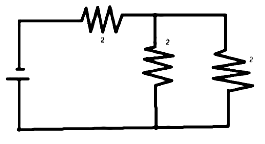
Three resistors each of 2Ω are connected together so that their total resistance is 3Ω. Draw a diagram to show this arrangement and check it by calculation.
Answer
A parallel combination of two resistors, in series with one resistor.
$
\begin{aligned}
& R_1=2 ohm \\
& R_2=2 ohm \\
& R_3=2 ohm
\end{aligned}
$
$
\begin{aligned}
& \frac{1}{ R }=\frac{1}{ R _1}+\frac{1}{ R _2} \\
& \frac{I}{ R }=\frac{1}{2}+\frac{1}{2}=1
\end{aligned}
$
$
R = R + R _3=1+2=3 ohm
$

View full question & answer
Question 145 Marks
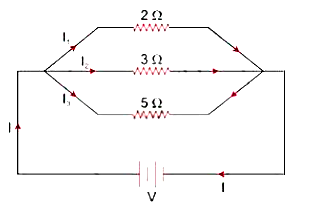
You have three resistors of values 2Ω, 3Ω and 5Ω. How will you join them so that the total resistance is less than 1Ω? Draw diagram and find the total resistance.
Answer
The three resistors should be connected in parallel To get a total resistance less than $1 \Omega$


Let ' $R$ be the total resistance.
Then,
$
\frac{1}{R}=\frac{1}{2}+\frac{1}{3}+\frac{1}{5}=\frac{15+10+16}{30}=\frac{31}{30}
$
Or, $R=\frac{30}{31}=0.97 \Omega$
View full question & answer
Question 155 Marks
A cell of e.m.f. ε and internal resistance 𝔯 sends current 1.0 A when it is connected to an external resistance 1.9Ω. But it sends current 0.5 A when it is connected to an external resistance 3.9 Ω.
Calculate the values of ε and 𝔯.
Answer
In first case
I = 1 A, R = 1.9 ohm
ε = I(R + r) = 1(1.9+r)
ε = 1.9 + r------------(1)
In second case
I = 0.5 A, R = 3.9 ohm
ε = I(R + r) = 0.5 (3.9 + r)
ε = 1.95 + 0.5r ----------------(2)
From eq. (1) and (2),
1.9 + r = 1.95 + 0.5r
r = 0.05/0.5 = 0.1 ohm
Substituting value of r
ε = 1.9 + r = 1.9 + 0.1 = 2 V
View full question & answer
Question 165 Marks

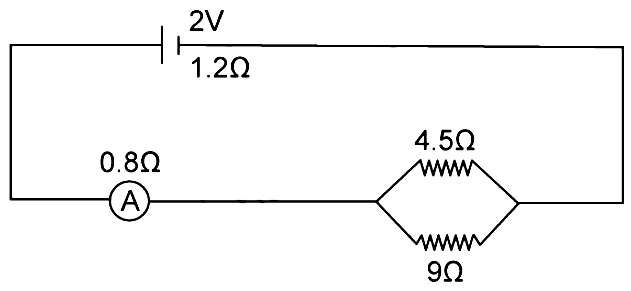
A cell of e.m.f. $2 V$ and internal resistance $1.2 \Omega$ is connected to an ammeter of resistance $0.8 \Omega$ and two resistors of $4.5 \Omega$ and $9 \Omega$ as shown in following figure.


Find:
1. The reading of the ammeter,
2. The potential difference across the terminals of the cells, and
3. The potential difference across the $4.5 \Omega$ resistor.

Answer
The total resistance of the circuit is
$
\begin{aligned}
& R _{\text {eq }}= R _{\text {cell }}+ R _{\text {ammeter }}+ R _1 \| R _2 \\
& \therefore R _{\text {eq }}=1.2+0.8+\frac{ R _1 R _2}{ R _1+ R _2} \\
& \therefore R _{\text {eq }}=2+\frac{4.5 \times 9}{4.5+9}=2+\frac{40.5}{13.5} \\
& \therefore R _{\text {eq }}=5 \Omega
\end{aligned}
$
(a) Therefore, the current through the ammeter is
$I =\frac{ E _{ cell }}{ R _{ eq }}=\frac{2}{5}=0.4 A$
(b) The potential difference across the ends of the cells is
$V _{\text {cell }}= E _{\text {cell }}- IR _{\text {cell }}$
$\therefore V _{\text {cell }}=2-0.4 \times 1.2$
$\therefore V _{\text {cell }}=2-0.48=1.52 V$
c. The potential difference across the $4.5 \Omega$ resistor is
$\begin{aligned} & V _{4.5}= V _{\text {cell }}- V _{\text {ammeter }} \\ & \therefore V _{4.5}=1.52-0.4 \times 0.8 \\ & \therefore V _{4.5}=1.52-0.32 \\ & \therefore V _{4.5}=1.2 Vz \end{aligned}$
View full question & answer
Question 175 Marks
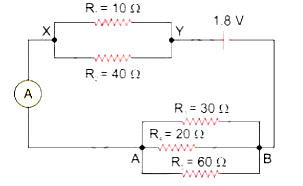
The following diagram shows the arrangement of five different resistances connected to a battery of e.m.f. 1.8V Calculate:
(a) the total resistance of the circuit, and
(b) the reading of ammeter A.

Answer

(a) In the figure above,
Let resistance between $X$ and $Y$ be $Rxy$
Then, $\frac{1}{ R _{ xy }=\frac{1}{10}+\frac{1}{40}=\frac{4+1}{40}=\frac{5}{40} \Omega}$
Or, $R _{ xy }=8 \Omega$
Let $R_{A B}$ be the net resistance between points $A$ and $B$.
Then, $\frac{1}{ R _{ AB }}=\frac{1}{30}+\frac{1}{20}+\frac{1}{60}=\frac{2+3+1}{60}=\frac{6}{60} \Omega$
Or, $R_{A B}=10 \Omega$
$\therefore$ Total resistance of the circuit $=8 \Omega+10 \Omega=18 \Omega$
(b) current, $I=\frac{\text { voltage }}{\text { Total resistance }}=\frac{1.8}{18} A$
Or, $I =0.1 A$
Thus, 0.1 A shall be the reading of the am meter
View full question & answer
Question 185 Marks
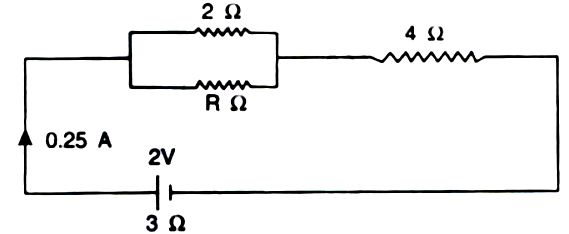
The following circuit diagram shows three resistors $2 \Omega, 4 \Omega$ and $R \Omega$ connected to a battery of e.m.f $2 V$ and internal resistance $3 \Omega$. If the main current of $0.25 A$ flows through the circuit, find:
a. the p.d. across the $4 \Omega$ resistors,
b. the p.d. across the internal resistance of the cell,
c. the p.d. across the $R \Omega$ or $2 \Omega$ resistors, and
d. the value of $R$.

Answer
Given: $I =0.25 A ; R =4 \Omega ; r =3 \Omega$
(a) p.d. across the $4 \Omega$
$
\begin{aligned}
& V=I R \\
& =0.25 \times 4 \\
& =1 \text { Volt }
\end{aligned}
$
(b) p.d. across $r$ of cell
$
\begin{aligned}
& V=I R \\
& =0.25 \times 3 \\
& =0.75 V
\end{aligned}
$
(c) $\frac{1}{R e q}=\frac{1}{R}+\frac{1}{2}=\frac{1}{2}+\frac{1}{2}=\frac{2}{2}=1$
$\operatorname{Req}=1 \Omega, I =0.25 A$
$V=I R$
$=1 \times 0.25$
$=0.25 V$
$\begin{aligned} & \text { (d) } \frac{1}{\operatorname{Req}}=\frac{1}{ R }+\frac{1}{2} \\ & \frac{1}{\operatorname{Req}}=\frac{2+ R }{2 R } \\ & \operatorname{Req}=\frac{2 R }{2+ R }\end{aligned}$
Total Resistance $=R+r+R e q$
$\begin{aligned} & =4+3+\frac{2 R }{ R +2} \\ & =7+\frac{2 R }{2+ R } \\ & R =\frac{ V }{ I }\end{aligned}$
$\begin{aligned} & \therefore 7+\frac{2 R }{2+ R }=\frac{2}{\frac{1}{4}} \\ & \therefore \frac{2 R }{2+ R }=2 \times 4-7 \\ & \therefore \frac{2 R }{2+ R }=8-7\end{aligned}$
$\therefore 2 R=(2+R)$
$\therefore 2 R-R=2$
$R =2 \Omega$
View full question & answer
Question 195 Marks
A battery of e.m.f 15 V and internal resistance 3 Ω is connected to two resistors 3Ω and 6Ω connected in parallel. Find: (a) the current through the battery. (b) p.d. between the terminals of the battery, (c) the current in 3 Ω resistors, (d) the current in 6 Ω resistor.
Answer
(a)In parallel 1/R = 1/3 + 1/6 = 1/2
So R = 2 ohm
r = 3 W
ε = 15 V
ε = I(R + r)
15 = I(2 + 3)
I = 15/5 = 3 A
(b) V = ?
R = 2 ohm
V = IR = 3 × 2 = 6 V
(c)V = 6 V
R = 3 ohm
I = V/R = 6/3 = 2 A
(d) R = 6 ohm
V = 6 V
I = V/R = 6/6 = 1 A
View full question & answer
Question 205 Marks
A cell supplies a current of 1.2 A through two 2 Ω resistors connected in parallel. When the resistors are connected in series, it supplies a current of 0.4 A. Calculate: (i) the internal resistance and (ii) e.m.f. of the cell.
Answer
In parallel R = ½ + ½ = 1 ohm
I = 1.2 A
ε = I(R + r) = 1.2(1 + r) = 1.2 + 1.2 r
In series R = 2+2 = 4 ohm
I = 0.4 A
ε = I(R + r) = 0.4(4 + r) = 1.6 + 0.4 r
It means :
1.2 + 1.2 r = 1.6 + 0.4 r
0.8 r = 0.4
r = 0.4 / 0.8 = ½ = 0.5 ohm
(i) Internal resistance r = 0.5 ohm
(ii) ε = I(R+r) = 1.2(1+0.5) = 1.8 V
View full question & answer
Question 215 Marks
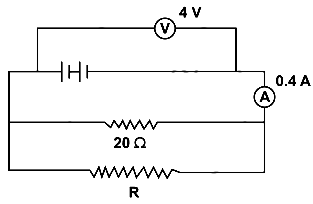
In the following figure calculate:
  1. the total resistance of the circuit
  2. the value if R, and
  3. the current flowing in R.
Answer
(a) $V =4 V ; I =0.4 A$
Total Resistance $R ^{\prime}=$ ?
$
R ^{\prime}=\frac{ V }{ I }=\frac{4}{0.4}=10 ohm
$
(b) $R_1=20 ohm ; R^{\prime}=10 ohm$
$
\begin{aligned}
& \frac{1}{ R ^{\prime}}=\frac{1}{ R }+\frac{1}{ R _1} \\
& \frac{1}{10}=\frac{1}{ R }+\frac{1}{20} \\
& \frac{1}{ R }=\frac{1}{10}-\frac{1}{20} \\
& \frac{1}{ R }=\frac{2-1}{20} \\
& \frac{1}{ R }=\frac{1}{20}
\end{aligned}
$
$R=20 \Omega$
(c) $R =20 ohm ; V =4 V$
$
I =\frac{ V }{ R }=\frac{4}{20}=0.2 A
$
View full question & answer
Question 225 Marks
Two resistors of 2.0 Ω and 3.0 Ω are connected (a) in series (b) in parallel, with a battery of 6.0 V and negligible internal resistance. For each case draw a circuit diagram and calculate the current through the battery.
Answer

(a) In Series -


$\begin{aligned} & R_1=2 \Omega \\ & R_2=3 \Omega \\ & R=R_1+R_2=2+3=5 \Omega \\ & V=6 V \\ & I=\frac{V}{R} \\ & I=\frac{6}{5} \\ & I=1.2 A \end{aligned}$
(b) In Parallel -


$R_1$ and $R_2$ are connected in parallel
$
\begin{aligned}
& \frac{1}{ R }=\frac{1}{ R _1}+\frac{1}{ R _2} \\
& \frac{1}{ R }=\frac{1}{2}+\frac{1}{3} \\
& \frac{1}{ R }=\frac{5}{6} \\
& R =\frac{6}{5}=1.2 \Omega \\
& V =6 V \\
& I =\frac{ V }{ R } \\
& =\frac{6}{1.2} \\
& =5 A
\end{aligned}
$

View full question & answer
Question 235 Marks
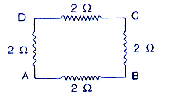
In the network shown in the following adjacent Figure, calculate the equivalent resistance between the points.
  1. A and B
  2. A and C
Answer
$
\begin{aligned}
& \text { (a) } R_s=r_1+r_2+r_3 \\
& R_s=2+2+2 \\
& R_s=6 \Omega
\end{aligned}
$
$R_1$ and $R_2$ are connected in parallel
$
\begin{aligned}
& \frac{1}{R}=\frac{1}{R_s}+\frac{1}{r_4}=\frac{1}{6}+\frac{1}{2}=\frac{4}{6} \text { i.e. } \frac{2}{3} \\
& R=\frac{3}{2} \\
& R=1.5 \Omega
\end{aligned}
$
(b) $R _{ s _1}= r _1+ r _2$
$
\begin{aligned}
& R _{ s _1}=2+2=4 \Omega \\
& R _{ s _2}= r _3+ r _4=2+2=4 \Omega
\end{aligned}
$
$R_1$ and $R_2$ are connected in parallel
$
\begin{aligned}
& \frac{1}{ R }=\frac{1}{ R _{ s _1}}+\frac{1}{ R _{ s _2}} \\
& \frac{1}{ R }=\frac{1}{4}+\frac{1}{4} \\
& \frac{1}{ R }=\frac{2}{4} \approx \frac{1}{2}
\end{aligned}
$
$
R=2 \Omega
$
View full question & answer
Question 245 Marks
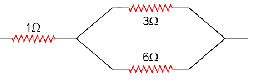
A circuit consists of a 1 ohm resistor in series with a parallel arrangement of 6 ohm and 3 ohm resistors. Calculate the total resistance if the circuit. Draw a diagram.
Answer
$\frac{1}{r}=\frac{1}{6}+\frac{1}{3}+\frac{1}{2}$
$R =2 ohm$
$R =2+1=3 ohm$

View full question & answer
Question 255 Marks

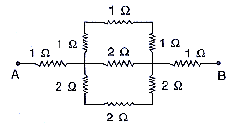
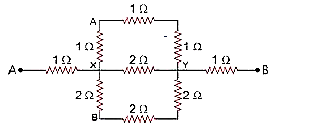
Calculate the effective resistance between the points A and B in the circuit shown in Figure 8.44.

Answer


In the figure above,
Resistance between XAY $=(1+1+1)=3 \Omega$
Resistance between $X Y=2 \Omega$
Resistance between XBY $=6 \Omega$
Let ' $R$ be the net resistance between points $X$ and $Y$
Then, $\frac{1}{R}=\frac{1}{2}+\frac{1}{3}+\frac{1}{6}=\frac{3+2+1}{6}=\frac{6}{6} \Omega$
Or, $RI =1 \Omega$
Thus, we can say that between points $A$ and $B$,
Three $1 \Omega$ resistors are connected in series.
Let RAB be the net resistance between points $A$ and $B$.
Then, $\operatorname{RAB}=(1+1+1) \Omega=3 \Omega$

View full question & answer
Question 265 Marks
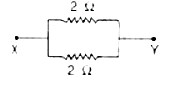
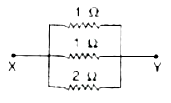
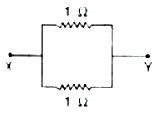
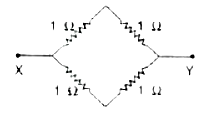
Which of the following combinations have the same equivalent resistance between X and Y?
Answer
(a) and (d)
In above fig (a), the resistors are connected in parallel Between $X$ and $Y$.
Let ' $R$ be their equivalent resistance.
Then,
$
\frac{1}{R}=\frac{1}{2}+\frac{1}{2}=\frac{2}{2} \Omega
$
Or, RI = $1 \Omega$................. (I)
In fig (d) a series combination of two 1 resistors Is in parallel with another series combination of two
$1 \Omega$ resistors
Series resistance of two 1 Ohm resistors,
$
R=(1+1) \Omega=2 \Omega
$
Thus, we can say that across $X$ and $Y$, two 2 resistors are connected in parallel
Let ' $R$ be the net resistance across $X$ and $Y$.
Then, $1 / R=1 / 2$
$\frac{1}{2}+\frac{1}{2}=\frac{2}{2} \Omega$
Or, ${ }^{\prime} R =1 \Omega$.....................(II)
From (i) and (ii), it is clear that (a) and (d) have
The same equivalent resistance between $X$ and $Y$.
View full question & answer
Question 275 Marks
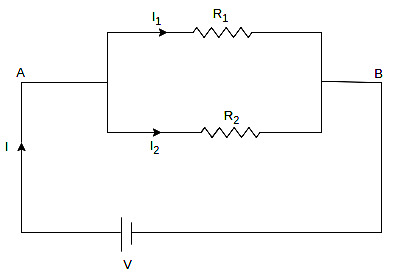
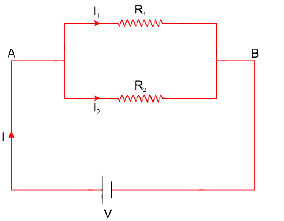
Show by a diagram how two resistors R1 and R2 are joined in parallel. Obtain an expression for the total resistance of combination.
Answer

On applying Ohm's law to the two resistors separately, we further Have
$
\begin{aligned}
& I 1=\frac{V}{R_1} \\
& I 2=\frac{V}{R_2} \\
& I=I_1+I_2 \\
& \frac{V}{R}=\frac{V}{R_1}+\frac{V}{R_2} \\
& \frac{1}{R}=\frac{1}{R_1}+\frac{1}{R_2}
\end{aligned}
$
View full question & answer
Question 285 Marks
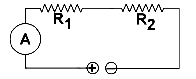
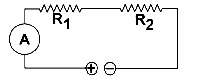
How would you connect two resistors in series? Draw a diagram. Calculate the total equivalent resistance.
Answer

If current I is drawn from the battery, the current through eac resistor will also be I. On applying Ohm's law to the two resistors separately, we further
have
$
V 1=I R_1
$
$
\begin{aligned}
& V 2=I R_2 \\
& V=V_1+V_2 \\
& I R=I R_1+I R_2 \\
& R=R_1+R_2
\end{aligned}
$Total Resistance in series $R$
$
R=R_1+R_2+R_3
$
View full question & answer
Question 295 Marks
State two differences between the e.m.f and terminal voltage of a cell.
Answer
e.m.f. of cell Terminal voltage of cell
1 It is measured by the amount of work done in moving a unit positive charge in the complete circuit inside and outside the cell. 1 It is measured by the amount of work done in moving a unit positive charge in the circuit outside the cell.
2 It is the characteristic of the cell i.e., it does not depend on the amount of current drawn from the cell 2 It depends on the amount of current drawn from the cell. More the current is drawn from the cell, less is the terminal voltage.
3 It is equal to the terminal voltage when cell is not in use, while greater than the terminal voltage when cell is in use. 3 It is equal to the emf of cell when cell is not in use, while less than the emf when cell is in use.
View full question & answer
Question 305 Marks
The V-I graph for a series combination and for a parallel combination of two resistors is shown in Fig – 8.38. Which of the two, A or B, represents the parallel combination? Give a reason for your answer.
Answer
For the same change in I, change in V is less for the straight line A than for the straight line B (i.e., the straight line A is less steeper than B), so the straight line A represents small resistance, while the straight line B represents more resistance. In parallel combination, the resistance decreases while in series combination, the resistance increases. So A represents the parallel combination.
View full question & answer
Question 315 Marks
A given wire of resistance 1 Ω is stretched to double its length. What will be its new resistance?
Answer
Let ' $I$ ' be the length and ' $a$ ' be the area of cross - section of the resistor with resistance, $R=1 \Omega$
when the wire is stretched to double its length,
the new length $I^{\prime}=21$ and the new area of cross section,
$a^{\prime}=a / 2$
$\therefore$ Resistance $\left( R ^{\prime}\right)=p=\frac{I \prime}{a \prime}=p \frac{2 I}{a / 2}$
$\therefore R =4 p \frac{I}{a}=4 R$
$\therefore R=4 \times 1=4 \Omega$
View full question & answer
Question 325 Marks
Two wires of the same material and same length have radii r1 and r2 respectively compare: (i)
their resistances, (ii) their resistivities.
Answer
(i) For wire of radius
$
\begin{aligned}
& R_1=p=\frac{1}{A_1} \\
& R_1=p=\frac{1}{\pi r_1^2}
\end{aligned}
$
(ii) For wire of radius $r_2$ :
$
\begin{aligned}
& R_2=p=\frac{1}{A_2} \\
& R_2=p=\frac{1}{\pi r_2^2}
\end{aligned}
$
$\begin{aligned} R_2: R_2 \text { Will be } p & =\frac{1}{\pi r_1^2}: p=\frac{1}{\pi r_2^2} \\ & =r_2^2: r_1^2\end{aligned}$
(ii) Since the material of the two wires is same, so their resistivities will also be same i.e.,
$p_1: p_2=1: 1$
View full question & answer
Question 335 Marks
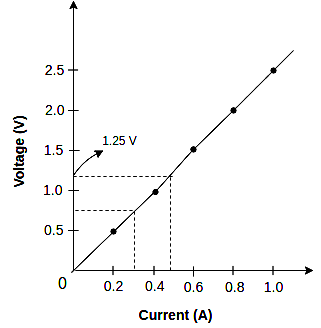
In an experiment of verification of Ohm’s law following observations are obtained.

potential difference V (in volt)

0.5 1.0 1.5 2.0 2.5
current I (in ampere) 0.2 0.4 0.6 0.8 1.0

Draw a characteristic V-I graph and use this graph to find:

  1. potential difference V when the current I is 0.5 A,
  2. current I when the potential difference V is 0.75 V,
  3. resistance in a circuit.
Answer


a. $1.25 V$
b. $0.3 A$
c. The graph is linear so resistance can be found from any value of the given table. For instance:
When $V =2.5$ Volt
Current is I $=1.0 amp$
According to ohm's law :
$\begin{aligned} & R =\frac{ V }{ I } \\ & R =\frac{2.5}{1.0} \\ & R =2.5 ohm \end{aligned}$
View full question & answer
Question 345 Marks
An electric bulb draws 1.2 A current at 6.0 V. Find the resistance of filament of bulb while glowing.
Answer
Current (I) = 1.2 A
Potential Difference/Voltage (V) = 6.0 V
Resistance (R) = ?
According to Ohm's Law :
V=IR
Then R = V/I
R = 6 / 1.2
R = 5 Ohm
View full question & answer
Question 355 Marks

A current of $1.6 mA$ flows through a conductor. If charge on an electron is $-1.6 \times$ $10^{-19}$ coulomb,
find the number of electrons that will pass each second through the cross section of that conductor.

Answer
Current, $I =1.6 mA =1.6 \times 10^{-3} A$
Charge, $Q=-1.6 \times 10^{-19}$ coulomb
$\begin{aligned} & t =1 sec \\ & I = Q / t \\ & Q = I \times t \end{aligned}$
$Q=1.6 \times 10^{-3} \times 1$
No. of electrons $=1.6 \times 10^{-3} / 1.6 \times 10^{-19}$
$=10^{16}$
View full question & answer
Question 365 Marks
In a conductor $6.25 \times 10^{16}$ electrons flow from its end $A$ to $B$ in $2 s$. Find the current flowing
through the conductor $\left(e=1.6 \times 10^{19} C \right)$
Answer
Number of electrons flowing through the conductor,
$N =6.25 \times 10^{16}$ electrons
Time taken, $t =2 s$
Given, $e =1.6 \times 10^{-19} c$
Let I be the current flowing through the conductor.
Then, $I =\frac{ ne }{t}$
$\therefore I=\frac{\left(6.25 \times 10^{16}\right)\left(1.6 \times 10^{-19}\right)}{2}=5 \times 10^{-j} A$
$
\text { Or, } I =5 mA
$
Thus, $5 Ma$ current flows from $B$ to $A$.
View full question & answer
Question 375 Marks
The filament of a bulb takes a current 100 mA when potential difference across it is 0.2 V. When the potential difference across it becomes 1.0 V, the current becomes 400 mA. Calculate the resistance of filament in each case and account for the difference.
Answer
According to Ohm's law,
$V=I R$
$\therefore R =\frac{ V }{ I }$
$\therefore R _1=\frac{ V _1}{ I _1}=\frac{0.2}{0.1}=2 \Omega$
Similarly
$R _2=\frac{ V _2}{ I _2}=\frac{1}{0.4}=2.5 \Omega$
Resistance of the wire increases with increase in temperature. So the difference arises because the temperature of the filament increased.

View full question & answer
Question 385 Marks
What is the cause of resistance offered by the metallic wire in the flow of current through it?
Answer

A metal includes free electrons and fixed positive ions.

Positive ions give away their valence electrons and thus attain a positive charge.

Electrons are free for movement, but positive ions do not move; thus, when a potential difference is applied across the circuit, and when free electrons begin to move, they collide with these fixed ions.

This collision is the major cause of resistance offered by the metallic wire in the flow of current through it.

View full question & answer
Question 395 Marks
Name the material used for making the connection wires. Give a reason for your answer. Why
should a connection wire be thick?
Answer
Copper or Aluminium' is used as a material for making connection wires because the resistivity
of these materials is very small, and thus, wires made of these materials possess negligible
resistance.
The connection wires are made thick so that their resistance can be considered as negligible.
$R = p \frac{I}{a}$
Therefore, greater the area of cross-section, lesser shall be the resistance.
View full question & answer
Question 405 Marks
Name three factors on which resistance of a given wire depends and state how is it affected by the factors stated by you.
Answer
(i) Resistance of a wire is directly proportional to the length of the wire means with the increase in length resistance also increases.

R ∝ I
(ii) Resistance of a wire is inversely proportional to the area of cross-section of the wire. If area of cross-section of the wire is more, then resistance will be less and vice versa.
R ∝ 1𝐴
(iii) Resistance increases with the increase in temperature since with increase in temperature the number of collisions increases.
(iv) Resistance depends on the nature of conductor because different substances have different concentration of free electrons. Substances such as silver, copper etc. offer less resistance and are called good conductors; but substances such as rubber, glass etc. offer very high resistance and are called insulators.

View full question & answer
Question 415 Marks
How does the resistance of a metallic wire depend on its temperature? Explain with reason.
Answer
With the increase in temperature of conductor, both the random motion of electrons and the amplitude of vibration of fixed positive ions increase. As a result, the number of collisions increases. Hence, the resistance of a conductor increases with the increase in its temperature. The resistance of filament of a bulb is more when it is glowing (i.e., when it is at a high temperature) as compared to when it is not glowing (i.e., when it is cold).
View full question & answer
Question 425 Marks
Two copper wires are of the same length, but one is thicker than the other.
  1. Which wire will have more resistance?
  2. Which wire will have more specific resistance?
Answer
We know that,
$
R =\rho \frac{l}{A}
$
Where, $\rho=$ specific resistance
$
L=\text { length of wire }
$
$A=$ area of cross-section
let the area of the cross-section of the wires be $A_1 \& A_2$. It is said that one is thicker than the other.
So $A_1>A_2$
When the length of the wire is given to be the same then we can see that $R \propto \frac{1}{A}$.
So, the wire with less area of the cross-section will have more resistance.
(2) We know that the specific resistance $(\rho)$ does not depend on the length or thickness of the wire. It depends upon the material used. It will be the same in this case.
View full question & answer
[5 Mark Question Answer] - Physics STD 10 Questions - Vidyadip