Question
State two important properties of photon which are used to write Einstein's photoelectric equation. Define (i) Stopping potential and (ii) Threshold frequency, using Einstein's equation and drawing necessary plot between relevant quantities.

Answer

Properties of Photon:

  1. For a radiation of frequency$\upsilon$, each photon has an energy, $\text{E} = \text{h}v,$ associated with it.
  2. The energy of a photon is independent of the intensity of incident radiation.
  3. During the collision of a photon, with an electron, the total energy of the photon gets absorbed by the electron.

Einstein’s photoelectric equation is,

$\text{K}_{max} = \text{hv} - \phi_{0}$

or $\text{eV}_{0} = \text{hv} -\phi_{0}$

  1. Stopping potential, $\text{V}_{0}$ equals that value of the negative potential for which

$|\text{eV}_{0}| =\text{K}_{max}$

Alternate Answer

(The stopping potential ($\text{V}_{0}$) equals that (least) value of the (negative) plate potential that just stops the most energetic emitted photoelectrons from reaching the plate.)

  1. Threshold frequency $(\vartheta_{o})$ equals that value of the frequency of incident radiation for which $\text{K}_{max} = 0 . $

Alternate Answer

(For a given photosensitive surface, its threshold frequency is the minimum value of the frequency of incident radiation for which photoelectrons can be just emitted from that surface or that maximum frequency of incident radiation below which no photo emission takes place.)

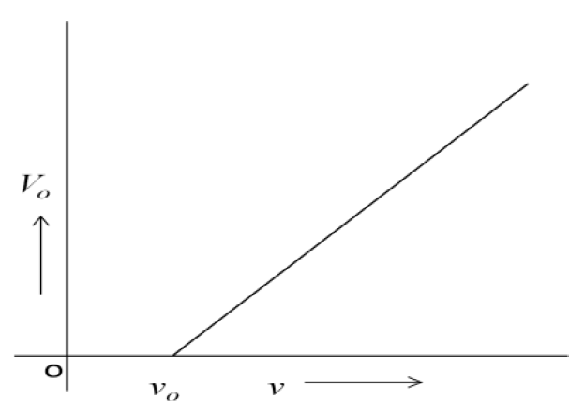
The plot, between $\text{V}_{0}$ and$\vartheta , $ , has the form shown:
Need a full question paper?

Generate a complete, print-ready paper with questions like this in minutes — across 16+ boards, with answer keys.

Start Generating Free

Similar questions

State the underlying principle of a potentiometer. Write two factors by which current sensitivity of a potentiometer can be increased. Why is a potentiometer preferred over a voltmeter for measuring the emf of a cell?
An object P is focused by a microscope M. A glass slab of thickness 2.1cm is introduced between P and M. If the refractive index of the slab is 1.5, by what distance should the microscope be shifted to focus the object again?
A long, straight wire carries a current. Is Ampere's law valid for a loop that does not enclose the wire? That encloses the wire but is not circular?
Establish a relation between resistance and resistivity of any substance. Explain in detail, the dependence of resistivity on the temperature.
Four identical rods AB, CD, CF and DE are joined as shown in figure. The length, cross-sectional area and thermal conductivity of each rod are l, A and K respectively. The ends A, E and F are maintained at temperatures T1, T2 and T3 respectively. Assuming no loss of heat to the atmosphere, find the temperature at B.

A simple microscope has a magnifying power of 3.0 when the image is formed at the near point (25cm) of a normal eye.
  1. What is its focal length?
  2. What will be its magnifying power if the image is formed at infinity?
Why are the magnification properties of microscopes and telescopes defined in terms of the ratio of angles and not in terms of the ratio of sizes of objects and images?
A monochromatic light source of intensity 6mW emits 8 × 10¹⁶ photons per second. This light ejects photoelectrons from a metal surface. The stopping potential for this setup is 2.0V. Calculate the work function of the metal.
A uniform wire of resistance $100\Omega$ is melted and recast as a wire of length is double that of the original. What would be the resistance of the wire?