Question
State when the line $\vec{\text{r}}=\vec{\text{a}}+\lambda\vec{\text{b}}$ is parallel to the plane $\vec{\text{r}}\cdot\vec{\text{n}}=\text{d}.$ Show that the line $\vec{\text{r}}=\hat{\text{i}}+\hat{\text{j}}+\lambda(3\hat{\text{i}}-\hat{\text{j}}+2\hat{\text{k}})$ is parallel to the plane $\vec{\text{r}}\cdot(2\hat{\text{i}}+\hat{\text{k}})=3.$ Also, find the distance between the line and the plane.
Answer

We know that line $\vec{\text{r}}=\vec{\text{a}}+\lambda\vec{\text{b}}$ is paralle to plane $\vec{\text{r}}\cdot\vec{\text{n}}=\text{d}$ if
$\vec{\text{b}}\cdot\vec{\text{n}}=0$
Given, line is $\vec{\text{r}}=(\hat{\text{i}}+\hat{\text{j}})+\lambda(3\hat{\text{i}}-\hat{\text{j}}+2\hat{\text{k}})$ and plane is $\vec{\text{r}}\cdot(2\hat{\text{i}}+\hat{\text{k}})=3,$
$\vec{\text{b}}=3\hat{\text{i}}-\hat{\text{j}}+2\hat{\text{k}},\vec{\text{a}}=(\hat{\text{i}}+\hat{\text{j}})$ and $\vec{\text{n}}=(2\hat{\text{j}}+\hat{\text{k}})$
Now, $\vec{\text{b}}\cdot\vec{\text{n}}=(3\hat{\text{i}}-\hat{\text{j}}+2\hat{\text{k}})(2\hat{\text{j}}+\hat{\text{k}})$
$=(3)(0)+(-1)(2)+(2)(1)$
$=0-2+2$
$=0$
Since, $\vec{\text{b}}\cdot\vec{\text{n}}=0$ So line is parallel to plane.
Distance between point $\vec{\text{a}}$ and plane $​​\vec{\text{r}}\cdot\vec{\text{n}}-\text{d}=0$ is given by
$\text{D}=\Bigg|\frac{\vec{\text{a}}\vec{\text{n}}-\text{d}}{|\vec{\text{n}}|}\Bigg|\ ...(\text{i})$
$\vec{\text{a}}$ is a point on the line. So diatance between line and plane is equal to the distance between $​​\vec{\text{a}}=(\hat{\text{i}}+\hat{\text{j}})$ and plane $\vec{\text{r}}\cdot(2\hat{\text{i}}+\hat{\text{k}})=3,$ so using (i)
$\text{D}=\Bigg|\frac{(\hat{\text{i}}+\hat{\text{j}})(2\hat{\text{j}}+\hat{\text{k}})-3}{\sqrt{(2)^2+(1)^2}}\Bigg|$
$=\bigg|\frac{(1)(0)+(1)(2)+(0)(1)-3}{\sqrt{4+1}}\bigg|$
$=\Big|\frac{0+2+0-3}{\sqrt{5}}\Big|$
$=\Big|\frac{-1}{\sqrt{5}}\Big|$
$=\frac{1}{\sqrt{5}}\text{ unit}$
So, required distance $=\frac{1}{\sqrt{5}}\text{ unit}$

Need a full question paper?

Generate a complete, print-ready paper with questions like this in minutes — across 16+ boards, with answer keys.

Start Generating Free

Similar questions

Determine the binomial distribution whose mean is 9 and variance $\frac{9}{4}.$
Evaluate the following integrals:
$\int\limits^{\frac{\pi}{2}}_{-\frac{\pi}{2}}\sin\text{x}|\sin\text{x}|\text{dx}$
In a hospital, there are 20 kidney dialysis machines and that the chance of any one of them to be out of service during a day is 0.02. Determine the probability that exactly 3 machines will be out of service on the same day.
$A$ factory has three machines $A, B$ and $C,$ which produce $100, 200$ and $300$ items of a particular type daily. The machines produce $2\%, 3\%$ and $5\%$ defective items respectively. One day when the production was over, an item was picked up randomly and it was found to be defective. Find the probability that it was produced by machine $A$.
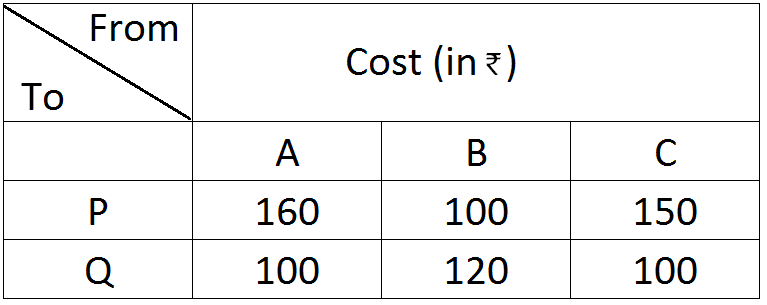
There are two factories located one at place P and the other at place Q. From these locations, a certain commodity is to be delivered to each of the three depots situated at A, B and C. The weekly requirements of the depots are respectively 5, 5 and 4 units of the commodity while the production capacity of the factories at P and Q are respectively 8 and 6 units. The cost of transportation per unit is given below:
How many units should be transported from each factory to each depot in order that the transportation cost is minimum. What will be the minimum transportation cost?
Solve the following differential equation:
$\text{x dy}=(2\text{y}+2\text{x}^4+\text{x}^2)\text{dx}$
Find the direction cosines of the line $\frac{4-\text{x}}{2}=\frac{\text{y}}{6}=\frac{1-\text{z}}{3}.$ Also, reduce it to vector form
If $\text{x}=10(\text{t}-\sin\text{t}),\text{y}=12(1-\cos\text{t}),$ find $\frac{\text{dy}}{\text{dx}}.$
Form the differential equation of the family of hyperebolas having foci on x- axis and centre at the origine.
A merchant plans to sell two types of personal computers a desktop model and a portable model that will cost Rs. 25,000 and Rs. 40,000 respectively. He estimates that the total monthly demand of computers will not exceed 250 units. Determine the number of units of each type of computers which the merchant should stock to get maximum profit if he does not want to invest more than Rs. 70 lakhs and his profit on the desktop model is Rs. 4500 and on the portable model is Rs. 5000. Make an LPP and solve it graphically.