Question
State whether the statement given below is true or false giving reason in brief. A ring of mass 0.3kg and radius 0.1m and a solid cylinder of mass 0.4kg and of the same radius are given the same kinetic energy and released simultaneously on a flat horizontal surface such that they begin to roll as soon as released towards a wall which is at the same distance from the ring and cylinder. The rolling friction in both the cases is negligible. The cylinder will reach the wall first.
Answer

In case of rolling, total kinetic energy

$\text{K}=\frac{1}{2}\text{mv}^2+\frac{1}{2}\text{I}\omega^2$

with $\omega=\frac{\text{v}}{\text{r}}$

$\text{K}=\frac{1}{2}\text{mv}^2+\frac{1}{2}\text{I}\frac{\text{v}^2}{\text{r}^2}=\frac{1}{2}$

$=\text{mv}^2\big[1+\frac{\text{I}}{\text{mr}^2}\big]$

For a ring, $\text{I}=\text{mr}^2$

$\therefore\text{K}_{\text{r}}=\frac{1}{2}\text{mv}^2(1+1)=\text{mv}^2$

$\text{v}=\sqrt{\frac{\text{Kr}}{\text{m}}}=\sqrt{\frac{\text{K}_{r}}{0.3}}$

For a cylinder, $\text{I}=\frac{1}{2}\text{mr}^2$

$\therefore\text{IK}_{\text{c}}=\frac{3}{4}\text{mv}^2$

$\text{v}=\sqrt{\frac{4\text{K}_{\text{c}}}{3\text{m}}}=\sqrt{\frac{\text{K}_{\text{c}}}{\frac{3}{4}\times0.4}}$

$=\sqrt{\frac{\text{K}_{\text{c}}}{0.3}}$

As Kr= Kc, therefore, velocity (v) of both the ring and cylinder is same. As the motion is uniform, both the ring and cylinder will reach the wall at the same time. The given statement is false.

Need a full question paper?

Generate a complete, print-ready paper with questions like this in minutes — across 16+ boards, with answer keys.

Start Generating Free

Similar questions

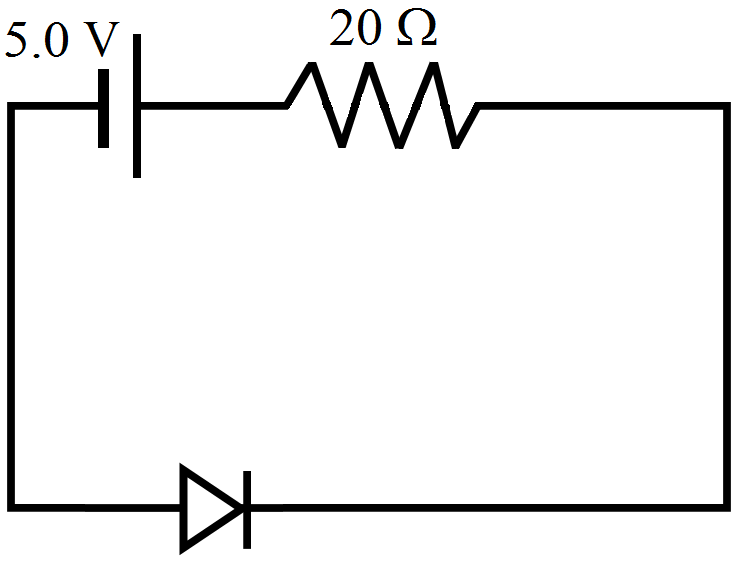
Calculate the current through the circuit and the potential difference across the diode shown in figure. The drift current for the diode is $20\mu\text{A}.$

Find the torque of a force $7 \tilde{ i }$ $+3 \overline{ j }-5 \tilde{ k }$ about the origin. The force acts on a particle whose position vector is $\tilde{ i }-\tilde{ j }+\tilde{ k }$.
A body rotates about a fixed axis with an angular acceleration of one radian/ second/ second. Through what angle does it rotate during the time in which its angular velocity increases from 5rad/s to 15rad/s.
A liquid has a definite volume but no shape of its own. Explain.
Calculate the bulk modulus of air from the following data about a sound wave of wavelength 35cm travelling in air. The pressure at a point varies between $(1.0\times10^5\pm14)$ Pa and the particles of the air vibrate in simple harmonic motion of amplitude 5.5 × 10-6m.
Why are soldiers marching in unison asked to break up step (walk like a normal person) while crossing the bridge?
Given the moment of inertia of a disc of mass M and R radius R about any of its diameters to be $\frac{\text{MR}^2}{4},$ find its moment of inertia about an axis normal to the disc and passing through a point on its rim.
Answer the following :
The absolute temperature (Kelvin scale) T is related to the temperature $t_c$ on the Celsius scale by
$
t_c=T-273.15
$
Why do we have 273.15 in this relation, and not 273.167?
Suppose you have two forces $\vec{\text{F}}$ and $\vec{\text{F}}.$ How would you combine them in order to have resultant force of magnitudes (a) zero, (b) $2\vec{\text{F}}$ and (c) $\vec{\text{F}}?$
The yield point of a typical solid is about 1%. Suppose you are lying horizontally and two persons are pulling your hands and two person are pulling your legs along your own length. How much will be the increase in your length if the strain is 1%? Do you think your yield point is 1% or, much less than that?